
IEEE 802.3af is the original Power over Ethernet (PoE) standard, ratified in 2003. It allows Power Sourcing Equipment (PSE) to deliver up to 15.4W of DC power per port over the same twisted-pair cable that carries Ethernet data. After worst-case cable loss, 12.95W is guaranteed at the powered device.
The standard is more than twenty years old and still in daily use. 802.3af defines Type 1 PoE, the baseline power tier that every later PoE standard must remain compatible with. A large share of industrial endpoints — fixed IP cameras, VoIP handsets, door controllers, and sensor gateways — run comfortably within its budget. Knowing exactly where that budget ends is what separates a clean deployment from a site full of rebooting devices.
This article covers how 802.3af works, how much power a device can actually use, what the cabling must support, where the standard fits in industrial networks, and when to move to 802.3at or 802.3bt. It ends with a deployment checklist for engineers and buyers.
802.3af in Numbers | Value |
|---|---|
PSE output voltage | 44–57V DC |
PD input voltage | 37–57V DC |
Maximum current per port | 350mA |
Power at the PSE port | 15.4W |
Power guaranteed at the PD | 12.95W |
Maximum channel length | 100m |
Power classes | 0–3 |
PoE Type | Type 1 |
What Is IEEE 802.3af? A Definition for Network and Product Engineers
IEEE 802.3af is an amendment to IEEE 802.3, the core Ethernet standard. It defines how DC power is injected onto Ethernet cabling, how a device requests that power, and how the power source protects itself and connected equipment. One cable carries both data and power, so the endpoint needs no local AC outlet or wall adapter.
Before 802.3af, installers had two poor options. They could run AC power to every camera, phone, and access point — adding electricians, conduit, and cost to each drop. Or they could use proprietary passive injectors that pushed a fixed voltage down the cable regardless of what was connected. Passive PoE damaged non-PoE equipment, and no two vendors’ systems were interoperable. 802.3af resolved both problems with a single requirement: power is applied only after the device proves it can accept it.
The standard defines two roles. The Power Sourcing Equipment (PSE) supplies power; the Powered Device (PD) consumes it. Between them, 802.3af specifies:
- Voltage and current limits at the PSE output and the PD input
- Detection, which confirms a compliant PD is present before power is applied
- Classification, which tells the PSE how much power to reserve per port
- Disconnect behavior, which removes power when the PD is unplugged
- Electrical isolation of 1500V between the PD’s PoE circuitry and the rest of the device, per IEEE 802.3 isolation requirements
Where 802.3af Fits in the IEEE 802.3 PoE Framework
PoE is a layered family of requirements, not a standalone document. Reading it as a hierarchy makes every later standard easier to place.
- IEEE 802.3 (the base standard): The core Ethernet specification. In 2005, 802.3af was incorporated as Clause 33, which became the home of PoE requirements. Four-pair PoE was later added as Clause 145.
- 802.3af / Type 1: The original power tier — 15.4W at the PSE over two pairs.
- 802.3at (Type 2) and 802.3bt (Types 3 and 4): Higher-power amendments that extend the same detection-and-classification model, both backward compatible with Type 1.
In current datasheets and RFQs, “Type 1” and “802.3af” are interchangeable. Specifications increasingly use the Type designation because it scales cleanly across all four tiers.
How 802.3af Works: PSE, PD, and the Power-Up Sequence
Every 802.3af link follows the same sequence: detection → classification → power-on → monitoring → disconnect. The PSE never applies full voltage blindly. It tests the line, identifies the load, powers it, and continuously checks that the load is still present. This handshake is what separates standards-based PoE from passive PoE, and it is why a compliant switch can coexist safely with non-PoE equipment on the same infrastructure.
Power Sourcing Equipment (PSE): Endspan vs. Midspan
The PSE runs the entire sequence — detecting, classifying, powering, monitoring, and disconnecting the PD. Two hardware forms exist:
PSE Type | What It Is | Best Fit |
|---|---|---|
Endspan | A PoE switch that injects power directly at its ports | New installations, or when a full switch replacement is planned |
Midspan | A PoE injector placed between a non-PoE switch and the PD | Retrofits, single drops, and mixed networks where the existing switch must stay |
In industrial retrofits, midspans are often the more practical choice. Replacing a managed industrial switch to add PoE to two camera drops means requalifying network configuration, VLANs, and redundancy settings. A compliant PoE injector adds power at one port without touching the data path. For single drops, it is usually the most cost-effective PSE option.
Powered Device (PD): What the Endpoint Must Do
For OEM product teams, the PD side carries most of the compliance burden. A compliant PD must present a valid detection signature, may declare a power class, and must operate across an input range of 37–57V DC — the low end accounting for worst-case cable voltage drop.
Three design requirements follow from this. First, the PD must accept power on either pair set (Mode A or Mode B) and in either polarity, which is why PD front ends use input bridge rectifiers. Second, the PoE interface must remain isolated from the rest of the device, including chassis and external I/O. Third, the PD must maintain a minimum current draw to stay powered — covered under Maintain Power Signature below. A PD that falls short on any of these points may work on one vendor’s switch and fail silently on another.
Step 1: Detection and the 25kΩ Signature
Before applying working voltage, the PSE probes the line at a low voltage of roughly 2.7–10.1V and looks for a signature resistance of about 25kΩ (valid range: approximately 19–26.5kΩ). If the measured resistance falls within that window, the PSE treats the far end as a compliant PD.
This is the core safety mechanism. A legacy network card, printer, or PLC Ethernet port does not present a 25kΩ signature and therefore never sees 48V. Passive PoE has no equivalent step — the single most important reason passive injectors do not belong in managed industrial networks.
Step 2: Classification (Classes 0–3)
After valid detection, the PSE applies a classification voltage of about 14.5–20.5V and measures the current the PD draws. That current identifies the PD’s power class.
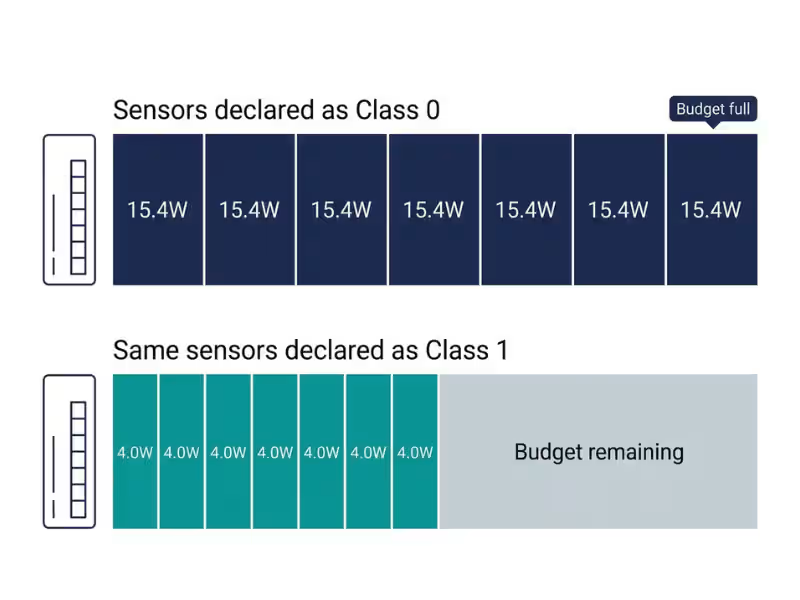
Classification lets the PSE manage its total power budget efficiently. A switch can reserve 4W for a Class 1 sensor instead of a full 15.4W, freeing budget for more ports. Class 0 is the default: a PD that declares no class is treated as needing the full 15.4W reservation. Class 4 was reserved in 802.3af and later used by 802.3at to identify Type 2 devices.
Class | Power Reserved at PSE | Power Available at PD |
|---|---|---|
0 (default) | 15.4W | 0.44–12.95W |
1 | 4.0W | 0.44–3.84W |
2 | 7.0W | 3.84–6.49W |
3 | 15.4W | 6.49–12.95W |
The practical implication for product teams: a 3W sensor shipped as Class 0 wastes 11W of switch budget on every port it occupies. Declaring the correct class is one of the cheapest scalability improvements a PD designer can make.
Steps 3–4: Power Delivery, Maintain Power Signature, and Disconnect
Once classified, the PSE ramps the port to 44–57V DC and limits output current to 350mA. The PD boots and runs normally.
The PSE then monitors the link continuously. The PD must maintain a Maintain Power Signature (MPS) — either drawing a minimum DC current of about 10mA or presenting a valid AC signature. If the MPS disappears, the PSE assumes the device has been unplugged and removes power, preventing a live 48V port from sitting on a disconnected cable.
MPS creates a well-known field problem: ultra-low-power PDs that enter deep sleep can drop below the minimum current threshold. The PSE reads this as a disconnect, cuts power, and the device reboots. On site, this appears as a sensor or reader that “randomly” drops off the network overnight. The fix belongs at the PD design stage — maintain a minimum load during sleep, or use the AC MPS pulse behavior the standard permits.
Mode A vs. Mode B: Which Pairs Carry Power
802.3af delivers power over two of the four pairs in the cable. The PSE selects which two.
Mode | Pairs Used | How Power Is Carried |
|---|---|---|
Mode A | 1-2 and 3-6 (data pairs) | Phantom power, superimposed on data via transformer center taps |
Mode B | 4-5 and 7-8 (spare pairs) | Dedicated pairs in 10/100 Mbps links |
The PSE selects one mode; the PD must accept either. Midspans typically use Mode B, since they inject onto the spare pairs without touching the data path. 802.3af never powers both pair sets simultaneously — four-pair power is a defining feature of 802.3bt, and that distinction accounts for most of the power gap between the two standards.
802.3af Power Limits: Why 15.4W Becomes 12.95W at the Device
802.3af guarantees 15.4W at the PSE port and 12.95W at the PD after worst-case cable loss. Every device should be sized against 12.95W. The 15.4W figure describes what leaves the switch, not what the device can use.
Parameter | Value |
|---|---|
PSE output voltage | 44–57V DC |
PD input voltage | 37–57V DC |
Maximum current | 350mA |
Power at PSE | 15.4W |
Power at PD | 12.95W |
Maximum channel length | 100m |
The gap is resistive loss in the cable. The standard assumes a worst-case loop resistance of about 20Ω over a 100m channel. At maximum current: I²R = 0.35² × 20 ≈ 2.45W. Subtract from 15.4W and 12.95W remains. That worst case is baked into the spec so the PD is guaranteed its full budget on any compliant cable at full length.
A concrete example: a fixed indoor camera rated at 11W peak fits within 12.95W with margin. An outdoor camera with an 8W core load plus a 6W enclosure heater peaks near 14W. It exceeds the 12.95W guarantee, and it will brown out or reboot on the first cold night when the heater switches on. That camera needs 802.3at.
The sizing rule: take the device’s peak load — heaters, IR illuminators, motors, and all attached peripherals — and compare it against 12.95W with margin. Average draw is irrelevant if the peak trips the port.
Cable Distance and Infrastructure Requirements for 802.3af
Distance. The 100m limit covers the full channel: 90m of permanent link plus up to 10m of patch cords. It applies equally to data and power. Low-class devices drawing well under 350mA tolerate marginal links better in practice, but that is not a basis for exceeding 100m — data integrity is only specified within the channel length.
Cable category. 802.3af was written to operate over Cat3 and Cat5. For any new industrial installation, Cat5e or Cat6 solid copper is the practical baseline. Copper-clad aluminum (CCA) cable must be avoided entirely: its higher resistance increases voltage drop and heat generation and can push a PD below its 37V minimum input on runs well under 100m. Corroded field connectors and poor terminations in outdoor and plant-floor installations cause the same failure.
Switch power budget. A 24-port PoE switch rarely carries 24 × 15.4W = 369.6W of PoE budget. Many industrial switches have a total budget well below the per-port maximum. Calculate from each PD’s declared class — not nameplate wattage — and confirm the total covers all powered ports simultaneously. This is where correct classification at the PD side directly benefits the system.
Beyond 100m. For longer runs, use a PoE extender or run fiber to a remote enclosure with a local midspan. In large industrial sites, the latter is generally more reliable than a chain of extenders.
Cable-bundling heat becomes a meaningful concern at 802.3bt power levels. At 802.3af currents, it rarely constrains a design.
Industrial Applications Where 802.3af Is Still the Right Fit
Many industrial endpoints draw well under 13W, keeping 802.3af common in both installed bases and new low-power designs where a Type 2 PSE adds cost with no benefit.
Device | Typical Draw | 802.3af Fit | What to Watch |
|---|---|---|---|
Fixed indoor IP cameras | 4–8W | Good | IR illuminators raise night-time draw |
VoIP desk phones | 3–7W | Good | Expansion modules and large color screens |
Single-band wireless APs (older or entry-level) | 6–12W | Marginal | Dual/tri-band and Wi-Fi 6/7 APs need 802.3at or higher |
Access control readers and door controllers | 3–10W | Good | Electric lock strikes can exceed the budget |
Industrial terminals, sensors, and IoT gateways | 2–10W | Good | Peripheral loads and cold-start heaters |
802.3af falls short for PTZ cameras, outdoor cameras with heaters or blowers, multi-radio access points, and thin-client terminals. These loads combine motors, heaters, and radios whose peaks stack simultaneously. A PTZ camera panning at night with its heater and IR active can draw two to three times its idle power. For how peak-load sizing applies to outdoor surveillance designs, see Quankang’s surveillance camera power supply solutions.
Industrial environments also impose demands the standard itself does not address. A midspan in an outdoor cabinet or on a plant floor needs a wide operating temperature range, Ethernet-port surge protection, and EMC robustness against variable-frequency drives and switching loads. An injector that passes on a lab bench can fail in the field beside that equipment. Additional application-specific examples are available on Quankang’s applications page.
802.3af vs. 802.3at vs. 802.3bt: How the PoE Standards Compare
The three standards differ primarily in power per port and the number of powered pairs. Each later standard remains backward compatible with Type 1 devices.
Standard | Year | Type | Power at PSE | Power at PD | Powered Pairs | PSE Voltage |
|---|---|---|---|---|---|---|
802.3af | 2003 | Type 1 | 15.4W | 12.95W | 2 | 44–57V |
802.3at | 2009 | Type 2 | 30W | 25.5W | 2 | 50–57V |
802.3bt | 2018 | Type 3 | 60W | 51W | 4 | 50–57V |
802.3bt | 2018 | Type 4 | 90W | 71.3W | 4 | 52–57V |
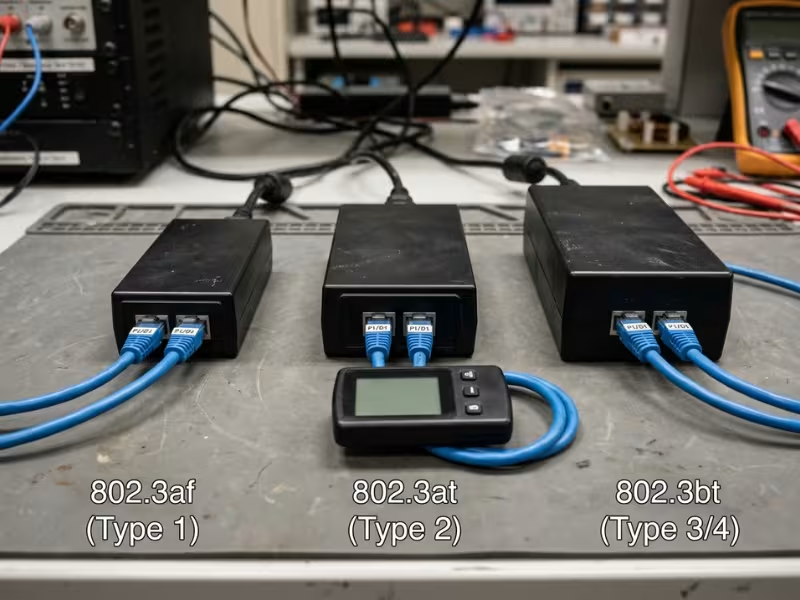
Compatibility runs in one direction. A Type 1 PD runs on any higher-type PSE — the PSE detects and classifies it as Type 1 and allocates accordingly. The reverse is not guaranteed. An 802.3at camera on an 802.3af port may refuse to boot or start in a reduced-power mode with the IR illuminator or heater disabled. That is the most common hidden failure in mixed-generation networks.
Choose the standard based on peak PD load plus margin, then check the device roadmap. If the next hardware revision is likely to add a radio, heater, or higher-resolution sensor, specifying a Type 2 or Type 3 PSE now avoids a mid-lifecycle infrastructure replacement. For higher-power designs, see 802.3bt PoE adapters explained. 802.3af is not obsolete — it is simply the right answer only for loads that fit comfortably within 12.95W.
Recommended Reading: 802.3af vs. 802.3at vs. 802.3bt: Which PoE Standard Do You Need?
5 Common Misunderstandings About 802.3af
1. “15.4W is available to the device.”
It is not. 15.4W is the PSE output. The guaranteed figure at the PD is 12.95W, and every power budget should start there.
2. “Passive 24V or 48V PoE is the same as 802.3af.”
Passive PoE skips detection and classification entirely and applies voltage unconditionally. It can damage non-PoE equipment and offers no cross-vendor interoperability.
3. “Every port on a PoE switch can deliver 15.4W simultaneously.”
Only if the switch’s total PoE budget permits it — and many do not. Verify the total budget against the sum of declared classes across all powered ports.
4. “802.3af devices won’t work on 802.3at or 802.3bt switches.”
They will. Backward compatibility with Type 1 is a requirement. The risk runs the other way: higher-power PDs connected to an 802.3af port.
5. “Any Ethernet cable performs the same.”
CCA cable, poor terminations, and corroded field connectors all raise loop resistance. That increases voltage drop at the PD and heat in the cable — even on runs well within 100m.
802.3af Deployment Checklist for Engineers and Buyers
Verify each item before specifying, purchasing, or installing 802.3af equipment:
- PD peak power — including heaters, IR, motors, and peripherals — is below 12.95W with margin
- PD declares its correct class rather than defaulting to Class 0 when it needs less power
- The switch or injector’s total PoE budget covers all powered ports simultaneously
- Cabling is Cat5e or better, solid copper (no CCA), with every channel under 100m
- The PSE is IEEE 802.3af compliant (not passive), with test reports available from the supplier
- The injector or adapter carries IEC/UL 62368-1 safety certification and the regional marks required for the target market
- Operating temperature, surge protection, and EMC performance match the installation environment
- The device roadmap has been reviewed for 802.3at or 802.3bt requirements within the product lifecycle
For midspan options across all three PoE standards, see Quankang’s PoE adapters.
How Quankang Supports 802.3af and Higher-Power PoE Projects
Quankang manufactures PoE adapters supporting 802.3af, 802.3at, and 802.3bt for IP cameras, VoIP systems, access control, and network devices. Universal 100–240V AC input means one SKU covers North American, European, and Asian deployments.
Every new design is pre-scanned in Quankang’s in-house EMC lab to FCC and CE standards. Across 10,000+ OEM projects, that process has delivered a 98.3% first-pass EMC compliance rate. Quankang also builds custom power adapters when a project requires a non-standard enclosure, cable, connector, or private label. Production lines and test capabilities are documented on the facilities page.
Specifying PoE for an industrial deployment?
Send Quankang your PD power class, peak load, and certification requirements. Our engineering team returns a compliance gap analysis within 24 hours. Request a PoE adapter quote.
Frequently Asked Questions About 802.3af
What voltage does 802.3af use?
The PSE outputs 44–57V DC; the PD must accept 37–57V DC at its input. The lower PD limit accounts for worst-case voltage drop over a full 100m channel. Detection and classification use lower probe voltages — roughly 2.7–10.1V and 14.5–20.5V respectively — before full power is applied.
What is the maximum power of 802.3af?
802.3af delivers up to 15.4W per port at the PSE. After worst-case cable loss over a 100m channel, 12.95W is guaranteed at the powered device. Size devices against 12.95W.
Is 802.3af the same as Type 1 PoE?
Yes. When PoE requirements were consolidated into IEEE 802.3, the power tiers were designated Types 1 through 4. Type 1 corresponds to 802.3af. Both terms refer to the same voltage, current, and power limits.
Can an 802.3at device run on an 802.3af port?
Sometimes, but not reliably. Some 802.3at devices boot in a reduced-power mode with features such as heaters or IR disabled; others will not power up at all. If the device’s peak draw exceeds 12.95W, use an 802.3at or higher PSE.
How far can 802.3af deliver power?
802.3af supports a 100m channel — 90m of permanent link plus up to 10m of patch cords. The same limit applies to data. For longer runs, use a PoE extender or fiber with a local PSE at the far end.
Is 802.3af still used in industrial networks?
Yes. Fixed IP cameras, VoIP phones, access control readers, sensors, and IoT gateways often draw well under 13W. For these loads, 802.3af remains a cost-effective, fully supported choice. Every higher PoE standard maintains backward compatibility with it.
Conclusion: Know the Limits, Then Specify with Confidence
802.3af is the Type 1 baseline of Power over Ethernet: a negotiated power-up that protects non-PoE equipment, 12.95W guaranteed at the device, and a 100m reach over standard copper cabling. For low-power industrial endpoints, it remains a sound engineering choice more than two decades after ratification.
The decision rule is straightforward. Size every device against its peak load and the 12.95W figure at the PD. When the margin gets thin, or when the device roadmap points to higher power, move to 802.3at or 802.3bt before the installation forces the change.
Need compliant PoE power for your next deployment?
Quankang supplies 802.3af, 802.3at, and 802.3bt PoE adapters with in-house EMC pre-compliance and custom ODM options.Explore PoE Adapters | Request a Custom Quote | See Industrial Applications