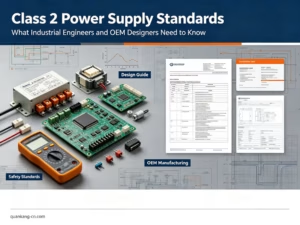
A Class 2 power supply is a source whose output voltage, current, and power are capped by the National Electrical Code (NEC). Because the energy is capped at the source, the circuit it feeds carries limited fire risk and acceptable shock exposure. On an industrial project, that one classification drives real decisions: which cable you pull, how you separate conductors inside a control panel, whether conduit is required, and what an inspector confirms on the nameplate.
The complication is that no single document owns Class 2. An installation code defines it. Product safety standards prove that a specific supply meets it. Panel and system-level standards govern how it is used inside larger assemblies. Confusing those roles leads to two common failures: specifying the wrong supply, or failing an inspection with the right one.
This guide maps that framework for industrial control, automation, and OEM equipment. It covers:
- What Class 2 means and where its numerical limits come from
- Which standards matter and what each one actually proves
- How Class 2 differs from similar-sounding terms
- Where Class 2 fits in industrial applications, and where it stops fitting
- How to select and integrate a supply without losing the rating in the field
What Is a Class 2 Power Supply?
The NEC Definition and Why It Exists
The NEC defines a Class 2 circuit by its power source, not by its load or its cable. The circuit qualifies as “Class 2” because the source feeding it cannot deliver more energy than the code allows, even when something goes wrong downstream. Because that ceiling is enforced at the source, the code permits lighter wiring methods, power-limited cable types, and in many installations drops the conduit requirement entirely.
That trade-off is the whole point. You accept a power ceiling, and in exchange you get simpler and less expensive field wiring. In the 2023 NEC, Class 2 and Class 3 circuits are covered in Article 725, with cable requirements for power-limited circuits in Article 722. Earlier editions organize this material differently, so always verify the edition adopted by the jurisdiction where the equipment ships.
Voltage, Current, and Power Limits
The numbers come from NEC Chapter 9, Table 11(A) for AC sources and Table 11(B) for DC sources. The limits depend on two factors: the voltage range, and whether the source is inherently limited or relies on overcurrent protection.
Parameter | AC sources — Table 11(A) | DC sources — Table 11(B) |
|---|---|---|
Maximum voltage, dry location | 30 V rms | 60 V |
Maximum nameplate rating, 0–20 V | 5 × Vmax VA | 5 × Vmax VA |
Maximum nameplate rating, above 20 V | 100 VA | 100 VA |
Practical example | 24 V AC control transformer: 100 VA maximum | 24 V DC output: ~100 W (≈4 A); 12 V DC: ~60 W (5 A) |
Wet-contact conditions | Lower ceiling — 15 V AC | Lower ceiling — 30 V DC |
Vmax is the maximum voltage the source can produce, not the nominal label. That matters for adjustable supplies: a “24 V” unit trimmable to 28 V is evaluated at its highest output setting.
For an industrial reader, the table answers one question fast. Most control-voltage loads — PLC I/O, sensors, relay coils, pilot lights, small HMIs — fit within 100 VA per circuit. Motor drives, heaters, brakes, and solenoid valve banks typically do not. If a single 24 V DC circuit draws more than about 4 A, it is not a Class 2 circuit regardless of what the supply’s datasheet implies.
Inherently Limited vs. Not Inherently Limited Sources
An inherently limited source stays within Class 2 limits by design, with no overcurrent device required. Internal impedance, transformer construction, or circuit topology keeps output within bounds even under short-circuit or overload. Many small Class 2 control transformers work this way.
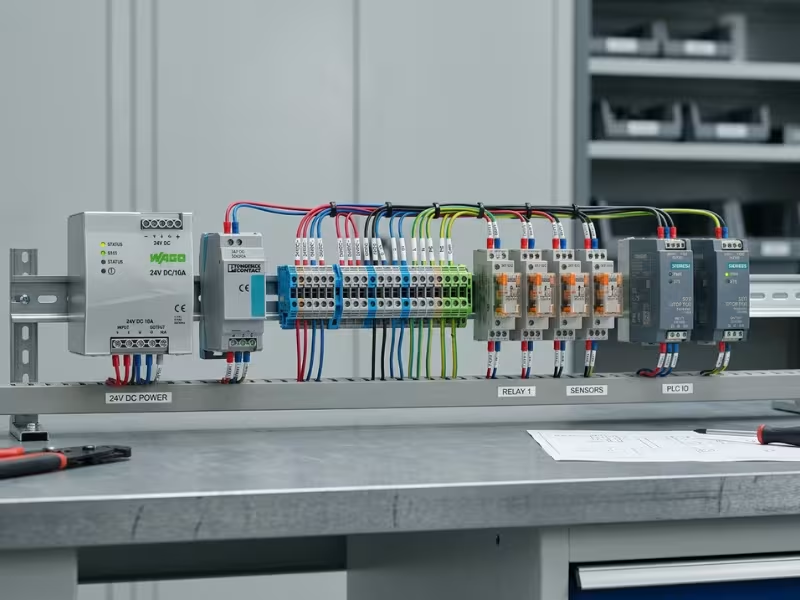
A not inherently limited source depends on overcurrent protection — a fuse, PTC device, or electronic current limit — to remain compliant. Most industrial switch-mode DIN-rail supplies fall here. Their Class 2 status is conditional on the protective mechanism working as intended, which is why that mechanism is part of what the certifier evaluates and why it must never be bypassed or modified in the field.
How the Class 2 Standards Framework Is Organized
Class 2 creates confusion because it appears in three distinct types of documents simultaneously. Each layer answers a different question, and treating one as a substitute for another is the root of most specification errors.
- Installation codes — “What is Class 2, and how must its circuits be wired?” This includes the NEC (U.S.) and Section 16 of the Canadian Electrical Code (CEC). These codes set the energy limits, permitted cable types, separation rules, and marking requirements.
- Product safety standards — “Does this specific supply actually meet Class 2 limits?” This includes UL 1310, UL 5085-3, UL/IEC 62368-1, UL 61010-1 with UL 61010-2-201, and CSA C22.2 No. 223. A listing under one of these standards is the evidence that a particular source qualifies.
- System and end-equipment standards — “How is a listed Class 2 source used inside a larger assembly?” UL 508A for industrial control panels is the primary example. It governs how Class 2 circuits are arranged, separated, and documented within the panel.
A supply’s listing proves the source qualifies. It does not prove the circuit stays Class 2 after installation. The panel builder and installer still determine whether wiring, separation, and interconnection preserve the rating.
Key Standards That Govern Class 2 Power Supplies
Each standard below follows the same pattern: what it covers, when an industrial team encounters it, and how it connects to Class 2.
NEC Article 725 and Chapter 9 Tables 11(A)/11(B)
Article 725 sets out the circuit classification, installation rules, and power source requirements for Class 2 and Class 3 circuits. Tables 11(A) and 11(B) provide the numbers. The code recognizes listed Class 2 transformers and listed Class 2 power supplies as acceptable sources, which is why the listing mark carries weight during inspections.
This article drives three recurring field decisions: separation from power, lighting, and Class 1 conductors; cable selection (CL2, CL2R, or CL2P depending on the installation space); and the rule against paralleling Class 2 sources unless listed for that configuration. The code also permits reclassification — a Class 2 circuit can be treated as Class 1 when its Class 2 markings are removed and Class 1 wiring methods are applied throughout.
UL 1310: Class 2 Power Units
UL 1310 is the dedicated product standard for power units whose outputs meet Class 2 limits. It covers direct plug-in, cord-connected, and similar configurations, with tests focused on output voltage, current, and power under normal and abnormal conditions.
Its industrial reach extends beyond its apparent scope. Many DIN-rail supply manufacturers cite UL 1310 to support a Class 2 output claim alongside their primary safety listing. Some electronic circuit protection modules use it to qualify individual output channels as Class 2 sources.
UL 5085-3: Class 2 and Class 3 Transformers
UL 5085-3 covers low-voltage transformers supplying Class 2 or Class 3 circuits, replacing the older UL 1585. In industrial and building automation work, this is the standard behind 24 V AC control transformers that feed relays, contactor coils, damper actuators, and HVAC controllers.
A standard industrial control transformer is not Class 2 simply because its secondary outputs 24 V. Unless the unit is listed and marked as Class 2, its secondary circuit must be treated as Class 1 and wired accordingly.
UL/IEC 62368-1 and Annex Q
UL/IEC 62368-1 is the hazard-based safety standard for audio/video and ICT equipment. It replaced UL 60950-1, and many general-purpose and DIN-rail supplies now carry a 62368-1 listing. Its framework classifies energy sources by hazard level (ES1–ES3 for shock, PS1–PS3 for fire) rather than prescriptive construction rules.
Annex Q addresses limited power sources (LPS) and circuits intended for connection to building wiring. Precision matters here. LPS compliance is closely related to Class 2 but the evaluation is not identical. An LPS claim is not a Class 2 claim. If your installation depends on Class 2, look for an explicit “Class 2” statement in the listing or on the marking — not just an LPS or PS2 designation.
UL 61010-1 and UL 61010-2-201: Control Equipment
UL 61010-1 sets safety requirements for measurement, control, and laboratory equipment. Part 2-201 applies those requirements specifically to industrial control equipment such as PLCs, I/O modules, HMIs, and their associated power supplies. For many DIN-rail control supplies, this pairing has become the core listing, largely taking over the role UL 508 once held. Manufacturers commonly pair it with a separate Class 2 output evaluation, so read the certificate for both the base listing and the Class 2 claim.
CSA C22.2 No. 223 and the Canadian Electrical Code
CSA C22.2 No. 223 covers power supplies with extra-low-voltage Class 2 outputs. CEC Section 16 is its installation counterpart, playing the same role as the NEC. OEMs shipping machines across North America need recognition on both sides of the border, usually through a combined cULus or CSA-US listing that names the applicable U.S. and Canadian standards.
Standard | Layer | What it governs or proves | Typical industrial product | Class 2 relationship |
|---|---|---|---|---|
NEC Art. 725 + Tables 11(A)/(B) | Code | Circuit limits and wiring rules | All Class 2 field circuits | Defines |
CEC Section 16 | Code | Canadian installation rules | All Class 2 field circuits (Canada) | Defines |
UL 1310 | Product | Output limits of power units | DIN-rail PSU outputs, protection module channels | Demonstrates |
UL 5085-3 | Product | Class 2/3 transformer construction and output | 24 V AC control transformers | Demonstrates |
CSA C22.2 No. 223 | Product | Canadian Class 2 output evaluation | DIN-rail and panel PSUs | Demonstrates |
UL 61010-1 / -2-201 | Product | Safety of control equipment | DIN-rail control PSUs | Base listing; Class 2 evaluated separately |
UL/IEC 62368-1 Annex Q | Product | LPS and building-wiring interfaces | General-purpose PSUs | Related but not equivalent |
UL 508A | System | Panel construction and circuit arrangement | Industrial control panels | Applies Class 2 inside assemblies |
Class 2 vs. Related Safety Concepts
Class 2 is an installation-based power-limitation concept. Several terms that sound like it come from insulation, product-energy, or hazardous-location frameworks. They answer different questions, and one cannot substitute for another.
Concept | Framework of origin | What it limits or addresses | Can it replace Class 2? |
|---|---|---|---|
Class II | IEC 61140 | Shock protection through double or reinforced insulation; no power limit | No |
Class 1 circuit | NEC | Higher-energy remote-control and signaling circuits with stricter wiring methods | No — it is the alternative when Class 2 does not apply |
Class 3 circuit | NEC | Power-limited circuits at higher voltages, with additional shock precautions | No — different limits and cable rules |
Class 4 (fault-managed power) | NEC (2023) | Higher-power systems relying on active fault monitoring | No — a separate category |
LPS / Annex Q | UL/IEC 62368-1 | Output energy limits at product level | Not by itself — confirm an explicit Class 2 claim |
PS2 | UL/IEC 62368-1 | Fire-hazard energy classification inside the product | No |
SELV / ES1 | IEC 61140, IEC 62368-1 | Voltage-based shock safety | No — limits voltage, not available power |
Intrinsic safety | UL 913, IEC 60079-11 | Ignition energy in explosive atmospheres | No — a fully separate certification path |
The rule that prevents most errors: specify the exact term your installation code or end-product standard requires, then confirm it on the nameplate or listing certificate. One classification never implies another — including when two terms share a number, as Class 2 and Class II do, or when “Class I, Division 2” appears in a hazardous-location context.
Where Class 2 Fits in Industrial Applications
Typical Industrial Use Cases
Industrial designers choose Class 2 for three reasons: it simplifies field wiring, makes routing control cable through machine frames and cable trays easier, and reduces installation cost. These are the applications where it delivers the most value:
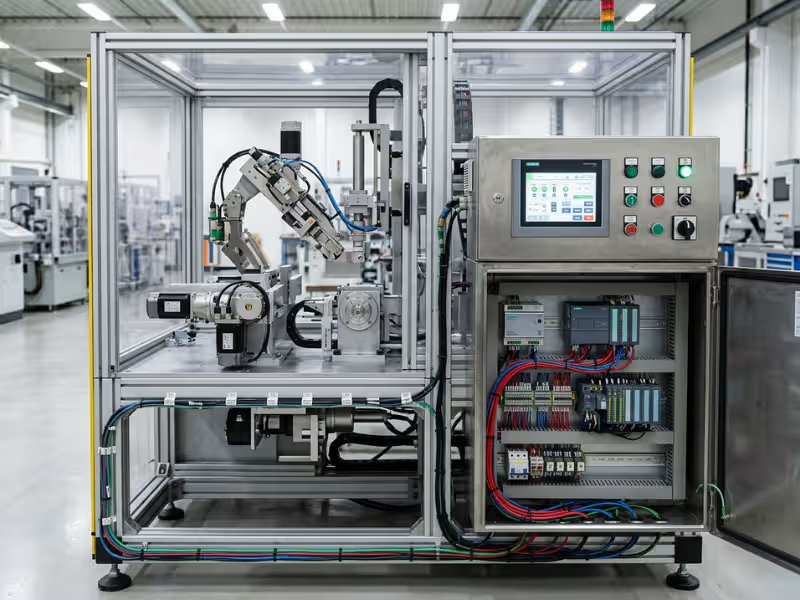
- 24 V DC control circuits in UL 508A panels. Separating Class 2 control wiring from power conductors becomes easier to manage, and wiring to door-mounted devices stays simpler.
- Sensors, I/O, and field devices on machine frames. Power-limited cable can reach proximity sensors, photo-eyes, and distributed I/O modules without Class 1 wiring methods.
- Building automation and HVAC controls. Class 2 24 V AC transformers feed controllers, actuators, and thermostats, and installers can use standard power-limited cable without conduit in most cases.
- Industrial signaling and low-voltage LED lighting. Stack lights, machine work lights, and indicator strips stay within Class 2 limits and require no conduit in many installations.
- Networked devices, including PoE and industrial IoT nodes. Class 2 power over data cabling is widely used. For industrial PoE applications, confirm that the adapter carries an explicit Class 2 claim and that bundled cabling complies with NEC temperature and ampacity rules.
For export-oriented OEMs, Class 2 offers a further practical advantage. One control-voltage architecture can be accepted at U.S. and Canadian sites without redesigning field wiring for each customer.
When Class 2 Is Not Enough
Class 2 has firm boundaries. These loads all fall outside it:
- Circuits requiring more than 100 VA
- Motors and drives
- Heaters
- Brakes and large solenoid manifolds
- Any circuit requiring voltages above the Class 2 ceiling
In these cases, the correct answer is a non-Class 2 supply with Class 1 wiring methods. Forcing a Class 2 architecture onto a load that exceeds its limits does not create a gray area — it creates a nonconformity.
When a machine carries many small loads, a sound alternative is to split them across multiple separately limited Class 2 outputs. Listed electronic circuit protection modules can divide a larger supply into individual channels, each evaluated as a Class 2 source. What cannot be done is paralleling two Class 2 supplies, or running them through a redundancy module, and calling the result Class 2. Combining sources defeats the energy limitation the classification depends on.
Selecting and Integrating Class 2 Power Supplies
Selection has two parts. First, confirm that the source qualifies. Second, confirm that the installation keeps it qualified. Apply this checklist at every specification and design review:
- Explicit Class 2 marking. Verify the nameplate and the listing for the words “Class 2.” “LPS,” “SELV,” and “low voltage” are not substitutes.
- Per-output rating. On multi-output units, confirm which outputs carry the Class 2 rating — it does not necessarily apply to all channels.
- Rating conditions. Check the ambient temperature range, mounting orientation, and output-voltage setting under which the Class 2 claim holds. Trimming output voltage upward can move Vmax into a different limit band.
- Input and overvoltage category. Industrial mains often require supplies rated for higher overvoltage categories and wide input ranges. Confirm the listing covers your actual supply conditions.
- No paralleling or redundancy wiring unless listed. Parallel operation and redundancy modules void Class 2 status unless the specific combination is listed.
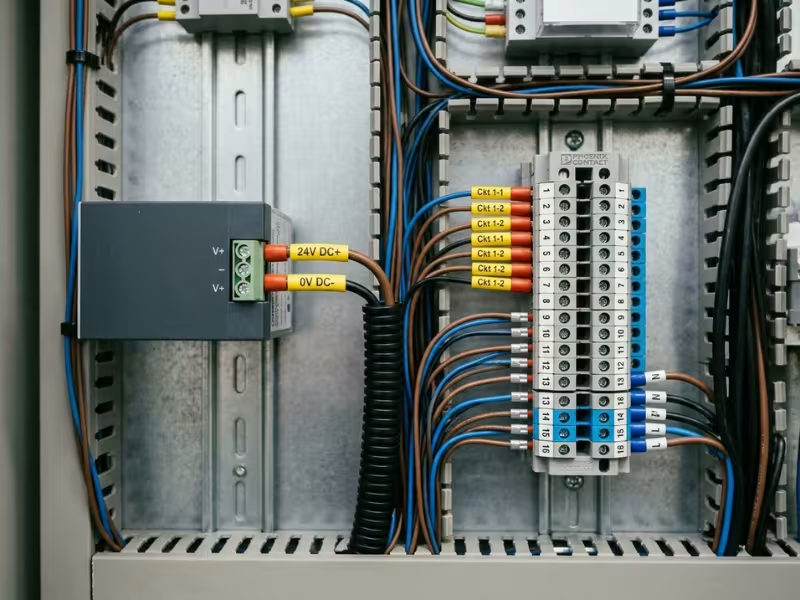
- Cable type and separation. Specify CL2-rated cable or a permitted equivalent. Keep Class 2 conductors separated from power and Class 1 conductors in panels and raceways.
- Labeling and documentation. Mark Class 2 circuits so inspectors and maintenance personnel can identify them without tracing wiring.
- Reclassification decision. If Class 2 wiring benefits are not needed for a given circuit, make a deliberate decision to reclassify it as Class 1 and wire it accordingly, rather than leaving its status undefined.
Documentation discipline converts this checklist into faster approvals. Keep the listing reference, the rating conditions, and each Class 2 wiring decision in the machine’s technical file. When an inspector or a customer’s safety team asks how a circuit qualifies, you answer in minutes rather than reopening the design. For OEMs shipping the same machine to multiple sites, that file pays for itself on the first inspection.
If you source power supplies for industrial control panels, automation equipment, or networked field devices, reviewing your supply’s listing against these criteria is the right starting point. Manufacturers that offer both ITE-grade and custom-specified power supplies can often provide per-output Class 2 evaluations and documentation support as part of the product qualification — which removes a significant amount of work from your compliance process.
Common Misunderstandings to Avoid
These errors recur across design reviews, field inspections, and supplier RFQs:
- Any 24 V supply is Class 2. Voltage alone proves nothing. Class 2 requires power limits and an explicit listing statement.
- Class 2 and Class II are the same. Class 2 limits available energy under the NEC. Class II describes insulation construction under IEC 61140. They address different hazards.
- An LPS listing equals Class 2. LPS is related but evaluated differently. Without an explicit Class 2 claim on the listing or nameplate, the installation cannot rely on it.
- Paralleling two Class 2 supplies keeps the circuit Class 2. Combining sources raises available energy. Unless the arrangement is specifically listed, the circuit is no longer Class 2.
- Class 2 makes equipment suitable for hazardous locations. Hazardous-location use requires dedicated certification — intrinsic safety, Zone, or Division ratings. Class 2 provides no coverage there.
- Once the supply is listed, the installation doesn’t matter. Wrong cable, inadequate separation, or improper interconnection will void Class 2 status in the field regardless of the supply’s listing.
Conclusion
Class 2 is straightforward once you work through its three layers. The installation code defines it, product safety standards prove it, and proper installation preserves it. In practice, that reduces to three consistent checks: confirm an explicit Class 2 marking, respect per-circuit and per-output power limits, and keep wiring and interconnection consistent with the rating from the supply terminals to the last field device.
Before you finalize your next control-power design, verify each supply’s listing documents against the code edition adopted at your installation site. If your application involves multi-output supplies, PoE-powered field devices, or multi-country OEM equipment, the selection and documentation requirements can compound quickly. Working with a supplier that builds Class 2 compliance into the product file from the start reduces that burden significantly.