A patient monitor clears IEC 60601-1 testing. The US launch goes smoothly, and the EU rollout follows on schedule. Then the Australian distributor flags a problem. The adapter ships with an interchangeable plug system, but the BOM doesn’t include a Type I clip. Nobody has confirmed which certificates the local regulator will accept. The importer can’t register the product until they have them.
Australia looks like an easy market on paper. Most modern adapters already accept 230V input, so engineering teams tend to treat the rollout as a labeling exercise. In practice, launches rarely stall because of voltage. They stall because of plug configuration, the local certification framework, and missing documentation.
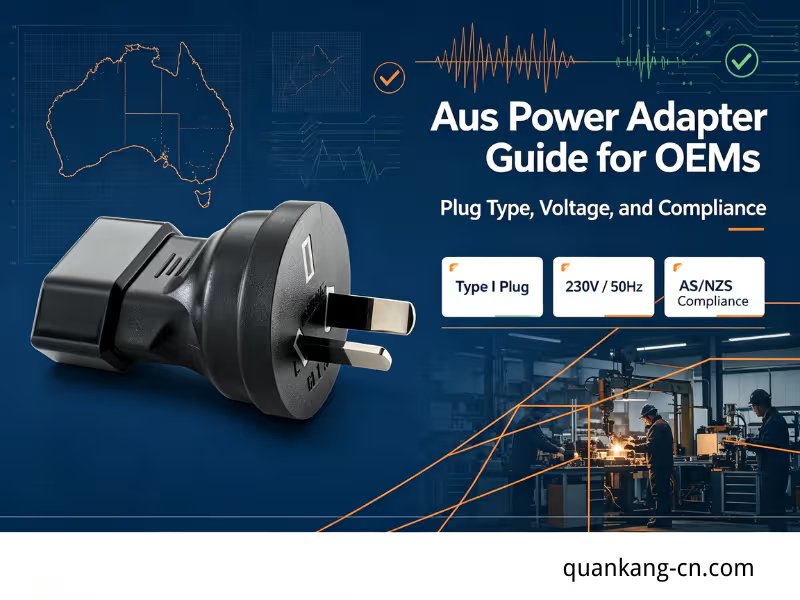
This guide is written for engineers, procurement managers, and compliance leads who need to ship industrial or medical power adapters into Australia and New Zealand. It covers the electrical basics, the decisions that follow, and the compliance details that most often cause late surprises.
Quick Answer: What Australia Requires at the Outlet
Parameter | Australia / New Zealand |
|---|---|
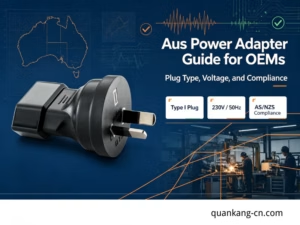
Plug type | Type I (two angled flat pins, plus a vertical earth pin on Class I versions) |
Plug standard | AS/NZS 3112 |
Nominal voltage | 230V AC |
Frequency | 50Hz |
Safety and EMC mark | RCM (Regulatory Compliance Mark) |
Two things matter more than the table suggests.
Australia’s grid was historically 240V. It was harmonized to 230V nominal, but the tolerance band (roughly +10% / −6%) means real-world readings often sit around 240V and can reach 253V. Your design needs to be comfortable at the top of that range, not just at nominal.
New Zealand shares the same plug and joint AS/NZS standards. One well-planned design covers both markets.
For most OEMs, the path is straightforward: a universal input adapter (100–240V AC, 50/60Hz) with a compliant Type I plug and the correct local certification. A voltage converter has no place in a professional product strategy.
Type I Plug and AS/NZS 3112: Where Most Mistakes Happen
The Type I plug is easy to recognize. It’s also easy to get wrong when you source tooling or plug clips from a supplier who mainly serves other markets.
Pin Geometry
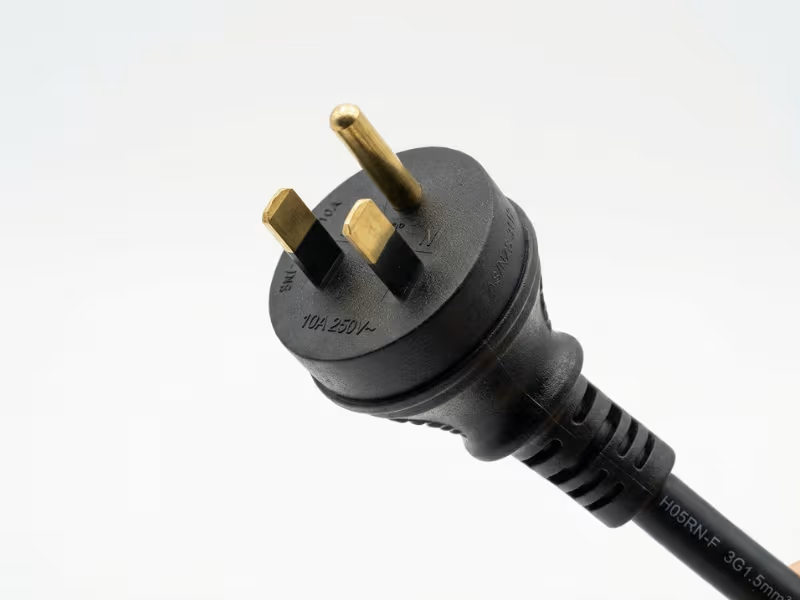
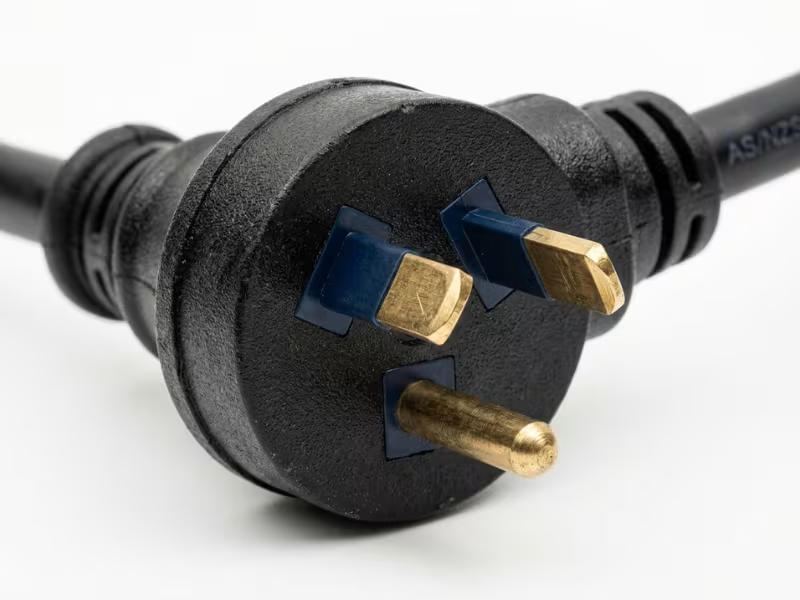
The plug carries two flat pins — active and neutral — angled at about 30° to form an inverted V. Class I (grounded) versions add a vertical earth pin below them. Pin dimensions, spacing, and angle are all defined in AS/NZS 3112. Small deviations that look harmless on a drawing can cause fit problems or failed inspections.
Insulated Pin Requirements
This is the detail that catches suppliers most often. AS/NZS 3112 requires insulation sleeves on the active and neutral pins to prevent finger contact with live metal when a plug is partly inserted.
Older plug tooling — and some clips built for other Type I markets — use bare pins. If your supplier reuses that tooling, the plug won’t comply no matter how good the adapter behind it is. Ask to see the actual plug sample, not just the datasheet.
Class I vs. Class II
- Class II (double-insulated) adapters typically use a two-pin Type I plug. Safety relies on reinforced or double insulation, with no dependence on a protective earth.
- Class I adapters require the earth pin and a verified protective earth path from the plug through to any accessible conductive parts.
For medical equipment, this choice links directly to your risk analysis. Many medical power supplies use Class II designs with 2x MOPP isolation, which avoids relying on the quality of the building’s earth connection. A Class I medical design is valid, but earth continuity and leakage current through the protective earth conductor both become part of the safety case.
The China and Argentina Type I Variants
China’s CCC Type I plug and Argentina’s IRAM version look almost identical to the Australian plug. They are not the same. Pin length, polarity, and orientation can differ in ways that matter.
A plug clip sourced as “Type I” for the Chinese domestic market isn’t automatically valid for Australia. If your BOM says “Type I” without further specification, fix it. Specify AS/NZS 3112 by name. Plug components are also assessed against AS/NZS 3100, the umbrella safety standard for electrical equipment, so your certifier will examine both.
One more practical note: many Australian outlets include a built-in switch. It doesn’t affect your electrical design, but it’s worth a line in your installation instructions. More than a few “device won’t power on” support calls turn out to be a switched-off outlet.
Universal Input 100–240V AC: What It Actually Guarantees
“Universal input” appears on millions of adapters. Few teams think carefully about what it actually commits to — and where it doesn’t.
How It Works
A switch-mode power supply rectifies AC input to a DC bus, then regulates that energy to the output voltage. Because the control loop compensates for input variation, one design accepts anything from roughly 90V to 264V AC without a manual voltage selector.
That’s why switching supplies dominate export products. A linear, transformer-based supply is tied to its input voltage by the transformer’s turns ratio, requiring a different transformer for each region. If you’re still evaluating the two architectures for a new design, the differences in efficiency, size, and noise immunity are worth working through before you commit.
Reading the Label
A typical label reads: Input: 100–240V~, 50/60Hz, 1.5A.
The rated input current is specified at the low end of the voltage range, where current draw is highest. At 230V, actual current will be well below that figure. When sizing fuses, cables, or upstream protection in a system, plan around the label value, not the high-line reality.
High-Line Headroom and Derating
Australian supply frequently runs above 230V nominal. A well-engineered universal adapter tolerates up to 264V continuously, leaving comfortable margin above the 253V upper tolerance. Confirm this in the datasheet.
Some adapters derate output power at low-line input. This matters less in Australia, which is a high-line market, but becomes important if the same SKU also ships to 100V markets such as Japan. Check derating curves before you treat one design as a universal solution.
Frequency
For modern switch-mode designs, 50Hz vs. 60Hz has negligible impact. Bulk capacitor ripple is marginally higher at 50Hz, and well-designed supplies already account for it. Frequency becomes a real consideration for transformer-based linear supplies (which need a larger core at 50Hz) and for any equipment with AC motors or mains-referenced timing circuits. If your product is moving from a US 60Hz design, review those subsystems separately.
Plug Change, Redesign, or Something in Between?
Most Australian projects fall into one of three scenarios. Getting this right early determines your timeline and budget.
Scenario 1: Universal Input Adapter, Wrong Plug
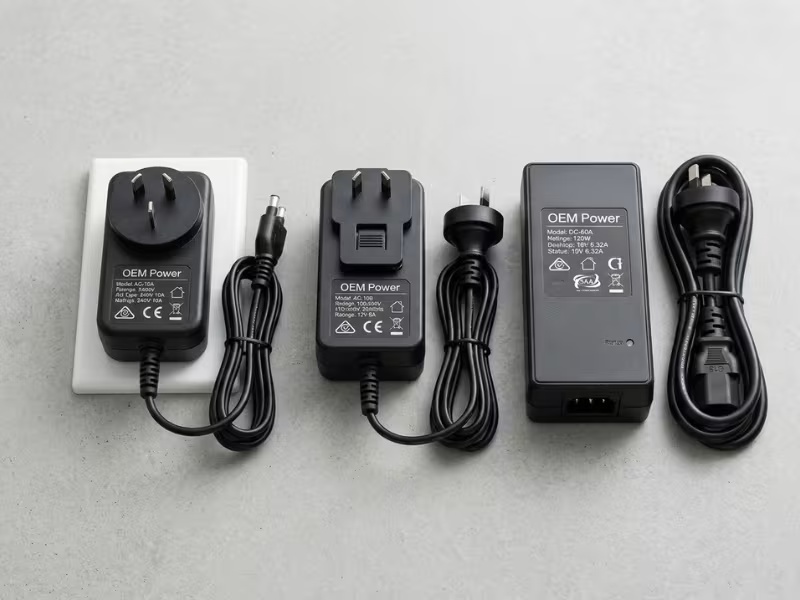
This covers the majority of cases. The adapter already accepts 100–240V. Only the plug configuration changes — through an interchangeable AU clip, a different fixed Type I plug on the same adapter body, or a regional cord set if the adapter uses an IEC inlet. Electrically, nothing changes. From a compliance standpoint, the new plug or cord set must be covered within the product’s Australian certification scope.
Scenario 2: Single-Voltage (120V-Only) Equipment
Legacy designs — often linear supplies or equipment with 120V motors or heaters — can’t be plugged into a 230V grid. The practical options are: redesign the power stage for universal input, add a certified step-down transformer inside the product, or replace the supply with a universal input unit.
A consumer-style external voltage converter is not an option for certified industrial or medical equipment. It sits outside the certified system and creates both a safety gap and a liability exposure.
Scenario 3: Internal or Open-Frame Supplies with an IEC Inlet
Products with an IEC inlet usually need only a compliant Australian cord set. Still, confirm two things: the internal supply’s rated input range, and whether its existing certifications extend to Australia and New Zealand.
Why a Plug Adapter in the Box Isn’t a Compliance Path
Shipping a US-plug adapter with a third-party travel adapter in the box can void the product’s certification. Australian regulators assess the product as supplied. If the plug that connects to the Australian outlet isn’t part of your certified configuration, the product isn’t compliant — full stop.
Four questions that determine your path:
- Is the adapter input rated 100–240V or wider?
- Is the plug fixed, interchangeable, or a detachable cord set?
- Is the adapter already certified for Australia and New Zealand?
- Is the end product a medical device, ITE equipment, or other industrial equipment?
If the answers are “yes, interchangeable, not yet, medical,” you’re scoping a plug clip addition plus a targeted certification project — not a redesign. That’s a significantly different timeline and cost.
US, EU, UK, and Australia: Plug and Voltage at a Glance
Market | Plug Type | Plug Standard | Nominal Voltage | Frequency | Key Safety Mark | What Changes for Australia |
|---|---|---|---|---|---|---|
United States | Type A / B | NEMA 1-15 / 5-15 | 120V | 60Hz | UL / ETL (NRTL) | Plug, certification; check input range |
European Union | Type C / F / E | CEE 7 series | 230V | 50Hz | CE | Plug, certification |
United Kingdom | Type G | BS 1363 | 230V | 50Hz | UKCA / CE | Plug, certification |
China | Type I (variant) | GB 2099 / GB 1002 | 220V | 50Hz | CCC | Plug geometry, certification |
Japan | Type A / B | JIS C 8303 | 100V | 50/60Hz | PSE | Plug, certification; check low-line derating |
Australia / NZ | Type I | AS/NZS 3112 | 230V | 50Hz | RCM | — |
Three things are worth calling out.
Australia is electrically closest to the EU and UK. None of those plugs are interchangeable, so a plug change is always required regardless of voltage compatibility.
The jump from US 120V/60Hz is the biggest. For universal input adapters, it’s a non-event. For anything else, it triggers a design review.
Certification marks don’t cross borders. A CE or UL mark doesn’t satisfy Australian requirements. That said, Australia recognizes IEC-based testing, and CB Scheme test reports can significantly accelerate the local certification process. If you’re building a multi-market program, structure your testing around CB reports from the start.
Compliance for Medical and Industrial Devices in Australia
This is where most of the hidden effort accumulates. Regulatory details change, so verify current requirements with your certifier and local Responsible Supplier before launch.
RCM and the Electrical Equipment Safety System (EESS)
The RCM covers both electrical safety and EMC for products supplied in Australia and New Zealand. The electrical safety side falls under the EESS, which divides in-scope equipment into three risk levels:
- Level 1: low-risk, general safety obligations
- Level 2: medium-risk, requires supplier registration and product compliance evidence
- Level 3: higher-risk “declared” equipment, requires a certificate of conformity from a recognized certifier and product registration
Switch-mode power supplies, plugs, and cord sets are generally treated as Level 3 declared equipment. That means a conformity certificate from an accredited certifier, plus registration on the national database.
Here’s the structural point that catches overseas manufacturers most often: a Responsible Supplier physically based in Australia or New Zealand must register on that database. An OEM in Dongguan or Shenzhen can’t normally hold that role directly. If your Australian channel partner isn’t prepared to act as Responsible Supplier, the product can’t be legally supplied — no matter how complete your test file is. Confirm this with your distributor before you start the certification process.
EMC Under the RCM Framework
EMC compliance runs through the same RCM framework, administered by the Australian communications regulator. The applicable standards are typically:
- CISPR 32 (AS/NZS CISPR 32) for ITE and multimedia equipment
- CISPR 11 (AS CISPR 11) for industrial, scientific, and medical equipment
The adapter’s emissions feed directly into the end product’s test results. A noisy adapter can push an otherwise clean system over the limit at final validation — and that’s where programs lose four to eight weeks. Pre-compliance scanning at the adapter level is the most cost-effective way to avoid it.
Medical Devices: TGA, IEC 60601-1, and the Adapter’s Role
Medical devices in Australia are regulated by the Therapeutic Goods Administration (TGA) and must appear in the Australian Register of Therapeutic Goods (ARTG) before they can be supplied.
Equipment regulated as a therapeutic good generally follows the TGA pathway rather than the standard EESS route. The question your compliance team needs to answer early: is the adapter assessed as part of the medical device system, or as a standalone accessory? The answer determines which framework applies and who holds the evidence.
Either way, IEC 60601-1 (adopted as AS/NZS IEC 60601-1) is the safety baseline. For patient-connected devices, the critical parameters are:
- 2x MOPP isolation between mains and the output
- Leakage current limits for applied parts
- IEC 60601-1-2 for EMC, with particular attention to the stricter immunity requirements for home healthcare environments
That last point is easy to underestimate. Under IEC 60601-1-2, home-use devices face higher immunity requirements than those used in professional healthcare settings. An adapter that passes a hospital test profile can fail a home-healthcare plan. If your product will be used in both settings, verify which profile governs.
Industrial and ITE Equipment: IEC 62368-1 in Practice
For ITE, communications, and AV equipment, IEC 62368-1 (AS/NZS 62368.1) is the primary safety standard. Beyond the certificate itself, industrial installations add practical questions that don’t show up in a lab environment:
- Is the adapter rated for the actual internal temperature of the enclosure, not just standard room ambient?
- Does the installation expose the adapter to dust, moisture, or corrosive atmospheres?
- Will the site introduce surge transients from motors, compressors, or long cable runs?
These are design and application questions, not just certification questions. Getting them wrong after certification creates field failures that are expensive to trace and costly to fix.
Energy Efficiency (GEMS)
External power supplies may fall under Australia’s Greenhouse and Energy Minimum Standards (GEMS) regulations. Verify current obligations, applicable efficiency tiers, and registration requirements before launch. Designs already compliant with DoE Level VI or ErP Lot 7 often meet comparable efficiency targets, but regulatory registration is a separate step. Add it to the launch checklist.
How to Reduce SKU Count Across Global Markets
Once Australia is handled, most OEMs face a broader question: how do we stop multiplying SKUs with every new market?
Where the Complexity Comes From
Every region-specific SKU adds more than a part number. It adds BOM lines, inventory risk, label variants, separate test reports, and forecasting complexity. A product sold across five markets with three output variants can quietly become fifteen SKUs — each with its own shortage exposure.
Three Architectures Worth Knowing
Interchangeable plug clips. One adapter body ships with swappable US, EU, UK, and AU heads. This gives the lowest SKU count. The requirement: clip retention and the certification of each individual clip must be verified, not assumed. A loose clip is both a safety issue and an audit finding.
Desktop adapter with an IEC inlet. One adapter body pairs with a region-specific cord set (C6, C8, or C14 inlet). Common for medical carts, industrial equipment, and higher-wattage designs. Cord sets are inexpensive to stock, and the adapter body itself never changes.
Fixed-plug regional variants. Each market gets its own fixed-plug version. Highest SKU count, but sometimes the right choice for tamper resistance or environments where a detachable plug creates risk — such as a clinical setting where adapters shouldn’t be removable.
The Certification Layer That Holds It Together
Build your certification strategy from a common foundation: CB Scheme reports and IEC-based testing. Add national marks (RCM, UL, CE, UKCA) on top. One core electrical design means one core test program, with national certifications as incremental additions rather than separate projects.
Lifecycle stability matters equally. If your power supply supplier discontinues a model after three years, every market certification linked to that model goes with it. Choosing a supplier with stable, long-lifecycle product lines protects your entire certification portfolio — not just your Australian one. This is part of what Quankang’s custom power adapters program is designed around: ODM designs that are maintained across product generations, so your certification investment doesn’t expire.
ODM Options for Australian and Multi-Region Power Adapters
When a standard product doesn’t fit the application, ODM customization fills the gap. These are the configurations most commonly requested for Australian and multi-region programs.
Plug and Inlet Configurations
- Fixed AS/NZS 3112 Type I wall plug
- Interchangeable AU clip within a multi-region clip set
- IEC C6, C8, or C14 inlet paired with an Australian cord set
- Two-pin (Class II) or three-pin (Class I) versions
Mechanical and Branding
Casing form factor, cable length, DC connector type, and strain relief can all be specified to fit the end product. Labels can carry RCM and other regional marks. Laser-etched branding is available. There’s no minimum order quantity for cosmetic modifications.
Electrical Parameters
Output voltage and current, Class I or Class II construction, leakage current targets for medical use, and USB PD output options are all configurable. The medical series achieves leakage current ≤100µA with 2x MOPP isolation, manufactured in an ISO 13485-certified facility.
Timelines
- 24 hours: compliance gap analysis in response to your technical brief
- ~10 days: functional samples with preliminary EMC reports
- 15–20 days: cosmetic modifications (casing, label, cable)
- 35–40 days: full electrical redesign, including EMC pre-scan
An on-site EMC lab pre-scans every new design. Across more than 10,000 OEM programs, the first-pass EMC compliance rate is 98.3%. Pilot builds of 100–500 units for clinical trials run on the same process as mass production.
FAQs: Australia Power Adapters for OEMs
What plug type and voltage does Australia use?
Australia uses the Type I plug defined by AS/NZS 3112, with 230V nominal voltage at 50Hz. Because the grid historically ran at 240V and the tolerance band is wide, real-world supply can reach 253V. Designs should be verified at the top of that range.
Will a 100–240V adapter work in Australia without electrical modification?
Electrically, yes. It still requires a compliant Type I plug or cord set and the correct Australian certification before it can be legally supplied.
Does a CE or UL mark satisfy Australian requirements?
No. Australia uses the RCM framework. CB Scheme test reports can support and speed up the local certification process, but they don’t replace it.
Who needs to register the product under the RCM?
A Responsible Supplier based in Australia or New Zealand — typically the importer, local distributor, or a local subsidiary of the OEM.
Can one SKU serve both Australia and New Zealand?
Generally, yes. Both markets share the Type I plug and joint AS/NZS standards, so one certified configuration usually covers both.
Do medical device power adapters follow the same compliance path as other adapters?
Not always. Medical devices are regulated by the TGA. Whether the adapter follows the EESS or TGA pathway depends on whether it’s assessed as part of the medical device system or as a separate accessory.
Are interchangeable plug clips compliant for Australia?
Yes, provided the AU clip meets AS/NZS 3112 — including insulated pins — and is explicitly covered within the adapter’s certification scope. Clip retention must be verified during testing.
Do I need a Class I adapter for medical equipment?
Not necessarily. Class II designs with 2x MOPP isolation are well established in medical applications. The right choice follows from the device’s risk analysis and overall system architecture.
How long does customization take for the Australian market?
Plug and cosmetic changes: 15–20 days. Full electrical redesign with EMC pre-scan: 35–40 days.
What documentation should I request from a power adapter supplier?
CB report, IEC 60601-1 or IEC 62368-1 test reports, EMC reports with verifiable certificate numbers, RoHS and REACH declarations, and ISO 13485 or ISO 9001 certificates.
Ready to Launch Into Australia?
Australia’s voltage is rarely the problem. What slows teams down is plug configuration, the RCM certification pathway, and documentation that isn’t ready when the importer needs it. Teams that resolve those three things early — ideally before tooling is finalized — typically launch on schedule. Those that don’t discover them at the distributor stage.
If you’re planning an Australian rollout or building a global-ready power adapter for medical or ITE applications, send your specs to Quankang’s engineering team: target voltage and current, the markets you need to cover, and the certifications your compliance team requires. We’ll return a gap analysis within 24 hours.