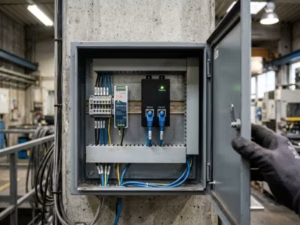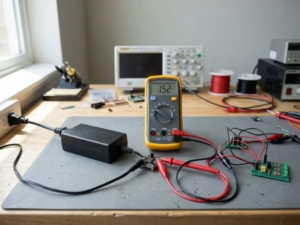
A portable patient monitor clears IEC 60601-1 testing at a European lab. The adapter has universal input, so the team treats the US rollout as a paperwork step. Then the first hospital customer’s biomedical engineering team holds the shipment at incoming inspection. The cord set isn’t hospital grade, the adapter carries no NRTL mark, and nobody can produce a test report covering the US national deviations.
On paper, the US looks like the easiest export market. Universal input adapters already cover 120V/60Hz, and the plug is familiar. In practice, US launches rarely stall because of voltage. They stall on four things:
- Plug and cord set grade
- Listing expectations no single federal law spells out
- Low-line thermal margin
- EMC and efficiency obligations that sit outside the safety certificate
This guide is written for engineers, procurement managers, and compliance leads shipping industrial, ITE, or medical power adapters into the US. It covers the electrical facts first, then the design decisions and compliance details that most often cause late surprises.
Quick Answer: US Voltage, Frequency, and Plug Type
Parameter | United States |
|---|---|
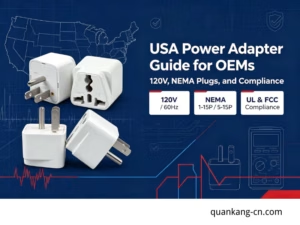
Plug type | Type A (NEMA 1-15, two-pin, polarized) and Type B (NEMA 5-15, grounded) |
Plug standard | NEMA WD 6 for dimensions; plugs and cord sets evaluated to UL 498 and UL 817 |
Nominal voltage | 120V AC at standard receptacles |
Frequency | 60Hz |
Safety expectation | Listing by an OSHA-recognized NRTL (UL, Intertek ETL, CSA, TÜV, and others) |
Two things matter more than the table suggests.
120V is a midpoint, not a floor. Under ANSI C84.1 Range A, service voltage sits between about 114V and 126V. By the time power reaches the equipment, voltage drop can push it toward 108V. Under Range B conditions, it can go lower. Design for the bottom of that range.
120V is also only part of the picture. Commercial and industrial buildings deliver 208V three-phase, 240V split-phase, and 277V on lighting circuits. For an OEM, those voltages often matter more than the 120V receptacle.
For most industrial and ITE programs, the path is clear: a universal input adapter (100–240V AC, 50/60Hz) with a NEMA plug or US cord set, NRTL listing, FCC compliance, and DOE efficiency marking. Medical programs add FDA expectations and, in patient care areas, hospital-grade cord sets.
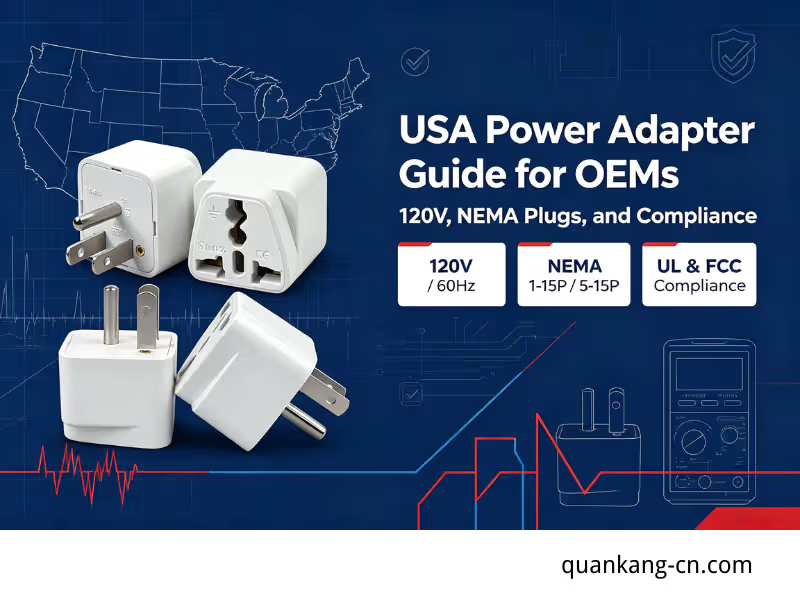
Type A vs. Type B: NEMA Plug Configurations Engineers Actually Use
The NEMA family is easy to recognize. Specifying it correctly takes more care, especially for equipment that leaves a standard office environment.
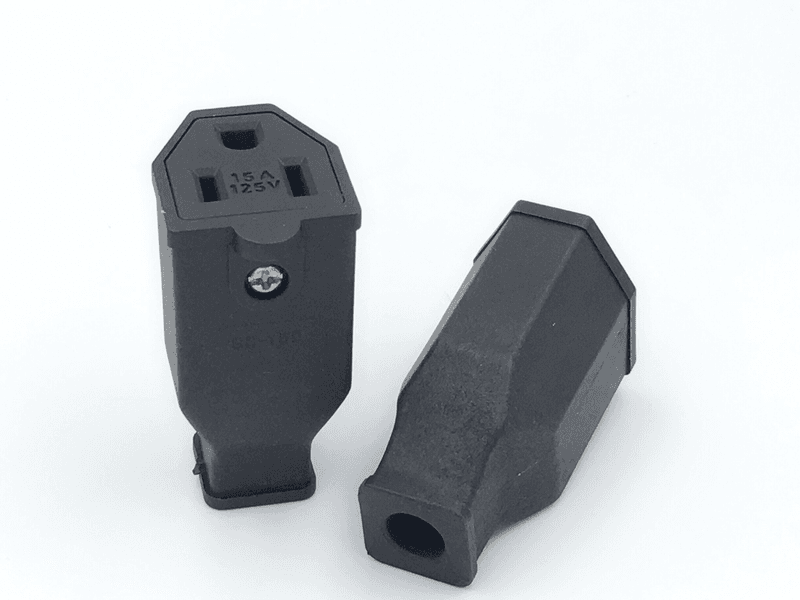
NEMA 1-15 (Type A): Polarized Two-Pin
Type A has two flat, parallel blades. On polarized versions, the neutral blade is wider, so the plug only inserts one way. That polarization ensures the line conductor reaches the side of the circuit where your fuse or switch sits. If your design relies on a single-pole fuse on one input leg, polarization is part of the safety architecture, not an option.
NEMA 5-15 (Type B): Grounded Three-Pin
Type B adds a round or U-shaped ground pin. That pin is longer than the blades, so it connects first and disconnects last.
The right choice follows your insulation class:
- Class II (double-insulated) adapters typically use a two-pin NEMA 1-15 plug. Many are wall-mount designs.
- Class I adapters need NEMA 5-15 and a verified protective earth path to any accessible conductive parts.
For medical equipment, this decision carries extra weight in the US. Earth quality in older facilities varies widely. A Class II design with 2x MOPP isolation removes that dependency entirely. That’s why many medical power supplies built for US hospitals don’t rely on building earth at all.
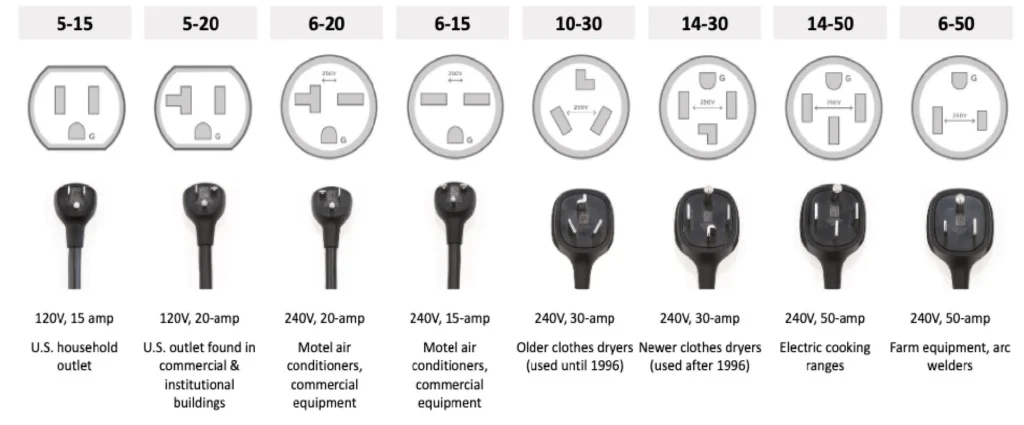
Beyond 5-15: 5-20, 6-Series, and Locking Plugs
Industrial programs frequently outgrow the standard 15A plug:
- NEMA 5-20: 20A, with a T-slot receptacle. A 5-15 plug fits a 5-20 outlet, but not the reverse.
- NEMA 6-15 / 6-20: Rated 250V, used on 208V or 240V circuits for higher-wattage industrial and IT equipment.
- Locking types (L5-15, L5-20, L6-20): Standard in industrial machinery, data centers, and mobile equipment where vibration or a snagged cable could cut power unexpectedly.
If your adapter will power equipment on a production line or a moving cart, a locking cord set is often the right call even when a standard plug would fit.
Hospital-Grade Plugs and Cord Sets
This is the most common US-specific failure point for medical equipment.
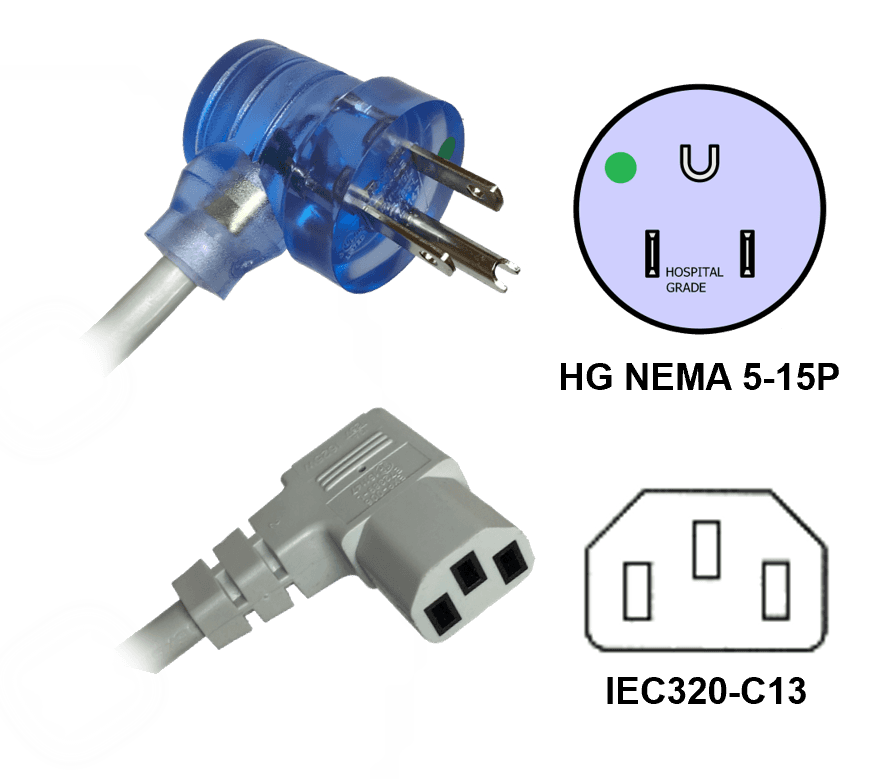
Hospital-grade plugs carry a “Hospital Grade” marking or green dot. They meet stricter UL 498 and UL 817 requirements for ground reliability, blade retention, and abuse resistance. NFPA 70 (NEC), Article 517, requires hospital-grade receptacles in many patient care spaces, and hospitals expect cord-connected medical equipment to arrive with matching plugs.
A generic NEMA 5-15 cord set on a medical cart works electrically. It still fails a hospital’s incoming inspection. If your device will be used in patient care areas, write “hospital grade” into the BOM explicitly.
Same Shape, Different Rules: Japan and Canada
Japan uses Type A geometry at 100V, with its own pin rules and PSE approval. A Type A plug sourced for Japan isn’t automatically valid for the US.
Canada shares NEMA configurations and 120V/60Hz, but requires separate Canadian certification (cUL, cETL, or CSA). Plug shape tells you what fits. It tells you nothing about what’s approved.
Universal Input 100–240V AC: Why the US Is the Hard End of the Range
Most teams assume the US is the easy case for universal input. It’s the opposite. Australia and the EU are high-line markets. The US is low-line, and low-line is where adapters run hottest.
Low-Line Is the Thermal Worst Case
For the same output power, input current at 120V is nearly double what it is at 230V. Conduction losses scale with the square of current, so the bridge rectifier, input filter, and PFC stage dissipate significantly more heat at low line.
An adapter validated only at 230V can look fine on the bench, then run hot inside a US enclosure. Many designs derate output power below about 100V. If site voltage sags toward 108V under load, an adapter specified near its limit can overheat or trigger protection. Ask your supplier for derating curves and thermal data measured at 90–100V input.
Reading the Input Rating for US Branch Circuits
A typical label reads: Input: 100–240V~, 50/60Hz, 1.5A.
The rated input current is specified at the low end of the range. In high-line markets, that figure is a conservative ceiling. In the US, it’s close to actual operating current. Use it when sizing fuses, cords, and branch-circuit loads. A 15A circuit is typically limited to 12A of continuous load—and multiple adapters on one cart or rack add up faster than expected.
Hold-Up Time, Brownouts, and Inrush at 120V
Without active PFC, the bulk capacitor charges to roughly 170V at 120V input, versus about 325V at 230V. Stored energy scales with voltage squared, so low-line hold-up time drops sharply. For patient monitors, controllers, and network equipment that must ride through short dips, specify hold-up time at 100V input. Active PFC largely solves this by holding the bulk voltage near 400V regardless of input.
Inrush is the other issue. Several adapters starting simultaneously on one circuit—carts, kiosks, racks—can trip a breaker. If your product installs in multiples, put an inrush limit in the spec.
208V, 240V, and the 277V Trap
Universal input covers 208V and 240V, which makes NEMA 6-series industrial circuits straightforward. The trap is 277V. Commercial buildings run lighting on 277V circuits, and installers regularly tap them for nearby equipment—building automation controllers, signage, sensors, access control. A standard universal input adapter tops out at 264V. On a 277V circuit, it’s out of spec from day one.
If there’s any chance your product will land on a lighting circuit, specify a wide-input design (90–305V AC) from the start. Field workarounds don’t fix this after the fact.
60Hz: When Frequency Still Matters
For modern switch-mode designs, 60Hz versus 50Hz has negligible impact. Frequency matters for transformer-based linear supplies, AC motors and fans, and mains-referenced timing circuits. If any of those subsystems came from a 50Hz design, review them separately.
Plug Change, Redesign, or Something in Between?
Most US projects fall into one of four scenarios. Identifying yours early determines your timeline and budget.
Scenario 1: Universal Input Adapter, Wrong Plug
This is the most common case. The adapter already accepts 100–240V, so only the plug changes—a US clip, a fixed NEMA variant, or a US cord set. Electrically, nothing changes. For listing, the new plug or cord set must fall within the NRTL listing scope.
Scenario 2: 230V-Only Equipment Moving Into the US
Designs from EU, UK, or Asian programs are sometimes 230V-only—usually linear supplies or equipment with 230V motors or heaters. Your options are redesign for universal input, add a certified internal autotransformer, or replace the supply. Whichever path you take, verify thermal performance at low line. “It powers on at 115V” is not a validation result.
Scenario 3: Internal or Open-Frame Supplies With an IEC Inlet
Products with an IEC C14 or C8 inlet typically need only a US cord set. Still, confirm the internal supply’s input range, whether it’s a recognized component or a listed product, and whether the end product needs its own listing.
Scenario 4: Medical Equipment Entering Patient Care Areas
The electrical design can be ready while the product still isn’t. US patient care environments may require hospital-grade cord sets and test reports that cover US national deviations. Hospital biomed teams will review documentation at incoming inspection. Plan for all three—not just the safety certificate.
Why In-Box Plug Adapters and Step-Up Transformers Fail Audits
Shipping a foreign-plug adapter with a third-party adapter in the box takes the product outside its evaluated configuration. So does recommending an external transformer. Inspectors, customers, and insurers assess the product as supplied. If the plug that meets the US outlet isn’t part of the listed configuration, the product isn’t compliant.
Five questions that determine your path:
- Is the input rated 100–240V or wider, with acceptable derating at 100V?
- Could the product ever be installed on 208V, 240V, or 277V circuits?
- Is the plug fixed, interchangeable, or a detachable cord set?
- Does the adapter carry an NRTL listing, or only CB or CE documentation?
- Is the end product medical, ITE, or industrial—and will it enter patient care areas?
If the answers are “yes, no, cord set, CB only, medical,” you’re scoping a hospital-grade cord set plus an NRTL listing built on your existing CB report. That’s a certification project, not a redesign.
US vs. EU vs. UK vs. Australia: Plug, Voltage, and Approval at a Glance
Market | Plug Type | Plug Standard | Nominal Voltage | Frequency | Typical Safety Approval | What Changes for the US |
|---|---|---|---|---|---|---|
United States | Type A / B | NEMA 1-15 / 5-15 | 120V | 60Hz | NRTL listing (UL, ETL, CSA, TÜV) | — |
European Union | Type C / F / E | CEE 7 series | 230V | 50Hz | CE | Plug, NRTL listing, FCC, low-line thermal check |
United Kingdom | Type G | BS 1363 | 230V | 50Hz | UKCA / CE | Plug, NRTL listing, FCC, low-line thermal check |
Australia / NZ | Type I | AS/NZS 3112 | 230V | 50Hz | RCM | Plug, NRTL listing, FCC, low-line thermal check |
Canada | Type A / B | NEMA (CSA C22.2 No. 42) | 120V | 60Hz | cUL / cETL / CSA | Often a shared design; separate Canadian approval |
Three things stand out.
The US is the only low-line market in this group. Moving a design from the EU, UK, or Australia means verifying thermal performance at 100–108V, not just reading the label.
No approval transfers. CE, UKCA, and RCM carry no weight in the US. A CB Scheme report to IEC 62368-1 or IEC 60601-1 can speed up NRTL listing, especially when it includes US national differences—but listing is still a separate step.
Canada is the natural extension. Most NRTLs can list for both markets in one program. Plan them together and you pay for one evaluation, not two.
US Compliance for Medical and Industrial Power Adapters
This is where most of the hidden effort accumulates. Regulatory details change, so verify current requirements with your NRTL, test lab, and regulatory consultant before launch.
NRTL Listing: Not a Federal Law, Still a Market Requirement
The US has no single mandatory federal safety mark for most electrical products. That surprises overseas teams. Listing is still expected through several overlapping channels:
- OSHA requires workplace electrical equipment to be “approved”—which in practice means NRTL-listed.
- Local electrical inspectors (the “authority having jurisdiction” under the NEC) expect listed equipment.
- Customers, distributors, and insurers routinely require it in purchase terms.
UL is the best-known NRTL, but it isn’t the only one. Intertek (ETL), CSA, TÜV SÜD, TÜV Rheinland, and others issue equivalent listings.
The distinction that causes the most trouble is listed vs. recognized. A recognized component—an internal or open-frame supply—is evaluated for use inside another product, with stated conditions of acceptability. A listed product—an external adapter—stands on its own. Teams that assume a recognized supply makes their end product “UL-listed” discover the gap at end-product certification.
Industrial and ITE Equipment: UL/IEC 62368-1 and NEC Class 2
For ITE, communications, and AV equipment, UL/IEC 62368-1 is the primary safety standard. Most ITE power supplies entering the US are evaluated against it.
The US-specific detail that matters most is NEC Class 2. Building automation, security, access control, and low-voltage control installations often require a Class 2 power source, which allows field wiring with lighter, less restricted methods. Class 2 output limits and marking come from UL 1310 or a Class 2 evaluation alongside UL 62368-1.
If the installer needs a Class 2 label and your adapter doesn’t carry one, the installation may fail inspection. Confirm this before you finalize the output rating.
Industrial sites also raise questions that a certification lab won’t ask: Is the adapter rated for the actual enclosure temperature, not room ambient? Will it see dust, moisture, or oil mist? Will it face surge transients from motors or long cable runs? Does vibration call for a locking plug?
FCC Part 15: EMC Is a Separate Obligation
An NRTL listing covers safety, not emissions. Switching power supplies with digital circuitry generally fall under FCC Part 15 Subpart B.
- Class A covers commercial and industrial environments.
- Class B covers residential settings, with tighter limits.
If equipment could reach a home-care or mixed-use setting, design to Class B from the start.
Most power supplies follow the Supplier’s Declaration of Conformity (SDoC) route, which requires a US-based responsible party—typically the importer or the OEM’s US entity. Sort that out before testing begins.
Part 15.103 exempts certain industrial plant control equipment and specialized medical devices from the technical limits. Don’t build a program around it. Exempt devices still must not cause harmful interference, and the FDA still expects IEC 60601-1-2 compliance for medical EMC. Confirm any exemption with your test lab before relying on it.
Adapter emissions feed directly into end-product test results. A noisy adapter can push an otherwise clean system over the limit at final validation—that’s typically a four-to-eight-week delay. Pre-compliance scanning at the adapter stage is the cheapest way to avoid it.
Medical Devices: FDA, ANSI/AAMI ES60601-1, and Where the Adapter Fits
FDA regulates medical devices through 510(k), De Novo, or PMA pathways. An external adapter supplied with a device is generally reviewed as part of the device system or as an accessory, so its test evidence ends up in your submission.
The standard to know is ANSI/AAMI ES60601-1, the US national version of IEC 60601-1. It includes US-specific deviations covering power cords, attachment plugs, and marking. A CB report written without those deviations can leave gaps that show up during FDA review or at the hospital loading dock.
FDA recognizes IEC 60601-1 and IEC 60601-1-2 as consensus standards. Declaring conformity to them simplifies the submission. NRTL listing isn’t an FDA requirement—but hospitals expect it, and biomed teams check for it.
The core electrical parameters remain constant regardless of market:
- 2x MOPP isolation between mains and output
- Patient and touch leakage limits
- Home-healthcare immunity levels under IEC 60601-1-2 for devices used outside clinical facilities
DOE Level VI and California Efficiency Rules
DOE Level VI applies to many external power supplies sold in the US, and compliant units carry a “VI” mark. The DOE test procedure runs at 115V/60Hz—so low-line efficiency, the same weak point as low-line thermal performance, is the number that matters.
Exemptions exist for certain power supplies used with FDA-regulated medical devices. Verify whether yours qualifies before assuming.
California also maintains its own appliance efficiency database with separate registration requirements. Meeting Level VI and being registered in California are two different checklist items.
How to Cover the US Without Adding Another SKU Family
Once the US is solved, the next question is how to stop every new region from multiplying part numbers.
Design for Low-Line First
Validate the platform thermally at 90–100V and electrically up to 264V or wider, and it works in every market. A platform validated only at 230V will reveal its thermal weaknesses in the US—usually after launch, not before.
Three Architectures for US-Plus-Global Adapters
Interchangeable plug clips. One adapter body ships with US, EU, UK, and AU heads. Lowest SKU count. Each clip must be within the listing scope, and clip retention must be verified. This option doesn’t work where hospital-grade plugs are required.
Desktop adapter with an IEC inlet (C6, C8, or C14). One adapter body pairs with regional cord sets, including hospital-grade US cords where needed. This is the most robust option for medical carts and industrial equipment, because the regulated adapter body never changes—only the inexpensive, separately approved cord does.
Fixed-plug regional variants. Highest SKU count, but sometimes necessary for tamper resistance, locking plugs, or Class 2 wall-mount designs.
One Certification Stack for US, EU, UK, and AU
Build on IEC-based CB reports with US national deviations included from day one. Then layer on regional approvals: NRTL listing for the US and Canada together, FCC SDoC, DOE marking, CE, UKCA, and RCM. One core design means one core test program, with national approvals added incrementally rather than started from scratch.
Lifecycle stability protects that investment. If your supplier discontinues an adapter, you face relisting in every market—and for medical devices, potentially a regulatory review. Choosing a supplier with long-lifecycle models keeps the whole stack intact. Quankang’s custom power adapters program is built around this: models aren’t discontinued, so certified devices stay certified.
A practical example: one universal input platform with a C14 inlet covers the US with a hospital-grade cord set and Canada under a combined NRTL listing. The same adapter body covers the EU, UK, and Australia with regional cords. One design, five markets.
ODM Options for US and Multi-Region Power Adapters
When a standard product doesn’t fit the program, ODM customization closes the gap.
Plug, inlet, and cord sets: Fixed NEMA 1-15 or 5-15 plugs, a US clip within a multi-region set, IEC C6, C8, or C14 inlets with standard or hospital-grade US cords, and locking cord sets for industrial use.
Electrical: Output voltage and current, Class I or Class II construction, wide-input versions for 277V installations, Class 2-limited outputs, medical leakage targets, and USB PD outputs. The medical series achieves leakage current ≤100µA with 2x MOPP isolation.
Labeling and mechanical: Labels can carry NRTL marks, the FCC statement, DOE Level VI marking, and other regional marks. Casing form factor, cable length, DC connector type, and laser-etched branding can all be specified. No MOQ for cosmetic changes.
Timelines:
- 24 hours: compliance gap analysis after a technical brief
- ~10 days: functional samples with preliminary EMC reports
- 15–20 days: cosmetic changes to casing, labels, or cables
- 35–40 days: full electrical design including EMC pre-scan
Every new design is pre-scanned to FCC and CE limits in the on-site EMC lab at our ISO 13485-certified facility. First-pass EMC compliance rate is 98.3% across more than 10,000 OEM projects. Pilot builds of 100–500 units for clinical trials run on the same process as mass production, with full MES and SAP traceability. DDP shipping covers US delivery, and technical support is aligned with US time zones.
USA Power Adapter FAQs for OEMs
What voltage, frequency, and plug type does the US use?
The US uses 120V nominal at 60Hz, with NEMA 1-15 (Type A) and NEMA 5-15 (Type B) plugs. Under ANSI C84.1, service voltage normally runs from about 114V to 126V, and it drops further at the equipment under load. Commercial and industrial buildings also deliver 208V, 240V, and 277V, which often matter more for OEM equipment.
Will a 100–240V adapter work in the US without modification?
Electrically, yes, as long as it performs well at low line. At 120V, input current is nearly double the 230V figure, so heat builds up in the rectifier, filter, and PFC stage. Ask for derating curves and thermal data at 90–100V input. The adapter still needs a US plug or cord set and an NRTL listing before it ships.
Is UL certification legally required to sell in the US?
Not by a single federal law for most products. In practice, OSHA requires workplace equipment to be approved, local inspectors expect listed equipment, and customers and insurers write listing into purchase terms. Treat NRTL listing as mandatory. UL is one option. Intertek ETL, CSA, and TÜV SÜD are also OSHA-recognized and issue equivalent listings.
Is a CB report or CE marking enough for the US?
No. CE marking carries no weight in the US. A CB Scheme report to IEC 62368-1 or IEC 60601-1 is still valuable because an NRTL can build on it, which shortens the listing program. It works best when the report already includes US national differences. Without them, expect additional testing before listing is granted.
Do power adapters need FCC compliance?
Yes, in most cases. Switching power supplies generally fall under FCC Part 15 Subpart B, usually through a Supplier’s Declaration of Conformity with a US-based responsible party. Choose Class A for commercial and industrial settings. Choose Class B for anything that could reach a home or mixed-use site. EMC is separate from the safety listing and needs its own test report.
When do I need a hospital-grade plug?
You need one when cord-connected equipment will be used in hospital patient care areas. NFPA 70 Article 517 requires hospital-grade receptacles in many of those spaces. Biomedical engineering teams expect matching plugs marked “Hospital Grade” or with a green dot. A standard NEMA 5-15 cord set works electrically but often fails incoming inspection. Specify hospital grade in the BOM by name.
What’s the difference between IEC 60601-1 and ES60601-1?
ANSI/AAMI ES60601-1 is the US national version of IEC 60601-1. The core safety requirements are the same, but the US edition adds national deviations covering items such as power cords, attachment plugs, and marking. A test report written only to the IEC text can leave gaps during FDA review or hospital acceptance. Ask your supplier for reports that include the US deviations.
Can one adapter cover the US and Canada?
Usually, yes. Both markets use NEMA plug configurations at 120V/60Hz, so the electrical design and cord set can stay the same. Canada still requires its own approval, such as cUL, cETL, or CSA. Most NRTLs can list for both countries in a single program, which costs far less than running two separate evaluations later.
Will a universal input adapter work on 277V circuits?
No. A standard universal input adapter is rated up to 264V AC, and a 277V lighting circuit is above that limit even before line tolerance is added. Building automation controllers, signage, sensors, and access control equipment often end up on these circuits. If your product could be installed on lighting circuits, specify a wide-input design such as 90–305V AC at the start of the project.
What documents should I request from a power adapter supplier for the US?
Ask for NRTL listing or certificate numbers you can verify in the lab’s online database, a CB report with US national differences, and UL/IEC 62368-1 or ES60601-1 test reports. Add the FCC test report and SDoC, DOE Level VI efficiency data, and ISO 13485 or ISO 9001 certificates. Request the full file before you issue the purchase order.