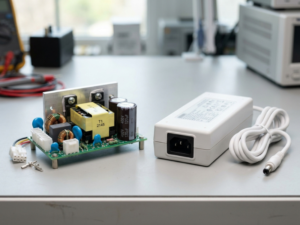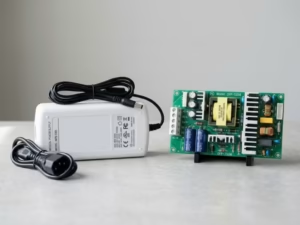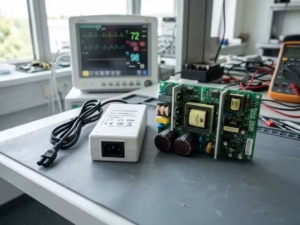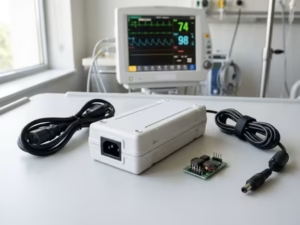
Power over Ethernet (PoE) simplifies network installation by allowing compatible Ethernet cables to carry both data and electrical power. It is widely used in IP cameras, wireless access points, VoIP phones, access control systems, IoT equipment, and other network-connected devices.
However, choosing the right PoE power supply adapter is not simply a matter of selecting the highest available wattage.
A suitable PoE power supply adapter must match the powered device’s power requirements, PoE standard, input voltage, network configuration, cable length, operating environment, and applicable safety and compliance requirements.
For ODM/OEMs, system integrators, and equipment manufacturers, the selection process can be even more complex. A PoE power adapter solution may need to meet specific requirements for power capacity, efficiency, thermal performance, protection, reliability, form factor, and long-term product availability.
So, how do you choose the right PoE power supply adapter for your application?
This guide explains the key factors to consider when selecting a PoE power supply, PoE adapter, or related PoE power solution.
Quick Answer: How to Choose a PoE Adapter
The right PoE power supply should be selected based on the complete requirements of the application.
Before choosing a product, check:
- PoE standard:3af, 802.3at, or 802.3bt
- PD power requirement:How much power does the powered device actually need?
- PSE output power:How much power can the PoE source provide?
- Power budget:Is there enough capacity for all connected devices?
- Input voltage:AC or DC, and what voltage range?
- Output power and voltage:Does the power supply match the application?
- Ethernet data rate:10/100 Mbps, Gigabit Ethernet, or higher?
- Cable length and type:Will cable losses affect available power?
- Operating environment:Indoor, outdoor, industrial, or harsh conditions?
- Protection:Is overvoltage, overcurrent, short-circuit, or overtemperature protection required?
- Safety and compliance:Does the product meet the requirements of the target market?
- OEM requirements:Is customization or long-term supply needed?
The basic selection principle is:
Device Requirements → PoE Standard → Power Budget → Electrical Specifications → Environment → Protection → Compliance
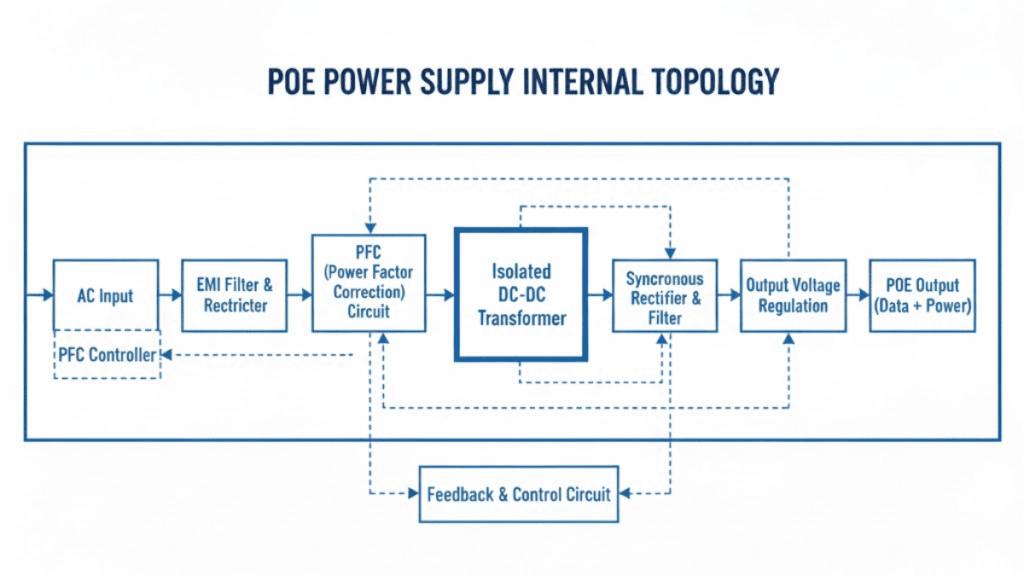
Step 1: Determine How Much Power Your Device Needs
The first step is to determine the actual power requirement of the powered device, also known as the PD (Powered Device).
Common PoE-powered devices include:
- IP cameras
- PTZ cameras
- Wireless access points
- VoIP phones
- Access control devices
- IoT gateways
- Network sensors
- Industrial Ethernet equipment
- Digital signage and other specialized devices
The power requirement can vary significantly between devices.
For example, a basic IP camera may require only a small amount of power, while a PTZ camera with motorized movement, infrared illumination, and additional functions may require considerably more.
Similarly, a basic WiFi access point may operate with lower power, while a high-performance multi-radio access point may require a higher-power PoE solution.
Before selecting a PoE adapter power supply, identify:
- Typical power consumption
- Maximum power consumption
- Startup power requirements
- Peak power demand
- Required operating voltage
- Required PoE standard
Do not select a power supply based only on the device’s average power consumption.
The maximum expected power requirement should be used as the starting point for system design.
Step 2: Select the Correct PoE Standard
Once you know the device’s power requirements, determine which PoE standard it supports.
The most common IEEE PoE standards are:
| IEEE Standard | Common Name | PoE Type | Maximum PSE Power | Maximum PD Power | Typical Applications |
| 802.3af | PoE | Type 1 | 15.4W | 12.95W | Basic IP cameras, VoIP phones |
| 802.3at | PoE+ | Type 2 | 30W | 25.5W | PTZ cameras, wireless APs |
| 802.3bt | PoE++ | Type 3 | Up to 60W | Up to approximately 51W | High-power APs, advanced cameras |
| 802.3bt | PoE++ | Type 4 | Up to approximately 90W* | Up to approximately 71W* | High-power network equipment |
*Actual power levels depend on the specific implementation and manufacturer specifications.
The important point is that the PSE power rating is not the same as the power available at the PD.
Power is lost as it travels through the Ethernet cable.
Therefore, when selecting a PoE power supply, always verify the power available at the powered device rather than looking only at the maximum output rating of the PSE.
For more information about the differences between PoE standards, see:
802.3af vs. 802.3at vs. 802.3bt: Which PoE Standard Do You Need?
This article should be internally linked to the corresponding Quankang PoE technical guide.
Step 3: Calculate the PoE Power Budget
If your application includes multiple powered devices, you need to calculate the total power budget.
For example, imagine a network with:
- 8 IP cameras
- Each camera requires a maximum of 12W
The theoretical device power requirement is:
8 × 12W = 96W
However, selecting a 96W power supply may not always be sufficient.
The system may also need to account for:
- Ethernet cable losses
- Startup power
- Peak power consumption
- Temperature effects
- Future expansion
- Power supply efficiency
- Design margin
A practical design should therefore provide sufficient reserve capacity rather than operating continuously at the absolute maximum rating.
Example Power Budget
| Device | Quantity | Maximum Power per Device | Total |
| IP Camera | 8 | 12W | 96W |
| Additional Power Margin | — | — | Recommended |
| Total Design Requirement | — | — | Above 96W |
For larger installations, power budget becomes particularly important.
A PoE system may have sufficient power for one device but insufficient capacity when multiple devices operate simultaneously.
This is why system designers should calculate the total expected power demand before selecting the PoE power supply.
Step 4: Understand PSE Power vs. PD Power
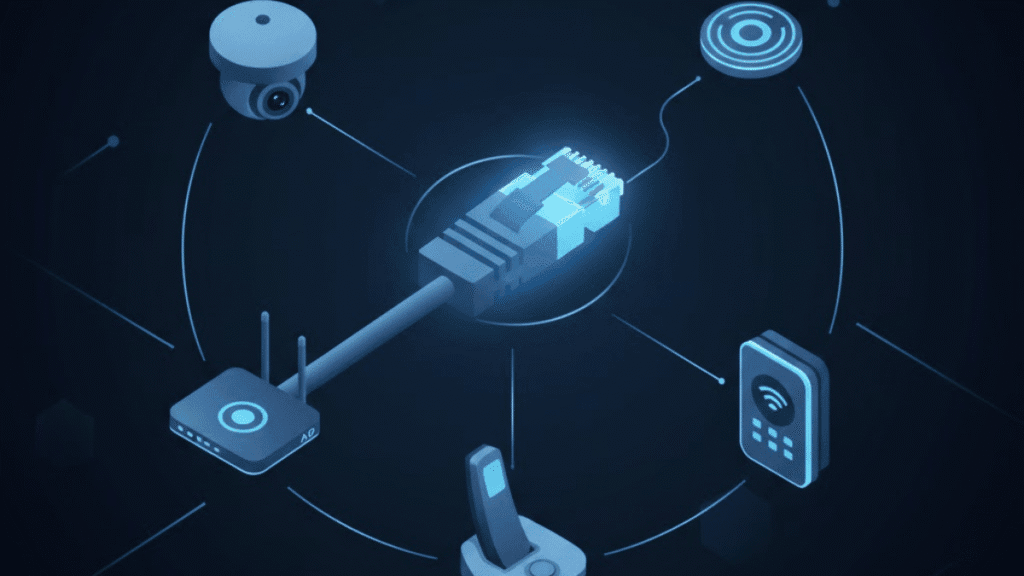
One of the most common mistakes in PoE system design is confusing PSE power with PD power.
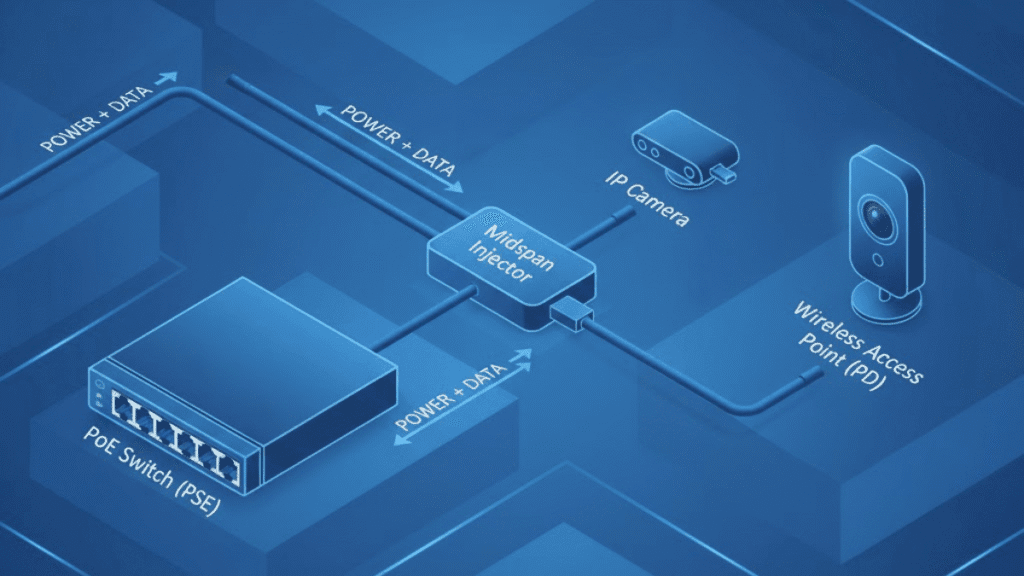
PSE
Power Sourcing Equipment (PSE) provides power to the Ethernet connection.
Examples include:
- PoE switches
- PoE injectors
- PoE power solutions
PD
Powered Device (PD) receives power from the PoE system.
Examples include:
- IP cameras
- Wireless access points
- VoIP phones
The simplified power path is:
PSE → Ethernet Cable → PD
Because power is lost during transmission, the power available to the PD is lower than the PSE’s maximum output.
Therefore, when choosing a PoE power supply, you should ask:
How much power must be available at the PD?
rather than simply:
How many watts does the PSE provide?
This distinction is especially important for higher-power applications and longer cable runs.
Step 5: Check the Input Voltage
The input voltage of a PoE power supply must match the available electrical infrastructure.
Depending on the application, the input may be:
- 100–240V AC
- 90–264V AC
- 12V DC
- 24V DC
- 48V DC
- Other custom DC input ranges
AC Input Applications
AC-input PoE power supplies are commonly used in:
- Office networks
- Commercial buildings
- Security systems
- Indoor IP camera installations
- Standard network infrastructure
DC Input Applications
DC-input solutions may be more suitable for:
- Industrial automation
- Transportation
- Telecom systems
- Outdoor equipment
- Solar-powered systems
- Battery-backed systems
- Remote installations
For OEM applications, the input voltage range should be determined by the complete system architecture.
A PoE power supply designed for industrial equipment may have very different input requirements from one designed for a standard office network.
Step 6: Select the Appropriate Output Power
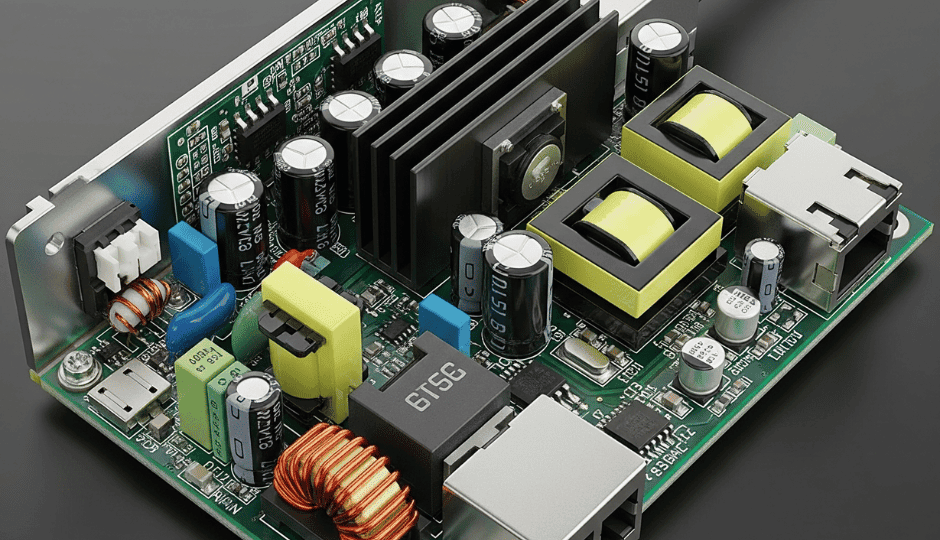
The output power of the PoE power supply should be sufficient for the connected device or system.
However, selecting a much higher power rating is not automatically better.
An oversized power supply may:
- Increase system cost
- Increase physical size
- Reduce space efficiency
- Increase standby energy consumption
- Complicate thermal design
On the other hand, an undersized power supply may cause:
- Device startup failure
- Intermittent operation
- System instability
- Unexpected shutdowns
The goal is to select a power supply with adequate capacity and appropriate design margin.
For OEM projects, the optimal power rating should be determined based on:
- Maximum load
- Startup behavior
- Peak load
- Environmental conditions
- Future product requirements
Step 7: Consider Ethernet Data Speed
PoE power delivery and Ethernet data transmission are related but separate functions.
When choosing a PoE power solution, verify the required network data rate.
Depending on the application, you may need:
- 10/100 Mbps
- Gigabit Ethernet
- Higher-speed Ethernet
For example, a high-resolution IP camera or advanced wireless access point may require higher network bandwidth.
The PoE solution should therefore be compatible with both:
Power Requirements
and
Data Transmission Requirements
Do not assume that a PoE product designed for a specific power standard automatically meets every network speed requirement.
Check the manufacturer’s specifications for data rate and Ethernet compatibility.
Step 8: Consider Ethernet Cable Length and Power Loss
Cable length can affect PoE performance.
As the Ethernet cable becomes longer, electrical resistance can increase power loss and voltage drop.
The installation should therefore consider:
- Cable length
- Cable category
- Conductor size
- Cable quality
- Connector resistance
- Ambient temperature
For standard network installations, Ethernet cable length is typically limited by network architecture and Ethernet standards.
However, for higher-power PoE applications, cable thermal performance and power loss become increasingly important.
If the application involves:
- Long cable runs
- High ambient temperatures
- High PoE power
- Dense cable bundles
the cable design should be evaluated carefully.
For critical applications, engineers should consider the complete power path rather than selecting the PoE power supply in isolation.
Step 9: Choose 2-Pair or 4-Pair PoE
The required PoE power level may also determine the power delivery architecture.
Lower-power PoE systems such as 802.3af and 802.3at typically use two pairs for power delivery.
Higher-power IEEE 802.3bt systems use four pairs to support higher power levels.
In general:
- 2-pair PoE:Suitable for lower and medium-power applications
- 4-pair PoE:Suitable for higher-power applications
When selecting a PoE power solution, verify that the power delivery method is compatible with the powered device and the Ethernet cabling system.
Step 10: Consider the Operating Environment
A PoE power supply designed for an office environment may not be suitable for an industrial or outdoor application.
Consider the actual installation conditions.
Indoor Commercial Applications
Typical requirements may include:
- Standard operating temperature
- Compact form factor
- Low acoustic noise
- High efficiency
- Standard safety compliance
Industrial Applications
Additional requirements may include:
- Wide operating temperature
- Higher reliability
- Vibration resistance
- Electrical noise immunity
- Robust protection
Outdoor Applications
The system may need to consider:
- Wide temperature range
- Humidity
- Dust
- Water exposure
- Surge events
- Lightning-related risks
The environmental requirements should be evaluated before selecting the power supply.
Step 11: Check Protection Functions
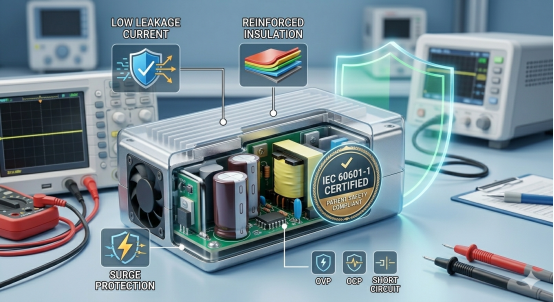
A reliable PoE power supply should provide appropriate protection for the application.
Depending on the product design, protection functions may include:
Overvoltage Protection
Helps protect connected equipment from excessive voltage.
Overcurrent Protection
Limits excessive current under abnormal operating conditions.
Short-Circuit Protection
Helps prevent damage when a short circuit occurs.
Overtemperature Protection
Protects the power supply when internal temperature exceeds safe operating limits.
Surge Protection
May be important for applications exposed to electrical disturbances or outdoor environments.
The required protection functions depend on the application and system risk level.
For OEM customers, protection requirements should be defined during the product design stage rather than treated as an afterthought.
Step 12: Evaluate Efficiency and Thermal Performance
Power efficiency affects both operating costs and thermal management.
A more efficient PoE power supply generally produces less wasted energy as heat.
This can be particularly important in:
- High-power PoE systems
- Enclosed equipment
- Dense network installations
- Industrial environments
- High ambient temperatures
Thermal performance should be evaluated based on:
- Maximum load
- Ambient temperature
- Enclosure size
- Ventilation
- Installation method
A power supply that performs well under laboratory conditions may behave differently in a tightly enclosed system operating at high ambient temperatures.
For OEM applications, thermal performance should therefore be evaluated under realistic operating conditions.
Step 13: Check Safety, EMC, and Regulatory Compliance
For commercial and OEM applications, technical performance is only one part of the selection process.
The PoE power supply may also need to comply with applicable:
- Electrical safety standards
- EMC requirements
- Energy efficiency regulations
- Regional certification requirements
The exact requirements depend on:
- Target market
- Product category
- End application
- Input voltage
- Installation environment
Before purchasing or integrating a PoE power supply, confirm the certifications and compliance documents required for the final product.
For OEM customers, it is also important to understand whether the power supply’s certifications can support the certification process of the final system.
Step 14: Consider Reliability and Long-Term Availability
For a consumer network installation, replacing a failed power supply may be relatively simple.
For an OEM product or large commercial deployment, the consequences can be much more significant.
Consider:
- Product reliability
- MTBF
- Component quality
- Thermal performance
- Manufacturing consistency
- Quality control
- Product lifecycle
- Long-term availability
- Technical support
Long-term product availability is particularly important for OEM customers.
If a PoE power supply is integrated into a product that will remain in production for several years, unexpected component changes or product discontinuation can create significant redesign costs.
Therefore, the supplier’s ability to provide stable, long-term support should be part of the selection process.
Step 15: Determine Whether You Need a Standard or Customized PoE Solution
Not every application can be solved with an off-the-shelf PoE adapter or power supply.
A standard product may be sufficient when:
- Input voltage is conventional
- Power requirements are common
- Standard PoE protocols are supported
- The form factor is acceptable
- Operating conditions are normal
A customized PoE power solution may be appropriate when you require:
- Custom input voltage
- Custom output power
- Specific PoE standard
- Special connectors
- Compact form factor
- Wide operating temperature
- Enhanced protection
- Custom mechanical design
- Long-term OEM supply
For OEM and ODM projects, the power supply should be considered as part of the complete product architecture.

How to Choose a PoE Power Supply for Different Applications
The appropriate PoE power solution varies by application.
PoE Adapter for IP Cameras
For IP camera applications, consider:
- Camera maximum power consumption
- Infrared illumination
- PTZ motor requirements
- Night vision functions
- Number of cameras
- Total power budget
- Cable length
- Outdoor or indoor installation
Basic IP cameras may be suitable for 802.3af.
More advanced cameras may require 802.3at or 802.3bt.
PoE Power Supply Adapter for PTZ Cameras
PTZ cameras can require significantly more power than basic fixed cameras.
Consider:
- Pan and tilt motor operation
- Zoom functions
- Infrared illumination
- Heating functions
- Peak power consumption
A higher-power PoE standard may be required depending on the camera design.
Always verify the manufacturer’s maximum power requirements.
PoE Adapter for WiFi Access Points
Wireless access points can have different power requirements depending on:
- Number of radios
- WiFi generation
- Number of antennas
- Advanced features
- Maximum transmit power
A basic access point may use 802.3af.
More advanced systems may require 802.3at or 802.3bt.
For future network upgrades, it may be beneficial to select a PoE infrastructure with sufficient capacity for the expected next-generation equipment.
PoE Adapter for VoIP Phones
Many standard VoIP phones have relatively low power requirements.
802.3af may be sufficient for many applications.
However, advanced phones with:
- Large displays
- Video capabilities
- Additional USB ports
- Integrated accessories
may require higher power.
Check the actual power specification of the device before selecting the PoE solution.
PoE Adapter for Industrial Applications
Industrial PoE applications may require more than just adequate power output.
Consider:
- Wide input voltage
- Wide operating temperature
- High reliability
- Electrical noise
- Surge protection
- Mechanical robustness
- Long product lifecycle
For industrial OEM applications, a customized PoE power solution may be preferable to a standard consumer-grade product.
PoE Adapter Selection Checklist
Before selecting a PoE adapter, verify the following:
Device power consumption
Maximum power requirement
Startup and peak power
IEEE PoE standard
PoE Type
PoE Class
PSE output power
PD input power
Total PoE power budget
Input voltage
Output voltage
Output current
Ethernet data rate
Cable length
Cable type
2-pair or 4-pair PoE
Operating temperature
Humidity and environmental conditions
Protection functions
Efficiency
Thermal performance
Safety compliance
EMC compliance
Regional certifications
Product reliability
Long-term availability
OEM/ODM requirements
Common Mistakes When Choosing a PoE Adapter
Mistake 1: Choosing Based Only on Wattage
A higher wattage does not automatically mean a better solution.
The power supply must match the complete system requirements.
Mistake 2: Confusing PSE Power with PD Power
The maximum PSE output is not necessarily the power available to the powered device.
Cable losses must be considered.
Mistake 3: Ignoring Peak Power
Some devices consume significantly more power during startup or when specific functions are activated.
Designing only for average power consumption may cause reliability problems.
Mistake 4: Ignoring Cable Loss
Longer cables and higher power levels can increase voltage drop and power loss.
The complete power delivery path should be considered.
Mistake 5: Choosing the Wrong PoE Standard
A device that requires 802.3at should not be paired with an insufficient 802.3af power solution.
Always verify compatibility.
Mistake 6: Ignoring the Operating Environment
A power supply designed for a controlled indoor environment may not be suitable for outdoor or industrial conditions.
Mistake 7: Selecting a Supplier Based Only on Price
For OEM and long-term commercial applications, the lowest initial price may not result in the lowest total cost.
Consider:
- Reliability
- Quality consistency
- Certifications
- Technical support
- Product lifecycle
- Long-term availability
PoE Adapter Selection Example
Consider a system that includes:
- 6 IP cameras
- Maximum power per camera: 15W
The theoretical maximum device power is:
6 × 15W = 90W
However, the system designer should also consider:
- Cable power loss
- Startup requirements
- Peak power
- Environmental conditions
- Future expansion
Therefore, selecting a PoE power solution with exactly 90W of capacity may leave little design margin.
A better approach is to select a solution that provides sufficient additional capacity while remaining appropriate for the system’s size, cost, and thermal requirements.
For a larger deployment, the same principle applies:
Total Device Power + System Losses + Design Margin = Required Power Capacity
The exact design margin should be determined based on the application and engineering requirements.
Frequently Asked Questions
How do I know what size PoE power supply Adapter I need?
Start with the maximum power requirement of the powered device or devices.
For multiple devices, calculate the total maximum power demand and then consider cable losses, peak power, and appropriate design margin.
Is a higher-wattage PoE Adapter always better?
No.
A higher-wattage power supply may provide additional capacity, but it can also increase cost, size, and thermal requirements.
The best solution is one that provides sufficient power with an appropriate design margin.
What is the difference between a PoE Adapter and a PoE injector?
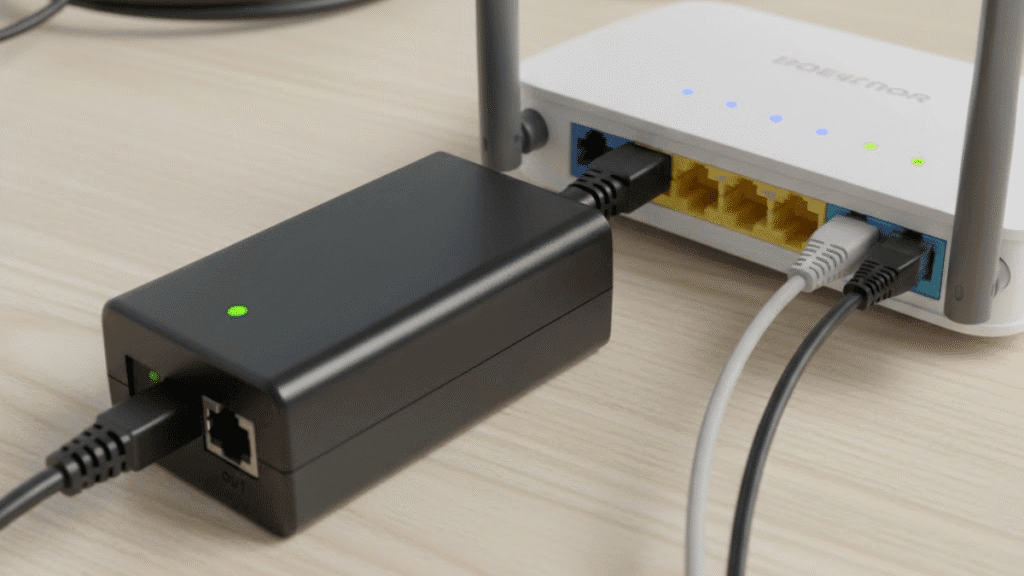
A PoE adapter focuses on providing the required electrical power for the PoE system.
A PoE injector typically combines network data and power and injects the combined signal into an Ethernet connection.
Depending on the product architecture, a PoE adapter may incorporate both power supply and injection functions.
Do I need 802.3af, 802.3at, or 802.3bt?
The answer depends on the powered device’s power requirements.
In general:
- 3af is suitable for lower-power devices.
- 3at supports medium-power devices.
- 3bt is designed for higher-power applications.
Always check the actual device specifications.
How far can PoE power be transmitted?
The practical distance depends on the PoE standard, Ethernet cable, network data requirements, power level, and installation conditions.
For standard Ethernet deployments, the typical maximum channel length is commonly around 100 meters, but longer-distance applications may require specialized solutions.
Can I use a PoE adapter for any IP camera?
No.
The power supply must be compatible with the camera’s PoE standard, power requirement, voltage, and other specifications.
Always verify compatibility before installation.
Should I choose a PoE adapter or a PoE switch?
A PoE adapter or injector may be suitable when powering one or a small number of devices.
A PoE switch is generally more suitable when many PoE devices need to be connected and centrally managed.
The best choice depends on the network architecture.
When should I consider a customized PoE power supply?
A customized solution may be appropriate when the application requires specific input voltage, output power, PoE standard, form factor, operating temperature, protection, connector configuration, or long-term OEM support.
Conclusion: Choose a PoE Adapter Power Supply Based on the Complete System
Choosing the right PoE adapter requires more than selecting a wattage rating.
The best solution should match the complete requirements of the application:
Device Power → PoE Standard → PSE/PD Requirements → Power Budget → Input Voltage → Output Power → Cable → Data Rate → Environment → Protection → Compliance
For simple applications, a standard PoE adapter or injector may be sufficient.
For larger network deployments, a PoE switch may provide a more centralized solution.
For ODM/OEMs, equipment manufacturers, and system integrators, a dedicated or customized PoE power supply may provide greater flexibility and better integration with the final product.
When evaluating a PoE power supply supplier, consider not only the electrical specifications but also product reliability, safety and EMC compliance, thermal performance, manufacturing capability, technical support, and long-term product availability.
Quankang provides PoE power solutions for network equipment and ODM/OEM applications. By evaluating your device’s power requirements, PoE standard, input voltage, operating environment, and product design requirements, Quankang can help identify a suitable PoE adapter or PoE power supply solution.
Contact Quankang to discuss your PoE power requirements and OEM/ODM project needs.