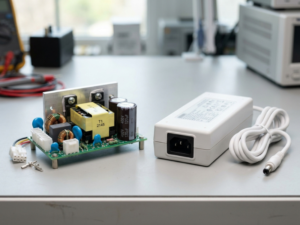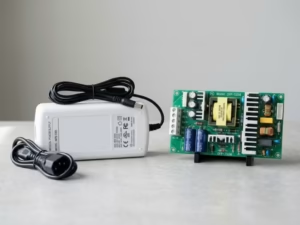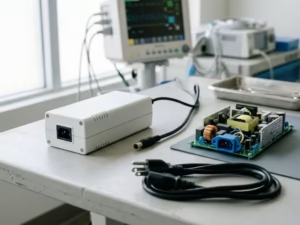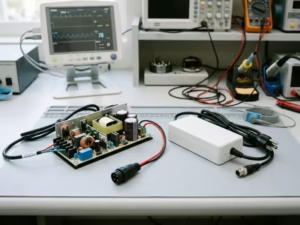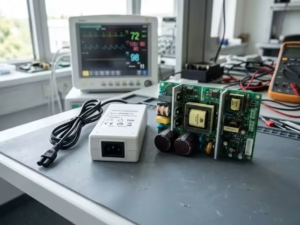

Switching power supplies (SMPS) are essential components in modern electronic equipment. Nearly all devices—from industrial controllers and communication systems to medical instruments—depend on efficient AC-DC or DC-DC power conversion.
Compared with traditional linear power supplies, switching power supplies provide:
- higher efficiency (typically 80–95%)
- smaller size and lighter weight
- wider input voltage range
- lower heat dissipation
Because of these advantages, SMPS technology has become the dominant power architecture in modern electronics.
This guide explains:
- how switching power supplies work
- key SMPS internal components
- different types of switching power supplies
- how engineers select the right SMPS
- how OEM manufacturers choose reliable power supply suppliers
What Is a Switching Power Supply?
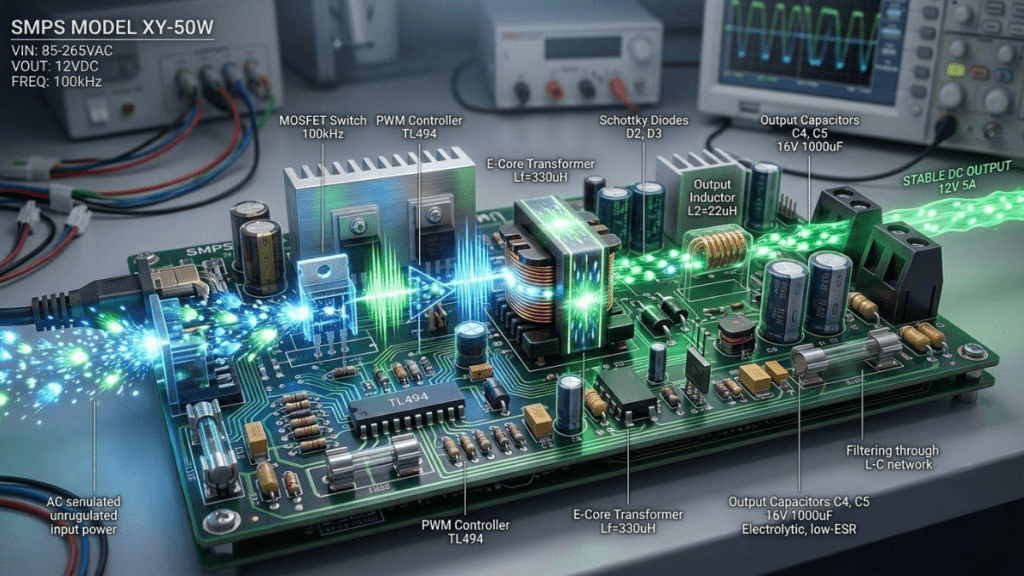
A switching power supply (SMPS) is an electronic circuit that converts electrical power using high-frequency switching technology.
Instead of dissipating energy as heat like linear power supplies, SMPS rapidly switches semiconductor devices on and off to control energy transfer.
This approach enables:
- higher efficiency
- compact design
- better thermal performance
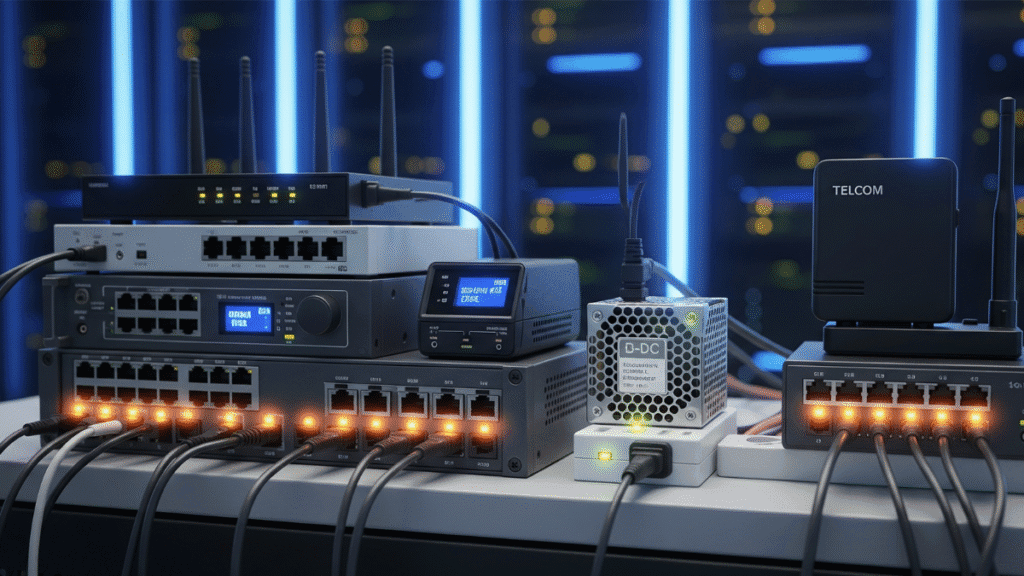
SMPS technology is widely used in:
| Industry | Typical Equipment |
| Communication | routers, network switches |
| Industrial automation | PLC controllers |
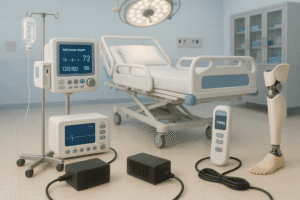
| Medical electronics | patient monitors |
| Consumer electronics | laptops and smart devices |
How Switching Power Supplies Work
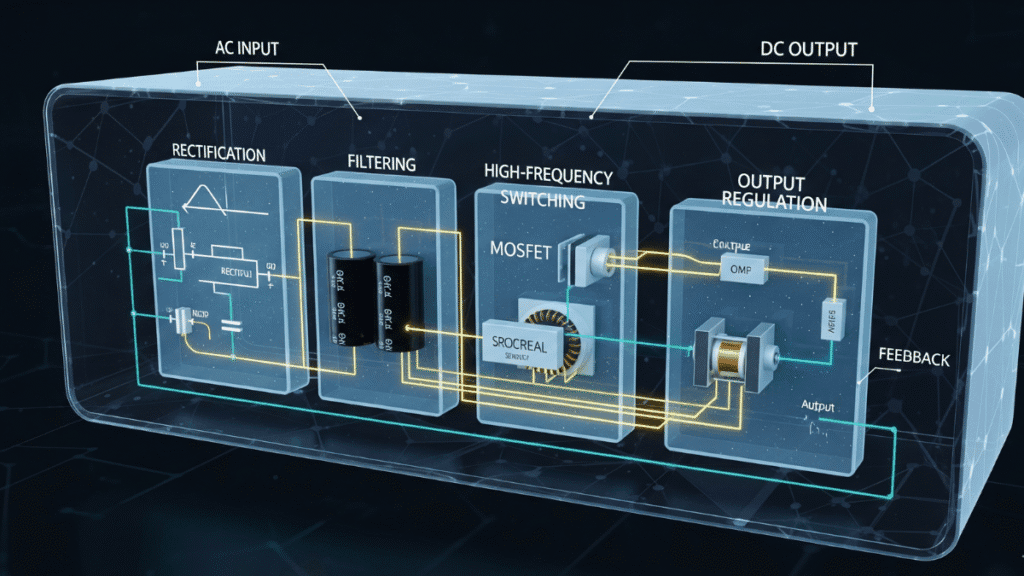
Switching power supplies regulate electrical energy through several stages.
SMPS Power Conversion Flow
| Stage | Function |
| AC Input | receives mains electricity |
| EMI Filter | removes electrical noise |
| Rectifier | converts AC to DC |
| Switching Stage | regulates energy transfer |
| Transformer | isolation and voltage conversion |
| Output Filter | smooths DC output |
| Feedback Control | stabilizes voltage |
This multi-stage design ensures stable DC output even under variable load conditions.
| Topology | Typical Power Range | Features & Best For |
| Flyback | 0W – 150W | Simple structure, low cost, isolated output; ideal for low-power adapters. |
| Forward | 100W – 500W | High efficiency, good for medium power industrial equipment. |
| LLC Resonant | 150W – 1000W+ | High efficiency, lower EMI, zero-voltage switching; ideal for medical & high-end server power supplies. |
Step-by-Step SMPS Working Principle
1. AC Input and EMI Filtering
The power supply receives AC input from the electrical grid.
Typical range:
100–240V AC
An EMI filter removes interference and ensures compliance with standards such as:
- FCC
- CE
- IEC 62368-1
2. Rectification and Power Factor Correction (PFC)
The rectifier converts AC voltage into pulsating DC.
Many modern SMPS designs include active PFC circuits to:
- improve energy efficiency
- reduce harmonic distortion
- meet IEC 61000-3-2 requirements
3. High-Frequency Switching
A transistor (MOSFET or GaN device) switches at high frequency—typically 50–500 kHz.
Operation principle:
| State | Energy Flow |
| MOSFET ON | energy stored in transformer |
| MOSFET OFF | energy transferred to output |
High switching frequency enables compact magnetic components.
4. Transformer Isolation
The transformer provides:
- voltage conversion
- electrical isolation
Isolation is essential for:
- medical equipment
- industrial control systems
- communication devices
Medical SMPS must support 2×MOPP protection to comply with IEC 60601-1.
5. Rectification and Output Filtering
The transformer output is rectified again and filtered using capacitors and inductors.
Typical ripple values:
| Application | Ripple Voltage |
| Consumer SMPS | 20–50 mV |
| Industrial SMPS | 10–30 mV |
| Medical SMPS | <10 mV |
6. Feedback Regulation
A feedback circuit monitors output voltage and adjusts the switching duty cycle.
An optocoupler transfers feedback signals while maintaining isolation.
This ensures stable DC output even when load conditions change.
Advantages of Switching Power Supplies
| Feature | Linear Power Supply | Switching Power Supply |
| Efficiency | 40–60% | 80–95% |
| Size | Large transformer | Compact design |
| Heat generation | High | Low |
| Input voltage range | Narrow | Wide |
| Weight | Heavy | Lightweight |
Because of these advantages, SMPS designs dominate modern power electronics.
Typical Switching Power Supply Applications
Switching power supplies are used across many industries.
| Device | Voltage | Typical Power |
| Router | 12V | 24W |
| Security camera | 12V | 12W |
| Industrial PLC | 24V | 72W |
| Patient monitor | 24V | 90W |
| Infusion pump | 12V | 30W |
Different applications require different safety certifications.
For example:
How to Choose the Right Switching Power Supply
Selecting the correct SMPS is critical during product development.
Engineers typically evaluate several parameters.
SMPS Selection Guide
| Parameter | Recommendation |
| Output voltage | must match device voltage |
| Output current | adapter ≥ device current |
| Power margin | add 20–30% safety margin |
| Efficiency | higher efficiency reduces heat |
| Safety certification | UL / CE / IEC required |
Key Technical Considerations for Design Engineers:
- Temperature Derating:Always check the thermal derating curve. Standard units may drop power output by 20–50% at operating temperatures above 50°C.
- Leakage Current Control:For medical grade (IEC 60601-1), earth leakage current must typically be < 300 µA (or < 100 µA for BF/CF patient contact).
Choosing the right power supply early helps prevent:
- overheating issues
- certification delays
- unstable device operation
Need Help Selecting the Right Power Supply?
Choosing a switching power supply can be complex when developing new equipment.
Our engineers can help you:
✔ select the correct voltage and power rating
✔ ensure compliance with IEC safety standards
✔ recommend power solutions for industrial or medical devices
Contact our engineering team for technical consultation
How to Choose a Switching Power Supply Manufacturer
For OEM equipment manufacturers, selecting a reliable supplier is essential.
Supplier Evaluation Table
| Evaluation Factor | Importance |
| Safety certifications | global market compliance |
| Engineering support | product integration |
| Customization capability | OEM design flexibility |
| Quality control | long-term reliability |
| Production capacity | stable supply chain |
Working with an experienced manufacturer simplifies certification and product development.
Why OEM Manufacturers Choose Quankang
Quankang specializes in high-reliability switching power supplies for global equipment manufacturers.
Our product portfolio includes:
- Medical power supplies (IEC 60601-1)
- ITE power adapters (IEC 62368-1)
- POE Adapter
- Industrial AC-DC SMPS
- Customized OEM power solutions
Our switching power supplies feature:
- high efficiency power conversion
- ultra-low leakage current
- stable voltage output
- global safety certifications
Applications include:
- medical devices
- industrial electronics
- communication equipment
- smart hardware systems
Looking for a Reliable Switching Power Supply Supplier?
If you are developing a new device or upgrading an existing product, selecting the right power partner is essential.
Quankang supports OEM manufacturers with certified SMPS power solutions.
✔ IEC certified switching power supplies
✔ OEM / ODM customization support
✔ long-term stable supply
Request a quotation within 24 hours
Contact our engineering team to discuss your project
People Also Ask (FAQ)
What is the main advantage of switching power supplies?
Switching power supplies offer higher efficiency, smaller size, and wider input voltage ranges compared with linear power supplies.
Why are switching power supplies more efficient?
Because they use high-frequency switching instead of linear regulation, reducing energy lost as heat.
Why do medical power supplies require isolation?
Medical equipment requires reinforced insulation and low leakage current to protect patients from electrical hazards.
What certifications are required for switching power supplies?
Common certifications include:
- IEC 62368-1 (IT equipment)
- IEC 60601-1 (medical equipment)
- UL and CE safety approvals
What is the difference between AC-DC and DC-DC SMPS?
AC-DC SMPS converts mains AC power to DC, while DC-DC SMPS converts one DC voltage level to another.