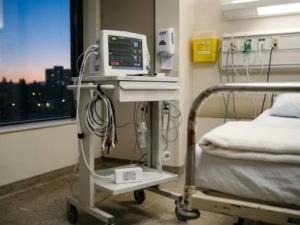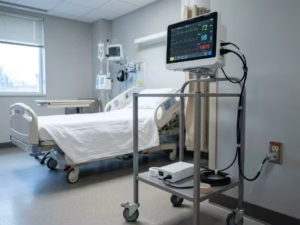
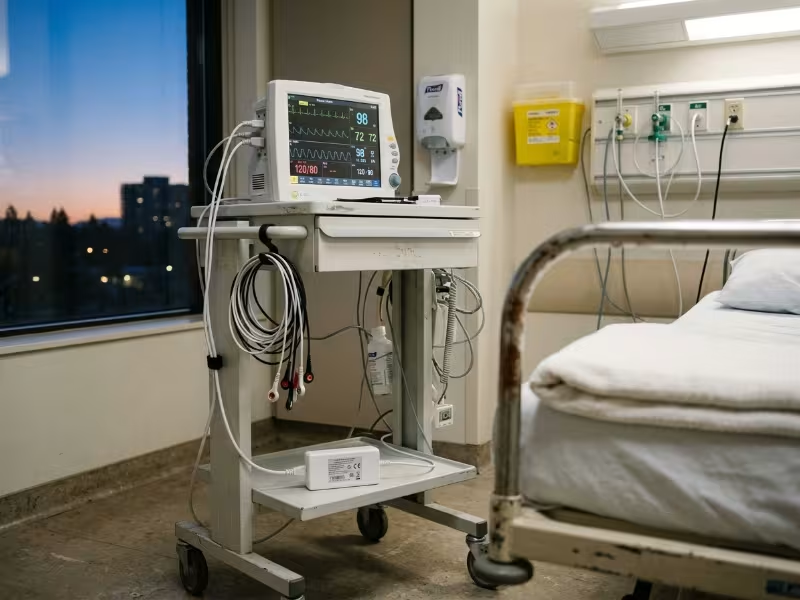
A patient in an ICU bed may be sedated, wired to ECG electrodes, and connected to a central line. Each connection removes some of the protection that skin normally provides. A few hundred microamps of leakage current would go unnoticed by a healthy adult holding a laptop charger. For that patient, the same current can be dangerous. In most medical devices, the power supply is the main barrier between mains voltage and the person on the bed.
This guide covers what separates a medical power supply from a standard one and the four safety specs that decide whether a supply fits your device. It also shows how requirements change between hospital, lab, and home settings, which mistakes lead to late-stage redesigns, and what to confirm before you approve a supply.
Why Do Medical Applications Need Safer Power Supplies?
Three conditions make healthcare riskier than an office or a factory:
- Direct body contact. Medical devices often connect to the body through electrodes, sensors, or catheters. These connections bypass the skin’s natural resistance, so a small current reaches tissue much more easily.
- Patients who can’t react. A sedated, elderly, or neonatal patient can’t pull away from a tingle or report that something feels wrong.
- Several devices around one patient. A monitor, an infusion pump, and a ventilator often run side by side. Small leakage currents from each one can add up.
Failure also means something different here. In a factory, a power fault causes downtime. In a hospital, a monitor that resets during a surge or an infusion pump that stops mid-dose is a clinical event. This is why medical electrical equipment falls under IEC 60601-1, which asks more of the power stage than general electronics standards do. The people it protects often can’t protect themselves.
Medical vs. Standard Power Supplies: What Actually Differs?
Standard ITE power supplies, built to IEC 62368-1, are safe for laptops, routers, and office equipment. Medical supplies are built to IEC 60601-1 and assume a far less forgiving user. The differences are measurable, and most of them come down to isolation, spacing, and leakage.
Dimension | Standard ITE Supply (typical) | Medical Supply, 2×MOPP (typical) |
|---|---|---|
Governing standard | IEC/UL 62368-1 | IEC 60601-1 / ANSI AAMI ES60601-1 |
Input-to-output isolation test | About 3,000 VAC | 4,000 VAC |
Input-to-output creepage | About 4–5 mm | 8 mm |
Input-to-output clearance | About 3–4 mm | 5 mm |
Touch (enclosure) leakage | About 0.25–3.5 mA, depending on construction | 100 µA normal, 500 µA single fault |
Risk management | Hazard-based safety engineering | Formal process aligned with ISO 14971 |
EMC basis | CISPR 32 / EN 55032 | IEC 60601-1-2 |
Isolation is the biggest gap, and no label can close it. Creepage and clearance are physical distances on the PCB and inside the transformer, so they have to be designed in from the start. An ITE supply can still appear in some medical systems, but only with added isolation, such as a medical-grade isolation transformer, and only when the full system is assessed together. ITE supplies aren’t unsafe. Medical use simply asks more of them than they were built to give.
Which Safety Specs Matter Most in a Medical Power Supply?
A medical power supply datasheet can list dozens of parameters. Four of them decide most selection outcomes: isolation level, leakage current, construction class, and EMC performance. Settle these first, and the rest of the review becomes much simpler.
Isolation and Means of Protection: MOOP vs. MOPP
A Means of Protection (MOP) is anything that prevents electric shock: an insulation barrier, a required spacing, or a protective earth connection. IEC 60601-1 divides these into two categories. Means of Operator Protection (MOOP) protects clinicians, technicians, and service staff. Means of Patient Protection (MOPP) protects the patient and carries stricter requirements, because the patient is more vulnerable and may be connected to the device.
The standard requires two means of protection, so a single fault still leaves one barrier in place. Typical values at a 250 VAC working voltage look like this:
Protection Level | Isolation Test | Creepage |
|---|---|---|
1×MOOP | 1,500 VAC | 2.5 mm |
2×MOOP | 3,000 VAC | 5 mm |
1×MOPP | 1,500 VAC | 4 mm |
2×MOPP | 4,000 VAC | 8 mm |
The decision rule is simple. If the patient can touch the device or its applied parts, specify 2×MOPP. Many design teams now choose 2×MOPP by default, even where MOOP might pass. The cost difference is small compared with redesigning the power stage after a risk assessment changes the patient-contact classification. Starting from certified medical power supplies with 2×MOPP isolation removes that risk before the first prototype.
Leakage Current and Applied Part Types
An applied part is the part of a device that touches the patient in normal use. IEC 60601-1 sorts applied parts into three types, and your leakage limit depends on which one your device has:
- Type B: Body contact, not electrically floating. Examples include some patient beds and examination lights.
- Type BF: Body contact through a floating, isolated circuit. Examples include blood pressure cuffs and skin-surface ECG electrodes.
- Type CF: Direct or potential cardiac contact. This type has the tightest limits.
Applied Part | Patient Leakage, Normal | Patient Leakage, Single Fault |
|---|---|---|
Type B / BF | 100 µA | 500 µA |
Type CF | 10 µA | 50 µA |
Your power supply’s leakage spec is not your device’s leakage. It is one contribution to the total. Interconnect cables, Y-capacitors in EMI filters, and the device’s own circuitry all add to it. For CF designs, the patient circuit usually needs its own isolation inside the device, yet supply leakage still shows up in what the finished product measures. Choose a supply with clear margin, such as touch current well below 100 µA at maximum input voltage, so the complete device still passes once everything is connected.
Class I vs. Class II Construction
Class I equipment relies on a protective earth through a three-prong plug. If insulation fails, fault current flows to earth and trips the circuit protection. Class II equipment uses double or reinforced insulation and needs no earth connection.
Class I has real strengths. The earth path can make EMC filtering easier, which helps in high-power or noise-sensitive designs. But a Class I device is only as safe as the building’s earth connection, and you don’t control that. Class II removes earth-fault risk and usually lowers enclosure leakage, which is why it dominates home-use medical adapters.
Choose Class II wherever a reliable protective earth can’t be guaranteed: private homes, older buildings, and devices that travel with the patient. Class I remains a sound choice for hospital equipment with verified earthing, especially at higher power.
EMC Performance in Clinical and Home Settings
In medicine, EMC is a patient-safety issue, not just a compliance step. Interference that resets a patient monitor, freezes an infusion pump display, or distorts an ECG trace can lead to a missed alarm or a wrong clinical decision. IEC 60601-1-2 covers both sides of the problem: emissions (how much noise your device creates) and immunity (how well it keeps working when noise hits it).
The intended environment sets the test levels. Professional healthcare facilities typically require 3 V/m radiated immunity. Home healthcare environments typically require 10 V/m, because homes are full of uncontrolled sources such as phones, Wi-Fi routers, microwave ovens, and low-cost chargers. Home use also calls for Class B emissions under CISPR 11. A supply that passes on its own can still push a finished device over the limit through cable routing or PCB layout, so run pre-compliance scans before formal testing.
How Requirements Change by Device and Care Setting
The same “medical power supply” label can cover very different needs. Use the table below to find a starting point for your device, then refine it with your own risk assessment.
Setting | Example Devices | Isolation | Construction | Key Extra Needs |
|---|---|---|---|---|
Hospital bedside, patient-connected | Patient monitors, infusion pumps, ventilators | 2×MOPP | Class I or II | BF/CF leakage margin, hold-up time, low-noise output |
Diagnostic and imaging, no patient contact | Analyzers, imaging workstations | 2×MOOP may be acceptable after risk assessment | Class I common | Higher power, EMC margin |
Clinical laboratory | Lab analyzers, centrifuges | IEC 61010-1 when not a medical device | Class I common | Resistance to chemicals and cleaning agents |
Home healthcare | CPAP machines, oxygen concentrators, home dialysis, glucose monitors | 2×MOPP | Class II strongly preferred | IEC 60601-1-11, 10 V/m immunity, lay-user handling, drop and cable durability |
Wellness and fitness | Massagers, fitness trackers | Often IEC 62368-1 | Class II | Confirm the product isn’t regulated as a medical device |
Home healthcare needs the most attention. The device runs in an uncontrolled environment, often on wiring nobody has inspected, and the user is a patient or family member rather than a trained clinician. Adapters get dropped, cords get pinched under furniture, and plugs get yanked out by the cable. Those realities belong in the power supply spec from day one.
The gray areas usually come from classification, not engineering. Your device’s regulatory classification decides which standard applies, not the label on the supply. A massager that adds a pain-relief claim may cross into medical device territory and need a medical-rated supply. A lab analyzer that also connects to patients moves onto the medical path. Settle the classification before you choose the supply. For device-specific examples, from oxygen concentrators to patient monitors, see how power supply requirements vary across applications.
Common Medical Power Supply Selection Mistakes
Most medical power problems start with a decision made early in design and surface late in certification. These six come up most often.
- Specifying 2×MOOP for a patient-contact device. The device fails certification, and the power stage has to be redesigned. Fix: decide between MOOP and MOPP from the patient-contact analysis on day one, and default to 2×MOPP when contact is possible.
- Treating the supply’s leakage as the device’s leakage. The finished device exceeds its limit once cables, filters, and internal circuits are added. Fix: build a leakage budget for the whole system and choose a supply with clear margin below 100 µA.
- Using a Class I supply in a home device. Patient safety then depends on household wiring you can’t inspect or control. Fix: default to Class II for any device intended for home use.
- Testing EMC to professional-facility levels for a home device. The device passes at 3 V/m but fails the 10 V/m home requirement. Fix: confirm the intended use environment before you set EMC targets.
- Assuming a certified supply means a certified device. The supply’s CB report covers only the supply. Your device still faces its own safety and EMC testing. Fix: plan system-level testing and build the time into your schedule.
- Choosing an ITE supply and planning to “add insulation later.” Retrofitting isolation adds cost, size, heat, and approval delays. Fix: start with a medical-rated supply that matches your patient-contact needs.
Medical Power Supply Safety FAQ
What makes a power supply “medical grade”?
A medical-grade power supply is certified to IEC 60601-1. In practice, that means higher input-to-output isolation (4,000 VAC for 2×MOPP), wider creepage and clearance distances, and touch current limited to 100 µA in normal conditions. Its evaluation also relies on a documented risk management process aligned with ISO 14971.
What is the difference between MOOP and MOPP?
MOOP protects operators, such as clinicians and service staff. MOPP protects patients and has stricter requirements. At 250 VAC working voltage, 2×MOOP typically needs a 3,000 VAC isolation test and 5 mm creepage, while 2×MOPP needs 4,000 VAC and 8 mm. Choose 2×MOPP for any device the patient can touch.
Can I use a standard ITE power supply in a medical device?
Sometimes, but rarely as a direct swap. An ITE supply lacks MOPP-level isolation and medical leakage limits. It can work only with added isolation, such as a medical isolation transformer, and only after the whole system is assessed. For patient-contact devices, a medical-rated supply is usually simpler, smaller, and faster to approve.
What leakage current is allowed for a medical power supply?
Touch current is limited to 100 µA in normal conditions and 500 µA under a single fault. Patient leakage depends on the applied part: Type B and BF allow 100 µA normal and 500 µA single fault, while Type CF allows only 10 µA and 50 µA. Leave margin, because other components add leakage too.
Does a home healthcare device need a different power supply than a hospital device?
Often, yes. Home devices fall under IEC 60601-1-11 and must withstand 10 V/m radiated immunity, compared with 3 V/m in professional facilities. They also need Class B emissions. Class II construction is strongly preferred because home earthing is unreliable, and the supply must hold up to handling by non-technical users.
Does using a certified medical power supply make my device compliant?
No. A certified supply makes approval easier, because the test lab can accept the power stage as a known component. Your finished device is still tested as a whole. Layout, cabling, the enclosure, and the other electronics all affect leakage and EMC results, so plan system-level testing from the start.
A Quick Safety Check Before You Choose a Supply
Run through these seven checks before you approve a medical power supply for your design:
- Confirm the device’s regulatory classification and intended care setting.
- Set isolation to 2×MOPP for any device the patient can touch.
- Identify the applied part type (B, BF, or CF) and budget system leakage with margin.
- Choose Class I or Class II based on how reliable the protective earth is where the device will be used.
- Match EMC immunity and emissions to the environment: 3 V/m for professional facilities, 10 V/m for home use.
- Request the CB report and test data, not just a certificate logo on a datasheet.
- Plan system-level safety and EMC testing for the finished device.
Quankang supplies medical power supplies designed to IEC 60601-1, including 2×MOPP and Class II options for hospital and home healthcare equipment. If you’re working through a new design, share your device type, applied part, and intended care setting, and our engineering team can suggest a suitable standard model. Where a standard unit doesn’t fit, we can also adapt the output, connector, cable, or housing through custom and modified power adapters.