Power over Ethernet (PoE) has become a widely used solution for powering IP cameras in security and surveillance systems. By transmitting both power and network data through a single Ethernet cable, PoE simplifies installation, reduces cabling requirements, and allows IP cameras to be deployed in locations where a nearby AC outlet may not be available.
However, choosing the right PoE adapter(PoE injector) for an IP camera is not simply a matter of selecting the highest available wattage.
The PoE adapter must be compatible with the camera’s PoE standard, maximum power consumption, network architecture, operating environment, and installation requirements. A basic fixed IP camera may require only standard PoE, while a PTZ camera with infrared illumination, a heater, or advanced imaging functions may require significantly more power.
For system integrators, security equipment distributors, network engineers, and IP camera manufacturers, selecting the right PoE adapter can help ensure reliable camera operation and avoid power-related performance issues.
This guide explains how to choose the right PoE adapter for IP cameras, including PoE standards, power requirements, PTZ cameras, outdoor installations, power budgets, cable considerations, and OEM requirements.
Quick Answer: What PoE Adapter Does an IP Camera Need?
The right PoE adapter depends on the IP camera’s maximum power consumption and supported PoE standard.
As a general rule:
- Basic fixed IP cameras may use IEEE 802.3af PoE.
- Higher-power cameras may require IEEE 802.3at PoE+.
- High-power PTZ cameras and advanced surveillance equipment may require IEEE 802.3bt PoE.
Before selecting a PoE adapter, check:
- IP camera model
- Maximum power consumption
- Required PoE standard
- PoE class
- Startup and peak power
- Cable length
- Operating environment
- Additional functions such as IR, heaters, or motors
The key principle is:
Choose a PoE adapter based on the IP camera’s maximum power requirements and required PoE standard, not simply on the camera type or advertised wattage.
What Is a PoE Adapter for an IP Camera?
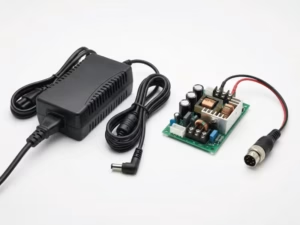
A PoE adapter is a power solution that enables a compatible IP camera to receive electrical power through an Ethernet connection.
In a typical installation, the Ethernet connection carries both:
- Network data
- Electrical power
This allows the camera to connect to the network and receive power through the same Ethernet cable.
A typical setup may look like:
AC Power
↓
PoE Adapter
↓
Ethernet Cable
↓
IP Camera
The exact architecture depends on the type of PoE equipment being used.
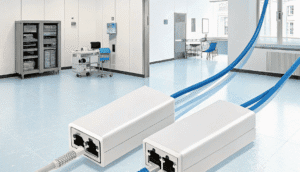
A PoE adapter may be used as part of a standalone power solution, while a PoE injector adds PoE power to a network connection and a PoE switch can provide PoE to multiple network devices.
The correct solution depends on the number of cameras and the overall network architecture.

Why Use a PoE Adapter for IP Cameras?
PoE can offer several advantages for IP camera installations.
1. Simplified Installation
Power and data can be delivered through a single Ethernet cable.
This can reduce the need for separate electrical wiring near the camera.
2. Flexible Camera Placement
IP cameras can be installed in locations such as:
- Ceilings
- Building exteriors
- Parking areas
- Warehouses
- Retail stores
- Factories
- Campuses
PoE can make installation easier when a dedicated AC outlet is not available near the camera.
3. Reduced Cabling Complexity
A single Ethernet cable can provide both network connectivity and power.
This can simplify installation and maintenance.
4. Centralized Network Architecture
For larger surveillance systems, PoE equipment can help integrate camera power and network connectivity into a centralized infrastructure.
However, for installations with many cameras, a PoE switch may be more suitable than using an individual PoE adapter for every camera.
How Much Power Does an IP Camera Need?
The power consumption of an IP camera varies significantly depending on its design and features.
Common factors include:
- Camera type
- Image sensor
- IR illumination
- PTZ motors
- Zoom mechanisms
- Heating elements
- Cooling systems
- AI processing
- Edge computing
- Audio functions
- Additional accessories
A simple fixed indoor IP camera may have relatively low power requirements.
A PTZ camera with motorized movement, optical zoom, infrared illumination, and a heater may require significantly more power.
Therefore, the most important specification to check is:
Maximum power consumption
Do not select a PoE adapter based only on the camera’s average power consumption.
The adapter should be capable of supporting the camera under its maximum expected operating conditions.
Which PoE Standard Does an IP Camera Need?
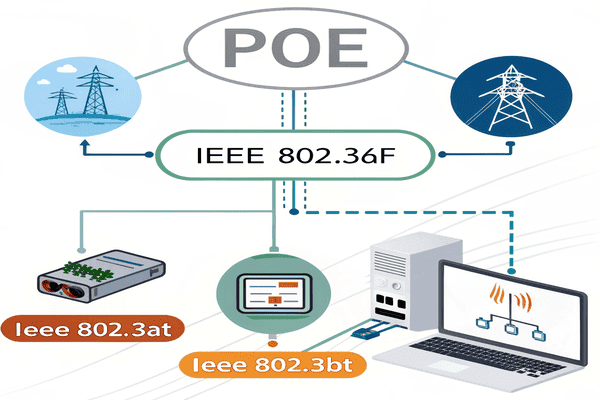
The most common IEEE PoE standards include:
| IEEE Standard | Common Name | PoE Type | Maximum PSE Power | Maximum PD Power | Typical Applications |
| IEEE 802.3af | PoE | Type 1 | 15.4W | 12.95W | Basic IP cameras |
| IEEE 802.3at | PoE+ | Type 2 | 30W | 25.5W | Higher-power cameras, PTZ cameras |
| IEEE 802.3bt | PoE++ | Type 3 | Up to 60W | Up to approximately 51W | High-power PTZ and advanced cameras |
| IEEE 802.3bt | PoE++ | Type 4 | Up to approximately 90W* | Up to approximately 71W* | High-power surveillance equipment |
*Actual available power depends on the implementation and equipment specifications.
The correct PoE standard should always be determined by the IP camera manufacturer’s specifications.
For more information about the differences between PoE standards, see:
802.3af vs. 802.3at vs. 802.3bt: Which PoE Standard Do You Need?
PoE Adapter for Fixed IP Cameras
Fixed IP cameras are commonly used for:
- Office security
- Retail surveillance
- Building monitoring
- Indoor security
- Warehouse monitoring
Many basic fixed IP cameras have relatively low power requirements.
A standard IEEE 802.3af PoE adapter may be sufficient for some models.
However, cameras with advanced features may require more power.
Before selecting a PoE adapter, check:
- Maximum power consumption
- PoE standard
- PoE class
- IR illumination requirements
- Audio functions
- Additional interfaces
The correct adapter should provide sufficient power for the camera’s maximum operating condition.
PoE Adapter for PTZ Cameras
PTZ cameras typically have higher power requirements than fixed IP cameras.
PTZ stands for:
Pan-Tilt-Zoom
The camera may require power for:
- Pan motors
- Tilt motors
- Optical zoom
- IR illumination
- Heaters
- Wipers
- Advanced image processing
Because these functions may operate simultaneously, the camera’s peak power consumption can be significantly higher than its average consumption.
When selecting a PoE adapter for a PTZ camera, check:
- Maximum power consumption
- Startup power
- Peak motor power
- Required PoE standard
- PoE class
A PoE adapter that is sufficient for a basic fixed camera may not provide enough power for a PTZ camera.
PoE Adapter for IR IP Cameras
Infrared illumination is widely used in security cameras for nighttime surveillance.
However, IR LEDs can increase power consumption.
Power requirements may increase when:
- IR LEDs are activated
- Night mode is enabled
- Multiple IR LEDs operate simultaneously
When selecting a PoE adapter for an IR camera, engineers should consider the camera’s maximum power consumption with IR illumination enabled.
This is particularly important for outdoor cameras that may operate in night mode for extended periods.
PoE Adapter for Outdoor IP Cameras
Outdoor surveillance cameras may require more demanding power and environmental specifications.
Depending on the application, the system may need to consider:
- Wide operating temperature
- Surge protection
- Overvoltage protection
- Short-circuit protection
- Moisture and environmental conditions
- Long cable runs
- Lightning-related electrical disturbances
The PoE adapter itself should be selected according to the overall installation environment.
For outdoor surveillance systems, engineers should evaluate the camera, Ethernet cable, PoE adapter, and protection system as a complete solution.

How to Choose the Right PoE Adapter Power Rating
One of the most important steps is matching the adapter’s power output to the camera’s maximum power requirement.
For example, suppose an IP camera has:
- Maximum power consumption: 18W
A suitable PoE adapter should provide sufficient power for the camera under its maximum operating condition.
However, engineers should not simply select an adapter based on a small margin above the average power consumption.
The design should consider:
- Maximum power
- Startup power
- Peak power
- Cable losses
- Operating temperature
- Future accessories
For applications with higher power requirements, the next available PoE power class may be more appropriate.
How to Calculate PoE Power Requirements for Multiple IP Cameras
For multi-camera systems, the total power requirement can be estimated as:
Total Camera Power = Number of Cameras × Maximum Power per Camera
For example, if a surveillance system contains:
- 20 IP cameras
- Maximum power consumption: 15W per camera
The theoretical maximum camera load is:
20 × 15W = 300W
However, the final PoE power budget should also consider:
- Power losses
- PSE efficiency
- Cable losses
- Startup conditions
- Peak loads
- Operating temperature
- Future expansion
For a detailed explanation of PoE power budget calculations, see:
How Much Power Does PoE Need? Understanding PoE Power Budget
PoE Adapter vs. PoE Injector vs. PoE Switch for IP Cameras
PoE adapters, PoE injectors, and PoE switches are related but serve different roles.
| Solution | Best For | Typical Use |
| PoE Adapter | Standalone or specific power applications | Providing PoE power to a compatible device |
| PoE Injector | Adding PoE to a non-PoE network connection | One or a small number of PoE devices |
| PoE Switch | Multiple network devices | Centralized IP camera deployments |
For a single IP camera or a specific equipment design, a PoE adapter may be suitable.
If an existing network uses a standard non-PoE switch and needs to power a PoE camera, a PoE injector may be considered.
For larger surveillance systems with many cameras, a PoE switch is often a more practical solution because it combines:
- Network connectivity
- PoE power delivery
- Centralized management
The correct choice depends on the network architecture and number of cameras.
For a detailed comparison, see:
PoE Adapter vs. PoE Injector: What Is the Difference and Which One Do You Need?
How Does Ethernet Cable Length Affect PoE for IP Cameras?
Ethernet cable length can affect PoE power delivery.
As cable length increases, electrical resistance can cause:
- Voltage drop
- Power loss
- Reduced power available at the camera
For standard Ethernet installations, the typical maximum channel length is around 100 meters.
However, actual PoE performance depends on:
- PoE standard
- Cable category
- Conductor quality
- Cable resistance
- Ambient temperature
- Power level
For long-distance IP camera installations, the cable and PoE power system should be evaluated together.
If the camera requires high power and is installed near the maximum cable distance, engineers should pay particular attention to power loss and voltage drop.
What Happens If an IP Camera Does Not Receive Enough PoE Power?
Insufficient PoE power can cause several problems.
The camera may:
- Fail to start
- Restart unexpectedly
- Disconnect from the network
- Disable IR illumination
- Disable heaters
- Limit PTZ functions
- Operate in a reduced-power mode
For example, a PTZ camera may require sufficient power to operate its motors and infrared illumination.
If the available PoE power is insufficient, some functions may not operate correctly.
Therefore, the PoE adapter should be selected based on the camera’s complete power requirements rather than its basic startup power.
How to Choose a PoE Adapter for IP Camera OEM Applications
For IP camera manufacturers, selecting a PoE adapter may involve requirements beyond standard power output.
An OEM or ODM project may require:
- Specific input voltage
- Custom output power
- IEEE 802.3af/at/bt compatibility
- Custom connectors
- Compact dimensions
- Custom enclosure
- Wide operating temperature
- High efficiency
- Overvoltage protection
- Overcurrent protection
- Short-circuit protection
- Overtemperature protection
- Surge protection
- Safety certifications
- EMC compliance
- Long-term product availability
For example, an IP camera manufacturer developing a high-power PTZ camera may require a PoE adapter capable of supporting motorized movement, IR illumination, and additional accessories.
In this situation, the PoE adapter should be evaluated together with the camera’s complete electrical and mechanical design.
OEM engineers should define:
Input Voltage + Maximum Power + PoE Standard + Peak Power + Operating Temperature + Protection + Certification + Mechanical Requirements
Working with an experienced PoE adapter manufacturer during the product development stage can help identify potential power and thermal issues before mass production.
What Should IP Camera Manufacturers Consider When Selecting a PoE Adapter Manufacturer?
For OEM and ODM projects, the supplier’s capabilities are as important as the adapter’s electrical specifications.
Consider the following:
PoE Standard Compatibility
Does the manufacturer support the required IEEE PoE standard?
Power Range
Can the supplier provide the required power level and future product variants?
Customization
Can the manufacturer support:
- Custom connectors
- Custom dimensions
- Custom labels
- Custom packaging
- Custom electrical specifications
Safety and EMC
Can the product meet the safety and EMC requirements for the target market?
Reliability
Does the manufacturer have appropriate quality control and reliability testing?
Production Capacity
Can the supplier support both sample development and mass production?
Long-Term Supply
Can the manufacturer maintain stable supply for the expected product lifecycle?
For IP camera manufacturers, these factors can be critical when selecting a long-term PoE adapter partner.
Common Mistakes When Choosing a PoE Adapter for IP Cameras
Mistake 1: Choosing an Adapter Based Only on Wattage
Wattage is important, but it is not the only consideration.
The PoE standard and compatibility must also be verified.
Mistake 2: Using Average Power Instead of Maximum Power
An IP camera may consume more power when IR illumination, PTZ motors, or heaters are active.
Use maximum power requirements when sizing the adapter.
Mistake 3: Ignoring PTZ Motor Power
PTZ cameras may have significantly higher peak power requirements.
Always check startup and peak power specifications.
Mistake 4: Ignoring Outdoor Conditions
Outdoor installations may require additional protection and wider operating temperature ranges.
Mistake 5: Confusing PoE Adapter with PoE Injector
Although related, these products may serve different purposes in a network architecture.
Understand the role of each device before selecting the solution.
Mistake 6: Ignoring Cable Loss
Long Ethernet cables can reduce the available power at the camera.
Consider cable length and power loss during system design.
Mistake 7: Selecting a Solution Without Considering Future Expansion
For OEM projects, future camera models and feature upgrades may increase power requirements.
A scalable PoE power architecture can reduce redesign costs.
PoE Adapter Selection Checklist for IP Cameras
Before selecting a PoE adapter, verify:
IP camera model
Maximum power consumption
Average power consumption
Startup power
Peak power
IEEE 802.3af / 802.3at / 802.3bt compatibility
PoE class
IR power requirements
PTZ motor requirements
Heater requirements
Cable length
Cable category
Operating temperature
Surge protection
Overvoltage protection
Overcurrent protection
Short-circuit protection
EMC requirements
Safety certifications
OEM/ODM requirements
How to Choose the Right PoE Adapter for an IP Camera
The selection process can be summarized in seven steps.
Step 1: Identify the IP Camera Model
Confirm the exact model and complete hardware configuration.
Step 2: Check Maximum Power Consumption
Do not rely only on average power consumption.
Step 3: Determine the Required PoE Standard
Check whether the camera requires:
- 3af
- 3at
- 3bt
Step 4: Check the PoE Class
Verify the required power classification.
Step 5: Consider Peak Power
Pay particular attention to:
- PTZ movement
- IR illumination
- Heaters
- Other accessories
Step 6: Evaluate the Installation Environment
Consider:
- Cable length
- Indoor or outdoor installation
- Temperature
- Surge protection
- EMC
Step 7: Consider OEM Requirements
For IP camera manufacturers, evaluate:
- Input voltage
- Output power
- Dimensions
- Connectors
- Protection
- Safety
- EMC
- Reliability
- Certifications
- Long-term supply
Frequently Asked Questions
Can I use any PoE adapter for an IP camera?
No.
The PoE adapter must be compatible with the camera’s required PoE standard, power level, and electrical specifications.
Do all IP cameras support PoE?
No.
Some IP cameras support PoE, while others require a separate power source.
Check the camera manufacturer’s specifications before selecting a PoE adapter.
What PoE adapter do I need for an IP camera?
The answer depends on the camera’s maximum power consumption and PoE standard.
Basic cameras may use 802.3af, while higher-power cameras may require 802.3at or 802.3bt.
Can a PoE adapter power a PTZ camera?
Yes, provided that the adapter supports the PTZ camera’s required PoE standard and maximum power consumption.
PTZ cameras may require more power because of motors, zoom mechanisms, IR illumination, and heaters.
Can I use a higher-power PoE adapter?
A higher-power PoE solution is not automatically better.
The adapter must be compatible with the camera and the applicable PoE standard.
Always verify compatibility before installation.
How far can PoE power an IP camera?
Standard Ethernet installations typically support a channel length of up to approximately 100 meters.
Actual performance depends on cable type, PoE standard, power level, and installation conditions.
Is a PoE adapter better than a PoE switch for IP cameras?
It depends on the application.
A PoE adapter may be suitable for a standalone or specific equipment application.
A PoE switch is generally more practical for centralized deployments with multiple IP cameras.
Do PTZ cameras need PoE++?
Not always.
The required PoE standard depends on the camera’s maximum power consumption and functions.
Some PTZ cameras may operate with PoE+, while higher-power models may require 802.3bt.
Need a PoE Adapter for Your IP Camera?
Choosing the right PoE adapter requires more than matching a wattage number.
The solution should be evaluated based on:
- IP camera power requirements
- IEEE PoE standard
- PoE class
- Peak power
- IR illumination
- PTZ functions
- Cable length
- Operating environment
- Protection requirements
- Safety and EMC compliance
For IP camera manufacturers and OEM customers, additional requirements may include customized power ratings, connectors, dimensions, protection functions, certifications, and long-term supply.
Quankang provides PoE adapter and PoE power supply solutions for network equipment and ODM/OEM applications.
If you are developing an IP camera, PTZ camera, security camera, or other PoE-enabled device, send us your product specifications and application requirements.
Quankang can help evaluate your PoE power requirements and discuss a suitable PoE adapter solution for your application.
Contact Quankang to discuss your IP camera PoE adapter requirements or OEM/ODM project.