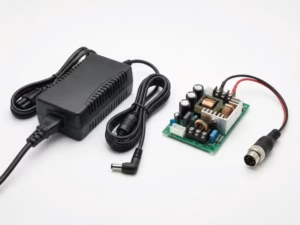
Power over Ethernet (PoE) allows compatible Ethernet cables to carry both network data and electrical power to connected devices. It is widely used in IP cameras, wireless access points, VoIP phones, access control systems, IoT devices, and other network equipment.
When adding PoE power to a network, buyers may encounter several terms, including PoE adapter, PoE injector, PoE splitter, and PoE switch. The terminology can be confusing because different manufacturers and suppliers may use PoE adapter to describe different types of products.
In some product categories, a PoE adapter may function as a PoE injector that adds power to an Ethernet connection. In other cases, the term may refer to a splitter, power conversion device, or another dedicated PoE solution. Therefore, the product name alone is not always enough to determine how a device works.
This guide explains the differences between PoE adapters and PoE injectors, how each is used, how they compare with PoE switches and splitters, and which specifications to check when selecting a PoE power solution.
Quick Answer: PoE Adapter vs. PoE Injector
The short answer is:
A PoE injector is a specific type of device that adds electrical power to an Ethernet connection, while “PoE adapter” is a broader term that may refer to different types of PoE power devices depending on the manufacturer and product design.
A typical PoE injector is installed between a non-PoE network switch and a PoE-powered device:
Network Switch → PoE Injector → Ethernet Cable → PoE Device
The injector receives:
- Datafrom the network switch
- Electrical powerfrom an AC or DC power source
It then combines the power and data and sends them through a single Ethernet cable to the powered device.
A PoE adapter may provide the same power-injection function, but the term can also be used for other PoE-related devices or power-conversion solutions. Therefore, do not rely on the product name alone when purchasing a PoE adapter. Check the product specifications, including:
- IEEE PoE standard
- Input voltage
- Output voltage
- Output power
- PoE type
- Power delivery method
- Data rate
- Connector type
- Protection functions
- Application requirements

What Is a PoE Injector?
A PoE injector is a device that adds electrical power to an Ethernet data connection, allowing a compatible powered device (PD) to receive both power and data through a single Ethernet cable.
A typical PoE injector is installed between a network switch and a powered device. It is particularly useful when the existing network switch does not have built-in PoE functionality.
The basic connection is:
Network Switch
↓ Data
PoE Injector ← AC/DC Power
↓ PoE + Data
Ethernet Cable
↓
Powered Device (PD)
The network switch provides the network data, while the injector provides electrical power. The injector combines the two and sends them through the Ethernet cable to the powered device.
Typical PoE Injector Applications
PoE injectors are commonly used to power compatible network devices such as:
- IP security cameras
- PTZ cameras
- Wireless access points
- VoIP phones
- IoT gateways
- Access control devices
- Other compatible PoE network equipment
IEEE-compliant PoE injectors may support standards such as IEEE 802.3af, 802.3at, or 802.3bt, depending on the model and its power rating.
How Does a PoE Injector Work?
The basic operation of a PoE injector involves three connections:
1. Data Input
The injector receives network data from a standard Ethernet switch or router.
2. Power Input
The injector receives electrical power from an AC or DC power source.
3. PoE Output
The injector combines the electrical power with the network data and delivers both through a single Ethernet cable to the powered device.
The simplified signal path is:
Network Switch
↓ Data
PoE Injector ← Power
↓ PoE + Data
Ethernet Cable
↓
Powered Device
The powered device can therefore receive network connectivity and electrical power through one Ethernet cable, provided that the injector, cable, and powered device are compatible.
What Is a PoE Adapter?
The term “PoE adapter” is not used consistently across the networking industry, and there is no universally accepted definition that determines exactly what a product called a PoE adapter must do.
Therefore, always verify the product specifications rather than relying solely on the product name.
Depending on the manufacturer, product design, or application, a PoE adapter may refer to:
- A PoE injectorthat adds power to an Ethernet data connection
- A PoE splitterthat separates power and data at the receiving end
- A PoE power conversion devicethat converts one power format into another
- A dedicated PoE power supplydesigned for a specific network device
- A compact external PoE solutionfor a particular application
For example, some manufacturers use “PoE adapter” to describe a device that accepts AC or DC power and provides PoE output to a network device. In this case, the product may perform the same basic power-injection function as a PoE injector.
Other products called PoE adapters may perform a different function, such as separating power and data for a non-PoE device.
This is why the actual function and specifications are more important than the product name.
When evaluating a PoE adapter, first determine what function the device needs to perform:
- Add power to Ethernet data?
- Separate power and data?
- Convert AC or DC power into a PoE-compatible output?
- Support a specific IEEE PoE standard and power level?
- Provide a dedicated power interface for a particular network device?
The answer determines which type of PoE solution and product architecture is appropriate.

PoE Adapter vs. PoE Injector: Are They the Same?
In some product categories, a PoE adapter and a PoE injector may perform the same basic function: adding electrical power to an Ethernet data connection and delivering both power and data through a single Ethernet cable.
Data + Power → PoE Ethernet Output
In these cases, manufacturers or suppliers may use the terms interchangeably in product listings.
However, not every PoE adapter is a PoE injector.
The term “PoE adapter” can describe a broader range of PoE-related power devices, depending on the manufacturer, product design, and application. Therefore, the product name alone does not determine how the device works.
Key Difference
PoE Injector
Usually describes a device whose primary function is to inject power into an Ethernet connection, typically between a network switch and a powered device.
PoE Adapter
May refer to a broader category of PoE-related power devices, including products that perform power injection, power splitting, or power conversion.
For OEM customers, system integrators, and B2B buyers, the technical specifications and electrical architecture are more important than the terminology used in the product name.
PoE Injector vs. PoE Adapter: Quick Comparison
Feature | PoE Injector | PoE Adapter |
Primary Function | Adds power to an Ethernet data connection | Depends on product design |
Typical Use | Powering a PoE device from a non-PoE network | PoE power delivery, splitting, or conversion |
Data Input | Usually Ethernet | Depends on product |
Power Input | AC or DC | AC or DC, depending on model |
PoE Output | Yes | May be available |
IEEE PoE Support | May support IEEE 802.3af/at/bt | Depends on model |
Typical Users | Network installers, system integrators | OEMs, equipment manufacturers, system integrators |
Terminology | More specific functional term | Broader product terminology |
The key takeaway is:
“PoE injector” describes a specific power-injection function, while “PoE adapter” is a broader product term whose exact function depends on the product design.
PoE Injector vs. PoE Switch
A PoE injector and a PoE switch can both provide PoE power, but they are designed for different network architectures.
PoE Injector
A PoE injector is typically used when one or a small number of devices need PoE power.
A typical setup is:
Non-PoE Switch
↓
PoE Injector
↓
PoE Device
Advantages include:
- Simple installation
- Lower initial cost for small deployments
- No need to replace the existing network switch
- Suitable for individual PoE devices
PoE Switch
A PoE switch combines network switching and PoE power delivery.
A typical setup is:
PoE Switch
↓
Multiple PoE Devices
Advantages include:
- Centralized network management
- Multiple PoE ports
- Easier large-scale deployment
- Centralized power distribution
A PoE switch is generally more suitable for networks with many PoE-powered devices.
Requirement | PoE Injector | PoE Switch |
Existing non-PoE switch | ✓ | Usually requires replacing or adding a switch |
Only a few PoE devices | ✓ | May be unnecessary |
Many PoE devices | Possible, but less convenient | ✓ |
Need centralized PoE management | Limited | ✓ |
Need VLAN/network management | Depends on network equipment | ✓ with managed models |
Need to add PoE to one Ethernet link | ✓ | Not necessary |
If you only need to add PoE to one or a small number of Ethernet connections, an injector is usually simpler. For multiple PoE devices and centralized network management, a PoE switch is generally more appropriate.
For detailed comparison, see: POE Adapter vs POE Switch: Which One Should You Choose?
PoE Injector vs. PoE Splitter
A PoE injector and PoE splitter perform opposite functions.
PoE Injector
Combines:
Data + Power
into:
PoE Ethernet Output
PoE Splitter
Separates:
PoE Ethernet Input
into:
Data Output + DC Power Output
A typical PoE splitter is used when a network device requires Ethernet data and DC power but does not have built-in PoE support.
The connection is:
PoE Switch or Injector
↓
PoE Ethernet Cable
↓
PoE Splitter
↓
Data → Network Device
DC Power → Device Power Input
This makes PoE splitters useful for certain non-PoE devices.
PoE Adapter vs. PoE Injector vs. PoE Splitter vs. PoE Switch
The following table provides a simple comparison.
Device | Main Function | Typical Use |
PoE Injector | Adds power to Ethernet | Power one or a few PoE devices |
PoE Adapter | Depends on product design | PoE power delivery or conversion |
PoE Splitter | Separates power and data | Power non-PoE devices |
PoE Switch | Provides switching + PoE | Multiple PoE devices |
Choosing the right product depends on the network architecture and the power requirements of the connected equipment.

When Should You Choose a PoE Injector?
A PoE injector is often a good choice when:
You Already Have a Non-PoE Network Switch
If your existing switch provides network data but does not support PoE, an injector can add PoE functionality without replacing the switch.
You Only Need to Power One or a Few Devices
Replacing an entire network switch may not be cost-effective if only a small number of devices require PoE.
You Need a Dedicated PoE Power Solution
An external injector can provide a dedicated power path for a specific network device.
You Are Deploying a Single IP Camera
For example:
Network Switch → PoE Injector → IP Camera
This can be simpler than installing a new PoE switch.
You Need Flexible Installation
External PoE injectors can be deployed at specific network locations without redesigning the entire network infrastructure.
When Should You Choose a PoE Adapter?
A PoE adapter may be the right choice when you need a dedicated power solution for a specific piece of equipment.
This is particularly relevant for:
- OEM equipment
- Industrial devices
- Custom network products
- Specialized IP cameras
- Wireless access points
- IoT equipment
For these applications, the product may need to match specific requirements such as:
- Input voltage
- Output voltage
- Power rating
- PoE standard
- Form factor
- Connector
- Operating temperature
- Protection requirements
In OEM projects, a standard off-the-shelf PoE injector may not always meet the system requirements.
A dedicated PoE adapter or PoE power supply may therefore be a better solution.
Which PoE Standard Should You Choose?
The correct PoE standard depends on the power requirement of the powered device.
The most common IEEE PoE standards include:
Standard | Common Name | Maximum PSE Power | Maximum PD Power | Typical Applications |
IEEE 802.3af | PoE / Type 1 | 15.4W | 12.95W | Basic IP cameras, VoIP phones |
IEEE 802.3at | PoE+ / Type 2 | 30W | 25.5W | PTZ cameras, wireless APs |
IEEE 802.3bt | PoE++ / Type 3 | Up to 60W | Up to approximately 51W | High-power APs, advanced cameras |
IEEE 802.3bt | PoE++ / Type 4 | Up to approximately 90W* | Up to approximately 71W* | High-power network devices |
*Actual ratings depend on the specific implementation and manufacturer specifications.
When selecting a PoE adapter or injector, always verify both:
PSE output power
and
PD power requirement
The PSE output rating is not the same as the power available at the powered device because of cable losses.
Active PoE vs. Passive PoE
When selecting a PoE adapter or injector, also check whether it uses active PoE or passive PoE.
Active PoE follows IEEE 802.3 standards, including 802.3af, 802.3at, and 802.3bt, and uses detection and classification mechanisms to help ensure that power is delivered to compatible powered devices.
Passive PoE does not use the same IEEE 802.3 detection and classification process. It typically supplies power at a predefined voltage, so the connected device must be specifically designed for that voltage and wiring configuration. An incompatible passive PoE connection can damage network equipment.
For professional applications, verify the required PoE type and standard before selecting an adapter or injector.
For a detailed comparison, see [Active PoE vs. Passive PoE: What Is the Difference and Which One Should You Choose?]
How to Choose the Right PoE Adapter or Injector
Before purchasing a PoE adapter or injector, consider the following factors to ensure compatibility with the powered device, network, and installation environment.
1. Check the PoE Standard
Determine whether the powered device requires:
- IEEE 802.3af
- IEEE 802.3at
- IEEE 802.3bt
- Passive PoE
Do not assume that all PoE products are compatible. The PoE standard and type should match the requirements of the connected device.
2. Check the Power Requirement
Determine the maximum power consumption of the powered device.
For multiple devices, calculate the total power requirement and allow appropriate capacity for cable losses, startup power, peak consumption, and potential future expansion.
3. Check the Input Voltage
Verify whether the PoE power solution accepts the required input voltage, such as:
- 100–240V AC
- 12V DC
- 24V DC
- 48V DC
- Other application-specific input ranges
The appropriate input depends on the power source and installation environment.
4. Check the Output Power
Make sure the selected PoE adapter or injector can provide sufficient power for the powered device.
When evaluating the power rating, consider cable losses, startup power, peak consumption, and the required operating margin.
5. Check Data Speed
Confirm that the PoE adapter or injector supports the required Ethernet data rate, such as:
- 10/100 Mbps
- Gigabit Ethernet
- Higher-speed Ethernet, where required
The PoE power solution should support the network performance required by the application.
6. Check Cable Length
Consider the planned Ethernet cable length when selecting the PoE solution.
Longer cable runs can result in voltage drop and power loss, which may affect the power available at the powered device.
7. Consider Operating Conditions
For industrial or outdoor applications, check environmental requirements such as:
- Operating temperature
- Humidity
- Dust
- Vibration
- Surge conditions
The selected product should be suitable for the actual installation environment.
8. Check Protection Functions
Depending on the application, the PoE solution may require protection against:
- Overvoltage
- Overcurrent
- Short circuit
- Overtemperature
- Surge
The required protection functions should be evaluated according to the equipment and installation conditions.
9. Check Safety and Compliance
Depending on the target market and application, verify applicable:
- Safety standards
- EMC requirements
- Regulatory requirements
- Energy efficiency requirements
Certification and compliance requirements may vary by market, product type, and intended application.
For a more detailed specification-by-specification selection process, see the PoE Adapter Complete Buying Guide.
PoE Adapter and Injector Selection Checklist
Before selecting a product, verify:
PoE standard
PoE Type
PSE output power
PD power requirement
Input voltage
Output voltage
Output current
Ethernet data rate
Cable length
2-pair or 4-pair PoE
Operating temperature
Protection functions
Safety certifications
EMC compliance
Product reliability
OEM/ODM requirements
Long-term product availability
PoE Adapter vs. PoE Injector: Which One Do You Need?
The right choice depends on the function required, the network architecture, and the electrical requirements of the connected device.
Choose a PoE Injector If:
- You already have a non-PoE network switch.
- You need to power one or a few PoE devices.
- You want to add PoE without replacing your existing network switch.
- You need a straightforward solution for injecting power into an Ethernet connection.
Choose a PoE Adapter If:
- You need a dedicated PoE power solution for a specific device.
- You are developing OEM or customized equipment.
- You require specific input or output specifications.
- You need a particular form factor or connector configuration.
- You require a specific PoE standard or power level.
- Your equipment has specific environmental, protection, or integration requirements.
Because “PoE adapter” can refer to different types of products, always verify the actual product function and specifications before purchasing.
Choose a PoE Switch If:
- You need to power many PoE devices.
- You require multiple PoE ports.
- You want centralized network and PoE management.
- You are building a larger PoE network.
Choose a PoE Splitter If:
- Your network device does not have a built-in PoE interface.
- You need to separate PoE power and Ethernet data.
- The device requires a separate DC power input.
In simple terms:
Use an injector to add PoE to an Ethernet connection, an adapter when a dedicated or application-specific PoE solution is required, a switch when multiple PoE devices need centralized connectivity, and a splitter when PoE power and data need to be separated at the device end.
How Quankang Defines PoE Adapters
Because the term “PoE adapter” can be used differently by different manufacturers, it is important to clarify how the term is defined for a specific product line.
At Quankang, PoE adapters are designed as IEEE-compliant active PoE injectors with integrated power supplies, providing a dedicated solution for delivering both power and data to compatible PoE devices.
Quankang PoE adapters feature:
- Support for IEEE 802.3af / 802.3at / 802.3bt, depending on model
- Stable power delivery for continuous operation
- Surge and lightning protection options, depending on model
- Industrial-grade component selection
- OEM and customization support
They are designed for professional applications such as IP cameras, wireless access points, and industrial IoT devices.
For OEM projects or application-specific requirements, the appropriate model should be selected according to the required PoE standard, power rating, input voltage, data rate, operating environment, and other system specifications.
Conclusion: Selecting the Right PoE Power Solution
PoE adapters and PoE injectors are both used to deliver power to network-connected devices, but the terminology is not always used consistently across manufacturers.
A PoE injector is a more specific term for a device that adds electrical power to an Ethernet data connection, typically between a network switch and a powered device.
A PoE adapter is a broader term that may refer to a PoE injector, power conversion device, splitter, or another dedicated PoE power solution, depending on the manufacturer and product design.
Therefore, when selecting a PoE power solution, do not rely on the product name alone. Verify the actual function and technical specifications, including the PoE standard, power requirements, input and output specifications, data rate, cable requirements, operating environment, protection, and applicable compliance requirements.
For OEMs, ODMs, system integrators, and equipment manufacturers, application-specific requirements may also determine whether a standard PoE injector or a dedicated PoE adapter and power solution is more appropriate.
Quankang provides PoE-related power solutions for network equipment and OEM applications. If you are looking for a PoE adapter, PoE injector, or customized PoE power solution, Quankang can evaluate your device requirements and help identify a suitable solution based on power, voltage, PoE standard, application environment, and product design requirements.
Contact Quankang to discuss your PoE power requirements and OEM/ODM project.
Frequently Asked Questions
Is a PoE adapter the same as a PoE injector?
Not always.
A PoE injector is specifically designed to add power to an Ethernet connection. The term “PoE adapter” is broader and may refer to a PoE injector, splitter, power conversion device, or another PoE-related solution, depending on the manufacturer and product design.
Always check the product’s technical specifications and intended function.
Can a PoE injector power any Ethernet device?
No.
The connected device must be compatible with the injector’s PoE standard, voltage, and power requirements. Always verify compatibility before connecting the equipment.
Can I use a PoE injector with a non-PoE switch?
Yes.
This is one of the common applications of a PoE injector. The injector receives network data from the non-PoE switch, adds electrical power, and sends the combined PoE signal to a compatible powered device.
Do I need a PoE switch if I only have one IP camera?
Not necessarily.
If the existing network switch does not support PoE, a compatible PoE injector may be a simpler solution for powering a single IP camera. A PoE switch becomes more useful when multiple PoE devices or centralized network management are required.
What is the difference between a PoE injector and a PoE splitter?
A PoE injector combines power and data for transmission over an Ethernet cable.
A PoE splitter separates power and data at the receiving end, providing Ethernet data and DC power to a compatible non-PoE device.
Can a PoE adapter replace a PoE switch?
Usually not.
A PoE adapter or injector typically provides a dedicated PoE power solution for one or a limited number of devices, while a PoE switch combines network switching and PoE power delivery across multiple ports.
How do I know whether I need 802.3af, 802.3at, or 802.3bt?
Check the PoE standard and power requirements specified by the powered device.
In general:
- 802.3af is intended for lower-power PoE devices.
- 802.3at supports higher-power devices.
- 802.3bt supports higher-power applications.
The required standard should be selected based on the actual power requirements and compatibility of the powered device.
What happens if the PoE injector does not provide enough power?
The powered device may fail to start, restart, or operate unreliably.
Select a PoE solution with sufficient power capacity and consider cable losses, startup power, peak consumption, and the required operating margin.
Is passive PoE the same as IEEE PoE?
No.
Passive PoE does not use the same IEEE 802.3 detection and classification mechanisms as IEEE 802.3af, 802.3at, and 802.3bt.
Passive PoE typically supplies power at a predefined voltage, so compatibility must be verified carefully before connecting the equipment.
Related Resources
- PoE Adapter Complete Buying Guide
- PoE Adapter vs. PoE Switch: Which One Should You Choose?
- PoE vs. Non-PoE Power Supply: Which Is Better?
- Active PoE vs. Passive PoE: What Is the Difference and Which One Should You Choose?