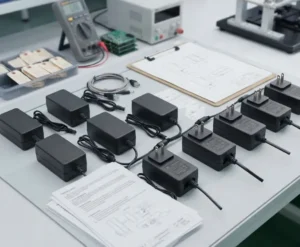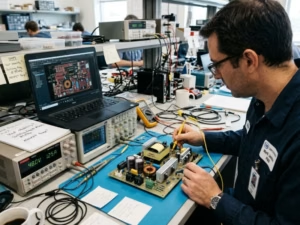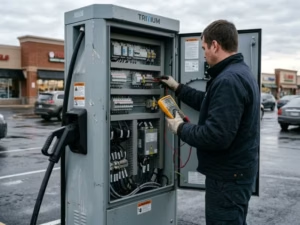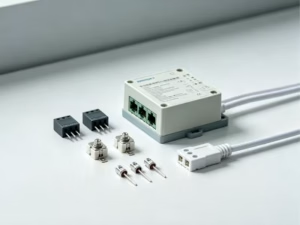
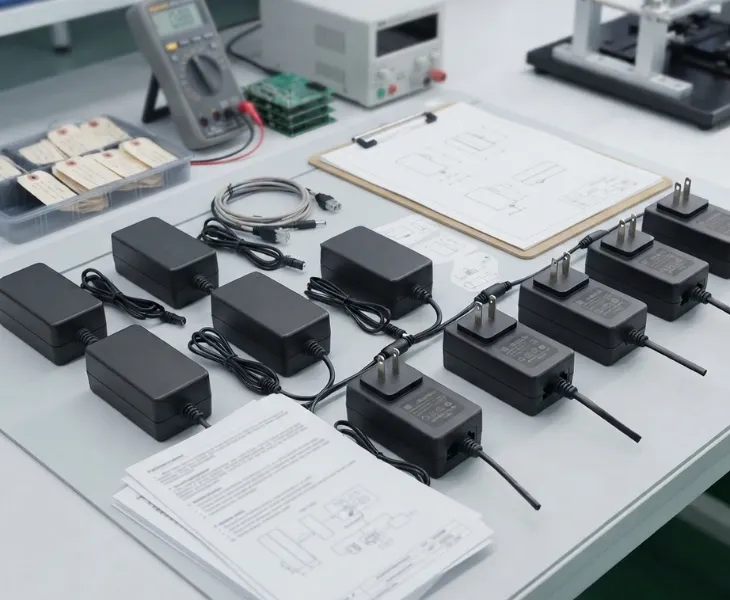
For an OEM equipment program, the purchase price of a PoE Adapter is only one part of the actual cost.
Once thousands of devices are deployed, a small difference in adapter price can become less significant than the cost of replacing a unit in the field, dispatching a technician, maintaining spare inventory, requalifying a revised component, or supporting multiple hardware generations over several years.
This changes how OEMs should evaluate their PoE power architecture.
Instead of asking only, “How much does the adapter cost?”, a more useful question is:
What will this power architecture cost from design release through the end of the equipment’s service life?
This article examines PoE Adapter total cost of ownership (TCO) from an OEM lifecycle perspective. It focuses on the factors that influence long-term manufacturing, maintenance, procurement, and service costs, including adapter replacement, spare-parts planning, configuration control, regulatory considerations, and component obsolescence.
The objective is to help OEMs select a PoE power solution that is not only suitable for initial production but also practical to manufacture, maintain, and support throughout the product lifecycle.
1. Why PoE Adapter Unit Price Is an Incomplete Procurement Metric
Unit price is attractive because it is easy to compare.
Suppose Supplier A offers a PoE Adapter that costs $1.20 less per unit than Supplier B. For an OEM purchasing 10,000 units, the immediate purchasing difference is:
10,000 × $1.20 = $12,000
That is a real saving, but it does not represent the full cost difference between the two solutions.
After purchasing, the adapter still creates costs across several stages:
- Engineering integration and validation
- Incoming inspection and production handling
- Installation and system configuration
- Field diagnosis and replacement
- Spare inventory and regional distribution
- Component or configuration changes
- Compliance review and requalification
- End-of-life planning and replacement sourcing
Life-cycle costing is an established dependability-management discipline. IEC 60300-3-3:2017 provides guidance on evaluating costs incurred throughout an item’s life, including costs associated with dependability.
For an OEM PoE Adapter program, the decision can be represented conceptually as:
Lifecycle Cost = Acquisition + Integration + Deployment + Service + Downtime + Inventory + Change + End-of-Life Cost
This is a decision-making model rather than a universal accounting formula. Each OEM should define the cost categories and calculation methods that reflect its own operations.
| Cost category | What should be evaluated |
| Acquisition | Adapter price, packaging, freight, tooling, and customization |
| Integration | Engineering hours, mechanical fit, interface documentation, and validation |
| Deployment | Installation time, cable requirements, and configuration errors |
| Field service | Diagnosis, replacement labor, technician access, and return handling |
| Downtime | Commercial or operational impact while equipment is unavailable |
| Spare inventory | Stock value, regional availability, and revision management |
| Change control | Engineering review, revalidation, and documentation updates |
| Obsolescence | Component availability and replacement qualification |
| End of life | Last-time purchases, remaining service demand, and migration planning |
The lowest acquisition price does not necessarily produce the lowest lifecycle cost.
For B2B buyers, this distinction becomes increasingly important as the installed base grows and the equipment remains in service for several years.
2. Treat the PoE Adapter as a Serviceable System Component
One advantage of an external PoE Adapter architecture is the physical separation of the power conversion function from the main equipment enclosure.
Depending on the system design, the adapter can provide a replaceable interface between the AC power source, Ethernet infrastructure, and the powered device.
Consider a network terminal installed in a warehouse, retail location, factory, office building, or security system. If its power conversion circuitry is integrated into the main equipment, a power-related service event may require opening the enclosure, replacing an internal assembly, or returning the complete unit for repair.
With an external adapter, the replacement process may be simpler:
Identify the approved replacement → reconnect the power and data interfaces → verify network connectivity and power-up behavior → confirm normal device operation.
However, an external adapter does not automatically guarantee good serviceability. The system must be designed and documented to support replacement.
Important considerations include:
- Connector and cable definitions must be controlled.
- Model numbers and revisions should be clearly identifiable.
- Different electrical configurations must not be confused.
- Replacement compatibility must be documented.
- Service procedures should define the required verification steps.
- Approved substitutions should be established before the original configuration becomes unavailable.
A useful service architecture should answer four questions:
| Service question | Desired outcome |
| Can technicians identify the correct replacement? | The exact model and configuration are clearly identifiable |
| Can the adapter be replaced without opening the OEM device? | Replacement is possible independently where the architecture permits |
| Can the replacement be verified quickly? | A repeatable power and network verification procedure is available |
| Can procurement obtain an approved replacement later? | Long-term sourcing and substitution rules are defined |
This turns the PoE Adapter from an interchangeable accessory into a controlled service component within the OEM equipment platform.
3. Calculate the Financial Value of Serviceability
A simple break-even calculation can help procurement teams evaluate whether a lower-cost adapter is actually the more economical choice.
Assume an OEM plans to deploy 10,000 devices. Configuration A saves $1.20 per adapter compared with Configuration B.
The initial purchasing saving is:
10,000 × $1.20 = $12,000
Now assume the OEM’s internal service records show that one additional field service event costs $220. This includes technician time, travel, administration, replacement logistics, and support overhead.
The number of additional service events required to eliminate the $12,000 purchasing saving is:
$12,000 ÷ $220 ≈ 55 service events
Across a 10,000-unit installed base:
55 ÷ 10,000 = 0.55%
In other words, approximately 55 additional service events would consume the initial purchasing advantage.
These figures are illustrative assumptions, not product failure-rate claims.
The value of this calculation is the method itself. OEMs can replace the assumptions with their own service data and compare the financial impact of different power architectures.
A practical formula is:
Break-even Additional Service Events = Initial Procurement Saving ÷ Cost per Service Event
The same method can evaluate a higher-priced configuration. If a more serviceable adapter costs $2 more per unit, the OEM can calculate how many avoided service events would justify that additional investment.
This provides a measurable business case instead of relying on general statements about quality or reliability.
4. Standardized PoE Does Not Eliminate Configuration Management
IEEE PoE standards provide an interoperability framework between power sourcing equipment (PSE) and powered devices (PDs).
The development of IEEE 802.3bt introduced four-pair powering and expanded the power capabilities available through standardized PoE architectures.
This standardization helps OEMs design compatible systems, but it does not eliminate the need to control the complete adapter configuration.
A replacement adapter must still match the intended system requirements, including:
- Required PoE standard and PSE functionality
- Supported PD power requirements
- Ethernet data-rate capability
- Input voltage range
- Connector and cable configuration
- Pin assignment and interface definition
- Housing dimensions and mounting conditions
- Operating temperature and installation environment
- Applicable safety approvals and destination markets
Quankang’s PoE Adapter portfolio covers product power ranges including 24W, 35W, 54W, 90W, and 100W. Available PoE functionality and Ethernet options depend on the specific model and configuration.
For OEM lifecycle management, these products should be treated as controlled technical configurations rather than interchangeable wattage categories.
A service part number should map to a defined technical baseline, including the model, approved revision, input range, PoE functionality, data interface, output capability, cable and connector configuration, compliance scope, mechanical drawing, and approved substitutions.
A description such as “100W PoE Adapter” alone is not sufficient to establish replacement compatibility.
5. Reduce SKU Complexity Without Creating Compatibility Risks
OEM product families often expand over time.
A security equipment manufacturer may introduce higher-performance models. A networking company may develop regional variants. An industrial equipment manufacturer may use the same platform with different communication or sensor configurations.
In these situations, procurement teams may consider using one PoE Adapter across several products.
This can simplify:
- Purchasing and supplier management
- Demand forecasting
- Incoming inspection
- Spare-parts stocking
- Service documentation
- Technician training
- Production planning
However, SKU consolidation only creates value when the technical requirements are compatible.
Selecting an oversized adapter simply because its rated power appears sufficient can introduce unnecessary cost or configuration risk. The PD requirements, PoE classification behavior, supported interfaces, operating conditions, cable path, and regulatory requirements must still be considered.
A more useful approach is to identify which product variants can legitimately share an approved power configuration.
| OEM platform situation | Recommended evaluation |
| Multiple products share the same PoE and mechanical interface | Assess whether one qualified adapter configuration can support them |
| Products require different PoE classes or interfaces | Maintain separate controlled configurations |
| Future product versions may require more power | Define the upgrade path before finalizing the service part |
| Different markets require different approvals | Maintain market-specific configurations where necessary |
| Mechanical installation differs but the electrical architecture is shared | Evaluate controlled cable or housing variants |
The objective is not to maximize adapter wattage. It is to reduce unnecessary configuration complexity without compromising electrical compatibility, safety, or serviceability.
6. Include Ethernet Cabling in the Lifecycle Cost Model
A PoE Adapter does not operate in isolation.
The complete power path includes the PSE, connectors, balanced cabling, installation environment, and PD. The condition and capability of the installed cabling can therefore affect the long-term suitability of a PoE architecture.
ISO/IEC TS 29125:2017 addresses telecommunications cabling requirements for remote powering of terminal equipment. It provides guidance relevant to new cabling installations and renovations. Industry work on remote powering also considers factors such as DC resistance, cable-bundle conditions, installation practices, and temperature rise.
For lifecycle planning, one distinction is particularly important:
The adapter may be replaced during a product upgrade, but the installed cable infrastructure may remain unchanged.
An OEM should not assume that every future installation will use newly installed cabling.
For products deployed in existing buildings, industrial facilities, retail networks, and distributed security infrastructure, the approved power architecture should be evaluated against the actual cabling conditions expected in the field.
This becomes more important when a later equipment revision requires higher power.
A next-generation PD may use the same RJ45 interface and fit the same installation, but its power requirements can impose different conditions on the existing cabling.
Therefore, a drop-in upgrade should not be approved solely because the connector remains unchanged.
Future compatibility depends on the complete electrical and installation interface, not just mechanical fit.
7. Control Product Changes Before They Create Requalification Costs
Power components rarely remain commercially unchanged throughout a long product lifecycle.
Semiconductor availability may change. Magnetics, connectors, cables, housings, or manufacturing processes may be revised. Regulatory requirements and target-market conditions may also evolve.
The important question is not whether changes will occur, but how they will be controlled.
IEC 62402:2019 provides a framework for obsolescence management across the product lifecycle, including planning, design strategies, resolution approaches, and performance improvement.
For an OEM PoE Adapter program, change-control expectations should be established during supplier selection rather than after an unexpected discontinuation notice.
The OEM and supplier should agree on which changes require notification, engineering review, or revalidation.
| Change category | Potential OEM concern | Possible action |
| Controller or switching-device change | Electrical behavior, efficiency, EMC, thermal performance | Engineering review and targeted verification |
| Transformer or isolation-system change | Safety construction and electrical performance | Safety and compliance review |
| RJ45 or connector change | Signal integrity, contact performance, mechanical compatibility | Interface verification |
| Cable construction change | Resistance, flexibility, and installation fit | Cable and application review |
| Enclosure material change | Flammability, mechanical fit, and thermal behavior | Mechanical and safety review |
| PCB layout revision | EMC, thermal distribution, and production consistency | Engineering comparison and verification |
| Label revision | Service identification and regulatory markings | Documentation review |
| Packaging revision | Shipping protection and logistics | Packaging approval where relevant |
The exact process depends on the OEM’s product design and certification strategy.
The commercial principle, however, should remain clear: an approved PoE Adapter is a controlled configuration, not an indefinitely interchangeable commodity.
A low-cost component that changes without structured notification can create engineering and validation costs that never appear on the original adapter quotation.
8. Manage Compliance as Part of Configuration Control
For information and communication technology equipment, IEC 62368-1 addresses safety requirements using an energy-source classification and safeguards approach. IEC 62368-3 addresses safety aspects of DC power transfer through communication cables and ports, including relevant PSE-to-PD power-transfer circuits.
For OEM purchasing, the objective should not be to collect as many certification logos as possible.
It should be to establish which compliance evidence applies to the exact configuration being purchased and used.
A certification associated with one product variant does not automatically establish that every voltage, cable, enclosure, revision, or market configuration has the same approval scope.
Compliance records should therefore be linked to controlled product information.
| Configuration record | Why it matters |
| Exact adapter model and revision | Prevents substitution with a visually similar but technically different product |
| Applicable safety standard and edition | Establishes the basis of the relevant safety evaluation |
| Market approvals | Keeps purchasing and replacement stock aligned with destination markets |
| PoE standard and PSE functionality | Confirms compatibility with the intended PD architecture |
| Cable, connector, and pin definition | Prevents incorrect electrical or mechanical substitution |
| Mechanical drawing | Supports manufacturing and service verification |
| Datasheet and controlled specification | Provides a shared technical baseline for engineering and procurement |
| Change history | Identifies whether later revisions require review or revalidation |
This becomes especially important when equipment remains in the field longer than the original purchasing cycle.
An adapter purchased in year four may not use exactly the same internal component set as the version approved in year one. What matters is whether the change has been properly communicated, evaluated, documented, and linked to the OEM’s approved equipment configuration.
Compliance should be considered early enough to influence adapter selection and system validation. Addressing these requirements only when a replacement part is needed can create avoidable engineering and service costs.
9. Plan Spare Parts Around Installed-Base Risk
Once a PoE Adapter becomes a service part, the next question is how many replacement units the OEM should hold.
There is no universal rule such as keeping 2% spare stock or maintaining six months of demand.
A practical spare-parts strategy depends on:
- Installed-base size and distribution
- Historical replacement demand
- Manufacturing and transportation lead times
- Regional service requirements
- Acceptable equipment downtime
- Product revision and compatibility risks
- Expected remaining service life
A useful planning model is:
Required Service Stock = Expected Replacement Demand During Replenishment + Service-Level Buffer + Lifecycle Buffer
This is a planning framework, not a universal inventory formula. The inputs should be based on the OEM’s actual service and supply-chain conditions.
For example, two OEMs with the same 20,000-unit installed base may need very different spare strategies.
One may support equipment through centralized warehouses with overnight dispatch. Another may have devices distributed across hundreds of industrial, retail, or security sites in multiple countries.
The second program may need regional stock even if its replacement rate is identical, because international replenishment can create longer downtime and higher logistics costs.
The lifecycle buffer also deserves attention. If an adapter is approaching a redesign, component transition, certification update, or end-of-life event, spare requirements may change temporarily.
Spare inventory and change control should therefore be managed together.
Separate Production Stock From Service Stock
Production inventory and service inventory serve different business purposes.
Production stock supports the manufacturing schedule. Service stock supports equipment that has already been sold and installed.
Using the same physical adapter does not make these inventory pools interchangeable.
| Inventory type | Primary purpose | Main planning question |
| Production stock | Support new equipment manufacturing | How much material is required to meet the production plan? |
| Service stock | Maintain installed equipment | How quickly must a replacement be available? |
| Engineering stock | Testing and investigation | How many controlled samples are needed for validation or failure analysis? |
| Lifecycle stock | Support an end-of-life period | How many units are needed until the installed base is retired or migrated? |
This separation reduces the risk of production consuming the last available units needed for field service.
It also helps prevent excessive service inventory from becoming obsolete when an equipment platform is retired.
The service database should identify approved adapter revisions, compatible equipment revisions, and permitted substitutions rather than relying on visual identification.
10. Reduce Repeat Service Visits Through Clear Replacement Procedures
The cost of a replacement event is not limited to the adapter itself.
A field service event may involve fault isolation, technician dispatch, site access, replacement labor, return logistics, customer communication, and verification of normal operation.
If the replacement part is incorrectly identified or incompatible, an otherwise straightforward repair can become a second service visit.
For a large installed base, the cost of this additional diagnosis can exceed the savings from a small reduction in adapter or labeling cost.
A repeatable replacement procedure should include:
- Confirm the service part number against the equipment configuration.
- Inspect relevant cables and connectors for visible damage or mismatch.
- Install the approved replacement PoE Adapter.
- Confirm the expected network link and PoE power-up behavior.
- Verify normal operation of the powered device.
- Record the removed adapter’s model and revision if failure analysis is required.
This process helps distinguish adapter-related issues from cable, connector, network, or PD problems.
Clear model identification, revision information, and compatibility records are therefore part of service design, not merely administrative details.
11. Documentation and Traceability Support Long-Term Serviceability
A PoE Adapter without controlled documentation is harder to support than the same hardware with a stable technical record.
For OEM programs, the documentation package may include:
- Datasheet and controlled product specification
- Mechanical drawing
- Label definition
- Connector and cable specification
- Approved configuration and revision history
- Relevant compliance documentation
- Approved replacement and substitution information
The business value becomes clear several years after product launch, when the original design engineer may no longer be responsible for the equipment.
A future engineering or service team should be able to determine:
- What configuration was originally approved?
- Which revision was used in each equipment build?
- What changed between revisions?
- Which replacement configurations are permitted?
- Which markets were covered by the original approval?
- Which drawings and test records belong to the adapter configuration?
Manufacturing traceability also helps identify whether a field issue is associated with a particular production batch, revision, component change, or configuration.
The objective is not to collect documentation for its own sake. It is to shorten the time between a field question and a reliable engineering answer.
12. Plan for Obsolescence Before Supply Becomes a Problem
Obsolescence management is more effective when response options are defined before a discontinuation event.
IEC 62402:2019 provides a lifecycle framework for managing obsolescence. This is relevant to OEM power architecture because a PoE Adapter may remain a required service item after the OEM has stopped manufacturing the original equipment.
Four common response paths are worth considering:
| Response path | When it may be appropriate | Main TCO question |
| Continue the existing configuration | Components and compliance remain supportable | What is the cost of maintaining supply? |
| Controlled component revision | A component changes but the adapter platform remains viable | What validation and documentation are required? |
| Qualify an approved replacement | The original configuration can no longer be sustained | What engineering, compliance, and service changes are needed? |
| Last-time buy | Migration is impractical for the remaining installed base | How many units are economically justified until retirement? |
A last-time buy should not be calculated simply by multiplying annual demand by the remaining service years.
The OEM should also consider installed-base attrition, historical service demand, storage conditions, regional distribution, possible repair or migration, and the financial cost of excess inventory.
Similarly, a mechanically compatible replacement adapter is not automatically a zero-cost substitute.
Changes to the cable, enclosure, label, PoE behavior, safety evidence, EMC performance, or installation procedure may require engineering and regulatory review.
These qualification costs belong in the lifecycle cost model.
13. Supplier Change Notification Has Measurable Economic Value
Change notification can appear administrative until an unexpected change affects production or field service.
For a long-running OEM program, early notification creates options.
When engineering receives advance notice of a material change, the team can review the impact, obtain samples, schedule validation, update documentation, adjust inventory, and coordinate production.
If the same information arrives only after the original configuration becomes unavailable, the OEM may have to complete these activities under an emergency schedule.
That can introduce additional costs, including:
- Expedited freight
- Emergency component purchases
- Production interruptions
- Engineering overtime
- Additional laboratory or validation costs
- Delayed customer shipments
The value of change control is not that it prevents every change. It reduces the cost and disruption of managing change.
For an RFQ, useful questions include:
- Which electrical, mechanical, component, cable, connector, or enclosure changes trigger customer notification?
- How are model revisions and configuration identifiers controlled?
- Can samples of a proposed revision be supplied before production conversion?
- What documentation is updated when a change affects the approved configuration?
- How is production traceability maintained across revisions?
- What options are available when a key component approaches end of life?
These questions can reveal more about long-term sourcing risk than a quotation based only on the current unit price.
14. Use TCO Scenarios Instead of Assuming One Exact Future Cost
A lifecycle model becomes less useful when it creates false precision.
No procurement team can know the exact number of future service events, freight costs, component discontinuations, or engineering changes over a multi-year product lifecycle.
Scenario analysis provides a more practical way to evaluate uncertainty.
An OEM can compare three cases:
Base Case
Use the most realistic assumptions available from current service data, purchasing forecasts, replenishment times, and planned product life.
Low-Service-Cost Case
Assume replacement demand remains low, logistics remain stable, and no major requalification is required. This shows how the decision performs when lifecycle risks remain limited.
High-Disruption Case
Model a supply interruption, higher service demand, regional spare requirements, or an unexpected replacement qualification event. This shows the potential financial exposure when the power architecture becomes difficult to sustain.
The purpose is not to predict the future perfectly. It is to determine whether the sourcing decision remains reasonable across different operating conditions.
A PoE Adapter configuration that is economical only under optimistic assumptions deserves more scrutiny than one that remains practical across a wider range of service and supply scenarios.
15. A Practical PoE Adapter TCO Worksheet for OEM Procurement
Before final sourcing approval, engineering, purchasing, quality, regulatory, operations, and service teams should contribute to one lifecycle cost assessment.
The following structure can be adapted to the OEM’s internal accounting model.
| TCO category | Data to collect | Possible owner |
| Unit acquisition | Adapter price, packaging, freight, customization | Purchasing |
| Integration | Engineering hours, samples, drawings, validation | Engineering |
| Compliance | Required reports, testing, market approvals, change review | Regulatory / Quality |
| Manufacturing | Incoming inspection, line handling, configuration control | Operations / Quality |
| Deployment | Installation time, cable assumptions, site constraints | Operations / Customer Engineering |
| Field service | Replacement labor, travel, return handling, diagnosis | Service |
| Downtime | Cost or service impact of equipment unavailability | Product / Operations |
| Spare inventory | Stock value, regional buffers, carrying cost | Supply Chain |
| Change management | Revalidation, documentation, samples, engineering review | Engineering / Quality |
| Obsolescence | Last-time buy, migration, replacement qualification | Purchasing / Engineering |
| End of life | Final service period, remaining stock, retirement plan | Product Management |
Each cost should be linked to an assumption.
For example, instead of entering only “service cost = $20,000”, record the installed base, assumed annual replacement events, cost per event, and planning horizon.
Instead of entering only “spares = $8,000”, record the target service stock, landed unit cost, and regional allocation.
This makes the model easier to review and update. Once the product has been deployed, actual service data can replace initial assumptions and support more accurate inventory and sourcing decisions.
16. When PoE Adapter Customization Can Reduce Lifecycle Cost
Customization is often treated as an additional upfront expense. However, in some OEM programs, a controlled custom configuration can remove recurring installation or service problems.
Examples include:
- A defined cable length that simplifies installation
- A connector configuration that matches the equipment interface
- Controlled pin assignments for the intended system architecture
- Housing or mounting changes that simplify integration
- Clear labeling that distinguishes service variants
- Mechanical adjustments that reduce packaging or installation complexity
The benefits should be evaluated against the additional cost and configuration responsibilities.
If a custom cable configuration adds a small per-unit premium but eliminates a recurring installation step, the OEM can compare the premium with the labor saved across production and service.
If a labeling change reduces incorrect replacement events, its cost can be compared with the expected reduction in service expense.
The key question is not whether a customized adapter is cheaper than a standard model.
It is:
Does the customization reduce total system cost enough to justify maintaining a dedicated configuration?
Customization also requires controlled drawings, revision management, approval rules, and lifecycle ownership. Without these controls, a custom configuration can increase SKU complexity rather than reduce TCO.
17. Do Not Confuse MTBF, Warranty, and Service Life
Lifecycle discussions often become misleading when different reliability terms are treated as if they mean the same thing.
MTBF, warranty duration, expected service life, and observed field replacement rate answer different questions.
- MTBFis a reliability metric based on a defined calculation or test method and its assumptions. It is not a promise that an individual adapter will operate for exactly that number of hours.
- Warrantyis a commercial commitment defined by the supplier’s warranty terms.
- Service lifedepends on operating conditions, loading, temperature, installation, component aging, and the OEM’s maintenance strategy.
- Field replacement ratereflects actual events in the installed population, including events that may not result from an intrinsic adapter failure.
For TCO modeling, the most useful input is usually the OEM’s own field evidence once enough units have been deployed.
Before that evidence exists, qualification data and reliability analysis can inform planning, but they should not be converted into unsupported failure-rate claims.
A reliable lifecycle model should distinguish measured results, contractual commitments, and planning assumptions.
18. Build Lifecycle Requirements Into the PoE Adapter RFQ
For an adapter used in an OEM product, the RFQ is an opportunity to define long-term support requirements before the first production order.
A lifecycle-oriented RFQ can include:
- Target equipment and operating environment
- Required IEEE PoE functionality
- Required Ethernet data rate
- Input and output requirements
- Cable, connector, and pin definitions
- Mechanical and installation constraints
- Target markets and required compliance evidence
- Expected annual production volume
- Expected production and service-support periods
- Required samples and validation documentation
- Change-notification expectations
- Revision-control requirements
- Spare-parts strategy
- Forecasting and replenishment expectations
- End-of-life notification expectations
- Requirements for approved replacement configurations
Not every project needs the same level of detail.
A short-lifecycle commercial product sold in one market may need a simpler process than industrial equipment expected to remain installed across several regions for many years.
The purpose of a lifecycle-ready RFQ is to make these requirements visible before supplier selection.
It also helps purchasing teams compare quotations on an equivalent basis. If one quotation covers only the adapter itself while another includes engineering review, documentation, customization, compliance coordination, and change-control support, comparing unit prices alone may lead to the wrong decision.
19. What OEMs Should Prepare Before Selecting a PoE Adapter
For a lifecycle-focused project, the most useful starting point is not simply a request for the lowest PoE Adapter price.
The supplier needs to understand the technical and commercial conditions that determine long-term cost.
Before a design review or quotation, OEMs should prepare the following information:
| Project information | Why it matters |
| Powered device and application | Defines the system context |
| Required PoE standard and power demand | Determines the required power functionality |
| Required Ethernet data rate | Confirms the data interface requirements |
| Input voltage and operating environment | Defines electrical and environmental conditions |
| Cable, connector, and mechanical requirements | Determines integration and installation compatibility |
| Destination markets | Identifies relevant compliance requirements |
| Expected annual volume and deployment scale | Supports production and supply planning |
| Product production and service life | Helps define lifecycle requirements |
| Field replacement strategy | Determines serviceability and spare-parts needs |
| Configuration and documentation requirements | Supports revision control and future replacement |
For projects where supply continuity is important, OEMs should also clarify whether several equipment variants may share one adapter, whether regional spare stock is needed, which changes would require revalidation, and how long the installed base must be supported.
Depending on the project and agreed scope, supplier support may include engineering consultation, design review, EMC pre-testing, certification or testing coordination, component-sourcing support, and production or inventory planning.
The actual support scope should be confirmed during project evaluation rather than assumed to be included in every standard-model quotation.
20. Review TCO After Product Launch
TCO should not disappear into a sourcing presentation after the purchase order is issued.
Once equipment is deployed, the OEM begins collecting information that is more valuable than the original planning assumptions.
A periodic review can consider:
- Field replacement events
- No-fault-found returns
- Average service cost per event
- Regional spare consumption
- Emergency freight and expedited shipments
- Adapter-related production interruptions
- Revision and change-control events
- Engineering hours spent on revalidation
- Obsolete or excess service inventory
- Actual replenishment times
- Installed-base growth and retirement
These measurements create a feedback loop between product engineering, procurement, supply chain, and service operations.
If service demand is lower than expected, spare inventory may be adjusted. If regional stock shortages create expensive downtime, buffer levels can be reviewed. If several product variants can safely share one controlled configuration, SKU consolidation may become practical.
TCO therefore becomes an ongoing management process rather than a one-time purchasing calculation.
This is consistent with the lifecycle-costing principle described in IEC 60300-3-3:2017: the cost of an item should be considered across its life, not only at acquisition.
Conclusion: Choose a PoE Adapter That Can Be Supported Throughout the Equipment Lifecycle
For OEM equipment, the best PoE Adapter purchasing decision is not necessarily the one with the lowest initial unit price. It is the solution that meets the equipment’s electrical and mechanical requirements while keeping integration, maintenance, replacement, and supply risks manageable over time.
Before finalizing a sourcing decision, OEMs should consider:
- Can the adapter be replaced without unnecessary service work?
- Can technicians identify the correct replacement configuration?
- Can procurement maintain an approved spare-parts supply?
- Can engineering track changes between revisions?
- Is compliance evidence linked to the exact model and configuration?
- Can the installed cabling support the intended power architecture?
- Are component changes and end-of-life risks addressed in advance?
- Is service stock based on actual installed-base requirements?
- Can the supplier maintain consistent specifications from sample approval through mass production?
These questions turn PoE Adapter sourcing from a component-price exercise into lifecycle engineering.
How Quankang Supports OEM PoE Adapter Projects
Quankang provides standard and customized PoE Adapter platforms from 24W to 100W, covering different equipment power requirements. Depending on the selected model, the portfolio supports IEEE 802.3af, 802.3at, or 802.3bt, with Ethernet data rates ranging from 10/100Mbps to 10Gbps on high-power models.
For OEM and ODM projects, our engineering team can work from the equipment requirements to evaluate or customize key specifications, including:
- Output voltage, current, and power rating
- PoE standard and power configuration
- Ethernet data rate and pass-through requirements
- RJ45 interface, pin assignment, DC connector, and cable configuration
- Cable length, housing dimensions, and mechanical design
- Applicable safety, EMC, and regional certification requirements
Our development process covers requirement evaluation, engineering sample development, design verification, safety and EMC testing, and production preparation. Once the sample specifications are approved, they provide the technical baseline for mass production. Incoming component inspection, production parameter monitoring, electrical performance verification, and final inspection help maintain consistency between production batches.
For OEM buyers, this means the sourcing decision can be evaluated beyond the initial adapter price. Product configuration, equipment integration, verification requirements, and production consistency can all be considered before the project enters volume production.
Discuss Your OEM PoE Adapter Requirements with Quankang
If you are developing a network device, IP camera, wireless access point, industrial terminal, or other PoE-powered equipment, Quankang can help evaluate a suitable standard or customized adapter configuration.
To start a technical review, share the following project information:
- Target device and application
- Required input/output voltage and power
- Supported IEEE PoE standard
- Required Ethernet data rate
- Connector type, pin assignment, and cable requirements
- Installation space or mechanical drawing, if available
- Destination markets and certification requirements
- Estimated annual volume and expected product service life
You do not need to have every specification finalized before making an inquiry. An existing adapter datasheet, equipment specification, or preliminary project requirement can provide a starting point for evaluation.
Contact Quankang to discuss your OEM PoE Adapter project, review configuration options, and request a solution based on your equipment requirements.
Explore our 24W–100W PoE Adapter product range or request a custom PoE Adapter quote.
Technical References
- IEC 60300-3-3:2017 — Dependability management — Part 3-3: Application guide — Life cycle costing
- IEC 62402:2019 — Obsolescence management
- IEC 62368-1:2023 — Audio/video, information and communication technology equipment — Part 1: Safety requirements
- IEC 62368-3:2017 — Safety aspects for DC power transfer through communication cables and ports
- ISO/IEC TS 29125:2017 — Telecommunications cabling requirements for remote powering of terminal equipment
- IEEE 802.3-2022 — IEEE Standard for Ethernet