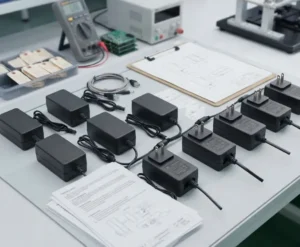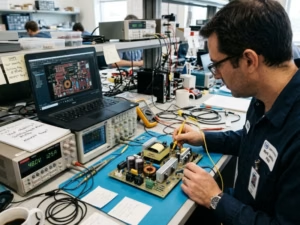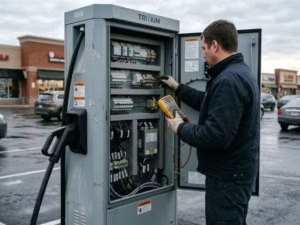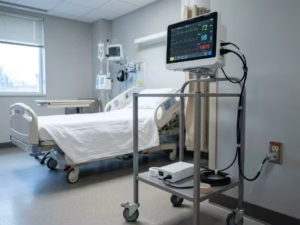
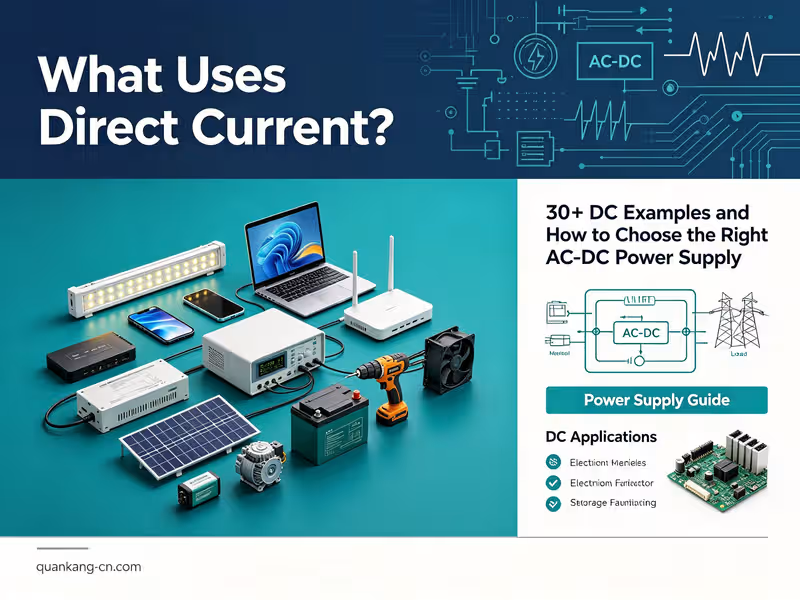
Wall outlets deliver alternating current (AC). Almost every device you design runs on direct current (DC).
Smartphones, PLCs, IP cameras, insulin pumps, and ventilators all depend on stable DC. Between the grid and the circuit board sits a power supply. That one component often decides whether a product passes certification on the first try or stalls in the test lab for weeks.
This guide covers 37 direct current examples across seven industries, from consumer electronics to patient-contact medical equipment. For each one, you’ll see why it uses DC, what voltage it typically needs, and what that means for power supply selection.
Key takeaways:
- DC flows in one direction with constant polarity. Semiconductors and digital circuits need it to work.
- Most devices convert AC to DC through an internal or external AC-DC power supply.
- Voltage needs vary by industry. Consumer devices center on 5–20V, industrial controls on 24V, and telecom on −48V.
- Supply selection affects compliance. Ripple, isolation, leakage current, and EMC performance shape certification outcomes.
- Medical devices need more. They require IEC 60601-1, 2x MOPP isolation, and very low leakage current.
What Is Direct Current (DC)?
Direct current (DC) is electric current that flows in one direction with constant polarity. Unlike alternating current, it never reverses, so its frequency is 0 Hz. Batteries, solar cells, fuel cells, and AC-DC power supplies all produce DC. It is the form of power that semiconductors and digital circuits need to operate.
DC comes from two broad sources:
- Native DC sources produce DC directly through chemical or photovoltaic processes. Batteries, solar panels, and fuel cells are common examples.
- Converted DC starts as mains AC. A power supply then rectifies, filters, and regulates it.
Not all DC is equally usable. Raw rectified AC is pulsating DC. It flows one way, but its voltage rises and falls 100 or 120 times per second. Sensitive electronics need smooth, regulated DC with tightly controlled ripple and noise. Delivering that clean output is the core job of a well-designed power supply.
How AC Becomes DC Inside a Power Supply
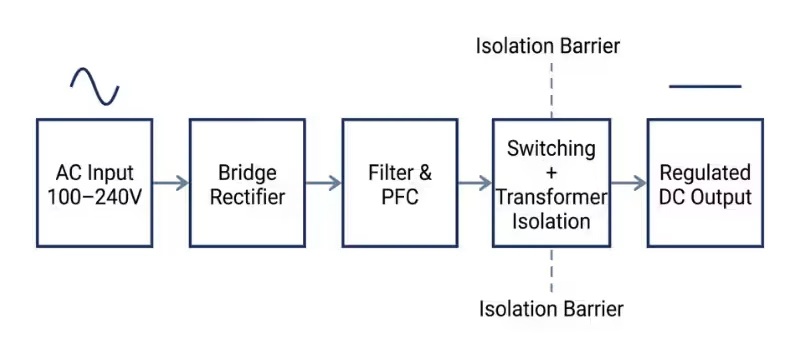
A modern switch-mode power supply (SMPS) converts AC to DC in four stages:
- Rectification. A bridge rectifier turns 100–240V AC into high-voltage pulsating DC.
- Filtering and power factor correction. Bulk capacitors smooth the voltage. Higher-power designs add active PFC to reduce harmonic distortion on the grid.
- High-frequency switching and isolation. A MOSFET switches the DC at tens or hundreds of kilohertz to drive a compact transformer. The transformer steps the voltage down and creates galvanic isolation between mains and output. This barrier is the main safety feature of the supply.
- Output rectification and regulation. Secondary-side rectifiers and filters produce the final DC rail. A feedback loop holds it within tight tolerance as load and input change.
Linear power supplies take a simpler path: a mains-frequency transformer, a rectifier, and a linear regulator. They produce very low noise but are larger, heavier, and less efficient. That’s why switch-mode designs dominate today’s adapters.
With the basics in place, the next question is why so many devices rely on DC in the first place.
Why Modern Electronics Run on DC Power
Nearly every electronic product is a DC system at its core. Six factors explain why.
1. Semiconductors Need Fixed Polarity
Transistors, microcontrollers, memory, and logic ICs are built around fixed voltage references. They expect stable rails such as 1.8V, 3.3V, 5V, or 12V. Reverse the polarity and the circuit fails, often permanently.
2. Batteries Only Store DC
Batteries store and release energy through electrochemical reactions that move charge in one direction. Any portable or battery-backed product is DC by default, from smartwatches to transport ventilators.
3. Motors and Sensors Need Precise Control
Brushless DC (BLDC) motors, stepper motors, and analog sensor front ends all depend on clean DC. Controllers use pulse-width modulation (PWM) to set motor speed and position. ADCs need a quiet reference voltage to produce accurate readings.
4. Low-Voltage DC Is Safer to Distribute
Low-voltage outputs classified as SELV (Safety Extra-Low Voltage) or Class 2 sharply reduce shock and fire risk inside the end product. The power supply keeps hazardous mains voltage away from anything the user can touch.
5. One Conversion, Many Rails
Engineers convert AC to DC once. Compact DC-DC converters then generate each board-level rail. This architecture is efficient, scalable, and easier to certify than multiple AC conversions inside one product.
6. Medical Accuracy Depends on Clean Power
In patient monitors, infusion pumps, and diagnostic devices, low-ripple and well-isolated DC protect both accuracy and safety. A noisy rail can distort an ECG trace or a glucose reading. Weak isolation can expose a patient to unsafe leakage current. This is why medical power supplies follow much stricter standards than general-purpose adapters.
The bottom line: Because every device is DC at its core, the AC-DC conversion stage is one of the most important design choices you’ll make. The examples below show how that plays out across industries.
30+ Direct Current Examples by Category
The 37 examples below fall into seven categories. Each table lists why the device uses DC, its typical voltage, and what to consider when sourcing power for it. You can explore many of these use cases in more depth on Quankang’s applications page.
DC Power Sources (Examples 1–5)
These sources produce DC natively. Most still rely on an AC-DC supply at some point, usually for charging.
# | Example | Why It Uses DC | Typical Voltage | Power Supply Note |
|---|---|---|---|---|
1 | Batteries (Li-ion, alkaline, lead-acid) | Redox reactions move electrons in one direction | 1.5V / 3.7V / 12V | Recharged by an AC-DC charger with charge control |
2 | Solar photovoltaic panels | The photovoltaic effect drives current one way | About 18–45V per panel | Needs an inverter for AC loads or a charge controller for batteries |
3 | Fuel cells | Hydrogen oxidation pushes electrons through the circuit | ~0.6–0.7V per cell under load, stacked | DC-DC conversion matches the stack to the bus |
4 | Power banks | Li-ion cells plus a boost converter | 5V / 9V / 15V / 20V via USB PD | Recharged with a USB PD charger |
5 | DC generators and alternator-rectifier systems | A commutator or rectifier turns rotation into DC | 12V / 24V / 48V | Common in vehicles, marine systems, and backup power |
Consumer Electronics (Examples 6–12)
Consumer devices are the most familiar direct current examples in everyday life. They’re also pushing the industry toward USB-C Power Delivery as a universal DC interface.
# | Example | Why It Uses DC | Typical Voltage | Power Supply Note |
|---|---|---|---|---|
6 | Smartphones and tablets | Battery-powered, all-digital circuits | 5–20V charge input; ~3.8V battery | USB-C PD charger negotiates voltage |
7 | Laptops | Battery plus high-performance processors | 19–20V barrel; up to 48V with USB PD 3.1 EPR | External adapter, typically 45–240W |
8 | Smartwatches and wearables | Small Li-ion cell in a tight space | 5V charge; 3.7–3.8V battery | Compact, low-power charger |
9 | LED lighting and strips | LEDs conduct in one direction only | 12V / 24V constant voltage, or constant current | Flicker-free driver protects eyesight and LED life |
10 | Portable projectors | High-brightness LED or laser light engine | 19–20V | High-density GaN adapter, around 100W |
11 | Game consoles | CPU and GPU rails come from a main DC bus | 12V main rail | High-wattage supply, around 300W continuous |
12 | Robot vacuum cleaners | Battery-driven BLDC motors and sensors | 14.4–24V | Docking adapter needs precise voltage matching |
Several of these products push power density hard. A 100W projector adapter has to fit in a bag. A game console supply must hold 300W continuously without overheating. Both rely on modern topologies, including GaN switching, to shrink size without sacrificing reliability.
Smart Home and Security Devices (Examples 13–16)
These devices often run around the clock, sometimes outdoors. Reliability and power budget planning matter more here than with typical consumer gear.
# | Example | Why It Uses DC | Typical Voltage | Power Supply Note |
|---|---|---|---|---|
13 | Smart locks | Motorized bolts and MCU control | 5V / 12V with battery backup | Ultra-thin internal supplies (e.g., 16.5mm) fit compact housings |
14 | IP and surveillance cameras | Image sensors, IR LEDs, and PTZ motors | 12V DC or PoE (48V nominal) | PoE supports cable runs up to 100m |
15 | Alarm panels and access control | Continuous low-voltage loop monitoring | 12V / 24V | Battery-backed ITE power supply |
16 | IoT sensors and hubs | Low-power microcontrollers and radios | 3.3V / 5V | Battery, USB, or PoE adapter |
Outdoor PTZ cameras show why peak load matters. On a cold night, the heater, IR illuminators, and pan-tilt motors can all draw power at once. If the PoE budget was sized for average load, the camera reboots exactly when you need it most. Plan for the worst-case combination, not the typical one.
Industrial Equipment (Examples 17–21)
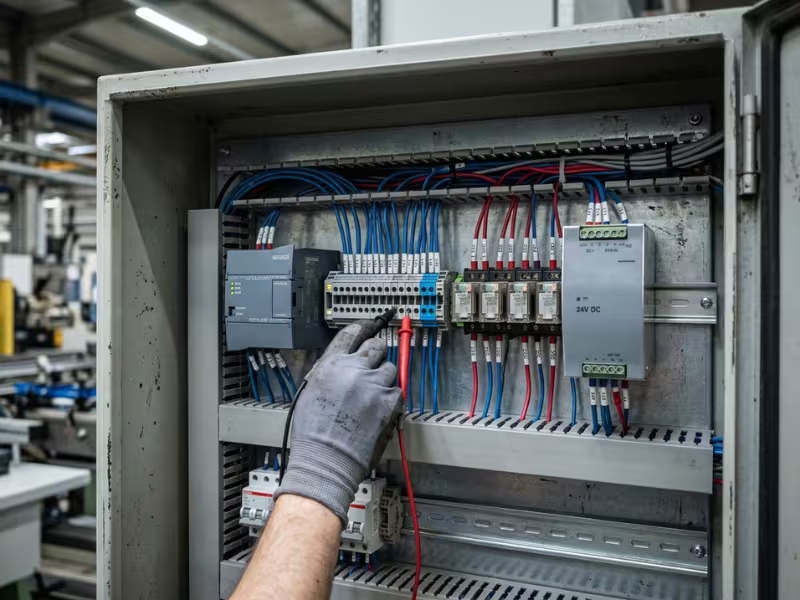
Industrial automation runs on DC, and 24V is the dominant control voltage. In this sector, batch-to-batch consistency matters as much as the spec sheet. Voltage drift or excess noise in one production lot can trigger rework rates of several percent on your line.
# | Example | Why It Uses DC | Typical Voltage | Power Supply Note |
|---|---|---|---|---|
17 | PLCs and I/O modules | Digital logic plus field I/O | 24V | Industry-standard control voltage |
18 | Industrial sensors and actuators | Analog signals need low noise | 12V / 24V | Specify ripple limits for accurate sensing |
19 | HMI panels and CNC controls | Displays and processors in electrically noisy plants | 24V | Strong EMC immunity required |
20 | POS terminals and barcode scanners | Embedded computing and scanning optics | 12V / 24V | External ITE adapter, DoE Level VI compliant |
21 | Robotics and BLDC motor drives | Precise speed and torque control | 24V / 48V | Peak current headroom for motor starts |
Specifying a 24V supply for industrial controls or commercial terminals? Compare options in Quankang’s ITE power supply range, built for DoE Level VI and EU Ecodesign compliance.
Medical Devices (Examples 22–29)
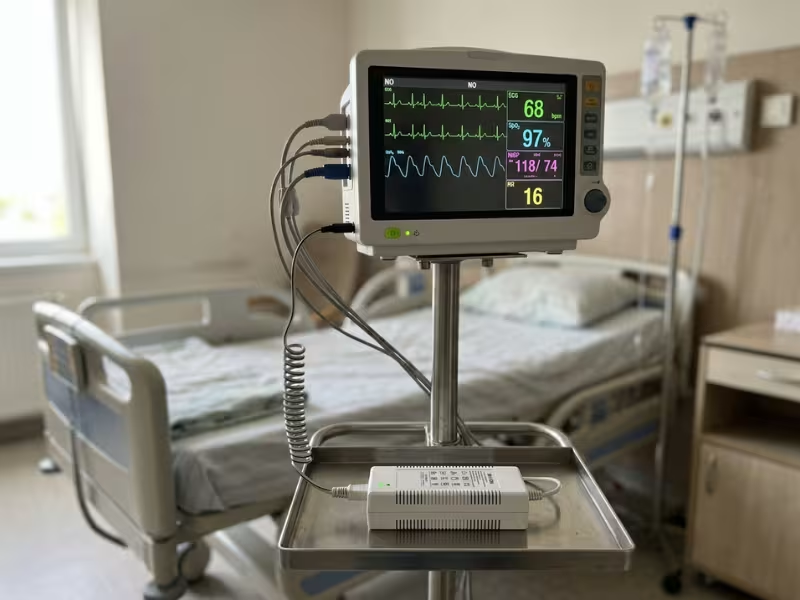
Medical equipment is where DC power quality matters most. A supply for a patient-contact device must do far more than hit the right voltage. It has to:
- Keep leakage current extremely low
- Provide two Means of Patient Protection (2x MOPP)
- Resist electromagnetic interference under IEC 60601-1-2
- Arrive with traceable certification documents
# | Example | Why It Uses DC | Typical Voltage | Power Supply Note |
|---|---|---|---|---|
22 | Patient monitors | Clean rails for ECG, SpO₂, and NIBP accuracy | 12V / 15V / 19V | Low ripple, 2x MOPP, IEC 60601-1-2 EMC |
23 | Ventilators and CPAP devices | Blower motors must hold pressure under changing load | 12V / 24V | Fast load-transient response plus battery backup |
24 | Infusion and insulin pumps | Stepper motors control dosing precisely | Low-voltage rails, battery-backed | Highly stable output for life-critical dosing |
25 | Blood glucose meters | Electrochemical sensing needs an exact bias voltage | 3–5V | Ultra-low ripple protects reading accuracy |
26 | Portable ultrasound | Battery operation plus high-voltage transducer drive | 12–19V input | High power density with low EMI |
27 | Sleep apnea monitors | Overnight contact with sleeping patients | 5V / 12V | Leakage current ≤100µA |
28 | Dental devices | Use in wet clinical environments | 5V / 12V | Enhanced sealing and 2x MOPP |
29 | Wearable health monitors | Compact form factors, frequent charging | 5V USB charging | Medical-grade USB PD, about 30% smaller |
Four of these show how power quality turns directly into clinical performance:
- Patient monitors combine many low-level analog signals on one board. Switching noise that leaks into an ECG front end can appear as baseline wander or false artifacts. The supply’s ripple spec and conducted emissions profile directly affect signal quality.
- Ventilators and CPAP devices put sudden, shifting loads on the supply as the blower speeds up and slows down with each breath. The supply must recover fast enough to keep pressure control accurate.
- Infusion and insulin pumps link power stability to dosing accuracy. Unstable voltage can affect motor positioning in the delivery mechanism.
- Blood glucose meters apply a precise DC voltage to a test strip and measure the resulting current. Any ripple on that bias voltage becomes measurement error.
Sleep apnea monitors and wearable health devices add another factor. They stay in contact with patients for hours, often while charging. That makes low leakage current non-negotiable. Dental equipment, meanwhile, operates near water and saliva, so sealing and isolation both matter. You can see how Quankang addresses each scenario on our medical and industrial applications page.
Designing a patient-contact device?
Quankang’s medical power supplies are certified to IEC 60601-1 with 2x MOPP isolation and leakage current ≤100µA. Request samples with full certification files before you commit to a purchase order.
Telecom and Networking Equipment (Examples 30–32)
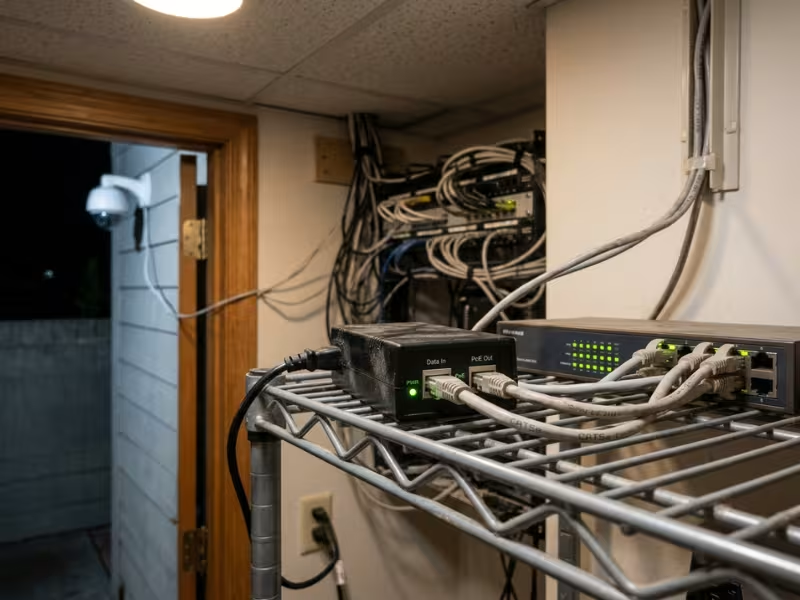
Telecom has run on DC for more than a century. Today, Power over Ethernet carries DC and data over the same cable.
# | Example | Why It Uses DC | Typical Voltage | Power Supply Note |
|---|---|---|---|---|
30 | Routers, switches, and gateways | Digital logic and RF chipsets | 12V / 19V | External ITE adapter |
31 | PoE devices (VoIP phones, access points, cameras) | DC travels over Ethernet pairs | 44–57V | 802.3af: 15.4W, 802.3at: 30W, 802.3bt: 60W/90W at the PSE |
32 | Telecom base stations and central offices | Direct battery backup integration | −48V | Rectifier plants with float-charged battery banks |
Telecom chose −48V for practical reasons:
- It’s high enough to deliver real power over long copper runs.
- It stays within safe extra-low-voltage limits.
- Batteries connect directly to the bus with no switching delay.
- Grounding the positive side reduces electrolytic corrosion on outdoor cables.
For network endpoints, Quankang’s PoE adapters support 802.3af, 802.3at, and 802.3bt.
Power Conversion and Infrastructure (Examples 33–37)
These systems create, convert, store, or distribute DC for every category above.
# | Example | Why It Uses DC | Typical Voltage | Power Supply Note |
|---|---|---|---|---|
33 | AC-DC adapters | Convert mains to the DC rail a device needs | 100–240V AC in; 5–48V DC out | Universal input enables one SKU for global markets |
34 | USB PD chargers | Negotiate DC voltage with the connected device | 5–20V (SPR); up to 48V (PD 3.1 EPR) | USB PD chargers up to 240W |
35 | DC-DC converters | Step DC up or down for board rails and EVs | Any to any | Used after the AC-DC stage |
36 | UPS and battery backup systems | Batteries store energy as DC | 12V / 24V / 48V battery banks | Inverters supply AC loads during outages |
37 | Data center DC distribution | Fewer conversion stages, higher efficiency | 48V rack; 380V DC | Convert once, then distribute DC to servers |
Across all seven categories, the pattern is the same. AC arrives at the wall. A power supply must turn it into DC that is clean, safe, and certified for that specific application.
Common DC Voltage Levels and Where They’re Used
Use this table as a quick reference when scoping a new product or reviewing an RFQ.
DC Voltage | Typical Applications | Notes |
|---|---|---|
3.3V / 5V | Logic, USB, IoT sensors, wearables | Usually generated on-board via DC-DC; 5V is the USB default |
9V / 15V | USB PD fixed levels, audio gear, small instruments | Negotiated through USB PD |
12V | Routers, CCTV, LED strips, automotive, game consoles | The most common external adapter output |
19–20V | Laptops, projectors, monitors | Legacy barrel standard and top USB PD SPR level |
24V | PLCs, industrial sensors, medical carts, LED lighting | Industrial control standard |
28V / 36V / 48V | USB PD 3.1 EPR, PoE, telecom, robotics | More power over thinner cables |
12V vs. 24V: Which Should You Specify?
At the same power, a 24V system draws half the current of a 12V system. Resistive losses scale with the square of current (I²R). So moving to 24V cuts cable losses to one quarter. That allows thinner wiring and longer runs.
- Choose 12V for short cable runs, compact consumer devices, and products that must fit an existing 12V ecosystem.
- Choose 24V for industrial controls, long LED runs, and higher-power loads where voltage drop becomes a problem.
Quankang’s ITE power supplies cover both standards across a wide power range.
Knowing the right voltage is only part of the decision. The next step is understanding where and how the conversion should happen.
AC vs. DC: Why Devices Still Need AC-DC Power Supplies
The grid uses AC because transformers can step it up and down easily. High-voltage transmission keeps losses low over long distances, and that infrastructure is deeply established. Electronics, however, need DC. So conversion happens at the device level, either inside the product or in an external adapter.
External Adapters vs. Internal (Open-Frame) Power Supplies
Factor | External Adapter | Internal / Open-Frame Supply |
|---|---|---|
Certification | Often pre-certified, simplifying end-device approval | Evaluated as part of the end-device certification |
Heat | Dissipated outside the enclosure | Must be managed inside the product |
Product size | Smaller end device | All-in-one design, larger housing |
Field replacement | Simple swap | Usually requires service |
Hazardous voltage | Stays outside the product | Present inside the enclosure |
For medical and ITE products, an external adapter often shortens time-to-market. It keeps mains voltage, and much of the safety burden, outside your enclosure. A pre-certified unit also gives your test lab a known quantity.
When no off-the-shelf model fits, a custom power adapter can match your voltage, connector, casing, and branding needs.
Universal Input (100–240V AC) for Global Markets
Universal-input supplies accept 100–240V AC at 50/60 Hz. One SKU works in New York, Berlin, and Tokyo. Only the plug or AC inlet changes. That reduces inventory, simplifies certification planning, and lets you launch in multiple regions with a single design.
How to Choose the Right AC-DC Power Supply: 10 Steps
Most power supply problems surface late: during EMC testing, certification review, or the first production run. Work through these 10 steps before you send an RFQ.
Step 1: Match Output Voltage and Polarity
Confirm the nominal output voltage, the allowable tolerance (±5% is typical), and connector polarity (center-positive or center-negative).
Common mistake: Accepting a legacy adapter with a “close enough” voltage. A 12V device on a 13.5V supply may pass bench tests, then fail early in the field.
Step 2: Size Output Current With Headroom
Plan for 20–30% current margin above maximum steady-state load. Account for motor inrush, capacitor charging, and peaks from heaters or radio bursts.
Common mistake: Sizing to average load. Startup surges can trip overcurrent protection and cause random resets.
Step 3: Specify Ripple and Noise Limits
Ripple and noise matter most for sensors, ADCs, audio circuits, and medical measurement. State a maximum in mV peak-to-peak, along with the measurement bandwidth (commonly 20 MHz).
Common mistake: Leaving ripple out of the RFQ, then finding signal problems during system validation.
Step 4: Confirm Safety Certifications for Your Market
Match the standard to your product category:
- ITE and AV equipment: IEC/UL 62368-1
- Medical electrical equipment: IEC 60601-1 (ANSI/AAMI ES60601-1 in the US)
- Home healthcare devices: add IEC 60601-1-11
Next, confirm the regional marks you need, such as UL, CE, UKCA, CB, PSE, and CCC. Ask for certificate numbers and verify that they’re active. Quankang’s certificates are traceable through TÜV and Intertek, with PDF copies available before you place an order.
Common mistake: Accepting certificate copies without checking them. Grey-market supplies with outdated or fabricated paperwork create real audit risk.
Step 5: Check Leakage Current and Isolation (Medical)
For patient-contact devices, require 2x MOPP isolation (4,000 VAC withstand) and low leakage current. Quankang’s medical power supplies hold leakage current at ≤100µA for applied-part applications. For devices that only operators touch, 2x MOOP may be acceptable. Your risk analysis should make that call.
Common mistake: Using an ITE-rated adapter in a device a patient might touch. That often forces a redesign during regulatory review.
Step 6: Plan for EMC/EMI Compliance Early
Your end product must pass both emissions and immunity testing:
- ITE: FCC Part 15 and EN 55032 (CISPR 32) for emissions; EN 55035 for immunity
- Medical: IEC 60601-1-2, with stricter immunity levels
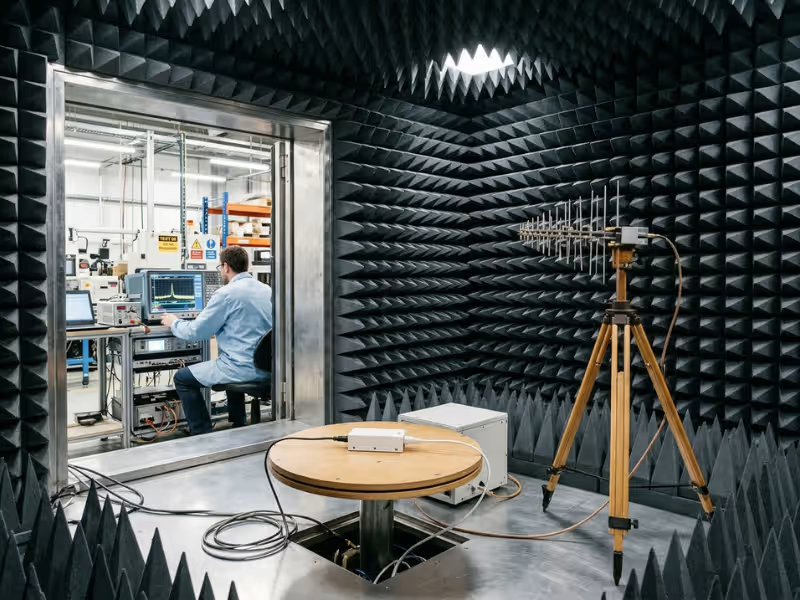
The power supply is often the single largest source of conducted emissions in a product. Supplier-level pre-compliance testing catches problems before your formal test slot. Quankang’s in-house EMC lab pre-scans every new design to FCC and CE standards. Across 10,000+ OEM projects, that process has produced a 98.3% first-pass EMC compliance rate.
Common mistake: Treating EMC as a final-stage test. A late failure typically delays launch by four to eight weeks.
Step 7: Meet Efficiency and No-Load Standards
External power supplies sold in the US must meet DoE Level VI limits for efficiency and no-load power. In the EU, Ecodesign Regulation (EU) 2019/1782, which replaced ErP Lot 7, sets similar rules. Check both active-mode efficiency and standby consumption.
Common mistake: Choosing a cheaper adapter that misses Level VI and can’t legally enter your target market.
Step 8: Verify Thermal Range and Derating
Review the operating temperature range (for example, −10°C to +40°C) and the derating curve beyond it. Sealed enclosures, high ambient heat, and poor airflow all reduce usable output.
Common mistake: Testing only at room temperature, then seeing shutdowns in a hot cabinet or a sunlit kiosk.
Step 9: Choose the Right Interface: Barrel, USB-C PD, or PoE
- Barrel connectors are simple, robust, and ideal for fixed-voltage designs.
- USB-C Power Delivery supports 5–48V and up to 240W through one connector. It suits laptops, tablets, and portable medical carts. See Quankang’s USB PD chargers.
- PoE delivers power and data over one Ethernet cable up to 100m. It fits cameras, access points, and VoIP phones. See our PoE adapters.
Common mistake: Choosing USB-C for convenience without confirming that the device’s PD controller and the charger negotiate correctly at every required voltage.
Step 10: Decide Between Standard and Custom ODM
Standard models are fast and cost-effective when they fit your specs. Custom ODM makes sense when you need a specific voltage, form factor, connector, cable length, casing, or private label.
Typical Quankang lead times:
- 15–20 days for cosmetic changes such as casing, labels, and cables
- 35–40 days for a full electrical design, including an EMC pre-scan
There’s no MOQ for cosmetic modifications. Learn more about Quankang’s custom power adapter ODM service.
Common mistake: Picking the lowest unit price without counting certification, testing, and lifecycle costs.
Your Power Supply RFQ Checklist
Before you send an RFQ, make sure you can answer each item:
- Output voltage, tolerance, and polarity
- Maximum and peak current, with 20–30% headroom
- Ripple and noise limit (mV p-p and measurement bandwidth)
- Safety standard and regional marks
- Isolation class and leakage current (medical)
- EMC standards for the end product
- Efficiency requirements (DoE Level VI, EU Ecodesign)
- Operating temperature and enclosure conditions
- Interface: barrel, USB-C PD, or PoE
- Standard model or custom ODM
Have your specs ready? Get an engineering review in 24 hours.
Send Quankang your voltage, current, and certification requirements. Our FAE team returns a compliance gap analysis within 24 hours. Functional samples with preliminary EMC reports ship in about 10 days.
Medical vs. Industrial Power Supply Requirements
Medical and industrial supplies can look alike on a datasheet. Underneath, they’re built to very different requirements.
Requirement | Medical Devices | Industrial / ITE Devices |
|---|---|---|
Primary safety standard | IEC 60601-1 | IEC 62368-1 (ITE); IEC 61010-1 or UL 508 for lab and control equipment |
Isolation | 2x MOPP (4,000 VAC) for patient contact | Basic or reinforced insulation |
Leakage current | Very low; ≤100µA is a common target | Standard ITE limits |
EMC standard | IEC 60601-1-2, with stricter immunity | EN 55032 / EN 55035, FCC Part 15 |
Quality system | ISO 13485 | ISO 9001 |
Documentation | Full traceability for FDA and EU MDR submissions | Standard CoC and test reports |
Design priority | Patient safety and measurement accuracy | Uptime, durability, and cost |
Product lifecycle | Long-term availability to avoid re-certification | Moderate |
Why Switching Suppliers Is Costly in Medical Projects
In a medical device, the power supply is part of the certified system. Change the supplier, or even a key component inside the supply, and you may need to repeat safety and EMC testing. That can cost tens of thousands of dollars and take months.
When you evaluate a medical power partner, look for:
- Long-term model support that keeps your certified design in production
- Advance notice of component changes, with alternatives proposed early
- Full certification dossiers delivered with samples, not after the order
- Traceability systems that identify which units shipped from which batch
Quankang operates an ISO 13485-certified facility with MES and SAP traceability on every component. We deliver certification dossiers with samples and support models over long product lifecycles, so your device stays certified.
When a Medical-Grade Supply Makes Sense Outside Healthcare
Some non-medical products benefit from medical-grade power. Common examples include:
- Laboratory instruments
- Beauty and wellness devices
- Fitness equipment with body-contact sensors
- Products sold into clinics and hospitals
Low leakage and higher isolation add a safety margin. They can also simplify sales into healthcare settings. Explore Quankang’s medical power supply range to compare options.
How Quankang Builds Reliable AC-DC Power Supplies
Choosing a power supply also means choosing a manufacturing process. Quankang operates a 120,000+ sq ft smart factory in Dongguan, China, designed around the compliance demands of US and European markets.
What that looks like in practice:
- 36 years of power conversion experience and 212+ active patents
- ISO 13485 medical quality system, plus ISO 9001, ISO 14001, and IATF 16949
- In-house EMC lab for FCC and CE pre-compliance on every new design
- 100% AOI and ICT inspection on every PCB
- MES and SAP traceability down to the component and batch level
- 5W–1000W portfolio across medical, ITE, PoE, and USB PD products
- Tens of millions of units produced each year, shipped to 50+ countries
The same stable process supports a 500-unit clinical trial and a 500,000-unit production run. See the production lines, test equipment, and quality systems on our facilities page.
Frequently Asked Questions About Direct Current
Do all electronic devices run on DC internally?
Nearly all of them do. Even AC-powered appliances such as TVs, microwaves, and washing machines convert mains AC to DC for their control boards, displays, and processors. Only simple resistive loads, like heating elements, and some AC motors run directly on alternating current without a DC conversion stage.
Is USB power AC or DC?
USB power is always DC. Standard USB ports supply 5V. USB Power Delivery negotiates higher fixed levels of 9V, 15V, and 20V, while USB PD 3.1 Extended Power Range adds 28V, 36V, and 48V for up to 240W. The charger and device agree on voltage before power flows.
What DC voltage do most industrial devices use?
Most industrial control equipment uses 24V DC. PLCs, sensors, actuators, HMI panels, and many motor drives are built around this standard. At the same power, 24V draws half the current of 12V, reducing cable losses and supporting longer wiring runs across a factory floor or control cabinet.
Is DC safer than AC?
Low-voltage DC is generally safer than mains AC. Circuits classified as SELV, typically below 60V DC, pose little shock risk. High-voltage DC can be just as dangerous as AC, though. DC arcs are also harder to extinguish because current never crosses zero, so DC systems need DC-rated breakers and switches.
What certification does a medical DC power supply need?
A medical power supply needs IEC 60601-1 for electrical safety (ANSI/AAMI ES60601-1 in the US) and IEC 60601-1-2 for EMC. Patient-contact devices also require 2x MOPP isolation and low leakage current. The manufacturer should run an ISO 13485 quality system and supply traceable certificates with samples.
Can I use a 24V adapter on a 12V device?
No. Feeding 24V into a 12V device can destroy regulators, capacitors, and ICs within seconds. Always match the rated voltage and polarity exactly. The adapter’s current rating, however, can be equal to or higher than the device’s maximum draw, because the device only pulls the current it needs.
What is the difference between an AC-DC adapter and a DC-DC converter?
An AC-DC adapter converts mains alternating current into regulated direct current, usually with isolation from the grid. A DC-DC converter takes an existing DC voltage and steps it up or down. Most products use both: one AC-DC stage at the input, then several DC-DC converters on the circuit board.
How long does a custom AC-DC adapter take to develop?
At Quankang, cosmetic customizations such as casing, labels, logos, and cables take about 15–20 days. A full electrical design with an EMC pre-scan takes about 35–40 days. Functional samples with preliminary EMC reports typically ship within 10 days, and there is no MOQ for cosmetic changes.
Conclusion: Clean DC Starts With the Right Power Supply
Direct current runs nearly everything with a circuit board. The 37 examples in this guide span phones, PLCs, PoE cameras, insulin pumps, and data center racks. Each uses DC for its own reasons: stable logic rails, battery compatibility, precise motor control, or patient safety.
In every case, the AC-DC conversion stage shapes how well the product performs. It also shapes how smoothly the product moves through certification.
To put this guide to work on your next project:
- Define the electrical spec. Lock in voltage, current headroom, and ripple limits before contacting suppliers.
- Map certifications to markets. Choose the right safety standard, isolation class, and regional marks.
- Test EMC early. Supplier-level pre-compliance prevents late, expensive surprises.
Quankang has spent 36 years solving these exact problems for medical, industrial, and communications OEMs. Our full product range covers medical, ITE, PoE, and USB PD applications from 5W to 1000W. Every design is backed by IEC 60601-1 certification options, 2x MOPP isolation, an in-house EMC lab, and a 98.3% first-pass EMC compliance rate.
Need a certified AC-DC power supply for your DC device?
Talk to Quankang’s engineering team about your medical, industrial, PoE, or USB PD requirements. Get a compliance gap analysis within 24 hours and samples with preliminary EMC reports in about 10 days.Request a Custom Quote | Download the Certification Package | Explore Applications