Choosing the right 5V 2A power adapter involves more than matching the output voltage and current rating. Connector compatibility, cable specifications, input voltage, polarity, electrical protection, and operating conditions all affect whether an adapter can reliably power the connected equipment.
A 5V 2A power adapter provides up to 10W of rated output power and is commonly used in electronic devices, monitoring equipment, communication systems, IoT products, and some home healthcare applications. However, not every 5V 2A adapter is interchangeable. Different devices may require specific connector dimensions, cable configurations, safety requirements, or power supply designs.
For equipment manufacturers and OEM/ODM buyers, selecting an appropriate adapter also involves evaluating product specifications, target-market requirements, customization options, and supply arrangements.
This guide explains how to select a 5V 2A power adapter, compare connector options, evaluate important electrical specifications, and identify suitable solutions for different equipment and OEM/ODM projects.
1. 5V 2A Power Adapter Specifications at a Glance
A typical 5V 2A power adapter converts AC input power into regulated 5V DC output for compatible electronic equipment.
Its main specifications include:
| Specification | Typical Requirement |
| Output Voltage | 5V DC |
| Output Current | Up to 2A |
| Rated Output Power | 10W |
| Input Voltage | 100–240V AC for universal-input models |
| Input Frequency | 50/60Hz |
| Output Interface | USB-A, USB-C, DC barrel, or custom connector |
| Applications | Electronic devices, IoT equipment, monitoring systems, and embedded systems |
How Many Watts Is a 5V 2A Power Adapter?
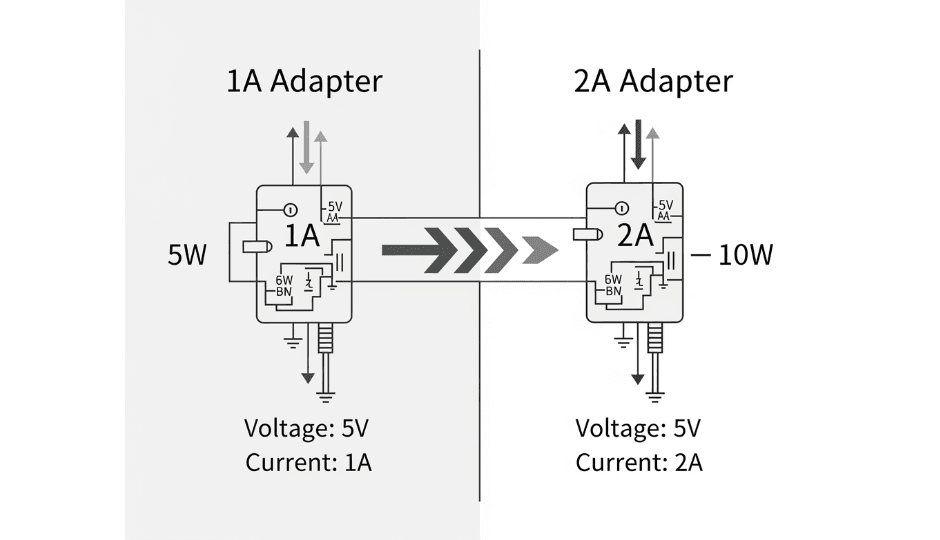
The rated output power of a power adapter is calculated by multiplying output voltage by output current:
Power = Voltage × Current
For a 5V 2A power adapter:
5V × 2A = 10W
Therefore, a 5V 2A adapter has a maximum rated output power of 10W under its specified operating conditions.
However, this does not mean every connected device continuously consumes 10W. Actual power consumption depends on the device’s operating requirements and load conditions.
For example:
A device requiring 5V 1A typically draws up to 5W.
A device requiring 5V 1.5A typically draws up to 7.5W.
A device requiring 5V 2A may draw up to 10W.
A 5V 2A adapter can generally power a compatible 5V device requiring less than 2A, provided the adapter, connector, and cable meet the device’s requirements.
The output voltage must match the equipment’s specified input voltage, and the adapter must have sufficient current capacity for normal operation and applicable peak loads.
For a comparison of different current ratings, see our guide to 5V 1A vs. 5V 2A adapters.
2. AC Input Voltage and Plug Types for Global Markets
When selecting a 5V 2A power adapter for international applications, input voltage compatibility and AC plug configuration should be considered together.
2.1 100–240V AC Universal Input
Many power adapters designed for international markets support a wide AC input range, such as 100–240V AC at 50/60Hz.
This allows the same adapter platform to operate across different electrical systems when configured with the appropriate AC plug.
Common input voltage ranges include:
100–120V AC for North American applications.
220–240V AC for many European and Asian markets.
100–240V AC for universal-input applications.
For OEM products distributed internationally, a universal-input power adapter can simplify product configuration and sourcing.
However, buyers should verify the actual input voltage range and frequency in the product datasheet rather than assuming all adapters support universal input.
2.2 US, EU, UK, and AU AC Plug Options
Different markets use different AC plug configurations.
| Plug Type | Common Target Markets |
| US Plug | United States and selected North American markets |
| EU Plug | Many European markets |
| UK Plug | United Kingdom |
| AU Plug | Australia and selected markets |
For OEM and ODM projects, the AC plug configuration can often be selected according to the destination market.
Buyers should also consider applicable electrical safety requirements, regional approvals, enclosure configuration, cable specifications, and packaging requirements.
Selecting the appropriate plug and electrical configuration early can help reduce product changes during international market preparation.
3. USB-A, USB-C, and DC Barrel Connector Options
The output connector is one of the most important factors when selecting a 5V 2A power adapter.
Even when two adapters have identical electrical ratings, they may not be interchangeable because of differences in connector dimensions, electrical interfaces, cable configurations, or polarity.
3.1 USB-A vs. USB-C 5V 2A Adapters
USB-A and USB-C are widely used interfaces for low-voltage power applications.
Both can be used in 5V power supply designs, provided the adapter’s output configuration supports the required current and is compatible with the connected equipment.
| Comparison | USB-A | USB-C |
| Connector Design | Rectangular connector | Reversible connector |
| Connection Direction | One orientation | Reversible |
| Typical Applications | Existing USB-powered products | Newer electronic devices |
| Power Configuration | Depends on adapter design | Depends on USB-C implementation |
| Fast Charging | Not guaranteed | Not guaranteed |
USB-C is increasingly used in newer electronic products because of its reversible connector design and compact form factor.
However, USB-C does not automatically mean fast charging or USB Power Delivery (USB PD).
A standard 5V 2A USB-C power adapter provides up to 10W of rated output power. It should not be confused with a USB-C PD adapter that supports additional voltage and current profiles.
When selecting a USB-C power adapter, buyers should evaluate:
Rated output voltage and current.
USB-C source configuration and CC implementation.
Cable compatibility and current rating.
Device charging or power requirements.
Applicable USB specifications and safety requirements.
The adapter, cable, and connected device must work together to provide the required power safely and reliably.
3.2 DC Barrel Connector Sizes and Compatibility
DC barrel connectors are commonly used in electronic equipment, communication devices, embedded systems, monitoring equipment, and other products with dedicated DC power inputs.
Common connector sizes include:
5.5 × 2.1 mm
5.5 × 2.5 mm
3.5 × 1.35 mm
These dimensions refer to the outer diameter and inner diameter of the connector.
A connector that looks similar may still be incompatible if its dimensions or mechanical configuration differ.
Before selecting a DC barrel power adapter, buyers should verify:
Outer diameter.
Inner diameter.
Connector length.
DC polarity.
Connector orientation.
Cable length and configuration.
For equipment with non-standard power interfaces, custom DC connectors may also be considered.
Connector specifications should be confirmed before production to avoid compatibility issues during equipment assembly or installation.
4. Critical Technical Factors for Power Adapter Compatibility
Matching output voltage and current is only the first step in selecting a suitable 5V 2A power adapter.
Several additional electrical and mechanical factors can affect equipment compatibility and operating reliability.
4.1 DC Polarity: Center-Positive vs. Center-Negative
DC polarity determines how positive and negative electrical connections are arranged between the adapter and the connected equipment.
Two common DC barrel configurations are:
Center-positive.
Center-negative.
Center-positive is widely used in many electronic products, but buyers should never assume polarity without checking the equipment specifications.
An adapter with incorrect polarity may cause equipment malfunction and potentially damage sensitive electronic components.
For OEM projects, polarity should be clearly defined in the electrical specification before finalizing the adapter and connector configuration.
4.2 Cable Gauge and Voltage Drop Calculation
Cable specifications can affect the voltage delivered from a 5V 2A power adapter to the connected device.
When current flows through a cable, the conductor’s electrical resistance creates a voltage drop. This becomes more significant when:
Cable length increases.
Current consumption increases.
Conductor cross-sectional area decreases.
Connector resistance increases.
Because 5V is a relatively low operating voltage, even a small voltage drop can affect equipment performance.
The voltage drop across a DC cable can be estimated using:
Vdrop = I × R
For a two-conductor copper cable, the approximate resistance can be calculated as:
R = 2 × ρ × L / A
Where:
Vdrop = Voltage drop.
I = Load current in amperes.
R = Total cable loop resistance.
ρ = Copper resistivity.
L = One-way cable length.
A = Conductor cross-sectional area.
For example, consider a 5V 2A power adapter connected to equipment through a 1-meter cable using approximately 20 AWG copper conductors.
Using a copper resistivity of approximately 0.0175 Ω·mm²/m at 20°C and a conductor cross-sectional area of approximately 0.517 mm²:
R = 2 × 0.0175 × 1 / 0.517
R ≈ 0.0677 Ω
The estimated voltage drop at 2A is:
Vdrop = 2 × 0.0677
Vdrop ≈ 0.135V
The estimated voltage at the equipment input would therefore be approximately:
5V − 0.135V = 4.865V
This is an illustrative calculation. Actual voltage drop also depends on conductor temperature, cable construction, connector resistance, and operating conditions.
For OEM applications, cable length, AWG, conductor material, and connector specifications should be evaluated together with the adapter.
The voltage delivered at the equipment input must remain within the device manufacturer’s specified operating range.
4.3 Protection Functions
A 5V 2A power adapter may include different electrical protection functions depending on its design and intended application.
Common protection features include:
| Protection Function | Purpose |
| Over-Voltage Protection (OVP) | Helps protect equipment from excessive output voltage |
| Over-Current Protection (OCP) | Limits or controls excessive output current |
| Short-Circuit Protection (SCP) | Provides protection during output short-circuit conditions |
| Over-Temperature Protection (OTP) | Helps prevent excessive operating temperature |
These protection functions help reduce risks associated with abnormal operating conditions.
However, not every power adapter includes all four protection functions. Buyers should confirm the actual protection configuration in the product datasheet.
4.4 Safety and Compliance Requirements
Certification and compliance requirements depend on the target market, product category, and intended application.
Depending on the product and destination market, relevant requirements may include:
UL or applicable North American electrical safety requirements.
CE requirements for applicable European markets.
Electromagnetic compatibility (EMC) requirements.
FCC requirements where applicable.
Regional energy-efficiency requirements.
It is important to distinguish between electrical protection functions and product compliance requirements.
OVP, OCP, and SCP are protection functions built into the power supply design. UL, CE, and FCC relate to different safety, conformity, EMC, or regulatory requirements.
For OEM projects, compliance requirements should be identified early because they can influence circuit design, component selection, testing, documentation, and production planning.
For medical power supply projects, buyers should also review the applicable requirements of IEC 60601-1 and relevant EMC standards. See our guide to IEC 60601 EMC testing problems and solutions.
5. Wall Adapter vs. Desktop Power Supply vs. USB Charger
A 5V 2A power source can be supplied in different physical configurations.
The appropriate type depends on equipment design, installation environment, and connection requirements.
| Type | Typical Applications | Main Considerations |
| Wall Adapter | Consumer electronics and compact devices | Integrated AC plug and compact design |
| Desktop Power Supply | Networking and electronic equipment | Separate AC cable and flexible DC output configuration |
| USB Charger | USB-powered electronics | USB interface and device compatibility |
5.1 Wall Plug Power Adapter
A wall plug power adapter integrates the AC plug into the adapter enclosure.
It is suitable for products where compact size, portability, and simple installation are important.
Common considerations include plug configuration, enclosure dimensions, output cable design, and regional safety requirements.
5.2 Desktop Power Supply
A desktop power supply typically uses a separate AC input cable and DC output cable.
This configuration offers greater flexibility for equipment that requires a specific output connector, cable length, or installation arrangement.
It is commonly considered for networking products, monitoring equipment, and other electronic systems.
5.3 USB Charger
A USB charger is generally designed around a USB output interface and is commonly used for USB-powered electronics.
However, the terms charger, power adapter, and power supply sometimes overlap in commercial product listings.
For technical selection, buyers should focus on the actual electrical specifications, output interface, compatibility, and safety requirements rather than the product name alone.
6. Applications of 5V 2A Power Adapters
A 5V 2A power adapter can be suitable for different types of electronic equipment when the required voltage, current, connector, and operating conditions are compatible.
The following are common application categories. Actual power requirements should always be confirmed from the equipment specifications.
6.1 Medical and Home Healthcare Equipment
Some home healthcare and medical-related electronic products use low-voltage DC power supplies.
Potential applications include compatible monitoring devices, portable healthcare electronics, and other equipment designed around a 5V DC input.
For medical applications, buyers should evaluate more than basic output specifications.
Important considerations include:
Medical electrical safety requirements.
Isolation classification.
Leakage current.
Electromagnetic compatibility.
Operating environment.
Applicable medical equipment standards.
A standard consumer-grade 5V adapter should not automatically be considered suitable for medical equipment.
Where medical electrical safety requirements apply, an appropriately designed medical-grade power supply should be selected.
6.2 Monitoring and Diagnostic Equipment
Some monitoring and diagnostic electronic systems use 5V DC power inputs.
For these applications, power supply selection should consider:
Required input voltage.
Maximum operating current.
Connector dimensions and polarity.
Cable length and voltage drop.
Continuous operating requirements.
Electrical safety and EMC requirements.
The actual power requirements should be confirmed from the equipment specification before selecting an adapter.
6.3 Communication and Networking Equipment
Some communication and networking products use dedicated 5V DC power inputs.
For these applications, stable output voltage, connector compatibility, cable configuration, and operating reliability are important considerations.
Certain products from manufacturers such as Yealink or VTech may use 5V power inputs. However, replacement adapters should always be selected according to the original equipment specifications rather than the brand name alone.
6.4 IoT and Embedded Systems
IoT devices and embedded electronic systems may also use 5V DC power sources.
Examples include compatible control modules, communication interfaces, sensors, and monitoring terminals.
For these products, buyers should evaluate:
Startup and peak current requirements.
Continuous power consumption.
Cable and connector compatibility.
Operating temperature.
Installation environment.
Required electrical protection.
In particular, the adapter should have sufficient current capacity for both normal operation and applicable startup conditions.
7. Medical-Grade 5V 2A Power Adapter Solutions
Medical electrical equipment may require more stringent power supply safety characteristics than standard consumer electronics.
In addition to output voltage and current, medical power supply selection may involve patient protection, electrical isolation, leakage current, and applicable medical safety requirements.
7.1 Medical Safety and 2 × MOPP Isolation
One important consideration in medical power supply design is the level of protection provided by electrical isolation.
MOPP stands for Means of Patient Protection.
Under IEC 60601-1, medical electrical equipment safety requirements include specific considerations for patient protection and electrical isolation.
A power supply designed with 2 × MOPP isolation is designed to provide two Means of Patient Protection, subject to the applicable insulation, creepage, clearance, working-voltage, and testing requirements.
However, the required protection level depends on the medical device design, applied parts, patient connections, and intended application.
Buyers should evaluate the complete medical electrical system rather than relying on the adapter specification alone. The use of a 2 × MOPP power supply does not by itself establish that the finished medical device complies with IEC 60601-1.

7.2 Quankang 10W Medical 5V 2A Power Supply
For applications requiring a medical-grade 5V 2A external power supply, Quankang offers the UES10LZ1-SPA / UES10LZ2-SPA series.
The series is specified with the following key characteristics:
| Specification | Product Details |
| Product Series | UES10LZ1-SPA / UES10LZ2-SPA |
| Rated Output Power | 10W |
| Output Voltage | 5V DC |
| Maximum Output Current | 2A |
| AC Input Voltage | 90–264V AC |
| Isolation | 2 × MOPP |
| Standard Reference | IEC 60601-1 |
| Output Configuration | USB or fixed DC cable options, depending on model configuration |
The series is designed for medical and home healthcare applications requiring an appropriate medical-grade external power solution.
Before selecting a model, buyers should confirm:
Required output voltage and current.
USB or fixed DC cable configuration.
Connector dimensions and polarity, where applicable.
AC plug requirements.
Applicable medical safety requirements.
Product-specific electrical specifications and documentation.
Explore the UES10LZ1-SPA / UES10LZ2-SPA 10W Medical Power Supply for detailed product specifications and configuration information.
8. How to Source Custom 5V 2A Power Adapters for OEM/ODM Projects
Standard 5V 2A power adapters can meet many common requirements. However, equipment manufacturers may need customized electrical specifications, connectors, cable configurations, or mechanical designs.
For OEM and ODM projects, defining these requirements before product development can help reduce compatibility problems and unnecessary redesign.
8.1 Electrical Specifications
The electrical requirements should be established first.
Typical specifications include:
AC input voltage and frequency.
DC output voltage.
Maximum output current.
Rated output power.
Output regulation requirements.
Protection functions.
Efficiency requirements.
Operating temperature range.
For example, a project requiring a 5V 2A adapter should confirm whether 2A represents the maximum continuous load or whether additional startup current capacity is necessary.
The power supply should be evaluated under the equipment’s actual operating conditions.
8.2 Connector and Cable Customization
Mechanical compatibility is another important part of OEM power adapter sourcing.
Depending on project requirements, customization may include:
USB-A or USB-C connectors.
Standard DC barrel connectors.
Custom DC connectors.
Connector dimensions and orientation.
Cable length.
Wire gauge and conductor specifications.
Cable jacket and construction.
AC input cable configuration.
For projects with non-standard equipment interfaces, connector drawings or physical samples can help confirm compatibility before production.
8.3 AC Plug and Regional Requirements
If the finished equipment will be sold internationally, the power adapter may require different AC plug configurations.
For example, an OEM project may use the same 5V 2A electrical platform with different US, EU, UK, or AU plug configurations.
The destination market should be identified early so that the appropriate electrical safety and compliance requirements can be evaluated during development.
8.4 Branding and Packaging Customization
OEM and ODM projects may also involve product appearance and packaging requirements, including:
Product labels.
Brand logos.
Model numbers.
Technical markings.
User documentation.
Retail packaging.
Customized cartons.
These requirements should be confirmed before mass production to maintain consistency between product specifications and final packaging.
8.5 Engineering Evaluation and Production Requirements
For long-term supply projects, buyers should evaluate more than the initial sample.
Important considerations include:
Sample development and specification confirmation.
Electrical performance evaluation.
Safety and compliance documentation review.
Production quality requirements.
Consistency between production batches.
Supply planning based on project forecasts.
A clearly defined technical specification helps the equipment manufacturer and power supply manufacturer establish consistent requirements throughout product development and production.
9. Why Choose Quankang for 5V 2A Power Adapter Solutions?
Selecting a 5V 2A power adapter solution involves more than comparing output ratings and product prices.
For OEM and ODM customers, connector compatibility, electrical specifications, target-market requirements, product safety, and supply arrangements are also important.
Quankang provides AC/DC power adapter solutions for electronic equipment and medical-related applications, supporting standard product selection and customized power supply requirements.
Depending on project specifications, configuration and project coordination may cover:
Input and output specification evaluation.
USB, DC barrel, and custom connector options.
Cable length and configuration.
AC plug configurations for different markets.
Enclosure and mechanical requirements.
Electrical protection functions.
Product labeling and packaging.
Applicable safety and compliance requirements.
For medical applications, Quankang also offers medical power supply solutions designed around relevant medical electrical safety requirements, including products featuring 2 × MOPP isolation.
By evaluating electrical, mechanical, and application requirements together, Quankang can help OEM/ODM customers identify suitable AC/DC power adapter configurations for their equipment.
For a project evaluation, buyers can contact Quankang with their technical specifications, application details, and target-market requirements.
10. Frequently Asked Questions About 5V 2A Power Adapters
What specifications should I check when buying a 5V 2A power adapter?
Check the output voltage, maximum current, rated power, AC input voltage, connector type, polarity, cable specifications, protection functions, and applicable safety requirements.
For international applications, also confirm the required AC plug configuration.
Can I use a 5V 2A adapter for a 5V 1A device?
Generally, yes.
A 5V 2A adapter can supply up to 2A, but the connected device draws the current it requires under normal operating conditions.
A 5V 1A device typically draws no more than 1A when operating as specified. The output voltage, connector, polarity, and other electrical requirements must still match the equipment.
What happens if a 5V power adapter cannot supply enough current?
If the equipment requires more current than the adapter can provide, the power supply may experience voltage drop, output instability, protection activation, or overheating, depending on its design.
The connected equipment may also restart, malfunction, or fail to operate correctly.
For reliable operation, select an adapter with sufficient rated current capacity for the equipment’s normal and peak power requirements.
Is a 5V 2A adapter suitable for continuous operation?
It can be suitable for continuous operation if the adapter is designed and rated for the required operating conditions.
Buyers should check the manufacturer’s specifications for rated output, ambient temperature, thermal performance, and applicable operating conditions.
The adapter should not be selected based on its nominal 10W rating alone.
Can a 5V 2A adapter use a 100–240V AC input?
Yes. Many power adapters designed for international applications support a wide input range, such as 100–240V AC at 50/60Hz.
However, the actual input voltage range must be confirmed from the product datasheet.
Which connector is best for a 5V 2A power adapter?
There is no single connector that is best for every application.
USB-A and USB-C are common for USB-powered products, while DC barrel connectors and custom connectors are often used for dedicated electronic equipment.
The correct connector depends on the equipment’s mechanical interface and electrical requirements.
Does USB-C mean a 5V 2A adapter supports fast charging?
No.
USB-C describes the connector interface, not necessarily the charging protocol or output power capability.
A 5V 2A USB-C adapter provides up to 10W of rated output power. USB Power Delivery requires additional compatible power supply and device functionality.
How do I choose a medical-grade 5V 2A power adapter?
Start by confirming the equipment’s voltage, current, connector, and operating requirements.
Then evaluate the medical electrical safety requirements, including isolation classification, leakage current, applicable IEC 60601-1 requirements, and relevant EMC considerations.
The required specifications should be evaluated according to the complete medical device design and intended application.
Conclusion
Selecting the right 5V 2A power adapter requires more than matching a 5V output and 2A current rating. Buyers should also evaluate connector compatibility, DC polarity, cable voltage drop, protection functions, input voltage, and applicable safety requirements.
For electronic equipment manufacturers, these considerations become even more important when developing customized power solutions for different applications and international markets.
Whether you need a standard 5V 2A adapter, a medical-grade 10W power supply, or a customized AC/DC power solution for an OEM/ODM project, defining the electrical and mechanical requirements early can help improve compatibility and reduce unnecessary development changes.
Looking for a 5V 2A power adapter solution for your project?
Contact Quankang to discuss your application and customization requirements. Share your input voltage, output specifications, connector type, cable length, AC plug configuration, and target market so the team can evaluate a suitable power supply solution.