Choosing between a 5V 1A and a 5V 2A adapter may seem simple. Both provide a 5V output, and the main difference appears to be the amount of current they can deliver.
But choosing the right adapter is not simply a matter of asking, “Is 2A better than 1A?”
The correct choice depends on the power consumption of your device, operating conditions, peak load requirements, connector specifications, efficiency, thermal performance, reliability, safety requirements, and—especially for professional equipment—certification and customization requirements.
A 5V 1A adapter provides up to 5W of output power, while a 5V 2A adapter provides up to 10W. For a low-power electronic device, 5V 1A may be sufficient. For equipment with higher power consumption, transient loads, displays, communication modules, or additional peripherals, 5V 2A may provide a more appropriate power margin.
For medical equipment, industrial electronics, IoT devices, and OEM products, however, output current is only one part of the selection process.
This guide explains the actual differences between 5V 1A and 5V 2A adapters, when each option is appropriate, whether they can be used interchangeably, and how to choose the right power supply for your product.
5V 1A vs 5V 2A: What Is the Difference?
The easiest way to understand the difference is to look at output power.
The basic relationship is:
Output Power = Voltage × Current
Therefore:
- 5V × 1A = 5W
- 5V × 2A = 10W
A 5V 1A adapter can supply up to 5W, while a 5V 2A adapter can supply up to 10W at 5V.
| Specification | 5V 1A Adapter | 5V 2A Adapter |
| Output Voltage | 5V DC | 5V DC |
| Maximum Current | 1A | 2A |
| Maximum Output Power | 5W | 10W |
| Suitable Load | Lower-power devices | Low-to-medium-power devices |
| Power Margin | Lower | Higher |
| Peak Load Capability | More limited | Better |
| Typical Application | Small electronics | More demanding electronics |
However, the higher 2A rating does not mean that a device will automatically receive 2A.
The current rating on a power adapter represents the maximum current the adapter is designed to provide under specified conditions. The connected device determines how much current it actually draws.
For example, if a device requires 5V at 0.8A, a properly designed 5V 2A adapter can normally supply that device without forcing 2A into it.
This distinction is important when selecting a replacement adapter.
What Does 5V 1A Mean?
A 5V 1A adapter provides a regulated 5V DC output with a maximum rated current of 1A.
Its maximum rated output power is:
5W
A 5V 1A power supply may be suitable for relatively low-power electronics such as:
- Small embedded devices
- Sensors
- Simple monitoring electronics
- Low-power IoT products
- Small communication modules
- Compact consumer electronics
- Certain portable instruments
The main advantage of a 5V 1A adapter is that it can be smaller, simpler, and potentially more economical when the application genuinely requires less than 5W.
However, designing a product around a 5V 1A supply without sufficient power margin can create problems if the device has startup surges, peak processing loads, wireless transmission peaks, or additional peripherals.
What Does 5V 2A Mean?
A 5V 2A adapter provides up to 2A of current at 5V, giving it a maximum rated output of:
10W
Compared with a 5V 1A adapter, a 5V 2A power supply provides twice the maximum output power at the same voltage.
This makes it suitable for a wider range of electronic products, including devices that require:
- More processing power
- Larger displays
- Wireless communication
- Multiple sensors
- USB peripherals
- Motors or small actuators
- Higher startup current
- Additional power margin
For product developers, the extra capacity can also provide greater flexibility when the product configuration changes during development.
However, choosing 2A simply because it is “more powerful” is not always the correct engineering decision.
The power supply should be selected according to the actual system requirements.
Is a 5V 2A Adapter Better Than a 5V 1A Adapter?
Not necessarily.
A 5V 2A adapter has a higher maximum output capability, but that does not automatically make it the better choice for every device.
The more useful question is:
How much power does your device actually require, and how much operating margin do you need?
For example:
Choose 5V 1A when:
- The device’s maximum power consumption is comfortably below 5W.
- Startup current is low.
- There are no significant transient loads.
- The device configuration is stable.
- Additional peripherals are not expected.
- The product does not require additional power margin.
Consider 5V 2A when:
- The device approaches 5W during normal operation.
- Startup or peak current is significantly higher than average consumption.
- The device contains a display or processor.
- Wireless communication modules create transient loads.
- Multiple peripherals are powered from the same supply.
- Future product revisions may increase power consumption.
- You need additional design margin.
For professional equipment, engineers should evaluate the maximum real-world load, rather than simply looking at average power consumption.
Can I Use a 5V 2A Adapter Instead of a 5V 1A Adapter?
In many applications, yes—provided that the voltage, connector, polarity, grounding, and other electrical requirements are compatible.
If a device is designed to operate at 5V and requires 1A, a 5V 2A adapter does not normally force 2A into the device.
The device draws the current it requires, while the adapter provides the capacity to supply up to its rated maximum.
For example:
Device requirement: 5V / 1A
Adapter rating: 5V / 2A
The adapter has sufficient current capacity for the device.
However, “5V 2A” alone is not enough to establish compatibility.
Before replacing an adapter, verify:
- Output voltage
- Output current
- DC connector size
- Connector polarity
- Input voltage range
- AC plug configuration
- Isolation requirements
- Grounding requirements
- Output regulation
- Ripple and noise
- Safety certifications
- EMC requirements
For a professional product, the replacement should be evaluated against the complete electrical specification rather than only the label.

Can I Use a 5V 1A Adapter for a Device That Requires 5V 2A?
This is where greater caution is required.
If the equipment genuinely requires up to 2A, a 5V 1A adapter is undersized.
Possible problems include:
- Voltage drop
- Unstable operation
- Unexpected shutdowns
- Rebooting
- Communication failures
- Excessive adapter heating
- Reduced reliability
- Failure during peak loads
For example, a device may consume only 4W during normal operation but temporarily require 8W during startup.
A 5V 1A adapter can provide only 5W maximum. If the device needs more power than the adapter can reliably provide, the system may become unstable.
Therefore, engineers should evaluate both:
Continuous power consumption
and
Peak power consumption
when selecting a power supply.
5V 1A vs 5V 2A: Why Power Margin Matters
One of the most common mistakes in power supply selection is choosing a supply based only on the device’s average power consumption.
Consider a device that normally consumes 4W.
At first glance, a 5V 1A adapter appears sufficient because it can provide up to 5W.
But what happens if the device occasionally reaches 5.5W or 6W?
The power supply no longer has sufficient capacity.
A 5V 2A supply provides up to 10W, giving the system substantially more headroom.
This does not mean that every product needs a 2A supply. Instead, engineers should consider:
- Normal operating power
- Maximum operating power
- Startup current
- Transient load
- Peripheral power consumption
- Temperature
- Aging
- Input voltage variation
- Future product revisions
A properly sized power supply should provide sufficient capacity without unnecessarily increasing cost, size, or complexity.
Does a 5V 2A Adapter Charge Faster Than a 5V 1A Adapter?
It can, but only if the connected device is capable of using the additional power.
A 5V 1A adapter can provide up to 5W.
A 5V 2A adapter can provide up to 10W.
If the device can accept 2A at 5V, the 5V 2A adapter can provide more power.
But if the device is designed to draw only 1A, changing to a 2A-rated adapter does not automatically make the device operate at 2A.
This is why the adapter’s current rating should not be confused with the current that the device actually consumes.
For equipment manufacturers, the more important consideration is often stable power delivery, not simply charging speed.
5V 1A vs 5V 2A for Electronic Products
Different products have different power requirements.
| Application | Typical Consideration | Possible Choice |
| Simple sensor | Very low power | 5V 1A |
| Small IoT device | Low power + communication peaks | 5V 1A or 2A |
| Embedded controller | Processor + peripherals | 5V 2A may be preferable |
| Portable monitoring device | Display + processor + sensors | 5V 2A |
| Communication terminal | Wireless/network loads | 5V 2A |
| Medical analyzer | Electronics + display + sensors | 5V 2A or higher |
| Industrial gateway | Processor + communication + peripherals | 5V 2A or higher |
| High-performance portable equipment | Higher system power | Consider higher-power or USB-C PD |
These are general engineering guidelines rather than fixed power requirements.
The final selection should always be based on the actual electrical specification of the equipment.
5V 1A vs 5V 2A for Medical Devices
For medical devices, the question becomes more complicated.
A medical device may require a 5V output, but selecting the adapter based only on 1A versus 2A is not sufficient.
Engineers may also need to consider:
- IEC 60601-1 compliance
- IEC 60601-1-2 EMC requirements
- MOPP/MOOP protection
- Leakage current
- Isolation
- Creepage and clearance
- Insulation system
- Hi-pot performance
- Output ripple and noise
- Thermal performance
- Reliability
- Global safety approvals
For example, a 5V 2A consumer adapter may provide exactly the required electrical output but still be unsuitable for integration into medical equipment if its safety architecture and certification do not meet the requirements of the finished product.
This is one of the most important differences between buying a generic adapter and selecting a medical-grade power supply.
For medical device OEMs, the question should therefore be:
“Which 5V medical power supply provides the required output while supporting the safety, EMC, isolation, and certification requirements of my device?”
rather than simply:
“Should I choose 1A or 2A?”
5V 2A Medical Power Supply: When Does It Make Sense?
A 5V 2A medical power supply may be appropriate for compact medical and healthcare equipment where the total system power is within the 10W output capability.
Potential applications include:
- Portable diagnostic equipment
- Blood glucose analyzers
- Patient monitoring equipment
- Point-of-care testing devices
- Medical communication terminals
- Small laboratory instruments
- Home healthcare equipment
- Medical IoT devices
The exact suitability depends on the actual system architecture and applicable regulatory requirements.
For medical equipment manufacturers, a power supply should be evaluated as part of the complete device certification strategy.
Don’t Choose a Power Supply Based on Amperage Alone
This is perhaps the most important lesson when comparing 5V 1A and 5V 2A adapters.
A power supply specification is much more than:
5V / 1A
or
5V / 2A
For a commercial product, engineers should evaluate at least the following:
1. Output Voltage
The output voltage must match the equipment’s requirements.
2. Maximum Current
The rated current must be sufficient for the maximum expected load.
3. Power Margin
The supply should have enough capacity for startup and transient loads.
4. Regulation
The output should remain stable across the specified input and load conditions.
5. Ripple and Noise
Sensitive electronics may require tight control of output ripple and noise.
6. Thermal Performance
The adapter should operate reliably at the expected ambient temperature and load.
7. Efficiency
Higher efficiency can reduce heat generation and improve system-level reliability.
8. Safety
The required safety standards depend on the application and target market.
9. EMC
Electromagnetic emissions and immunity can be critical for professional and medical equipment.
10. Mechanical Compatibility
The connector, cable, enclosure, mounting configuration, and AC plug must fit the product.
5V 1A vs 5V 2A: Which One Should You Choose?
A simple decision process can help.
Step 1: Determine the maximum device power
Do not use only the average consumption.
Determine:
- Normal power
- Maximum power
- Startup power
- Transient power
- Peripheral power
Step 2: Calculate the required current
For a 5V system:
Required Current = Power ÷ Voltage
For example, if the equipment requires 7W:
7W ÷ 5V = 1.4A
A 5V 1A adapter would therefore be insufficient.
A 5V 2A adapter provides a higher current capacity and may be suitable, subject to the other system requirements.
Step 3: Check the operating margin
Do not design the power supply to operate continuously at its absolute maximum rating if the application requires additional margin.
Step 4: Check electrical compatibility
Verify:
- Voltage
- Current
- Connector
- Polarity
- Input range
- Regulation
- Ripple/noise
Step 5: Check application-specific requirements
For medical, industrial, laboratory, communication, and other professional products, evaluate the applicable safety and EMC requirements.
Step 6: Consider future requirements
If your product may later require more power, additional peripherals, or USB-C Power Delivery, a higher-power platform may reduce redesign costs.
5V 1A vs 5V 2A: Quick Selection Guide
| If Your Device… | Recommended Direction |
| Requires less than 5W with low startup demand | Consider 5V 1A |
| Requires close to 5W continuously | Consider 5V 2A |
| Has significant startup or transient loads | Consider 5V 2A or higher |
| Uses displays, processors, or wireless modules | 5V 2A may provide better margin |
| Requires more than 10W | Choose a higher-power solution |
| Is a medical device | Evaluate medical-grade power supplies |
| Requires special connector/enclosure | Consider OEM customization |
| Will be sold in multiple markets | Evaluate global certification requirements |
| Has future power upgrades planned | Consider a scalable power platform |
Standard Adapter or Customized Power Supply?
For low-volume prototypes, a standard off-the-shelf adapter may be sufficient.
But once a product moves toward commercial production, manufacturers often need more than a standard catalog product.
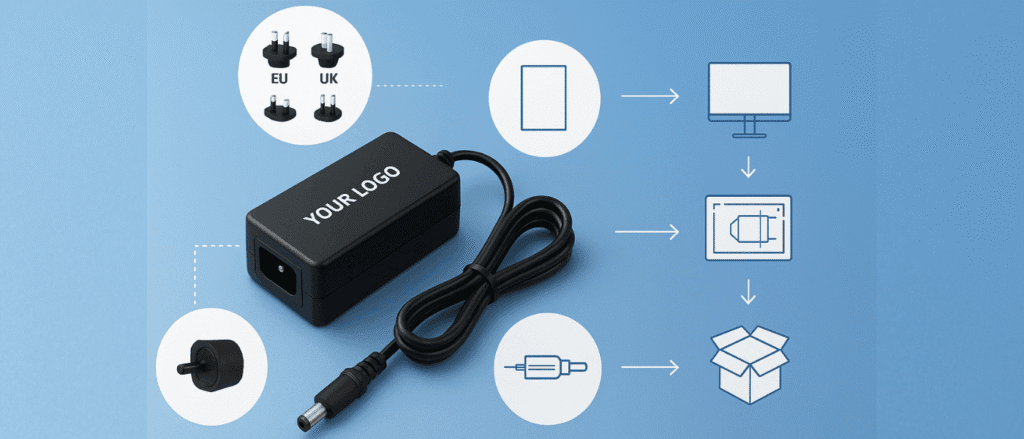
Common customization requirements include:
- Custom output voltage
- Custom output current
- Custom DC connector
- Custom cable length
- Custom AC plug
- Custom enclosure
- Wall-plug or desktop configuration
- Special labeling
- Customized mechanical dimensions
- Customized safety approvals
- Different output specifications
- USB-C Power Delivery
- OEM branding
- ODM electrical or mechanical modifications
This is where working directly with a power supply manufacturer can provide advantages over buying generic adapters.
OEM and ODM 5V Power Supply Solutions
If you are developing a new electronic product, you may not need a completely new power supply from scratch.
An experienced power supply manufacturer can often start from an existing platform and customize the electrical or mechanical configuration according to the product requirements.
For example, an OEM/ODM project may involve:
Existing Power Platform
↓
Output Voltage / Current
↓
Connector & Cable
↓
Enclosure
↓
Safety & EMC Requirements
↓
Branding
↓
Prototype
↓
Testing & Validation
↓
Mass Production
This approach can help reduce development time compared with designing a completely new power architecture.
For medical and professional equipment, engineering support is particularly important because the power supply may directly affect the certification and reliability of the final product.

Quankang 5V Power Supply Solutions for OEM and ODM Projects
For applications that require more than a generic 5V adapter, Quankang provides medical-grade AC/DC power supply solutions designed for professional equipment manufacturers.
For example, the UES24LZ5-SPA Series provides a platform covering 5V to 24V output configurations with power up to 24W, making it suitable for applications that require a 5V output while leaving additional power headroom for system design.
Depending on the application, the platform can be considered for equipment such as:
- Portable diagnostic equipment
- Blood glucose analyzers
- Pulse oximeters
- Small medical instruments
- Medical printers
- Healthcare electronics
- Industrial and IoT equipment
For products requiring higher power or USB-C Power Delivery, Quankang also offers higher-power platforms that can support the transition from a basic 5V adapter to more flexible power architectures.
The advantage of selecting a manufacturer with multiple power platforms is that your product does not necessarily have to change suppliers when its power requirements increase.
Why Work with a Power Supply Manufacturer Instead of Buying a Generic Adapter?
For a consumer device, the cheapest compatible adapter may be sufficient.
For an OEM product, however, the power supply becomes part of the product’s overall engineering and supply chain strategy.
Working directly with a power supply manufacturer can provide access to:
Engineering Support
The supplier can evaluate voltage, current, load profile, connector, thermal requirements, and other specifications.
OEM Customization
Output specifications, cables, connectors, enclosures, labels, and other requirements can be customized.
ODM Development
For products requiring more extensive electrical or mechanical changes, an ODM approach can help develop a solution around the customer’s product requirements.
Certification Support
Professional equipment may require specific safety and EMC documentation for regulatory submissions.
Long-Term Supply
Commercial products need stable supply, consistent quality, and controlled component changes over their lifecycle.
Product Roadmap Support
A manufacturer with multiple power platforms can help customers move from low-power 5V products to higher-power or USB-C PD solutions as the product evolves.
5V 1A vs 5V 2A: Common Mistakes to Avoid
Mistake 1: Choosing Based Only on the Voltage
Both products output 5V, but that does not mean they have the same capacity.
Mistake 2: Assuming More Amps Is Always Better
A higher current rating is useful only when the application benefits from the additional capacity.
Mistake 3: Ignoring Peak Loads
A device that consumes 4W normally may require substantially more power during startup or communication peaks.
Mistake 4: Ignoring Connector Compatibility
A 5V 2A adapter with the wrong connector or polarity is not a suitable replacement.
Mistake 5: Using Consumer Adapters in Professional Applications
Professional and medical products may require safety, EMC, isolation, and certification characteristics that a generic consumer adapter does not provide.
Mistake 6: Designing Only for Today’s Product
If the next product revision requires more power, a narrowly optimized 5V 1A design may require another engineering cycle.
Frequently Asked Questions
Is 5V 2A better than 5V 1A?
Not necessarily. A 5V 2A adapter provides up to 10W, while a 5V 1A adapter provides up to 5W. The correct choice depends on the device’s maximum power consumption, peak load, and required design margin.
Can I use a 5V 2A adapter for a 5V 1A device?
In many cases, yes, provided the voltage, connector, polarity, and other electrical specifications are compatible. The device normally draws only the current it requires.
Can I use a 5V 1A adapter for a 5V 2A device?
Generally, this is not recommended if the device actually requires up to 2A. An undersized supply may cause voltage drop, instability, overheating, or shutdown.
Is 5V 2A equal to 10W?
Yes. At the nominal output rating:
5V × 2A = 10W
Is a 5V 2A adapter safe for medical equipment?
Not automatically. A 5V 2A output specification only describes electrical output capacity. Medical equipment may require specific safety, isolation, leakage current, EMC, and certification characteristics.
How do I choose a 5V power supply for a medical device?
Start with the device’s maximum and transient power requirements, then evaluate IEC 60601-1, applicable EMC requirements, MOPP/MOOP, leakage current, isolation, connector configuration, thermal performance, and required certifications.
When should I consider an OEM power supply?
OEM customization is worth considering when you need a specific connector, cable, enclosure, output specification, certification, branding, or long-term supply arrangement.
Can a power supply manufacturer customize a 5V 1A or 5V 2A adapter?
Yes. Depending on the supplier’s capabilities, customization may include output specifications, connectors, cables, enclosure design, AC plug configuration, labeling, certifications, and other mechanical or electrical requirements.
Final Takeaway: 5V 1A or 5V 2A?
The answer is not simply that 5V 2A is better.
A 5V 1A adapter provides up to 5W, while a 5V 2A adapter provides up to 10W.
Choose 5V 1A when your device has a genuinely low and stable power requirement with sufficient operating margin.
Choose 5V 2A when your device requires more power, has transient loads, uses multiple peripherals, or benefits from additional power headroom.
For professional equipment, however, the decision should go beyond voltage and current.
Engineers should evaluate:
Power → Regulation → Ripple/Noise → Thermal Performance → Safety → EMC → Reliability → Certification → Mechanical Compatibility → Future Scalability
And for medical equipment, the power supply should be evaluated as part of the complete medical device certification and safety strategy.
If you are developing a new product and need a 5V 1A, 5V 2A, or customized medical-grade AC/DC power supply, a standard adapter may not always be the most efficient solution.
Quankang can support OEM and ODM power supply projects from specification evaluation and platform selection to customization, certification support, and mass production.
Need a customized 5V power supply for your product?
Send us your required input voltage, output voltage/current, power consumption, connector type, application, certification requirements, and target market. Our engineering team can recommend a suitable power platform or discuss an OEM/ODM solution for your project.