
A startup asks two suppliers to quote a 30 W USB-C adapter. One quotes $3.80 per unit. It looks like an easy win.
Then the details arrive. The buyer sees $6,000 for housing tooling, $8,000 for certification, two paid sample rounds, and a 3,000-piece MOQ.
Custom adapter pricing is rarely just the unit price.
I help buyers and engineers evaluate ODM quotes for custom power adapters before they commit to a supplier. This guide covers the real cost, a realistic MOQ and lead time, and how to judge a quote before you sign.
What an ODM Really Means for Custom Power Adapters
Buyers often use “ODM,” “OEM,” and “custom” as if they mean the same thing. They don’t. The difference shapes your cost, your MOQ, and your timeline, so pin it down before you ask for a quote.
ODM Is Not OEM, and It Is Not Stock Buying
With ODM (original design manufacturing), the factory owns the base design. You choose the output, connector, housing, and branding. The factory then adapts its own platform to match.
With OEM (original equipment manufacturing), you bring the design. The factory builds to your schematic, layout, and housing files. You own more of the IP, and you also carry more of the engineering and certification work.
Stock buying is the simplest path. You pick a finished catalog model, add your label, and ship.
One warning: many suppliers use “OEM” loosely to mean a logo on a stock unit. Always ask what they actually plan to change.
Most ODM Projects Start From a Proven Platform
A capable ODM rarely starts from a blank page. It begins with a circuit that has already passed safety and EMI testing, then tunes it to your spec.
Typical changes include output voltage, cable length, connector type, plug style, housing color, and logo. Shifting a 20 V / 1.5 A platform to 19 V / 1.6 A usually means a small feedback change and a retest. Jumping from 30 W to 65 W means a different platform.
So I always ask suppliers which platform they plan to use. The closer it sits to your spec, the lower your NRE and the fewer sample rounds you’ll pay for. You can often reuse existing test reports, too.
Where ODM Fits, and Where It Doesn’t
ODM works best for moderate customization. Think of your own brand look, a specific output, or regional plugs, at a few thousand units per order.
It fits poorly in two cases. If you need 200 units next month, buy stock. If your electronics must be truly unique, go OEM or full custom.
Option | Best for | Cost level | Speed | Limits |
|---|---|---|---|---|
Stock / off-the-shelf | Small orders, fast launches | Lowest | Days to a few weeks | Limited branding, fixed specs |
ODM | Branded, moderately custom adapters | Moderate NRE and tooling | About 10–16 weeks | Bound by the supplier’s platform |
OEM | Unique designs you control | Highest | Often 4–9 months | You carry design and certification risk |
What a Custom Power Adapter Really Costs
A unit price tells you very little until you know what sits around it. I break every ODM quote into three layers: money you pay once, money you pay on every unit, and money you pay to get the goods to your door.
Once you see all three, two quotes that looked far apart often land close together. Sometimes the cheap quote turns out to be the expensive one.
One-Time Costs: Tooling, NRE, Samples, and Certification
These costs hit before mass production starts. Plan for them first, because they shape your real cost per unit on the first order.
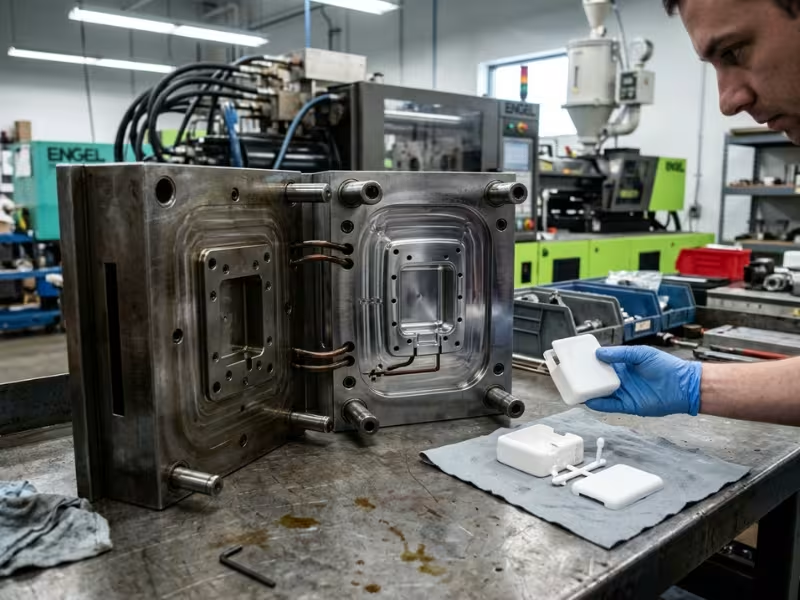
Housing tooling covers the injection mold for a custom enclosure. Most projects fall between $3,000 and $15,000. Larger housings, multi-cavity molds, textured or high-gloss finishes, and two-color designs push it up. Different plug types for the US, EU, UK, and Australia can also mean separate molds or an interchangeable plug system.
NRE pays for engineering changes, such as output tuning, layout edits, or a new connector footprint. A small change on a proven platform may cost $1,000 to $3,000. A new platform costs far more.
Samples are often free for the first round. Revisions usually aren’t.
Certification can match or exceed tooling. A UL or ETL listing for the US alone often runs several thousand dollars. Each extra market, such as UKCA, PSE, SAA, or CCC, adds its own fees. If your supplier already holds a report for the base platform, adding your model can cost a fraction of a new test.
Before you sign, ask two questions: who owns the mold, and does the supplier refund tooling after a set volume? Some refund it after 10,000 to 20,000 units.
Cost item | One-time or recurring | What drives it up |
|---|---|---|
Housing tooling | One-time | Size, cavities, finish, multiple plug styles |
NRE | One-time | Distance from the base platform |
Sample revisions | One-time | Late spec changes, unclear requirements |
Certification | One-time, plus renewals | Number of markets, new vs. reused reports |
Factory inspections | Recurring | UL/ETL follow-up visits, often quarterly |
Unit price | Recurring | Power, connector, cable, efficiency, packaging |
Freight and duties | Recurring | Shipping method, tariffs, Incoterms |
Unit Price: What You Pay on Every Adapter
Power class drives the unit price more than anything else. A 5 W adapter uses a simple circuit with few parts. At 18 to 20 W, USB PD chargers add a PD controller. Around 30 W, many designs move to GaN to stay compact.
At 65 W and above, you pay for a larger transformer, better capacitors, and more thermal margin. Above 75 W, EU harmonic rules typically require PFC, which adds another stage.
The details stack up fast after that:
- Connector and cable: A barrel jack costs least. A captive USB-C cable rated for 5 A needs an e-marker chip. Braided or extra-long cables add cents to dollars.
- Plugs: Foldable pins and interchangeable plug kits add parts and assembly steps.
- Efficiency: DoE Level VI and CoC Tier 2 set the floor. Going beyond them means better parts.
- Packaging: A retail box with multilingual manuals costs far more than a bulk polybag.
Treat the ranges below as rough FOB guides at a few thousand units, with a standard cable and simple packaging.
Power class | Typical ODM situation | Common price pressure |
|---|---|---|
5 W (roughly $1–$2) | Basic chargers, small devices | Cable and packaging take a large share |
18–20 W (roughly $2–$4) | Phone fast charging, USB PD | PD controller, multi-region plugs |
30 W (roughly $3–$6) | Tablets, compact GaN designs | GaN vs. silicon, housing size |
65 W+ (roughly $6–$15+) | Laptops, tools, multi-port | GaN, thermals, 5 A cables, PFC above 75 W |
Hidden Costs That Change the Landed Price
An FOB price stops at the port of origin. Ocean or air freight, insurance, customs clearance, duties, and inland delivery all come after it. A DDP quote includes those costs, so it always looks higher. Compare FOB with FOB, or convert both to landed cost.
Tariffs on China-origin power supplies have changed several times in recent years. Check the current rate when you order, not when you first ask for quotes. Air freight can add $0.30 to $1 per unit. Sea freight usually adds only cents, but it adds weeks.
Here’s how I break down the quote from the opening example:
- 3,000 units at $3.80 = $11,400
- Housing tooling = $6,000
- Certification = $8,000
- Sample revisions ≈ $500
That totals about $25,900, or roughly $8.63 per unit before freight and duties.
That number, not $3.80, belongs in your budget.
Why MOQ Changes So Much From One Project to Another
Two suppliers can quote the same 30 W adapter with MOQs of 500 and 5,000 pieces. Neither one is bluffing.
MOQ reflects what your project forces the factory to buy, set up, and pay off. Once you see those three pressures, you can tell which MOQs you can negotiate and which you can’t.
What Actually Sets the Number
Parts come in minimum lots. A USB PD controller often ships on a reel of 3,000 to 5,000 pieces. A custom-wound transformer needs its own production lot. Cable makers rarely extrude a custom color or length for fewer than a few thousand pieces. If your design needs any of these, the factory either buys the full lot or passes the risk to you.
Every run needs setup. The line needs a changeover, a loaded test program, burn-in racks, and a first-article check. That can take half a shift. On a 300-piece order, setup can cost as much as the build itself.
Tooling must pay for itself. A $6,000 mold adds $6 per unit across 1,000 pieces. Across 5,000 pieces, it adds only $1.20. Many suppliers raise the MOQ so the mold cost doesn’t swamp your unit price.
How Customization Depth Moves the MOQ
Light changes keep the MOQ low. A logo on a stock housing, a standard color, and a catalog connector all use parts the factory already stocks.
Deep changes push it up fast. A new housing, a new circuit, or a fresh certification means new molds, new magnetics, and new paperwork to spread across units.
Project type | Typical MOQ direction | Why |
|---|---|---|
Stock unit with your logo | Low (often 500–1,000) | No new parts. Only printing or a label changes |
Standard housing in a custom color | Low to moderate | The resin color batch has a minimum |
Output or cable tweak on a proven platform | Moderate (about 1,000–3,000) | Custom cable lots and a retest |
New housing on an existing circuit | Higher (about 3,000–5,000) | Tooling cost needs volume to amortize |
New circuit plus new certification | Highest (5,000+) | Custom magnetics, IC reels, and certification costs |
What You Can Trade, and What You Can’t
You have more leverage than most buyers realize. I usually suggest three trades:
- Pay a bit more per unit. Many factories cut the MOQ in half for a 10% to 20% higher unit price.
- Stay on a shared platform. Use the supplier’s standard housing, color, and cable, so your parts come from stock they already hold.
- Stage your orders. Commit to an annual volume, such as 5,000 pieces, but release it in 1,000-piece batches. Expect to pay a deposit on long-lead parts.
Some MOQs won’t move, though. A custom-wound transformer, a custom cable color, or a printed retail box carries a supplier minimum that the factory can’t waive. During component shortages, IC allocations can also lock the MOQ to the full reel.
When a supplier refuses to lower a number, ask which part drives it. The answer usually tells you exactly what to simplify.
Lead Time: Where the Weeks Really Go
Most suppliers quote “25 to 30 days” for production. Many buyers hear that and plan a launch six weeks out.
In practice, a typical ODM adapter takes 10 to 16 weeks from first inquiry to goods in your warehouse. Production is rarely the slow part. Here is where the time actually goes.
Sampling Takes Longer Than Anyone Plans
The real clock starts when your spec stops moving. Many projects begin with a one-line request: “30 W USB-C, black, our logo.” The factory builds a sample, and then the questions start. Which PD profiles? What cable length? Matte or gloss?
Each answer can trigger another sample round. A first sample on a proven platform usually takes 1 to 2 weeks. Each revision adds 1 to 2 more, plus courier time. A new housing needs a mold first, and that alone takes 3 to 5 weeks.
I ask buyers to send a one-page spec before they request samples. It should list:
- Output and PD profiles
- Connector and cable length
- Plug types and target markets
- Color and packaging
That single page often saves two revision rounds.
Certification Often Becomes the Longest Stage
The lab can’t start until you approve a golden sample. Then each market adds its own timeline. A UL or ETL listing often takes 4 to 8 weeks. PSE, SAA, or CCC can each add several more.
Lab queues stretch this further. A busy lab may not start your project for 1 to 2 weeks. If the unit fails a test, such as conducted EMI, the factory fixes it, builds new samples, and waits in line again. One failure can add 3 to 4 weeks.
A certified platform saves the most time here. Often, the lab only reviews the changes and adds your model to an existing report.
Production Is Only One Slice
Building 3,000 adapters, including burn-in and hipot, takes 2 to 4 weeks. But the line can’t start until every part arrives. A custom transformer or custom cable may need 2 to 4 weeks. During shortages, a PD controller can take 12 weeks or more.
The calendar matters too. Chinese New Year shuts most factories for 2 to 4 weeks, and workers often return slowly. Orders placed in December compete for crowded lines. After that, sea freight adds 3 to 6 weeks.

Small Late Changes Can Reset the Clock
A minor change after certification rarely stays minor. Swap the transformer, Y-capacitor, or housing resin, and the lab may need to retest. A new label layout means updated marking files for every certificate. Even a cable length change can require new samples and a fresh approval.
Freeze your spec before you sign off on the golden sample. If you must change something, ask the supplier which tests it triggers before you approve it.
Stage | Typical duration | What often delays it |
|---|---|---|
Spec lock and sampling | 2–6 weeks | Vague specs, extra revision rounds |
Housing tooling | 3–5 weeks | Mold corrections, finish changes |
Certification | 4–8+ weeks per market | Lab queues, failed tests, missing documents |
Component sourcing | 2–12+ weeks | PD ICs, custom transformers and cables |
Mass production | 2–4 weeks | Chinese New Year, pre-holiday rush |
Shipping | About 1 week by air, 3–6 by sea | Port congestion, customs holds |
Plan around the full chain, not the production quote. Your launch date depends on the slowest stage.

The Fastest Way to Judge Whether an ODM Quote Is Realistic
A quote is a scope document with a price attached. Most buyers read the price first. I read the scope first, and it takes about ten minutes.
Here’s how I review a quote before I compare it with anything else.
A Low Number With No Scope Is a Warning
If a quote lists only a unit price and an MOQ, the supplier hasn’t priced your project yet. They’ve priced a stock unit. Every missing detail comes back later as a change order, usually after you’ve paid the tooling deposit.
A capable supplier itemizes. I expect separate lines for tooling, NRE, sample rounds, certification, packaging, and shipping terms. If a line is missing, I treat it as excluded until the supplier confirms it in writing.
Match the Scope Before You Compare Prices
I put every quote into one spreadsheet with the same rows. Then I fill each gap with an email, not a guess. These are the rows I always check:
- Certification: which markets, a new test or an existing report, and who holds the certificate
- Housing tooling: cost, mold ownership, and any refund after a set volume
- Plugs: US only, or US, EU, UK, and AU versions
- Sample rounds: how many are free, and the cost of each extra round
- Packaging and labeling: bulk polybag or retail box, rating label, and manual
- Shipping terms: EXW, FOB, or DDP, and from which port
- Warranty: length, and who pays when units fail
I compare totals only after every row matches. The cheapest quote often drops to second or third place once the gaps are filled.
Certification and Warranty Gaps Cost the Most
These two gaps hurt because they show up late. “CE compliant” on a quote often means a self-declaration based on a report for a different model. It won’t help when a US retailer asks for a UL or ETL listing.
Ask for the report number, the listed model names, and the certificate holder. Then confirm the listing in the certifier’s online directory.
Warranty wording needs the same care. “1-year warranty” means little if you must ship failed units back at your own cost. I ask for three things in writing:
- The warranty period
- An agreed field failure rate for the platform
- Who pays for freight, failure analysis, and replacements when a batch exceeds that rate
If the quote says… | Check this next… |
|---|---|
“Certification available” | Which markets, the report number, and who holds it |
“Tooling: $0” | Whether tooling is hidden in the unit price or MOQ |
“Standard plug” | Which regions, and whether other plugs need new molds |
“Free samples” | How many rounds, and the cost of revisions |
“FOB price” | Port of origin, freight estimate, and duties |
“Standard packaging” | Bulk or retail, plus labels and manuals |
“1-year warranty” | Failure rate limit, return freight, and replacement terms |
“Lead time: 30 days” | Whether that includes sampling and certification |
When a supplier won’t fill in these rows, that refusal tells you more than the price does.
How to Choose an ODM Without Creating Expensive Delays Later
A certificate on the wall tells you a supplier can pass a test. It doesn’t tell you whether your project will run on time.
Most of the delays I see come from a few causes: vague updates, sample revisions nobody tracks, unclear certificate ownership, and part swaps nobody announces. So I judge an ODM on three things before I care about price.
Start With the Platform, the Paperwork, and the People
Ask how long the base platform has been in production and roughly how many units have shipped. A design with two years and 100,000 units in the field has already shown its weak spots. A brand-new platform will show them during your project.
Then check the certification history. Ask for the CB report or UL file number, the listed model names, and the certificate holder. If the supplier holds the certificate, you can’t easily move production to another factory later. If you need that freedom, negotiate it now.
Finally, find out who owns your project. You want one named project engineer, not just a sales rep who forwards emails. Confirm in writing who owns the mold, the artwork, and any custom design files.
Ask How They Test, Fail, and Change
A certificate is a summary. The full test report shows the margins. Ask for the safety report and the EMI report on the base platform. If conducted emissions pass by only 1 or 2 dB, your cable change could push them over the limit.
Next, ask how the supplier handles failures. A capable ODM can show you a recent failure analysis or 8D report. It should commit to a first response within a few days and a root cause within two weeks.
Change control matters most. Factories sometimes swap a capacitor, a transformer vendor, or a housing resin to save cost or dodge a shortage. On a certified adapter, that swap can void the listing. I ask for three commitments in the purchase agreement:
- A locked list of approved safety-critical parts
- Written change notice at least 60 to 90 days before any swap
- A signed golden sample that both sides keep for comparison
Test the Communication Before You Cut Steel
Once the mold is cut, every mistake gets expensive. A housing change after tooling can cost thousands of dollars and three more weeks. So I test how a supplier communicates while changes are still cheap.
Watch how they handle your first spec sheet. Do they come back with smart questions about PD profiles, plug types, and labels? Or do they just say “no problem”? Good questions early mean fewer surprises later.
Before tooling starts, ask for three things:
- A DFM review of the housing, covering wall thickness, draft, and plug retention
- A shared change log that records every sample revision and who approved it
- A weekly update with photos, open issues, and the next milestone date
Sign an NDA before you share drawings, and keep your own copy of every approved file.
An ODM that pushes back on these requests will rarely get easier to work with after you pay the deposit.
Common Buyer Concerns, With Practical Answers
Most ODM conversations run into the same three worries, usually right after the first quote lands. Here’s how I answer them when a buyer raises them on a call.
“The MOQ Is Too High for Us”
That’s fair. A 3,000-piece MOQ can tie up a startup’s cash for months. But the MOQ usually comes from your spec.
Start with the lightest option and put your logo on a stock adapter. A pad print or laser mark on an existing housing often brings the MOQ down to 500 or 1,000 pieces, with no tooling at all.
If you need more than a logo, go semi-custom. Keep the supplier’s housing, color, and cable, and change only the output or the label. Swap a custom cable color for black, and a custom box for a printed sleeve. Each stock part you accept removes one supplier minimum.
Still too high? Commit to an annual volume and release it in smaller batches. I’ve seen buyers launch with 1,000 stock-based units, prove demand, and then fund custom tooling from the second order.
“The Quote Is Much Higher Than Alibaba”
It usually is, and for real reasons. A $2 listing often carries a CE mark backed by nothing, or by a report for a different model. It has no UL or ETL listing, no follow-up factory inspections, and no traceable parts list. The capacitors and transformer can change from batch to batch without notice.
A certified ODM unit covers the lab fees, the quarterly inspections, the locked bill of materials, and a burn-in and hipot test on every unit. You also pay for someone to answer when a batch fails.
If a retailer pulls your product over a missing certificate, the cheap adapter becomes the most expensive part you bought.
“What If Certification Fails After We Start?”
It happens, so plan for it. The simplest protection is a platform that already holds a report for your markets. The lab then reviews only your changes, and the risk drops sharply.
For anything new, ask for pre-compliance testing first. A quick EMI and safety pre-scan costs a few hundred dollars. It catches most problems before you join the formal lab queue.
Then put the risk split in writing. I usually agree that the supplier pays for retests caused by its design or parts, and the buyer pays for retests caused by spec changes. That one clause prevents a lot of arguments later.
FAQ
These six questions come up on almost every first ODM call. Here are the short answers I give buyers.
What is the difference between ODM and OEM for power adapters?
With ODM, the factory owns the base design. It adapts a proven platform to your output, connector, housing, and branding.
With OEM, you supply the design files, and the factory builds to them. ODM costs less and moves faster. OEM gives you more control, but you carry more of the engineering and certification work.
How much does a custom power adapter cost per unit?
Power class sets most of the price. At a few thousand units FOB, expect roughly:
- $1–$2 for 5 W
- $2–$4 for 18–20 W
- $3–$6 for 30 W
- $6–$15 or more for 65 W and above
Then add tooling, certification, and sample costs, and divide the total by your first order quantity. Use that number in your budget, not the quoted unit price.
What is a typical MOQ for custom power adapters?
It depends on how much you change. A logo on a stock unit often starts at 500 to 1,000 pieces. An output or cable tweak usually lands between 1,000 and 3,000. A new housing or a new circuit can push the MOQ to 5,000 or more.
How long does it take to produce a custom power adapter?
Plan on 10 to 16 weeks from first inquiry to goods in your warehouse. Production takes only 2 to 4 weeks of that time. Sampling, tooling, certification, and shipping take up the rest. Chinese New Year can add another 2 to 4 weeks.
Do ODM power adapters include safety certifications?
Not automatically. Many suppliers hold reports for the base platform, but the lab may still need to add your model. Ask which markets the quote covers, along with the report number and the certificate holder. Then confirm the listing in the certifier’s online directory.
Can I add my logo to a standard adapter without paying for a new mold?
Yes. Pad printing or laser marking on an existing housing needs no new tooling. You may pay a small setup fee for the print plate.
Keep the stock color and cable as well, and your MOQ stays low. A molded-in logo, a custom color, or a new shape will require mold work.
Compare the Full Project Cost, Not Just the Unit Price
A low unit price makes a quote look easy to approve. But it rarely tells you what the project will really cost. Tooling, certification, sample rounds, and freight can more than double your cost per unit on the first order.
MOQ and lead time follow one simple rule. The further you move from an existing platform, the more you pay and the longer you wait. A logo on a stock housing can ship in a few weeks. A new circuit with fresh certification can take months.
The buyers who make the best ODM decisions do two things well. They lock their specs early, and they compare quotes line by line.
So start there. Write a one-page spec sheet that lists output, connector, certifications, and target price. Then check which of our existing products sits closest to that spec, and request itemized quotes from at least three ODM suppliers to compare row by row.