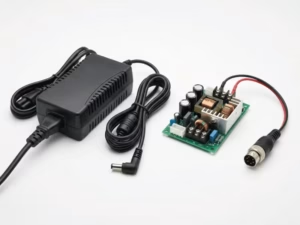
When sourcing a PoE adapter for an IP camera, WiFi access point, IoT device, network product, or industrial application, choosing the right supplier can be just as important as choosing the right power specification.
A quick search for PoE adapter suppliers may return hundreds of companies. Some are manufacturers with their own engineering and production capabilities. Others are distributors, trading companies, or sourcing companies that purchase products from third-party factories and resell them.
For a standard PoE adapter and a small one-time order, working with a supplier or distributor may be sufficient.
However, if you need a custom PoE adapter, OEM/ODM development, certification support, product modifications, or long-term production, working directly with an experienced PoE adapter manufacturer can provide significant advantages.
The key question is therefore not simply:
“Which company has the lowest price?”
A better question is:
“Which type of supplier can support my project’s technical, commercial, and long-term requirements?”
This guide explains the differences between a PoE adapter manufacturer and supplier, when each option makes sense, how to verify a manufacturer’s capabilities, and what B2B buyers should evaluate before placing an order.
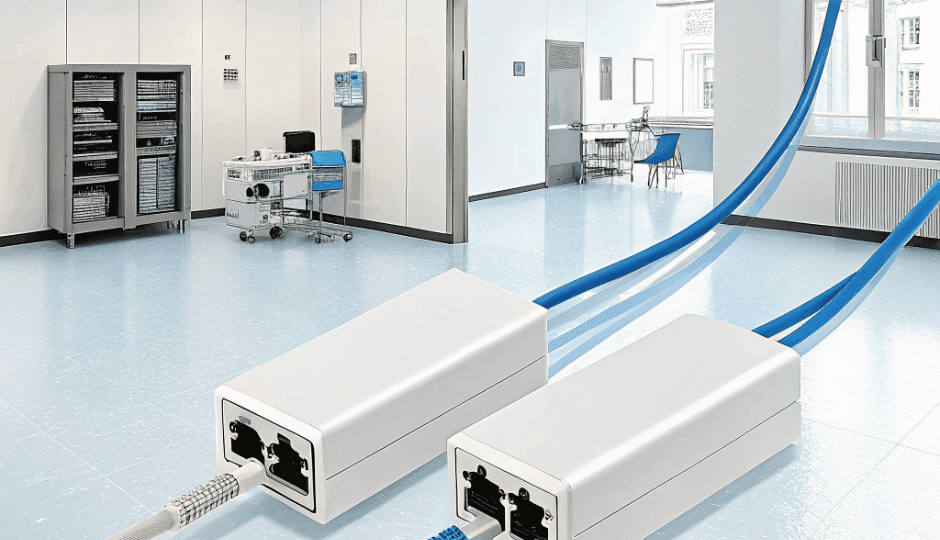
PoE Adapter Manufacturer vs. Supplier: What Is the Difference?
The terms manufacturer and supplier are sometimes used interchangeably, but they can represent very different business models.
What Is a PoE Adapter Manufacturer?
A PoE adapter manufacturer develops and/or produces PoE power products in its own manufacturing facilities or through controlled production resources.
Depending on the company, a manufacturer may provide:
- Product engineering
- Electrical design
- Mechanical design
- Product testing
- Prototype development
- Manufacturing
- Quality control
- Certification support
- OEM services
- ODM services
- Customization
- Mass production
- After-sales technical support
The exact capabilities vary from one manufacturer to another.
A manufacturer is particularly valuable when the project involves technical requirements rather than simply purchasing an existing product.
What Is a PoE Adapter Supplier?
“Supplier” is a broader term.
A PoE adapter supplier may be:
- A manufacturer
- A distributor
- A wholesaler
- A trading company
- An importer
- A sourcing company
A supplier may purchase PoE adapters from one or more manufacturers and then sell them to customers.
This business model can be perfectly suitable for standard products.
For example, if a customer needs 100 standard PoE adapters with no customization, a distributor may be able to provide the required products quickly.
The important point is that supplier does not automatically mean manufacturer.
Therefore, buyers should determine what capabilities are actually available behind the company they are purchasing from.
PoE Adapter Manufacturer vs. Supplier: Key Differences
| Factor | PoE Adapter Manufacturer | Distributor / Trading Supplier |
| Own manufacturing capability | Usually | Usually not |
| Product engineering | Often available | Limited or outsourced |
| OEM | Usually possible | May depend on factory |
| ODM | Possible with capable manufacturers | Usually limited |
| Customization | More flexible | Depends on upstream factory |
| Prototype support | Usually available | May require coordination |
| Direct technical communication | Usually | May be indirect |
| Production control | Higher | Depends on manufacturer |
| Certification support | Often available | May rely on factory |
| MOQ flexibility | Depends on project | Depends on source |
| Price structure | Factory-based | Includes intermediary margin |
| Long-term customization | Stronger | May be more difficult |
| Best for | OEM, ODM, custom, long-term projects | Standard products and sourcing |
This does not mean that every manufacturer is better than every supplier.
The correct choice depends on the requirements of your project.
When Should You Buy From a PoE Adapter Supplier?
A supplier or distributor may be a practical choice when you need a standard product and do not require engineering support.
For example, a supplier may be suitable if:
- You need a standard PoE adapter.
- The required power rating is already available.
- No customization is required.
- The connector is standard.
- No special mechanical requirements exist.
- You need a relatively small quantity.
- You need products quickly.
- The existing certifications are sufficient.
In these situations, the most important factors may be:
- Product availability
- Price
- Delivery time
- Minimum order quantity
- Basic quality
- Logistics
There may be little benefit in starting an engineering project if an existing standard product already meets all requirements.

When Should You Work Directly With a PoE Adapter Manufacturer?
A manufacturer is generally more suitable when the project involves technical development, customization, or long-term supply.
Consider working directly with a manufacturer when you need:
Custom Power Specifications
For example:
- Specific output power
- Specific output voltage
- Higher power requirements
- Application-specific power requirements
Custom Connectors
You may need:
- A specific DC connector
- Custom pin configuration
- Special cable length
- Customized cable assembly
Custom Mechanical Design
For example:
- Smaller dimensions
- Special housing
- Customized cable exit
- Application-specific installation requirements
OEM Branding
You may need:
- Company logo
- Model number
- Product label
- Packaging
- Documentation
ODM Development
If you have a product concept but need engineering assistance, a manufacturer with ODM capabilities may be more appropriate.
Long-Term Supply
If the PoE adapter will be integrated into a product that will be manufactured for several years, direct communication with the manufacturer can become particularly important.
Standard PoE Adapter vs. Custom PoE Adapter: Which Supplier Is Better?
The required supply model often depends on whether you are purchasing a standard or customized product.
Standard PoE Adapter
A distributor or supplier may be sufficient when:
“I need an existing PoE adapter with known specifications.”
The purchasing process may focus primarily on:
- Price
- Stock
- MOQ
- Lead time
- Certifications
Custom PoE Adapter
A manufacturer is generally more valuable when:
“I need a PoE adapter that meets specific requirements for my product.”
The project may involve:
- Technical evaluation
- Engineering
- Sampling
- Testing
- Modification
- Certification
- Mass production
This difference is critical for B2B buyers.
A company may offer a “custom PoE adapter” but actually outsource all engineering and production to another factory.
That does not automatically make the supplier unsuitable, but the customer should understand who is responsible for the actual product development and manufacturing.
Why Direct Communication With a Manufacturer Matters
For simple products, communication may be straightforward.
For customized PoE adapters, however, technical details can become much more important.
Consider a project where a customer says:
“We need a 60W PoE adapter for our WiFi access point.”
That specification alone may not be enough.
The manufacturer may need to understand:
- Required PoE standard
- Input voltage
- Output requirements
- Maximum power consumption
- Startup behavior
- Connector
- Cable
- Operating environment
- Target market
- Certification requirements
If the customer communicates directly with the manufacturer’s engineering team, technical requirements can often be clarified more efficiently.
If communication passes through several intermediaries, technical information may be incomplete or misunderstood.
For OEM and ODM projects, this can lead to:
- Repeated revisions
- Incorrect samples
- Longer development time
- Unexpected costs
- Compatibility problems
Therefore, direct technical communication can be a major advantage.
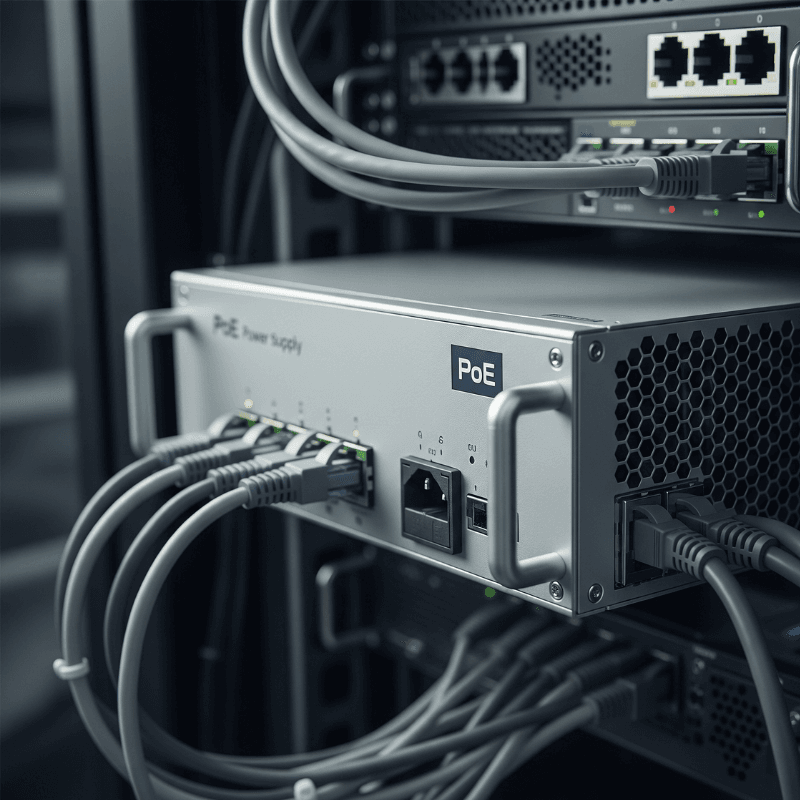
What Are the Advantages of Buying Directly From a PoE Adapter Manufacturer?
1. Better Engineering Support
A capable manufacturer can evaluate whether an existing product can satisfy the application or whether customization is necessary.
This can prevent unnecessary development work.
2. More Flexible Customization
Depending on the product platform, customization may include:
- Input
- Output
- Power
- PoE standard
- Connector
- Cable
- Housing
- Label
- Packaging
The available options should always be confirmed with the manufacturer.
3. Faster Technical Feedback
Questions about:
- Compatibility
- Power requirements
- Thermal performance
- Protection
- Certification
can be discussed directly with the engineering team.
4. Better Control Over Product Quality
A manufacturer with its own production and quality systems can have greater control over:
- Incoming materials
- Production processes
- Testing
- Final inspection
- Engineering changes
However, buyers should verify these capabilities rather than assume them.
5. Better Support for OEM Projects
OEM projects often require more than a product quotation.
They may require:
- Specifications
- Samples
- Documentation
- Labels
- Packaging
- Quality agreements
- Production planning
A direct manufacturer relationship can make these processes easier to coordinate.
6. Better Support for ODM Development
For customers without extensive internal power-supply engineering resources, an ODM manufacturer can participate in product development.
This can include:
- Requirement analysis
- Engineering evaluation
- Prototype development
- Testing
- Product optimization
Does Buying Directly From a Manufacturer Always Mean a Lower Price?
Not necessarily.
This is an important point for B2B buyers.
A manufacturer may offer a competitive factory price, but the final project cost depends on many factors.
For example:
- Product specification
- Order quantity
- Customization
- Tooling
- Certification
- Packaging
- Testing
- Shipping
- Payment terms
A distributor may sometimes offer a lower price for small quantities because it already holds inventory.
Therefore, buyers should compare total procurement cost, not simply the factory unit price.
Manufacturer vs. Supplier: Which Is Better for Small Orders?
For small quantities, a distributor or supplier may sometimes be more convenient.
For example, if you need:
- 10 units
- 20 units
- 50 units
of a standard PoE adapter, purchasing an existing product from a distributor may be easier than starting a factory customization project.
However, if those small quantities are for:
- Prototype testing
- Product development
- Future mass production
then communicating with the manufacturer can still be valuable.
A manufacturer may provide engineering samples that are intended to transition into larger-scale production later.
Therefore, order quantity alone should not determine the sourcing strategy.
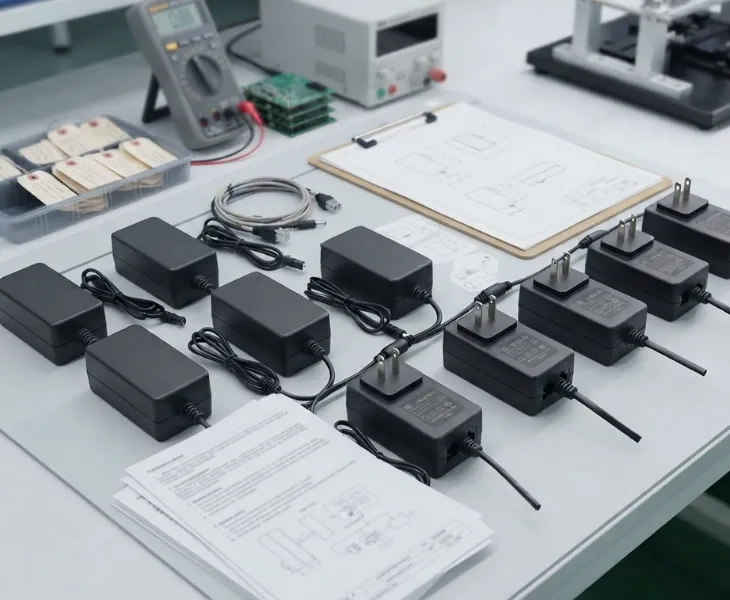
Manufacturer vs. Supplier for High-Volume Projects
For larger production programs, the manufacturer’s capabilities become increasingly important.
A high-volume OEM project may require:
- Stable component sourcing
- Production capacity
- Quality control
- Engineering change management
- Production scheduling
- Long-term product availability
- Certification maintenance
If the supplier is only an intermediary, the customer may have less direct visibility into these areas.
For long-term products, it is therefore useful to understand who actually manufactures the PoE adapter.
How to Verify Whether a PoE Adapter Company Is a Real Manufacturer
This is one of the most important questions for B2B buyers.
A company may describe itself as a manufacturer without having substantial production capabilities.
Before placing a large order, consider checking the following.
1. Factory Information
Ask for information about:
- Manufacturing location
- Production facilities
- Production lines
- Assembly capabilities
- Testing equipment
2. Engineering Team
Ask whether the company has internal engineers who can handle:
- Electrical design
- Product modification
- Troubleshooting
- Prototype development
3. Product Development Capability
Ask:
Can you modify an existing PoE adapter to meet our specifications?
Then ask what parameters can actually be customized.
4. Sample Process
A capable manufacturer should be able to explain:
- Sample availability
- Sample development
- Testing
- Approval
- Mass-production transition
5. Certification
Ask for certification information relevant to the exact product configuration.
Do not assume that one certification automatically applies to every customized model.
6. Quality System
Depending on the application, ask about:
- Incoming inspection
- Production testing
- Final inspection
- Reliability testing
- Traceability
- Quality management
7. Production Capacity
For larger projects, confirm whether the manufacturer can support the required production volume.
8. Long-Term Product Support
Ask:
- How long can the product remain available?
- How are component changes managed?
- How are engineering changes communicated?
- Can replacement components be controlled?
These questions are especially important for OEM customers.
10 Questions to Ask a PoE Adapter Manufacturer Before Ordering
A professional RFQ should go beyond:
“What is your price for a 60W PoE adapter?”
Instead, ask:
1. Do you manufacture the PoE adapter in-house?
2. Can you provide OEM or ODM services?
3. Which PoE standards do your products support?
4. What parameters can be customized?
5. Can you provide engineering samples?
6. What certifications are available for the required configuration?
7. What is the MOQ for customized products?
8. What is the development and production lead time?
9. Can you support long-term production?
10. Can you provide technical support during product integration?
The answers to these questions can reveal much more about a supplier’s suitability than the initial quotation.
What Information Should You Provide to a PoE Adapter Manufacturer?
A complete RFQ allows the manufacturer to evaluate the project more accurately.
Provide, where available:
Application
- Device type
- Application
- Installation environment
Power
- Input voltage
- Output voltage
- Normal power consumption
- Maximum power
- Startup power
- Peak power
PoE
- IEEE 802.3af
- IEEE 802.3at
- IEEE 802.3bt
- Other requirements
Interface
- Ethernet connector
- DC connector
- Cable length
- Pin configuration
Mechanical
- Maximum dimensions
- Housing requirements
- Installation requirements
Compliance
- Target countries
- Required certifications
- Regulatory requirements
Commercial
- Initial quantity
- Annual forecast
- Target launch date
- Expected product lifecycle
The more complete the RFQ, the more accurately the manufacturer can determine feasibility, development requirements, lead time, and pricing.
Red Flags When Choosing a PoE Adapter Supplier
Some warning signs deserve additional investigation.
Red Flag 1: Extremely Low Price
A price significantly below the market may indicate differences in:
- Components
- Certification
- Testing
- Quality
- Warranty
- Product specifications
Always compare equivalent products.
Red Flag 2: Cannot Explain the Product Specifications
A company selling technical products should be able to clearly explain the key specifications.
If the sales team cannot answer basic technical questions, ask whether engineering support is available.
Red Flag 3: No Clear Manufacturer Information
If the company cannot provide meaningful information about the actual production source, buyers should investigate further.
Red Flag 4: “Everything Can Be Customized”
This sounds attractive but is not necessarily credible.
A professional manufacturer should explain:
- What can be customized
- What cannot
- What requires engineering
- What affects cost
- What affects certification
Red Flag 5: No Sample Testing
For a custom PoE adapter, testing the actual product with the customer’s equipment is important.
Red Flag 6: No Long-Term Supply Plan
For an OEM product, the manufacturer should be able to discuss component availability and product lifecycle considerations.
PoE Adapter Manufacturer Selection Checklist
Before selecting a supplier, evaluate:
Is the company the actual manufacturer?
Does it have engineering capabilities?
Does it support OEM?
Does it support ODM?
Can it customize PoE specifications?
Can it customize connectors and cables?
Can it provide samples?
Can it support required certifications?
Does it have appropriate quality controls?
Does it have sufficient production capacity?
Can it support the target volume?
Can it provide technical support?
Can it support long-term supply?
Are design responsibilities clearly defined?
Are MOQ and lead times acceptable?
Is the total project cost competitive?
Which Should You Choose: PoE Adapter Manufacturer or Supplier?
There is no single answer for every project.
Choose a Supplier or Distributor When:
- You need a standard product.
- No customization is required.
- Quantity is relatively small.
- Fast availability is more important than engineering support.
- Existing specifications and certifications are sufficient.
Choose a PoE Adapter Manufacturer When:
- You need customization.
- You need OEM branding.
- You need ODM development.
- You need engineering support.
- You require application-specific specifications.
- You need product samples and testing.
- You expect long-term production.
- You need stable technical support.
Choose a Manufacturer With OEM/ODM Capability When:
- You are developing a new network device.
- The standard product does not meet your requirements.
- You need customized power, connectors, cables, or dimensions.
- You need assistance with product development.
- You expect the PoE adapter to become part of your long-term product portfolio.
Why Quankang for PoE Adapter OEM and ODM Projects?
For companies sourcing a PoE adapter for a long-term product program, the key question is not simply whether a supplier can sell an adapter.
The more important question is whether the supplier can support the product from technical evaluation through development, sampling, testing, and mass production.
Quankang provides PoE adapter and PoE power supply solutions for applications including network equipment, IP cameras, WiFi access points, IoT products, and other PoE-powered devices.
For projects requiring customization, Quankang can evaluate requirements such as:
- Input specifications
- Output power
- PoE requirements
- Connectors
- Cables
- Mechanical configuration
- Product labeling
- Packaging
For OEM and ODM projects, customers can provide their application requirements and technical specifications for feasibility evaluation.
The appropriate solution depends on the specific device, power requirements, target market, customization scope, and expected production volume.
How to Request a PoE Adapter Quotation
To receive a more useful quotation, avoid sending only:
“Please quote your PoE adapter.”
Instead, provide your basic project requirements.
For example:
Application: WiFi access point
PoE standard: IEEE 802.3at
Required power: 30W
Input: 100–240VAC
Connector: [Specify]
Cable: [Specify]
Target market: [Country/region]
Certification: [Required certifications]
Initial quantity: [Quantity]
Annual forecast: [Quantity]
Customization: OEM label / custom connector / other
Target production date: [Date]
If some specifications are not yet available, provide the information you do have.
An experienced manufacturer can help identify the remaining requirements during the technical evaluation.
Frequently Asked Questions
Is a PoE adapter supplier the same as a manufacturer?
No.
“Supplier” is a broad term that can include manufacturers, distributors, wholesalers, trading companies, and other sourcing businesses.
A manufacturer is directly involved in product development and/or production.
Is it better to buy PoE adapters directly from a manufacturer?
Not always.
For standard products and small quantities, a distributor may provide faster availability and convenient purchasing.
For customized, OEM, ODM, or long-term projects, direct communication with the manufacturer can provide greater technical and production support.
Can a PoE adapter supplier provide OEM products?
Possibly.
A supplier may cooperate with an upstream manufacturer to provide OEM products.
However, buyers should clarify who actually develops and manufactures the product and who is responsible for engineering and quality.
Can a PoE adapter manufacturer provide ODM services?
Some manufacturers can.
ODM typically requires greater engineering involvement than standard OEM production, so the manufacturer’s actual engineering capabilities should be verified.
Is a manufacturer always cheaper than a supplier?
No.
For small quantities, a distributor may sometimes offer competitive pricing because it already holds inventory.
For larger or customized projects, direct manufacturer sourcing may provide advantages in production cost and customization.
The best comparison should consider the total project cost.
What should I look for in a PoE adapter manufacturer?
Key factors include:
- Manufacturing capability
- Engineering capability
- OEM/ODM support
- Customization
- Product quality
- Certification
- Sample support
- Production capacity
- MOQ
- Lead time
- Long-term supply
- Technical support
How do I verify whether a PoE adapter company is a real manufacturer?
Ask for information about its factory, production capabilities, engineering team, quality system, testing process, product development process, and certifications.
For larger projects, factory verification or an audit may also be appropriate.
Can a manufacturer customize an existing PoE adapter?
Depending on the product platform, yes.
Possible customization may include:
- Power
- Connector
- Cable
- Housing
- Label
- Packaging
- Other application-specific requirements
The manufacturer should evaluate whether the requested changes can be made without compromising performance or certification.
Conclusion: Choose the Supplier That Fits Your Project
The choice between a PoE adapter manufacturer and supplier should depend on the complexity and lifecycle of your project.
If you simply need an existing standard product, a distributor or supplier may be the most efficient option.
If you need:
- Custom specifications
- OEM branding
- ODM development
- Engineering support
- Product integration
- Certification support
- Long-term production
then working directly with an experienced PoE adapter manufacturer can provide significant advantages.
Most importantly, do not evaluate a PoE adapter supplier based solely on unit price.
Consider the complete supply chain:
Technical Requirements → Engineering → Prototype → Testing → Certification → Mass Production → Quality Control → Long-Term Supply
The right manufacturing partner should be able to support your project across this lifecycle.
Looking for a PoE adapter manufacturer for your OEM, ODM, or custom project?
Send Quankang your application, PoE standard, power requirements, connector specifications, target market, expected quantity, and customization requirements for a technical evaluation and quotation.