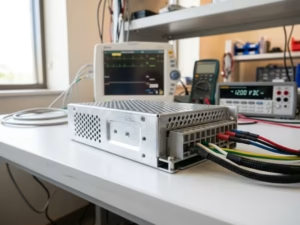
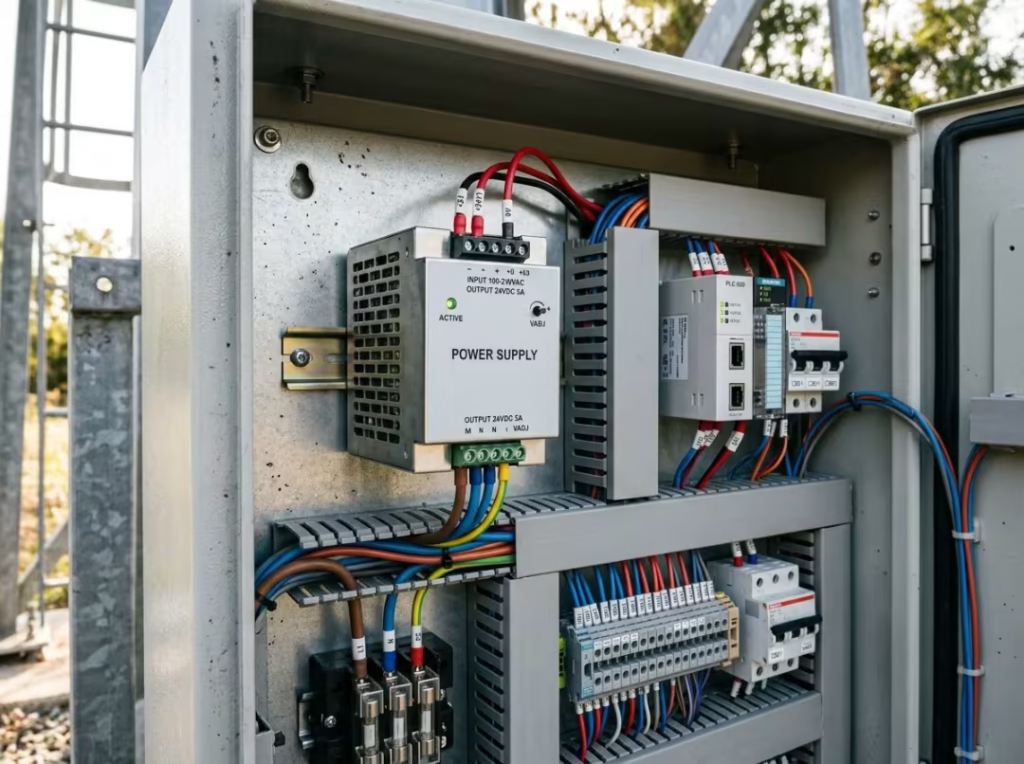
A power supply can clear every test on your indoor bench, ship in volume, then start dropping out on cold winter mornings or shutting down inside a sun-baked roadside cabinet by afternoon. Nothing was wrong with the unit. The problem was assuming a room-temperature bench predicts a real installation. A wide operating temperature power supply is not a premium you tack on to pad a quote. It is a design decision that either spares you field failures or leaves you paying for them later.
When a Standard Power Supply Stops Being “Good Enough”
A standard commercial supply usually carries an ambient rating around 0°C to 50°C, sometimes 0°C to 70°C. On paper, that looks fine. But the number describes the air around the supply, and that air is rarely the air in the room.
Drop that unit into a sealed outdoor cabinet and the assumption breaks. Internal air commonly runs 15°C to 25°C above outside temperature once you add solar load, other heat-generating boards, and no real airflow. A supply rated to 50°C ambient, sitting in a box that hits 60°C inside, is operating past its limit every hot afternoon. The rating was honest. The installation quietly invalidated it.
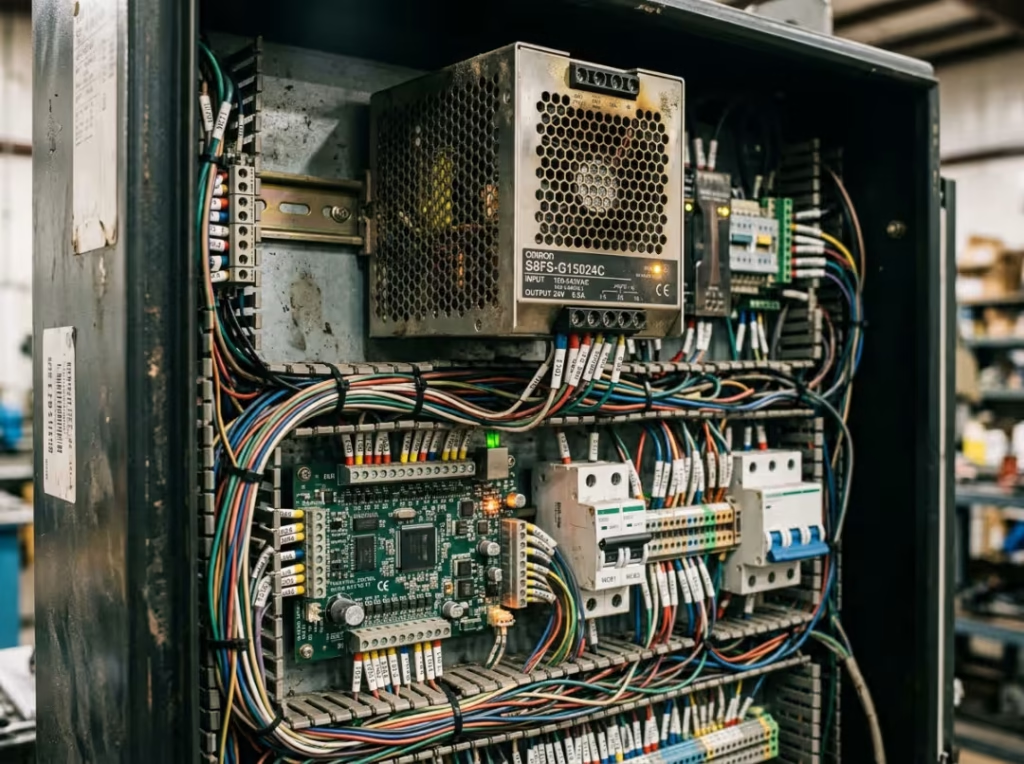
Cold does its own damage. A standard unit on a freezing morning can fail to start reliably, or start and deliver reduced output until everything warms up. For a remote site that has to power on at first light, “it works once it’s warm” is not the same as “it works.”
Push a supply outside its envelope and the failure modes stack:
- Electrolytic capacitor degradation — heat is the classic life-killer, and it ages parts long before anything visibly breaks.
- Thermal shutdown — the unit protects itself by dropping the load, and takes your product down with it.
- Output voltage drift — regulation wanders as temperature climbs, and downstream circuits start to misbehave.
- Intermittent faults — the worst of the four. The unit fails hot, passes a retest cold, and burns days of root-cause hunting while eroding trust in the whole product.
The rule is easy to state and easy to skip: rate the supply for the environment the enclosure creates, not the room it happens to sit in.
What a Wide Operating Temperature Supply Actually Buys You
“Costs more” is the wrong frame. A wide-temp supply buys you specific outcomes at the system level — whole categories of problems that stop happening. Here is what the premium covers.
Reliable Startup in Cold, Stable Output in Heat
A wide-temp rating is really two guarantees, and it pays to keep them separate. On the cold side, the supply starts reliably and delivers full output at −40°C, with no sluggish ramp and no brownout while the enclosure warms. On the hot side, it maintains rated output rather than quietly derating or tripping as the cabinet heats up.
The failure that costs you the most sleep is rarely a dead unit — it is one that works sometimes. Marginal cold startup and hidden heat derating are exactly what produce field flakiness that no one can reproduce on the bench. Spec for reliable cold start and sustained hot output, and verify each on its own. A unit that powers on is not a unit that performs.
Longer Service Life Under Real Operating Stress
The value of a wide envelope is not just the extreme moment. It is the lower thermal stress the supply sees every ordinary day. A unit running comfortably within its range strains its capacitors, semiconductors, and transformers far less than one operating at the edge of its limit — and less strain means a longer service life.
That feeds straight into mean time between failures. Put plainly: fewer stressed components means fewer failures across a deployed fleet. And the payoff compounds — fewer truck rolls, fewer spares tied up in inventory, less engineering time lost to chasing intermittent faults instead of building the next product. This matters most in clinical and diagnostic settings, where an unplanned failure isn’t just an inconvenience; supplies built for those environments, like purpose-designed medical power supplies, earn their keep on reliability alone. Buy margin, not just coverage.
Simpler System Design and Fewer Thermal Workarounds
This is the most underrated benefit. A wide-temp supply deletes the other parts you would otherwise bolt on to survive the environment. No auxiliary heater for cold climates. No fan or active cooling for hot ones. No thermostat to babysit the arrangement.
Every one of those additions is a liability. A fan is a moving part in a box you wanted to seal. A heater draws power and can fail open or closed. Each adds a BOM line, a component to qualify, and one more thing to service in the field — usually in the exact harsh environment that made the design hard in the first place. Strip them out, and you can often shrink the enclosure and place components more freely, because the supply can sit near heat sources instead of being isolated and cooled around. Let the supply carry its own thermal range, and the rest of the system gets simpler.
Where Wide-Temperature Supplies Earn Their Keep
Some installations punish a standard supply in ways that are expensive to fix after deployment. These four cover most of them.
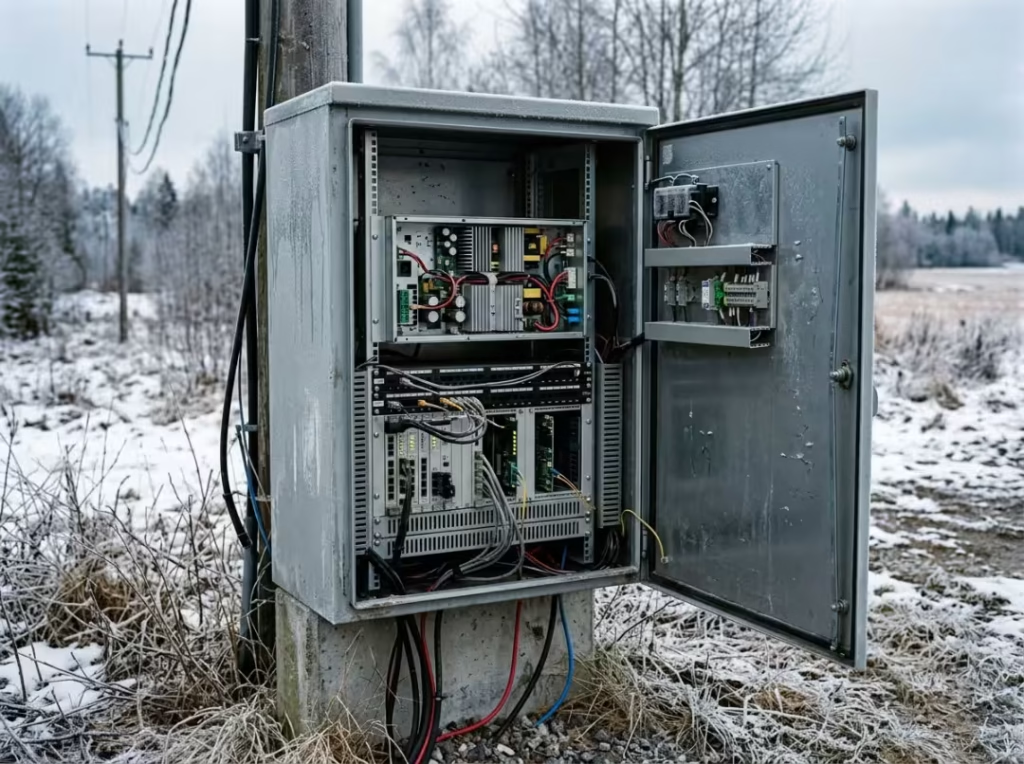
Outdoor cabinets and remote equipment. Telecom cabinets, roadside sensors, and remote monitoring boxes take direct sun in summer, freezing wind in winter, and sit inside sealed enclosures that trap heat. When a standard unit fails here, someone drives to the site — sometimes hours away. The wide-temp unit avoids the truck roll entirely, and the truck roll is usually where the real cost hides.
Industrial equipment with trapped heat or freezing ambient. Factory floors sit beside machinery that radiates heat. Cold storage and refrigeration run below freezing. Plenty of sites swing hard between seasons. In all three, the ambient is nowhere near “room,” and reaching embedded equipment often means a line-down or a full shutdown. This is why ITE power supplies built into networking and industrial gear so often carry wide-temperature ratings — the equipment runs continuously in environments the spec sheet never assumed.
Transportation and mobile platforms. Vehicle-mounted electronics face cabin heat in summer and deep cold in winter, plus vibration and confined spaces that trap heat and pile on thermal cycling. Rail and transit gear see the same. Pulling equipment from a vehicle in service is costly and disruptive, so a unit that tolerates both the swing and the cycling earns its price quickly.
Edge devices no one wants to service twice. Remote gateways and edge compute boxes often live in unheated enclosures in regions with wide seasonal variation. The thermal environment is unmanaged by design, and the service call frequently costs more than the device. Install once, forget it — that is the entire point.
The pattern across all four: specifying standard temperature for a punishing site trades a small saving today for a failure that is expensive to reach and fix later.
Is the Higher Price Actually Worth It?
The honest answer depends on where the unit is located and what a failure there would cost you. To decide it, stop comparing stickers and start comparing total cost of ownership.
Upfront Price Is Only Part of the Cost
Wide-temp units typically run 15% to 40% more than standard ones, depending on the rating and the brand. That premium is real — and it is only the first line of the bill. A standard supply dropped into a harsh site rarely survives on its own; it forces you to add heaters, fans, thermostats, or cooling to close the gap. Each carries its own purchase cost and its own maintenance burden. Compare the total installed and maintenance cost, not the unit price on a quote.
The First Avoided Field Failure Pays for the Upgrade
Run the simplest version of the math. Say the wide-temp unit costs $50 more. A single field failure that triggers a service call runs $500 or more once you count labor, travel, and time. The upgrade pays for itself the first time it prevents one failure — and that is before the rest of the bill lands.
Widen the lens, and the case only gets stronger. Downtime in an industrial or telecom setting carries a per-minute cost. Spares sit in inventory as tied-up capital. Engineering hours spent chasing an intermittent fault are hours not spent shipping. And every field failure quietly spends customer trust you cannot easily buy back. Run the numbers on one avoided failure before you decide the premium is too high.
When Standard Temperature Units Still Make Sense
Wide-temp is not always the right call, and pretending otherwise would cost you money. A standard supply is the correct choice for climate-controlled equipment rooms with stable ambient conditions, for indoor gear that is cheap and easy to reach if it ever fails, and for designs that already carry genuinely generous thermal headroom. If the environment is controlled and service is trivial, the premium buys you almost nothing. Spend it where it prevents a failure you would otherwise pay to fix.
How to Tell If Your Design Really Needs One
You can run this diagnosis on your own project in a few minutes. Four checks tell you most of what you need to know.
Check the real ambient, not the room temperature. Measure or estimate the internal enclosure temperature, not the temperature of the space the cabinet stands in. Add sun load, account for a sealed box with no airflow, and factor in proximity to heat-generating parts. The number that matters is the air immediately around the supply — and it often sits 15°C to 25°C above whatever anyone assumed.
Check startup conditions, not just steady-state. A unit can run fine once warm and still refuse to start cold. Ask what the coldest power-on actually looks like: a winter morning at a remote site, a cold-storage boot, an unheated cabinet coming online at first light. Steady-state performance tells you nothing about that first cold start.
Check service cost, not just component cost. Ask how difficult and expensive it would be to reach this unit if it fails. Remote, embedded, vehicle-mounted, or line-critical installations shift the math toward wide-temp fast, because the failure is never the unit price — it is the trip, the downtime, and the disruption to get there.
Check the derating curve before you trust the headline number. A spec that reads “−40°C to +85°C” indicates the unit operates over that range. It says nothing about how much output survives at +85°C. Pull the curve and confirm there is still enough current at your hot extreme to run the load. A rating that looks sufficient and a rating that actually delivers are two different things.
How to Choose the Right Wide-Temperature Power Supply
Once you know you need a wide-temp unit, four buying actions separate a solid choice from an optimistic datasheet.
Read the derating curve first. Find the current-versus-temperature curve and look at your hot extreme. A well-built unit holds useful output well up its range; a weak one guts its current exactly where you need it most. The headline range is marketing copy — the curve is the truth. If the datasheet does not show one, that is your answer.
Verify test evidence and certifications. Do not take the datasheet at face value. Confirm the unit is certified against recognized safety and performance standards such as UL 60950-1 or IEC 62368-1, which verify thermal behavior rather than restate a claim. Then ask how the rating was tested — you want thermal cycling and full-load runs at both extremes, not a single spot check at one convenient point. A supplier with its own in-house testing and EMC facilities can produce that data directly rather than pointing to a third-party report it has never seen.
Match the range to the actual installation environment. Temperature is only part of the picture. Humidity and altitude both affect heat dissipation and component stress, and a supply that behaves at sea level can run hotter at altitude, where thinner air carries away less heat. Match temperature, humidity, and altitude to the real site, not a generic worst case.
Ask for application notes or thermal test data. The best manufacturers show real-world thermal performance, not just lab-condition numbers. Application notes and measured data indicate that the unit was characterized under conditions like yours. If a supplier cannot or will not produce them, read that reluctance as a statement about the product.
Common Mistakes Buyers Make
Even careful buyers trip on the same few assumptions.
Treating the headline temperature range as the full story. “−40°C to +85°C” is a range, not a promise of full output across it. Skip the derating curve, and you can land a unit that technically “supports” your extreme while delivering a fraction of its rated current there. The range gets you in the door; the curve tells you whether the unit can do the job.
Assuming a fan or heater solves it just as well. Bolting on active thermal management brings moving parts, added power draw, more BOM, and new failure points — usually planted in the exact harsh environment that made the design difficult to begin with. That is more design effort for a less robust result than a purpose-built wide-temp supply delivers.
Assuming a wide-temp rating excuses poor enclosure design. The supply handles its own heat. It does not fix a box that traps everyone else’s. A wide rating is not a license to ignore airflow, component spacing, and heat paths for the rest of the system. Get the enclosure wrong, and even the right supply runs hotter than it should.
FAQs
What is the difference between operating temperature and storage temperature?
Operating temperature is the ambient range within which the supply meets spec when powered and loaded. Storage temperature is the wider range it survives unpowered without damage. Storage limits are almost always broader, so never design to the storage number — it describes survival, not performance.
Do wide-temperature power supplies still derate at high temperatures?
Most do. The real question is how much. A well-designed unit holds useful output well up its range, while a weak one drops current sharply near the top. Read the derating curve at your specific hot extreme instead of trusting the headline range.
Can a standard commercial power supply be modified for extreme temperatures?
You can add heaters, fans, or insulation, but you are adding failure points and design work to push a part outside its intended envelope — often at a total cost near or above a purpose-built wide-temp unit. For anything hard to service, buy the right rating instead of patching the wrong one.
Which certifications or test evidence should I look for?
Look for recognized safety standards such as UL 60950-1 or IEC 62368-1, and ask how the temperature rating was verified. Solid evidence means thermal cycling and full-load testing at both extremes, backed by application notes or measured thermal data — not a single claim.
The Bottom Line
The decision comes down to total cost of ownership, not the price on the quote. For most outdoor, industrial, transportation, and hard-to-service edge designs, the math favors the wider range once you count the failures it prevents. Pull the datasheets for both options, lay their derating curves side by side at your expected temperature extremes, and run the numbers on a single avoided field failure. In the environments that punish a supply, that one calculation usually settles the question before you finish it.