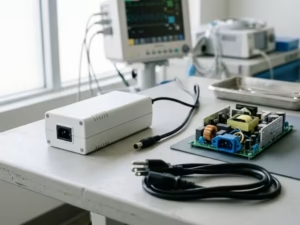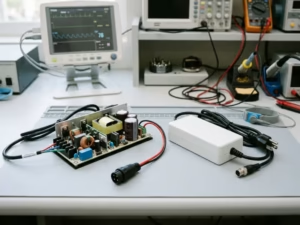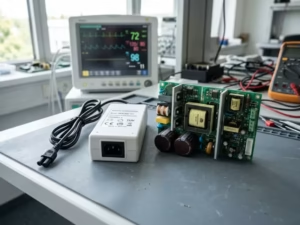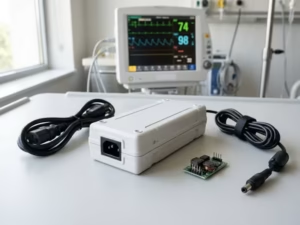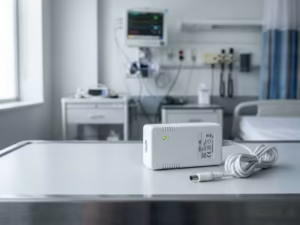
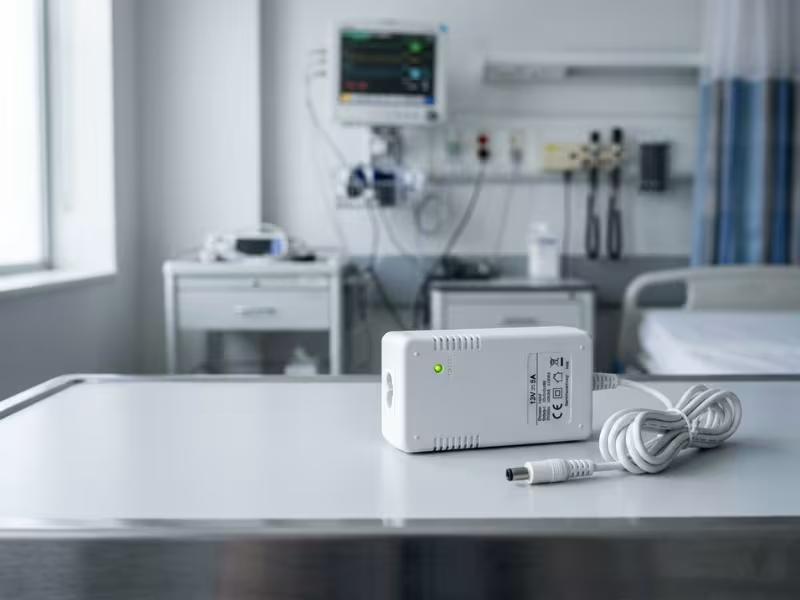
A nurse plugs a patient monitor into a wall outlet at 3 a.m. The screen lights up, and nobody thinks about the power supply inside.
If that small part leaks current or drops voltage, though, both the patient and the staff carry the risk.
A medical power supply converts incoming power into stable, clean voltage for a medical device. It also protects patients and operators from electric shock.
That second job changes everything. The power supply shapes your safety design, your test results, and your path to approval. Teams that choose it too late often pay for costly redesigns.
This guide explains how medical supplies differ from standard ones, the main types, the key IEC 60601-1 standards, and a practical selection framework. You can also browse our medical power supplies as you compare real options.
What Is a Medical Power Supply?
A medical power supply powers a medical device and meets the safety rules of IEC 60601-1. It does two jobs at once.
It delivers stable power. Sensors, displays, pumps, and processors all need clean, steady voltage. A small dip or a burst of noise can skew a reading or reset an infusion pump mid-therapy.
It protects people. The supply stands between the wall outlet and everyone who touches the device, from the patient in bed to the nurse at the controls.
A medical supply is not a standard unit with a new label. Treat it as a safety barrier first and a converter second. Four ideas define that protection:
- Isolation: Barriers that keep mains voltage away from users
- MOPP: The level of protection the supply gives a patient
- Leakage current: The tiny current that can still reach a person
- EMC: The ability to avoid disturbing other equipment and to resist interference
Each one affects which supply fits your device.
Why Medical Power Supplies Are Different From Standard Power Supplies
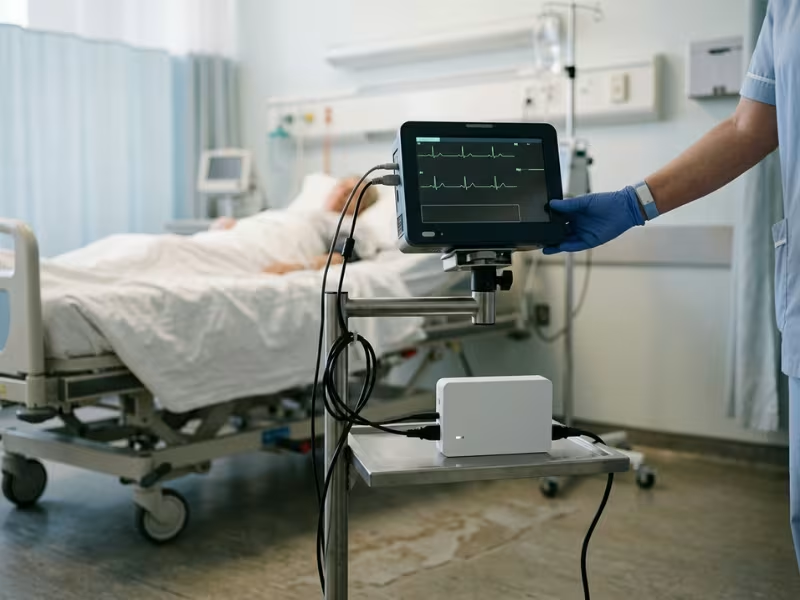
A standard supply keeps a laptop user safe. A medical supply may sit beside a sedated patient with a catheter in place. That higher risk drives four key differences.
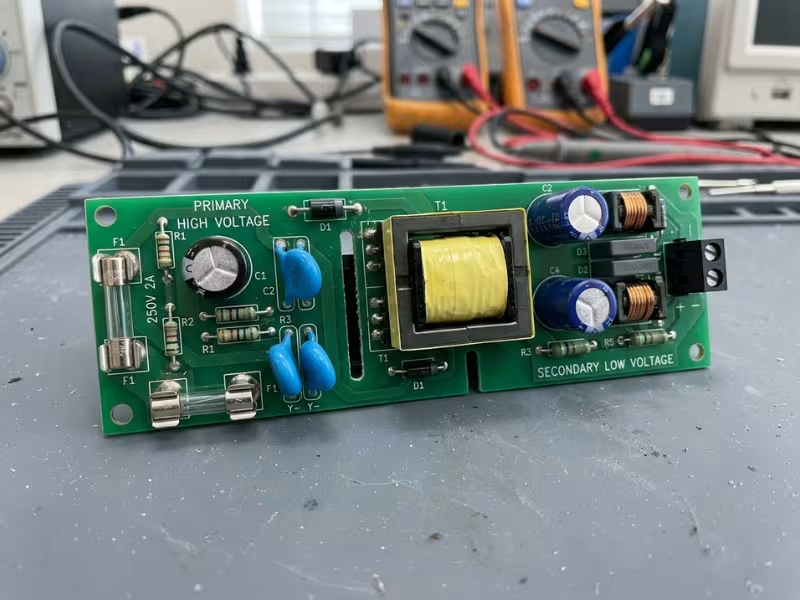
Tighter Leakage Current Limits
Commercial IT supplies may typically allow touch current up to 3.5 mA. IEC 60601-1 commonly caps touch current at 100 µA in normal use. For cardiac-contact parts (Type CF), patient leakage drops to 10 µA.
To hit those limits, designers often reduce Y-capacitors, which makes EMC harder. So check leakage and EMC data together, before you even look at wattage.
Stronger Isolation
A 2x MOPP supply typically passes a 4,000 VAC input-to-output test with about 8 mm of creepage. Many commercial supplies test near 3,000 VAC with shorter spacing. Those extra millimeters explain why medical units often run slightly larger at the same power rating.
Higher EMC Expectations
IEC 60601-1-2 asks for low emissions and strong immunity. Medical ESD tests commonly reach ±8 kV contact and ±15 kV air. Home healthcare devices often face 10 V/m radiated immunity. A noisy supply can distort an ECG trace, and neither outcome belongs at the bedside.
Longer Lifecycles and Strict Change Control
Consumer products often refresh every two to three years. Medical devices may stay in production for a decade, and every component change can trigger new testing. Strong suppliers work under ISO 13485, issue formal product change notices (PCNs), and keep full test records.
Use this table as a quick filter when you compare datasheets.
Factor | Medical Power Supply | Standard Commercial Supply |
|---|---|---|
Touch current | Typically ≤100 µA in normal use | Often up to 3.5 mA |
Isolation test | Typically 4,000 VAC for 2x MOPP | Often about 3,000 VAC |
Creepage distance | About 8 mm for 2x MOPP | Commonly 4–6 mm |
EMC standard | IEC 60601-1-2 | EN 55032 / EN 55035 |
Production lifecycle | Often 7–10+ years | Often 2–3 years |
Change control | ISO 13485, formal PCNs, full reports | Basic notices, limited records |
The Key Safety Terms You Need to Understand First
These terms shape your design more than wattage does. Once you know which risk each one blocks, datasheets get much faster to read.
MOOP vs. MOPP: Who Are You Protecting?
MOOP (Means of Operator Protection) guards staff who touch the casing or controls. MOPP (Means of Patient Protection) guards the patient, who may be unconscious or wired to electrodes. That’s why MOPP demands wider spacing and higher test voltages.
Start every project with one question: will the patient touch the device or connect to it? If yes, you need MOPP. Staff-only equipment, such as a lab analyzer, may only need MOOP.
1x MOPP typically requires 1,500 VAC isolation and 4 mm creepage. 2x MOPP requires 4,000 VAC and 8 mm. For most teams, 2x MOPP on the mains-facing supply is the safer choice. Roadmaps change, and a patient sensor added later shouldn’t force a new power supply.
Leakage Current and Isolation Work as a Pair
Isolation is the wall. Leakage current is what still slips through it.
Touch current is commonly limited to 100 µA in normal conditions and 500 µA under a single fault. Patient leakage stays at 100 µA for Type B and BF parts and drops to 10 µA for Type CF.
Also check the insulation class. A Class II supply has no earth ground and relies fully on isolation, which is common in home healthcare adapters.
IEC 60601-1 vs. IEC 60601-1-2
IEC 60601-1 covers basic safety: shock, fire, and mechanical hazards. Look for a CB report to Edition 3.1 or later.
IEC 60601-1-2 covers EMC. Only the complete device can pass it, but a pre-tested supply with healthy margin lowers your risk in the lab.
Term | What It Means | Why It Matters in Selection |
|---|---|---|
MOOP | Operator protection | Often enough for staff-only equipment |
MOPP | Patient protection | Needed when patients touch or connect to the device |
2x MOPP | Typically 4,000 VAC, 8 mm creepage | Supports patient contact without added isolation |
Leakage current | Current that can reach a person | Must fit Type B, BF, or CF limits |
IEC 60601-1 | Electrical safety standard | Ask for the CB report, not just a logo |
IEC 60601-1-2 | EMC standard | Pre-tested supplies cut device test risk |
Quick datasheet check: Look for “2x MOPP” stated clearly, isolation in VAC, leakage values in µA, the applied part rating (BF or CF), and a CB report number. If anything is missing, ask before you go further.
Main Types of Medical Power Supplies
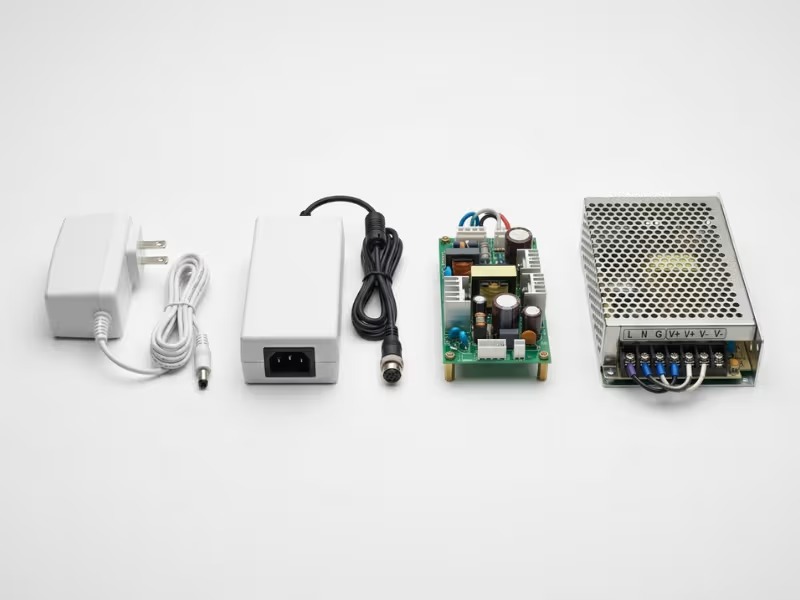
You can sort supplies by the job they do in the power chain and by how they fit your device. Start with the job, because it shapes your whole architecture.
By Power Conversion Role
AC-DC power supplies convert mains power to DC. They sit at the front of nearly every plug-in device and usually carry the main isolation barrier. They add heat and size, and they can’t help when mains power fails. Choose one when your device runs from a wall outlet.
DC-DC converters turn one DC voltage into another, after an AC-DC stage or on a battery. They’re small, efficient, and great for clean local rails. Isolated versions can protect applied parts, but MOPP ratings vary widely, so check each one.
Battery-backed architectures combine a charger, battery, and switchover logic so the device keeps running during an outage. Infusion pumps and ventilators rely on them. The trade-off is complexity, including battery safety under IEC 62133 and cells that age.
By Form Factor or Integration Style
Once you know the role, the choice becomes physical. Fit affects cooling, certification, and field service.
- External adapters keep hazardous voltage outside your enclosure and make replacement easy. Power often tops out around 250 W, and users may swap in a non-medical adapter.
- Open-frame supplies offer the lowest cost and smallest footprint. You supply the airflow, touch protection, and spacing, so more safety work lands on your system.
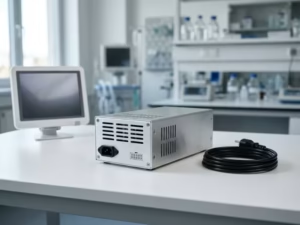
- Enclosed supplies come in a metal case, ready for carts and imaging systems. They’re rugged and touch-safe, but bulkier, and fans add noise and dust.
- Encapsulated supplies use resin potting to resist moisture, vibration, and harsh cleaning. They weigh more, can’t be repaired, and shed heat slowly.
- Modular supplies accept plug-in output modules. They suit multi-rail systems and often allow rail changes without a full requalification, at a higher cost.
Type | Best For | Main Advantage | Main Limitation |
|---|---|---|---|
AC-DC | Mains-powered devices | Carries main isolation | No help during power loss |
DC-DC | Extra rails, isolated patient circuits | Small and efficient | Needs upstream source |
Battery-backed | Pumps, ventilators, transport | Uninterrupted operation | Battery safety and upkeep |
External adapter | Home and compact devices | High voltage stays outside | Limited power; easy to swap wrongly |
Open-frame | Cost-sensitive designs with airflow | Lowest cost, smallest size | More system-level safety work |
Enclosed | Carts, analyzers, imaging | Rugged, touch-safe | Bulkier; fan noise |
Encapsulated | Ambulance, field, wet cleaning | Resists moisture and shock | Heavy, harder cooling |
Modular | Multi-rail systems | Flexible isolated outputs | Higher cost and size |
How to Choose a Medical Power Supply
Most selection mistakes happen before anyone orders samples. Work through these six steps in order. Each one narrows the field for the next.
1. Define the Real Power Profile, Not Just Rated Wattage
A 150 W label tells you very little. Map these numbers first:
- Steady load: Measure normal draw on a prototype if you can.
- Startup surge: Motors and large capacitors often pull two to three times running current briefly.
- Peak draw: Check the supply’s peak rating and how long it holds.
- Rail requirements: List each voltage, current, and noise limit.
Then add 20–30% headroom. In one dialysis pump project, a supply sized on running current tripped on every cold start. A peak-rated model fixed it.
2. Match the Power Supply to the Use Environment
- Hospital: Crowded with equipment, so EMC and low leakage matter most.
- Home healthcare: Old wiring and untrained users. IEC 60601-1-11 applies.
- Portable: Drops and temperature swings. Efficiency sets runtime.
- Ambulance and field: Vehicle transients, vibration, and IEC 60601-1-12.
Also ask about cleaning agents, shock, and the hottest ambient, including a parked vehicle in summer.
3. Confirm Safety and Compliance Before Layout Freeze
After layout freezes, a supply change can cost weeks. Decide on MOPP or MOOP based on patient contact, and confirm Type B, BF, or CF limits. List every target market. The US expects ANSI/AAMI ES60601-1, while most regions use IEC or EN 60601-1.
Ask for the full CB report, EMC data to IEC 60601-1-2 Edition 4.x, and inputs for your ISO 14971 risk file. A logo proves little. One “medical” supply’s report covered only 115 VAC input, though the customer planned to ship to Germany.
4. Check Thermal and Mechanical Fit Early
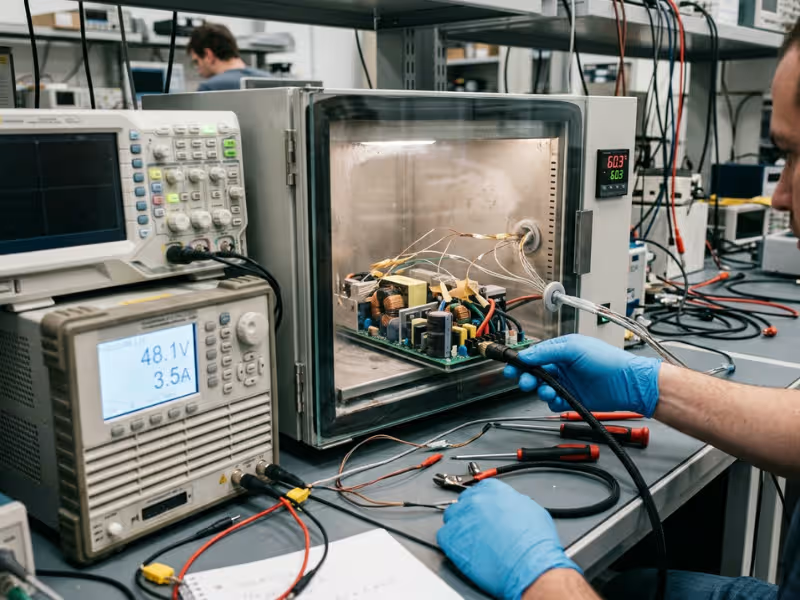
Give the supply a real place in your 3D model from day one. Many open-frame supplies list full power at 10–20 CFM of forced air. Fanless designs must use the convection rating, which often sits 30–40% lower.
Read the derating curve at your hottest internal temperature. Many supplies commonly start derating near 50 °C. Plan connector placement and service access too.
5. Evaluate Reliability, Lifecycle, and Supplier Support
Treat MTBF as a reference, not a verdict. Vendors calculate it differently. Capacitor life at your real temperature predicts wear-out more honestly.
Then confirm PCN notice of six to twelve months, a seven- to ten-year supply commitment, a clear end-of-life plan, and fast field replacement. Get it in writing.
6. Compare Total Cost, Not Unit Price
Saving $8 per unit can cost $80,000 later. Count engineering time, certification risk, redesign cost, field failures, and sourcing resilience. In most medical programs, the proven, well-documented supply wins.
Your Selection Checklist
Selection Area | What to Check | Common Risk if Ignored |
|---|---|---|
Power profile | Steady, surge, peak load; 20–30% headroom | Startup trips, overheating |
Use environment | Location, cleaning, vibration, max ambient | Early field failure |
Compliance | MOPP/MOOP, CB report, EMC data, markets | Failed certification |
Thermal and mechanical | Derating, airflow, space, access | Late redesign |
Lifecycle | PCN terms, availability, EOL plan | Forced requalification |
Total cost | Engineering, testing, field, sourcing | Low price, high program cost |
Selection by Application Scenario
The six steps give you a method, but each device type shifts the priorities. Here’s how they change across four common categories.
Bedside and Patient-Monitoring Devices
Monitors and infusion pumps run nonstop and connect to patients. Start with 2x MOPP and a BF rating, and plan for CF limits if any lead could reach the heart.
ECG signals measure in microvolts, so ask for ripple data under real load. Convection-cooled units often suit quiet wards better than fan-cooled ones.
Portable and Battery-Powered Devices
Here, efficiency controls both heat and runtime. A 40 W load at 90% efficiency wastes about 4.4 W. At 94%, it wastes about 2.6 W.
A 4-cell lithium-ion pack typically swings from 16.8 V to 12 V, so choose wide-input DC-DC converters. Budget runtime for an aged battery, cold conditions, and peak load.
Home Healthcare Equipment
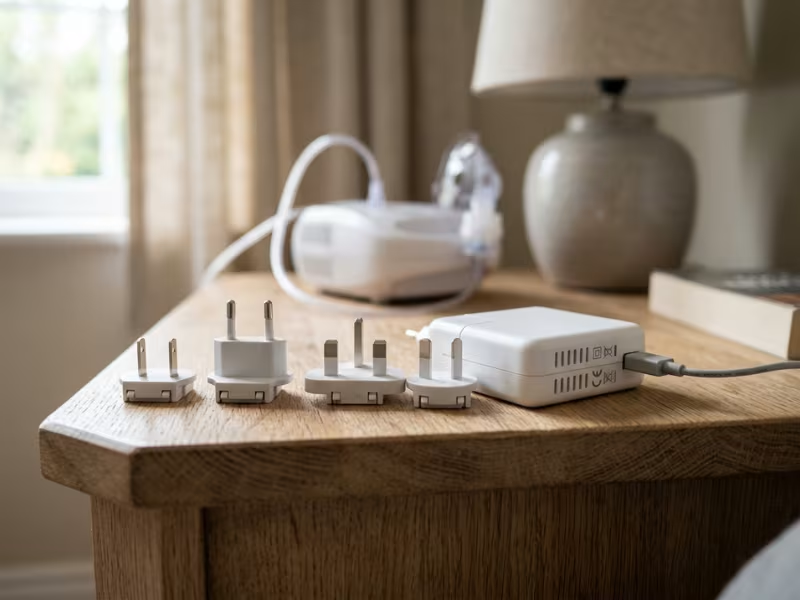
CPAP machines and oxygen concentrators face extension cords, old wiring, and nearby Wi-Fi routers. Pick a supply with real EMC margin.
External adapters fit this setting best. A Class II, two-prong adapter avoids missing-ground problems. For specific plug formats, output ranges, or keyed connectors, custom power adapter solutions make home-use compliance and replacement easier. Confirm IEC 60601-1-11 approvals for every market.
Complex Multi-Rail Systems Such as Analyzers
Analyzers and surgical consoles may need five or more rails. Sketch the power tree first, including sequencing and power-good signals.
A modular supply gives isolated outputs in one chassis. A central AC-DC with point-of-load converters saves cost but adds board work. Design for fast module swaps in the field.
Application | What Matters Most | Usually Preferred Type |
|---|---|---|
Bedside monitoring | Low leakage, low noise, 24/7 duty | Convection-cooled AC-DC, 2x MOPP |
Portable devices | Efficiency, size, runtime | Wide-input DC-DC plus medical charger |
Home healthcare | EMC margin, safe replacement | Class II external adapter |
Multi-rail analyzers | Rail count, sequencing, service | Modular or AC-DC with point-of-load |
Common Mistakes When Selecting a Medical Power Supply
Most power problems trace back to a few early decisions.
Choosing by wattage and price first. This skips MOPP level, leakage class, and surge behavior. Settle safety needs first, then compare price.
Trusting compliance claims without reports. “Medical grade” is marketing. Check which edition, input range, and applied part the CB report covers.
Ignoring real-temperature derating. A 200 W unit inside a 55 °C cart may safely deliver closer to 150 W. Size from the derating curve.
Overlooking change control. A silent capacitor swap can break your test data. Get PCN terms and supply commitments in writing.
Treating the supply as a commodity. It forms a main barrier between mains and the patient. Swapping in a cheaper “equivalent” can void your safety file.
FAQs
What is a medical power supply?
It’s a power supply certified to IEC 60601-1. It powers a medical device while protecting patients and operators with low leakage and strong isolation.
What does 2x MOPP mean?
It means two independent patient protection barriers. If one fails, the second still protects the patient. It typically requires 4,000 VAC isolation and about 8 mm of creepage.
Can a commercial power supply be used in a medical device?
Sometimes, but rarely without extra isolation, insulation, or protective earth, plus full system testing. For patient-facing devices, a certified medical supply usually costs less overall.
What is the difference between IEC 60601-1 and IEC 60601-1-2?
IEC 60601-1 asks, “Is it safe?” IEC 60601-1-2 asks, “Does it work well around other equipment?” Your device needs both.
How do I choose the right wattage?
Add every rail’s steady load, check surges, add 20–30% headroom, and apply derating. A 90 W device often needs a 150 W supply once you account for heat.
Conclusion
A sound medical power supply decision follows a clear order. Define who touches the device and where it will live. Confirm the safety level, leakage limits, and approvals that setting demands. Only then compare wattage, size, and price.
Teams that flip this order often pay twice, usually after a failed leakage test or a gap in the CB report.
Your next step: Write a one-page power brief before you request a quote. List patient contact type, use environment, target markets, rail needs, and hottest internal temperature. Then review these application scenarios to match your power architecture to the end-use setting, and send your brief to every supplier on your list.