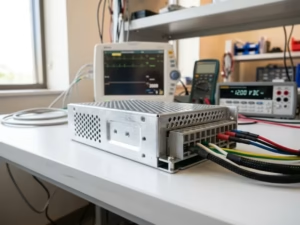
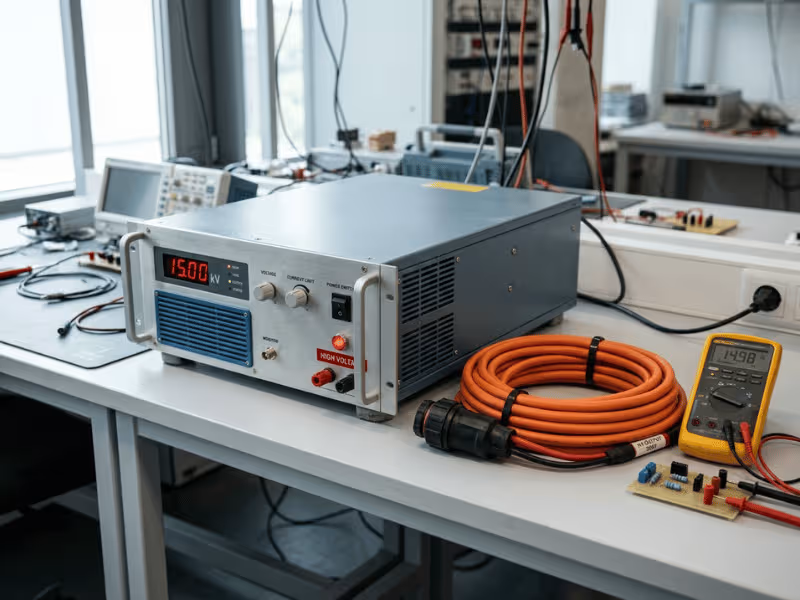
Many engineers and buyers run into high voltage power supplies when they work on X-ray equipment, laser systems, test gear, or capacitor charging setups.
At first, the question sounds simple. How much voltage do I need?
But high voltage power is never just about the number on the label.
I often see people compare an HV power supply to a standard one. That leads to trouble fast. At high voltage, insulation, discharge paths, output cable ratings, and control methods matter just as much as voltage and current.
That is why this topic deserves a closer look before you choose any unit.
What a High Voltage Power Supply Actually Is
A high voltage power supply takes a lower input — AC mains, a DC bus, or a battery — and converts it into a much higher, controlled output. That output can range from a few hundred volts to tens of kilovolts, depending on the job.
Where does “high voltage” actually start? It depends on the field. Some standards draw the line above 1,000 V AC or 1,500 V DC. Other applications call something high voltage well below that. The threshold shifts with context, so I never treat it as a fixed number.
Here’s the part people miss: the value of an HVPS isn’t the big voltage figure alone. Plenty of things can push voltage up. What sets a real supply apart is everything wrapped around that output.
It holds the voltage steady under a changing load. It limits and controls current, so the load gets what it needs and nothing more. It isolates the output from the input to protect your electronics and the operator. And it manages insulation carefully, so the energy goes where you want it instead of arcing where you don’t.
That combination — regulation, controlled current, isolation, insulation, and safety — is the real product.
It also helps to know what an HVPS is not.
A high voltage transformer only steps voltage up. It doesn’t rectify, regulate, or protect. It’s one piece, not the finished system.
An inverter turns DC into AC. It changes the waveform, but it doesn’t deliver a stable, controlled high voltage output on its own.
An amplifier boosts a signal and reproduces its shape. Its goal is fidelity, not a steady, regulated rail feeding a demanding load.
An HVPS pulls these functions together and adds the regulation and safety a high voltage load truly depends on.
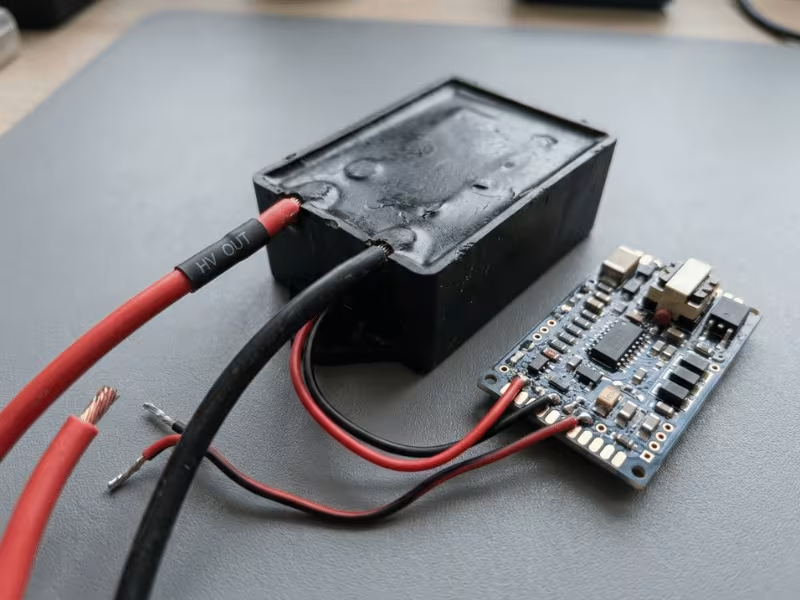
How a High Voltage Power Supply Works
Follow the power on its trip through the supply, and the whole design makes sense. It moves through six clear stages, each one setting up the next.
It starts with input conditioning. The supply takes AC mains or a DC bus and cleans it up, filtering noise and limiting the inrush current that hits when the unit powers on cold. Skip this step and a hard startup can stress everything downstream.
Next comes rectification. The supply turns that AC into rough DC, giving the switching stage steady raw material to work with.
Now the real work begins. A switching stage chops that DC into a high-frequency AC waveform, flipping tens or hundreds of thousands of times per second.
Why high frequency wins
Modern designs switch fast for one big reason: size. A high-frequency waveform lets the step-up transformer shrink dramatically. A slow line-frequency transformer built for the same job would be heavy and huge. Speed keeps the supply compact and efficient.
That high-frequency AC then hits the step-up transformer. The turns ratio pushes the voltage way up, and the transformer also isolates the output from the input — a barrier that protects both your load and the operator.
Why the high voltage side is harder
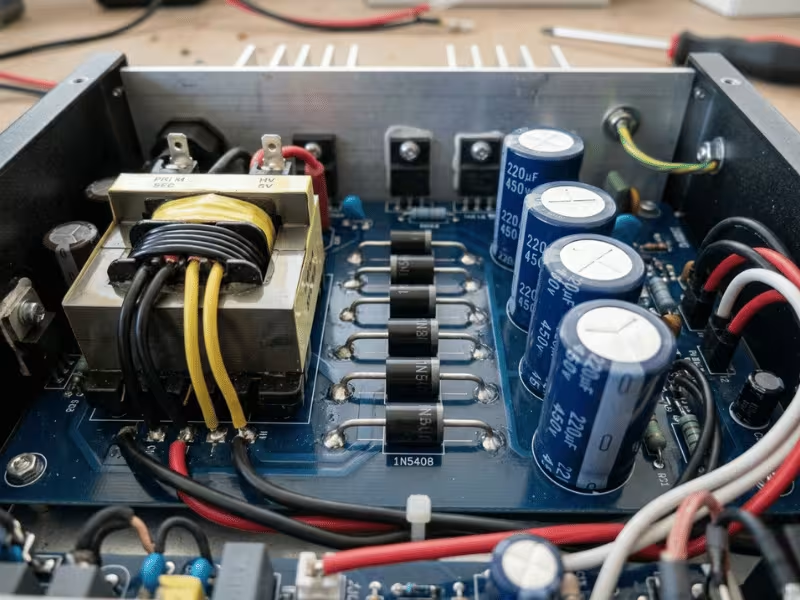
After the transformer, the supply rectifies and filters that high voltage AC back into smooth DC. This is where high voltage work gets tricky.
At these levels, no single diode can handle the full voltage. So designers stack rectifier diodes in series to share the load. Filtering fights the same battle — capacitors have to hold off enormous potential without breaking down.
Finally, a feedback loop keeps the output honest. It samples the voltage through a divider network, compares it to a target, and adjusts the switching on the fly. When your load shifts, the loop corrects in an instant and holds the voltage steady.
Stage | What it does |
|---|---|
Input conditioning | Filters noise and limits inrush at startup |
Rectification | Turns input AC into rough DC |
High-frequency switching | Chops DC into fast AC to shrink the transformer |
Step-up transformer | Raises voltage and isolates output from input |
HV rectification & filtering | Rebuilds smooth DC using stacked diodes and rated caps |
Feedback regulation | Samples output and adjusts to hold voltage stable |
One thing runs through every stage: insulation and layout discipline. At tens of kilovolts, poor spacing invites arcing, and a sloppy board becomes a failure waiting to happen. That care is what separates a supply that lasts from one that flashes over.
What Makes a High Voltage Power Supply Different from a Standard Power Supply
By now you’ve seen how an HVPS builds and holds a high output. So here’s the point that trips up a lot of buyers: you cannot spec one the way you spec a standard supply.
The differences run deeper than a bigger number.
A standard supply gives you a few volts to maybe 48 V. Insulation is barely a thought. Arcing never comes up. Most loads behave, and a basic cable does the job.
Push into the kilovolt range and every one of those assumptions breaks.
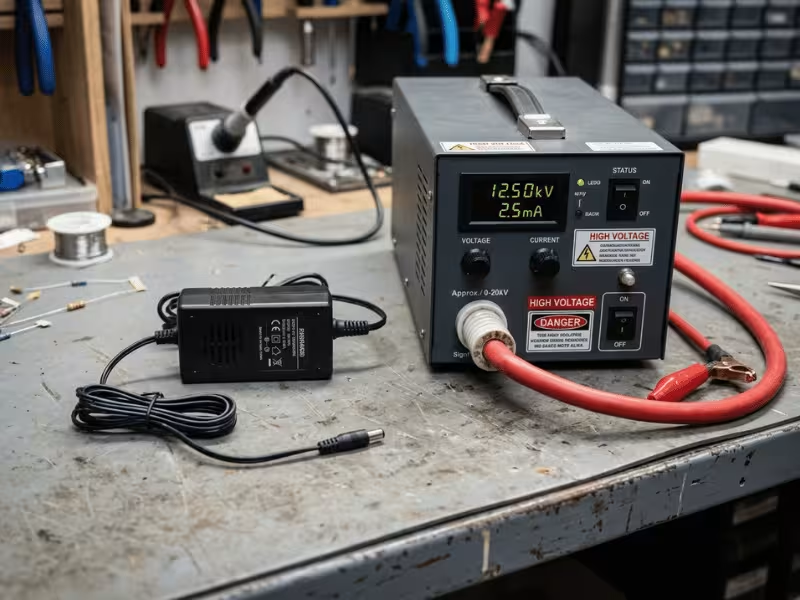
Here’s how the two stack up side by side.
Factor | Standard Power Supply | High Voltage Power Supply |
|---|---|---|
Output level | A few volts up to ~48 V | Hundreds of volts to tens of kilovolts |
Insulation demands | Minimal, standard spacing works | Critical — creepage, clearance, potting all matter |
Arc risk | Practically none | Constant concern; poor spacing means flashover |
Load behavior | Usually steady and forgiving | Often capacitive or arc-prone, hard at startup |
Cable/connector | Ordinary wire and plugs | Rated HV cable and connectors, or they fail |
Discharge path | Not needed | Required — stored energy stays lethal after power-off |
Operator safety | Low risk | High risk; interlocks and guarding are essential |
Regulation | Straightforward | Harder to hold steady at high potential |
Why insulation and arc risk change everything
At high voltage, the air itself becomes a weak point. Too little spacing on a board or a connector, and the energy jumps where you never wanted it.
That’s why potting, creepage, and clearance stop being nice-to-haves. They decide whether the supply survives.
Why the load and the discharge path matter
Many high voltage loads act nothing like a resistor. A capacitor bank looks like a dead short the instant you switch on, then charges up. A gas tube can arc. The supply has to control current through all of it.
And once you cut the power, the danger isn’t over. Stored charge sits on the output, ready to bite. A proper bleeder or discharge path drains it safely — a standard supply never needs one.
Put it together and the lesson is simple. Voltage is just the starting point. Insulation, load type, cabling, discharge, and operator protection all shape the right choice, and none of them show up when you shop for an ordinary supply.
Where High Voltage Power Supplies Are Used
High voltage rarely shows up because someone wants a big number. It shows up because the physics of a job demands it. Here are the places I run into an HVPS most, and what to watch for in each.
Electrostatic systems
Coating lines, painting booths, and precipitators all rely on charged particles. High voltage creates the electric field that pulls paint or dust exactly where it should go.
The supply has to hold a steady field and ride through the occasional arc without shutting down. The risk to watch is arc recovery. Pick a unit that trips cleanly and restarts fast, or you lose throughput every time the load flashes over.
Medical imaging and diagnostics
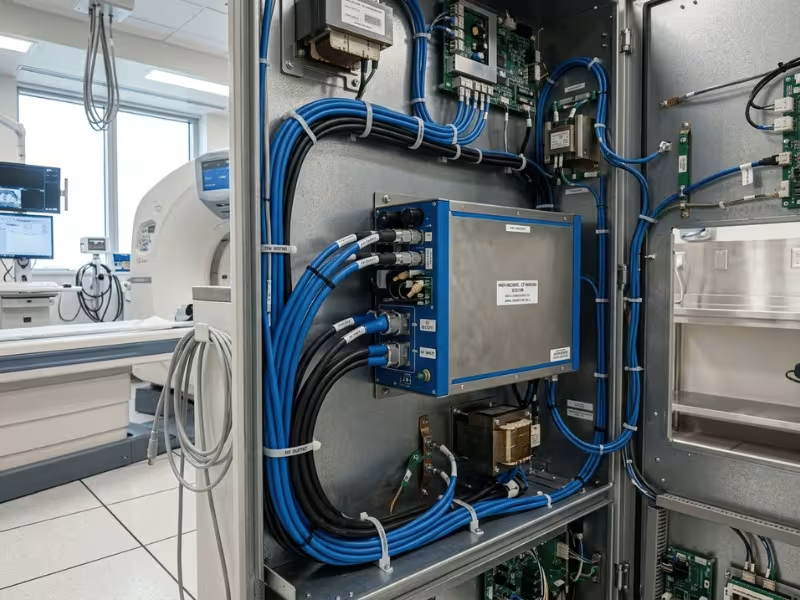
X-ray tubes and CT scanners need tens of kilovolts to accelerate electrons and produce a usable beam. No high voltage, no image.
Here the supply must deliver tight regulation and low ripple, because voltage stability shapes image quality directly. The selection risk is drift and noise. A supply that wanders even slightly blurs the result, so favor certified medical power supplies built for that kind of stability.
Test and measurement
Hipot and insulation testing push components to their breakdown limits on purpose. You need controlled high voltage to prove a part survives.
The supply has to ramp smoothly and limit current the instant something breaks down. The main risk is a slow or sloppy current limit. If it reacts late, you damage the very sample you meant to test.
Capacitor charging and pulsed systems
Pulsed lasers, welders, and pulsed-power rigs store energy in capacitors, then release it fast. Charging those banks calls for high voltage delivered under real control.
This is where load behavior bites hardest. A capacitor bank looks like a dead short at t=0, so the supply must run in constant-current mode without folding back. Size it for that inrush, not the steady state, or it never charges properly.
Detector biasing and scientific instruments
Photomultiplier tubes, mass spectrometers, and lab detectors need a clean, stable bias to work. The voltage isn’t huge in every case, but it must be quiet.
The supply must hold ultra-low ripple and long-term stability, since any noise rides straight into your measurement. The risk is picking a switching unit that’s too noisy. For sensitive detectors, weigh a linear supply or an SMPS with heavy filtering.
Notice the pattern across all five. The voltage gets you in the door, but the load behavior and noise tolerance decide whether the supply actually fits. Match those first, and the right unit gets much easier to spot.
Main Types of High Voltage Power Supplies
Not every high voltage supply is built the same way. Once you know how they split, matching one to your job gets much simpler. Three choices shape nearly every decision.
Linear vs. switching
Linear supplies give you the cleanest output. Very low ripple, very little noise — perfect for sensitive detectors. The trade-off is size and heat. They run larger, warmer, and less efficient.
Switching supplies flip that around. They pack more power into a smaller, cooler package, which is why most modern units switch. You just have to manage the extra EMI they produce.
DC, AC, or pulsed
The output form follows the load. Most jobs want steady DC for bias, testing, or a constant field. AC high voltage shows up in insulation testing and certain drive tasks. Pulsed supplies charge capacitor banks and fire lasers, delivering energy in fast, controlled bursts. Pick the form your load actually needs, not just the voltage.
Benchtop, rack, or OEM module
This is about where the supply lives. Benchtop and rack units suit labs and production floors, with displays and controls built in. OEM modules go inside your own equipment — smaller, barer, and made to integrate. Potted modules handle harsh, dirty, or high-vibration spots.
Here’s how the common types compare.
Type | Main strength | Limitation | Best fit |
|---|---|---|---|
Linear | Ultra-low ripple and noise | Large, hot, less efficient | Detectors, precision measurement |
Switching | Compact, efficient, high power | EMI needs filtering | Most industrial and OEM jobs |
DC output | Steady, controlled bias | One fixed job | Testing, biasing, static fields |
AC output | Suits dielectric work | Narrow use | Hipot and insulation testing |
Pulsed | Fast, high-energy bursts | Complex control | Capacitor charging, lasers |
Benchtop/rack | Built-in control and readout | Bulky, not embeddable | Labs, production floors |
OEM module | Small, easy to integrate | Needs external control | Building into your own gear |
Start with the load and the environment, and the right type usually picks itself.
Safety and Isolation: The Part Buyers Should Not Skip
Buyers love to focus on voltage, current, and price. Then safety becomes an afterthought. At high voltage, that mindset costs you — sometimes in blown hardware, sometimes in a hurt operator. I treat these features as part of the spec, right next to the output rating.
Here’s what actually keeps a high voltage supply safe.
Galvanic isolation comes first. A real barrier between input and output means a fault on the high voltage side can’t punch straight back to your mains or your control electronics. It protects the operator and everything downstream. Confirm the isolation rating covers your full output, with margin.
Creepage and clearance decide whether the supply survives. Creepage is the distance along a surface; clearance is the gap through air. Too little of either, and the energy tracks or jumps where you never wanted it. Ask for these distances, and check they suit your altitude and humidity — thinner air arcs sooner.
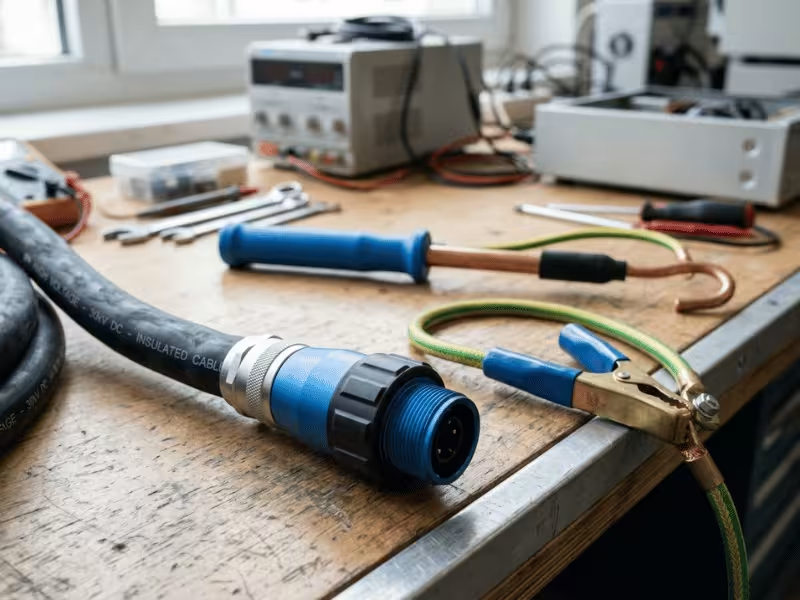
Cable insulation is the part people underrate the most. At tens of kilovolts, an ordinary wire becomes the weak point. The supply can be flawless and still flash over at a cable you bought to save a few dollars. Match the cable’s insulation rating to the peak output, not the nominal.
Interlocks give you a hard stop. A good supply kills the output the moment someone opens an enclosure or breaks a safety loop. Confirm the unit supports a remote interlock, then wire it into your guarding. Don’t leave it as an optional afterthought.
Bleeder and discharge paths matter after you cut the power. Stored charge sits on the output and stays lethal long after the display goes dark. A bleeder resistor or an active discharge circuit drains it to a safe level. Never assume “off” means “safe” without one.
Arc and overvoltage protection handle the moments things go wrong. A quality supply senses an arc, folds back the current, and rides through without damage. It also clamps overvoltage before it stresses the load. Check how fast the unit reacts and whether it restarts cleanly.
Put these six together and a picture forms: safety isn’t a bolt-on. Isolation rating, spacing, cable rating, interlocks, discharge, and protection are selection criteria, same as voltage and current.
Ask vendors for every one of them in writing before you buy. A supply that stays quiet on these details is telling you something.
How to Choose the Right High Voltage Power Supply
This is where every earlier point pays off. A good pick starts with the load, not the label. Voltage is only the opening question — the rest of these steps decide whether the supply actually works in your setup.
I run through them in the same order every time.
Start with voltage, current, and power — realistically. List the peak output voltage you need, not just the nominal. Then add up the current in steady state, at startup, and during a fault. Size the power rating with headroom, and check the derating curve for your ambient temperature. A supply rated at 25°C gives you less in a hot cabinet.
Then study the load. This is the step most people skip, and it bites the hardest. A resistor behaves. A capacitor bank looks like a dead short at t=0 and demands a supply that holds constant current without folding back. Arc-prone loads like gas tubes need a unit that rides through a flashover and recovers fast. Match the supply to how the load acts at switch-on, not just at steady state.
Check ripple, stability, and regulation. Ask how ripple is measured — peak-to-peak or RMS — and whether that number suits your load. Detectors and imaging need it tight. Look at line and load regulation, plus long-term drift if you’re doing precision work. Noise that seems small rides straight into a sensitive measurement.
Confirm control and monitoring. Decide how you’ll set and read the output. Analog 0–10 V programming suits simple rigs. RS-232, USB, or Ethernet fits automated test racks. Make sure the interface matches your control system, and confirm the supply offers voltage and current readback so you can see what’s really happening.
Check the environment and installation. Look at operating temperature, cooling method, and airflow needs. Factor in altitude and humidity, since thinner air arcs sooner. Then confirm the form factor drops into your space — benchtop, rack, or OEM module — and that mounting and connectors fit before you commit.
Verify safety features and cable ratings. Confirm isolation, overvoltage, overcurrent, and arc protection. Check for a remote interlock and a proper discharge path. And rate the output cable to the peak voltage — an underrated cable becomes the weak point no matter how good the supply is.
Decide between standard and custom last. Reach for a standard module whenever one fits with minor mechanical changes. Only when your voltage, current, or form factor truly has no off-the-shelf match should you turn to custom power adapters and purpose-built units. Custom builds cost more and take longer, so earn that decision.
Selection factor | What to check | Why it matters |
|---|---|---|
Voltage, current, power | Peak values, fault current, derating curve | Undersizing overheats the unit and starves the load |
Load behavior | Resistive, capacitive, or arc-prone; startup inrush | A capacitive load looks like a short at t=0 |
Ripple and stability | Ripple spec, regulation, long-term drift | Noise rides straight into sensitive measurements |
Control and monitoring | Analog or digital interface, voltage/current readback | The supply has to fit your control system |
Environment | Temperature, cooling, altitude, humidity | Hot, thin air lowers output and invites arcing |
Safety and cabling | Isolation, interlock, discharge, cable rating | An underrated cable flashes over first |
Standard vs. custom | Off-the-shelf fit vs. true special need | Custom costs more time and money |
Work these seven in order and the field narrows fast. The supplies that look fine on voltage alone drop out once you weigh the load, the noise, the cabling, and the environment they’ll actually live in. It also helps to look at how a supplier handles real applications close to yours before you commit.
That’s the habit worth keeping: never trust the headline number. Read the curves, check the safety details, and match the supply to the real job.
Common Mistakes When Buying or Specifying an HVPS
I see the same missteps over and over. Most trace back to treating a high voltage supply like an ordinary one. Sidestep these, and you’ll save yourself a blown unit or a stalled project.
Choosing by voltage alone. The number on the label is where selection starts, not where it ends. A supply that hits your voltage can still fail if the current, load type, or safety details don’t line up.
Ignoring load behavior. This one burns people the most. A capacitor bank looks like a dead short the instant you switch on. An arc-prone tube flashes over. If the supply can’t hold constant current or ride through a fault, it never charges or it shuts down mid-job.
Overlooking ripple and noise. Digital loads forgive it. Detectors, imaging, and precision measurement don’t. Noise that seems tiny on paper rides straight into your reading and ruins the result.
Skipping derating. A supply rated at 25°C gives you far less inside a warm cabinet. Run it at the limit in real heat, and you cook it early. Always read the derating curve for your actual ambient.
Underestimating the cable and connectors. At tens of kilovolts, an ordinary wire becomes the weak point. The supply can be flawless and still flash over at a cheap cable. Rate the cable and connectors to the peak output, not the nominal.
Forgetting control and interlock needs. People wire the supply in, then realize the interface doesn’t match their test rack, or there’s no remote interlock for the guarding. Sort out programming, readback, and interlocks before the unit ships, not after.
Over-customizing too early. Custom builds cost more and take longer. Reach for one only when no standard module fits with minor mechanical changes. Many “custom” jobs I review could have used an off-the-shelf unit with a different bracket.
The thread here is simple. Voltage gets you in the door. The load, the noise, the heat, the cabling, and the controls decide whether the supply actually works where you put it.
Frequently Asked Questions
What voltage counts as high voltage?
It depends on the field. Some standards draw the line above 1,000 V AC or 1,500 V DC. Other applications call something high voltage well below that. I never treat it as one fixed number — the threshold shifts with the job and the safety rules around it.
What’s the difference between an HVPS and a transformer?
A transformer only steps voltage up. It doesn’t rectify, regulate, or protect. An HVPS pulls all of that together — it converts, holds the voltage steady under a changing load, limits current, isolates the output, and adds safety features. The transformer is one piece inside the finished system, not the system itself.
How do I measure HV output safely?
Use a properly rated high voltage probe, never an ordinary meter lead. Match the probe to your peak output, connect the ground first, and keep one hand clear. And remember the output stays charged after power-off, so drain it through the bleeder or discharge path before you touch anything.
Are switching HV supplies noisier than linear ones?
Yes, usually. Switching designs chop current fast, and that produces more ripple and EMI. Linear supplies run much quieter. For detectors or precision measurement, weigh a linear unit or a switching supply with heavy filtering.
Do HV power supplies need calibration?
For precision work, yes. Output can drift over time and with temperature. If your readings depend on a stable, accurate voltage — imaging, testing, detector biasing — schedule regular calibration and keep the records. Rough industrial jobs need it less often.
How do I choose the right output cable?
Rate the cable to the peak output voltage, not the nominal. At tens of kilovolts, an ordinary wire becomes the weak point and flashes over first. Match the insulation rating, the connector, and the bend radius to your setup — a cheap cable undoes a good supply.
The Bottom Line
The hard part of a high voltage power supply was never the voltage. It’s holding that voltage steady, keeping the current under control, and staying safe at every point along the way.
So before you buy, write it all down. Your load and how it behaves at startup. How much ripple you can live with. The control interface you need. The heat, altitude, and humidity where it runs. And the safety features that protect your gear and your people.
Match the supply to that list, not to the biggest number on the label.
Then ask your vendor the pointed questions — derating curves, isolation ratings, discharge paths. The supplier who answers clearly is the one worth trusting with your next project.