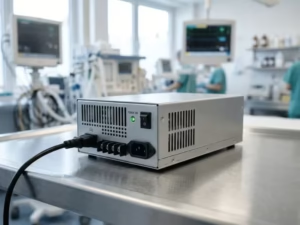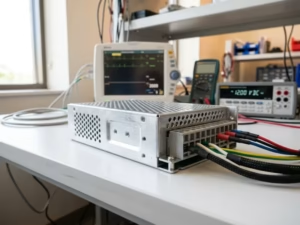

For an OEM buyer, an ITE Power Supply RFQ should be more than a request for voltage, wattage, quantity, and price. We recommend treating it as a controlled technical package that gives engineering, compliance, purchasing, quality, and the power supply manufacturer the same definition of what is being quoted.
That distinction has a direct commercial impact. A quotation may appear complete while still depending on assumptions that have never been confirmed. The output voltage may be clear, but the peak-load profile may not be. A required safety standard may be named, but the destination markets may be missing. The enclosure may have a maximum external dimension, but the actual internal thermal environment may not have been evaluated. The connector may still be open for discussion even though purchasing is already comparing unit prices.
When these assumptions are resolved after quotation, the result can be a revised price, another sample round, mechanical rework, additional testing, or a change in the certification plan. None of those outcomes necessarily means the original product was poor. Often, they mean the original RFQ did not describe the finished application precisely enough.
Our preferred sourcing principle is therefore straightforward:
Remove technical ambiguity before comparing commercial offers.
The objective is not to make an RFQ unnecessarily long. It is to make each quotation technically comparable and to reduce the number of decisions that must be reopened later.
Why a “24V, 120W ITE Power Supply” Is Not Yet a Complete Specification
Consider a common RFQ statement:
Output: 24V DC, 120W.
Those two values are important, but they do not yet describe how the power supply will operate inside the customer’s equipment.
A 120W maximum requirement could mean the equipment continuously operates near full load. It could also mean the normal load is much lower and only reaches 120W for a short period. The product may have a significant startup demand, several operating modes, or a rapidly changing electronic load. The power supply may be installed externally on a desktop, mounted directly to a wall outlet, or integrated as an open-frame unit inside the host equipment.
Each situation creates a different design context.
Before selecting a platform, we want to understand not only the maximum number on the specification sheet but the load envelope. That includes continuous current, peak current, peak duration, startup behavior, standby conditions, and any operating mode that changes the load materially.
The same principle applies to mechanical and environmental requirements. A power supply that works comfortably on an open laboratory bench still has to be evaluated in the actual host environment. Available airflow, nearby heat-generating components, mounting orientation, cable routing, enclosure dimensions, and local ambient temperature can all affect integration decisions.
For this reason, we recommend separating the RFQ into two groups:
Non-negotiable requirements are conditions the final design must satisfy. Examples include a fixed output voltage, maximum dimensions, a required connector interface, target-market compliance, or a specific mounting method.
Design variables are parameters where engineering has flexibility. Examples can include cable length, housing details, connector alternatives, label format, or the choice between adapting an existing platform and developing a more customized configuration.
This separation is useful because it gives engineering room to optimize the solution without accidentally changing the requirements that determine product acceptance.
What Information Should an ITE Power Supply RFQ Include?
A practical RFQ should let the manufacturer reconstruct the intended operating environment with as little guesswork as possible.
| RFQ field | What we recommend specifying | Why it matters |
| AC input | Nominal input, allowable range, frequency, target countries | Defines electrical and market requirements |
| DC output | Voltage, continuous current, maximum current | Establishes the primary output requirement |
| Load profile | Peak current, peak duration, startup behavior, operating modes | Prevents selection based only on nominal wattage |
| Environment | Local ambient temperature, airflow, altitude, enclosure conditions | Defines the thermal operating context |
| Form factor | Desktop, wall-mount, open-frame, or flexible | Narrows the integration architecture |
| Mechanical envelope | Maximum L × W × H, mounting points, orientation | Prevents late fit problems |
| DC interface | Connector, polarity, cable length, wire requirements | Controls electrical and mechanical compatibility |
| Grounding/shielding | System grounding approach and shielding constraints | Supports integration and EMC review |
| Compliance | Destination markets and required standards/marks | Defines the certification objective |
| EMC context | Host equipment, cable routing, shielding, sensitive circuits | Helps identify system-level risks early |
| Documentation | Datasheet, drawing, reports, labeling requirements | Defines the approval package |
| Validation | Sample quantity, test plan, acceptance criteria | Establishes what “approved” means |
| Forecast | Annual demand, order size, production schedule | Supports realistic commercial planning |
| Change control | PCN/EOL expectations and revision controls | Protects the qualified production configuration |
If your electrical architecture is still being defined, our ITE Power Supply range provides desktop, wall-mount, and open-frame starting points. Our official ITE portfolio covers configurations across a broad power range, so an RFQ can begin with an existing platform rather than assuming that every project requires a new design.
For teams that already know their required form factor, power, output voltage, or safety category, our AC-DC Power Supply product finder can also help narrow the initial candidate set before engineering review.
Start With the Load Profile, Not an Arbitrary Wattage Margin
One of the easiest ways to make an RFQ less useful is to specify a wattage value without explaining how it was calculated.
Adding a large power margin may appear conservative, but more wattage is not automatically a better engineering decision. A higher-power platform may change the enclosure size, cost, connector requirements, thermal behavior, or other integration conditions. Conversely, selecting a unit too close to the real operating requirement without understanding transient loads can leave insufficient margin for the application.
We therefore prefer to review the actual operating states.
For example, an ITE product might have:
- a low-power standby state;
- a normal operating state;
- a short startup or initialization event;
- a temporary high-processing or high-communication load;
- an accessory or peripheral that is activated intermittently.
The RFQ should identify which condition is continuous and which is temporary. If a peak exists, state its approximate magnitude and duration rather than combining everything into one maximum wattage number.
This approach gives both engineering and purchasing a clearer basis for decision-making. The engineering team can evaluate whether the candidate platform has appropriate operating margin, while purchasing can understand why a particular power rating was proposed.
It also makes later value engineering more disciplined. Instead of asking whether a lower-wattage supply is “probably enough,” the team can compare it against a documented load profile.
Treat IEC 62368-1 as a Compliance Requirement, Not a Complete RFQ
For ITE applications, IEC/EN/UL 62368-1 is an important part of the safety discussion. However, writing “IEC 62368-1 required” does not by itself define the complete certification scope.
We recommend that the RFQ also identify:
- the countries or regions where the finished product will be sold;
- which certification marks or reports are required for the power supply;
- whether an existing approved model is preferred;
- whether the customer’s certification laboratory has additional documentation requirements;
- whether the power supply configuration may change mechanically or electrically during customization.
The reason is practical: certification scope can vary by model and configuration. A safety approval shown for one model should not automatically be assumed to apply to every model, output, cable, enclosure, or customized version.
Our own ITE portfolio includes product-level and category-level references to IEC/EN/UL 62368-1 and market certifications, but we treat certification as model-specific when selecting a unit for a project. The exact approval package should be confirmed against the exact configuration being quoted.
This protects both sides of the RFQ. Purchasing avoids comparing a quotation based on an already-approved configuration with another quotation that still requires additional compliance work as though they were identical. Engineering also gains a clearer view of what can be changed without reopening part of the qualification process.
Decide the Form Factor Before Mechanical Design Becomes Expensive to Change
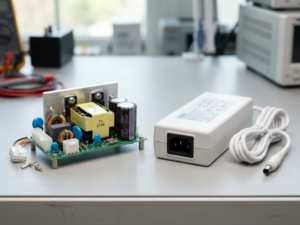
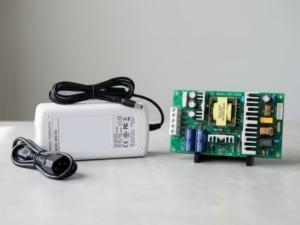
Our ITE range includes desktop power adapters, wall-mount adapters, and open-frame power supplies, and the form factor should be selected before the surrounding mechanical design becomes difficult to change.
A desktop adapter keeps AC-DC conversion outside the host enclosure, while a wall-mount adapter places additional importance on plug geometry and regional configuration. An open-frame supply is integrated into the host equipment, so mounting, clearances, airflow, grounding, shielding, and system-level EMC conditions require closer attention.
The RFQ should therefore state the preferred architecture, maximum dimensions, mounting constraints, and whether the form factor is fixed or open to engineering recommendation. The key question is not only whether a candidate can deliver the required wattage, but whether it can be integrated under the application’s electrical, thermal, mechanical, and compliance constraints.
Put the Host Equipment Environment Into the RFQ
Ambient temperature should describe the environment around the power supply, not simply the temperature of the room where the finished product is used.
Inside a host enclosure, processors, radios, displays, motors, storage devices, or other electronics may raise the local temperature. Airflow may be restricted. A power supply may be mounted close to another heat source or in a location with limited convection.
For projects where thermal conditions are important, we recommend including a simplified mechanical layout with the RFQ.
It does not need to be a finished industrial design. Even an early-stage drawing can identify:
- available power-supply volume;
- mounting position;
- airflow direction;
- nearby heat sources;
- ventilation openings;
- cable exits;
- conductive surfaces;
- expected internal ambient temperature.
This allows thermal questions to be raised while the enclosure can still be changed.
The alternative is much more expensive: select the power supply first, complete the mechanical design, build a prototype, discover a thermal constraint, and then reopen the power architecture.
Freeze the DC Connector and Cable as Engineering Components
A cable and connector may appear to be minor accessories, but for an external ITE power adapter they are part of the electrical and mechanical interface between the power supply and the host equipment.
The RFQ should define the connector type, polarity, cable length, and any mechanical constraints. If the exact connector is not yet frozen, state the host-side requirement and identify the connector as a design variable.
Cable length should also be treated as an engineering parameter rather than a cosmetic choice. Changing it can affect packaging, installation, user experience, and the electrical interface seen by the equipment.
For customized projects, our capabilities include changes to DC plugs, cable length, wire diameter and shape, voltage/current configuration, grounding and shielding, PCB layout, housing, enclosure, labeling, and packaging. These options are useful when they solve a real integration requirement, but we recommend defining them before the production configuration is released.
If your application cannot be satisfied by an existing configuration, our Custom Power Adapters page outlines the types of electrical, mechanical, cable, housing, and branding changes we can review.
Include EMC Context Before the First Sample
EMC is often treated as a test performed near the end of product development. For an OEM sourcing project, we prefer to discuss the EMC environment earlier.
The power supply is only one part of the finished system. Cable routing, grounding, shielding, enclosure construction, switching circuits, displays, radios, processors, and peripheral interfaces can all influence the final system behavior.
An RFQ does not need to predict every EMC result. It should simply provide enough context for engineering to identify obvious integration risks.
Useful information can include:
- whether the power supply is external or internal;
- cable lengths and routing constraints;
- grounding architecture;
- shield connections;
- nearby radios or sensitive measurement circuits;
- metal or plastic enclosure construction;
- known emissions or immunity requirements for the host equipment.
We maintain in-house EMC testing capability and provide EMC pre-testing as part of our engineering support. For the buyer, the value of early EMC work is not a marketing number. It is the ability to identify a potential integration problem before tooling, certification, or mass production makes the design expensive to change.
Make the Engineering Sample a Controlled Approval Milestone
We recommend treating the engineering sample as more than a unit that demonstrates that the equipment can power on.
A useful sample process should answer a specific question:
Is this the configuration we are prepared to qualify and release toward production?
Before sample approval, the buyer and manufacturer should agree on what the sample represents. Depending on the project, that can include:
- model and hardware revision;
- output specification;
- cable and connector;
- housing or open-frame dimensions;
- mounting details;
- label content;
- relevant documentation revision;
- approved customization;
- required compliance documents.
The customer can then validate the sample under the conditions that matter to the finished product.
A practical validation plan may include startup behavior, continuous maximum-load operation, peak-load behavior, thermal testing inside the real enclosure, mechanical fit, cable and connector checks, EMC pre-compliance work, and any application-specific abnormal conditions that the engineering team considers relevant.
The important point is to define the acceptance criteria before the sample is tested.
If the criteria are not defined, different teams can interpret the same sample differently. Engineering may consider it an early prototype while purchasing treats it as the final production configuration. That gap is a common source of late changes.
Compare Total Project Cost Instead of Unit Price Alone
Once each supplier receives the same technical package, purchasing can normalize the commercial proposals.
| Comparison item | What buyers should confirm |
| Quoted configuration | Exact model, revision, and included customization |
| Unit price | Quantity tier and commercial assumptions |
| Engineering/NRE | Electrical or mechanical development included |
| Tooling | Housing, cable, connector, or packaging tooling |
| Certification | Existing approvals versus additional work |
| Samples | Configuration, quantity, cost, and scope |
| Documentation | Drawings, reports, labels, and technical files |
| Validation support | Engineering review and pre-compliance support |
| Production | Lead-time and forecast assumptions |
| Logistics | Shipment terms and packaging assumptions |
| Change control | PCN/EOL and revision-management process |
| Traceability | Ability to identify production batches |
This changes the sourcing question.
Instead of asking:
“Which ITE Power Supply has the lowest unit price?”
the team can ask:
“Which proposal reaches a validated, production-ready configuration with the lowest avoidable project cost and risk?”
That is a more useful ROI framework for OEM procurement.
A small difference in component price can be outweighed by an extra prototype cycle, additional certification work, enclosure modification, connector rework, delayed market launch, or a production change that requires engineering to reopen a qualified design.
Unit price remains important. It simply should not be evaluated separately from the cost of reaching and maintaining an approved configuration.
Define the Documentation Package Before Supplier Selection
Technical documentation should be part of the RFQ rather than an afterthought. Depending on the project, buyers may require datasheets, mechanical drawings, user information, labeling details, compliance reports, or other records for engineering approval, regulatory review, incoming inspection, and production release.
Our official support information includes datasheets, mechanical drawings, user manuals, and additional compliance documentation depending on the product and project. Defining the required package early lets purchasing compare quotations on the same basis and helps prevent documentation gaps after supplier nomination.
Define Production Traceability Before Mass Production
A prototype problem and a production problem are investigated differently.
During development, the engineering team may know exactly which sample is being tested. In mass production, the same product may be manufactured over many batches and over a much longer period. If an issue appears later, the ability to identify the relevant production configuration becomes important.
Our manufacturing and quality framework includes automated SMT production, AOI, ICT, aging/burn-in activities, verification processes, and MES/SAP-based traceability.
From an OEM buyer’s perspective, the important question is not simply which systems exist in the factory. The useful question is:
Can the manufacturer identify what was produced, when it was produced, and which controlled configuration was associated with the affected batch?
That requirement should be discussed during supplier qualification rather than after a field issue occurs.
Freeze Change-Control Requirements Before the First Purchase Order
Power supply qualification should not end when the first production order is placed.
Once an ITE Power Supply becomes part of an approved BOM, changes to components, PCB revisions, construction, cables, connectors, labels, or certified configurations may affect engineering and compliance decisions.
The RFQ or supplier-quality agreement should therefore define the expected change-control process.
Depending on the customer’s quality system, this can include:
- product change notification expectations;
- end-of-life notification;
- revision identification;
- rules for substitutions;
- documentation updates;
- customer approval requirements;
- revalidation expectations when relevant.
The exact process should match the program rather than follow a generic template.
For a short commercial product, the priorities may be different from a long-life industrial platform. What matters is that both parties know which changes require communication before the design is altered.
When Should an RFQ Move From a Standard Model to Customization?
Customization is valuable when it removes a real product constraint. It should not automatically be the first step.
If an existing ITE power platform satisfies the electrical, mechanical, thermal, interface, and certification requirements, starting from that platform can reduce unnecessary development variables.
Customization becomes more relevant when the host product requires a non-standard combination such as:
- a specific output voltage or current configuration;
- a particular DC connector;
- a non-standard cable length;
- grounding or shielding changes;
- a constrained enclosure;
- a custom housing;
- PCB or internal design changes;
- special labeling or branding;
- project-specific packaging.
The RFQ should distinguish mandatory customization from optional preferences.
For example, if a connector is dictated by the host equipment, it is mandatory. If the housing color is preferred but not required, it should be identified as optional. That allows us to evaluate whether an existing platform can satisfy the core requirements before adding project-specific changes.
This approach can reduce engineering effort while preserving the features that actually matter to the finished product.
A Practical Pre-RFQ Review for OEM Teams
Before releasing an ITE Power Supply RFQ, we recommend one cross-functional review involving engineering, compliance, purchasing, and product management. The team should confirm the requirements that materially affect supplier selection: continuous and peak load, form factor and space, thermal environment, destination markets, certification expectations, connector and cable constraints, EMC context, sample acceptance criteria, required documentation, expected demand, traceability, and change control.
Not every detail has to be final. What matters is that unresolved items are marked as open requirements rather than left for the manufacturer to guess. This gives suppliers a clearer basis for engineering review and gives purchasing a more reliable basis for comparing quotations.
A Better RFQ Produces a Better ITE Power Supply Decision
The purpose of an ITE Power Supply RFQ is not simply to obtain several prices. It is to create a common baseline from which engineering feasibility, compliance, validation, production readiness, supply planning, and commercial terms can be evaluated together.
A strong RFQ does four things well:
- It describes the real application rather than only the power rating.
- It separates mandatory requirements from variables that engineering can optimize.
- It defines what must be validated before the configuration is approved.
- It considers how the approved configuration will be controlled after mass production begins.
At Quankang, we design and manufacture ITE power adapters and related power solutions for B2B projects, with support that can extend from product selection and engineering review through customization, EMC pre-testing, validation, certification coordination, and production. Our manufacturing framework includes automated production and inspection processes as well as digital traceability, allowing technical requirements to be carried forward into the production stage.
If you are preparing a new OEM project, send us the input/output requirements, load profile, destination markets, operating environment, mechanical constraints, interface requirements, expected demand, and validation objectives. We can review those requirements against our existing ITE platforms first and identify where customization is technically justified.