Selecting a medical power supply manufacturer requires more than comparing output ratings and unit prices. For medical device OEMs and ODMs, the power supply is part of the device’s safety-critical power system, so the supplier must be evaluated for regulatory compliance, engineering capability, manufacturing controls, product consistency, and long-term support.
A supplier may offer a power adapter that appears technically suitable, but that does not necessarily mean the manufacturer can support your device through certification, production, and product lifecycle management.
This guide provides a practical framework for qualifying a medical power supply manufacturer and identifies the evidence buyers should request before approving a supplier.
Quick Answer
A qualified medical power supply manufacturer should be evaluated across ten areas:
- IEC 60601-1 compliance and applicable safety certifications
- Medical quality management system
- Safety and EMC engineering capability
- MOPP and leakage current capability
- Model-specific certification documentation
- Manufacturing traceability and production testing
- OEM/ODM engineering capability
- Component control and engineering change management
- Production capacity, MOQ, and lead time
- Long-term product lifecycle and technical support
The most reliable approach is to verify each claim with model-specific documentation, manufacturing evidence, testing records, and defined engineering processes, rather than relying only on certificates or supplier statements.
Why Medical Power Supply Supplier Qualification Matters
A medical power supply does more than convert AC input into regulated DC output. Its electrical safety, insulation system, leakage current, EMC performance, thermal behavior, and reliability can directly affect the compliance and performance of the medical device.
For this reason, supplier qualification should cover both:
- The power supply itself
- The manufacturer’s ability to consistently produce and support it
A supplier that can provide a certified sample but cannot control component changes, maintain production consistency, or support EMC and safety issues may create problems later in the product development cycle.
For medical device manufacturers, supplier qualification should therefore take place before the power supply is fully integrated into the product design.
10 Factors to Qualify a Medical Power Supply Manufacturer
1. Verify IEC 60601-1 Compliance and Applicable Certifications
IEC 60601-1 is one of the first standards buyers should examine when evaluating a medical power supply supplier.
However, simply seeing the words “IEC 60601-1 compliant” on a product page is not enough.
Ask the supplier for documentation that allows you to verify:
- The exact power supply model
- Applicable IEC 60601-1 edition
- Certification scope
- Certification body or testing organization
- CB certificate, where applicable
- Test report
- Rated input and output conditions
- Applicable insulation and protection requirements
The certification should correspond to the actual model and configuration being evaluated.
Buyers should also determine whether additional standards are relevant to their target market and device architecture, such as EMC requirements under IEC 60601-1-2.
Red flag: A supplier provides only a generic CE declaration or marketing statement without model-specific safety documentation.
For a deeper explanation of medical electrical equipment safety requirements, see Quankang’s guide to IEC 60601-1 safety requirements.
2. Evaluate the Supplier’s Medical Quality Management System
Certification of the power supply is only one part of supplier qualification. The manufacturer’s quality management system determines how consistently certified products are manufactured and controlled.
For medical applications, buyers should evaluate whether the supplier has an appropriate quality management system and whether the certification applies to the relevant manufacturing operation.
Key areas to verify include:
- Quality management certification
- Manufacturing-site information
- Incoming material inspection
- Production process controls
- Final inspection
- Product traceability
- Nonconforming product control
- Corrective and preventive actions
- Engineering change control
A supplier should be able to explain how quality requirements are maintained from incoming components through final shipment.
What to Request
Instead of asking only:
“Do you have ISO 13485?”
ask:
“How does your quality system control this specific medical power supply throughout production?”
This produces much more useful supplier-qualification information.
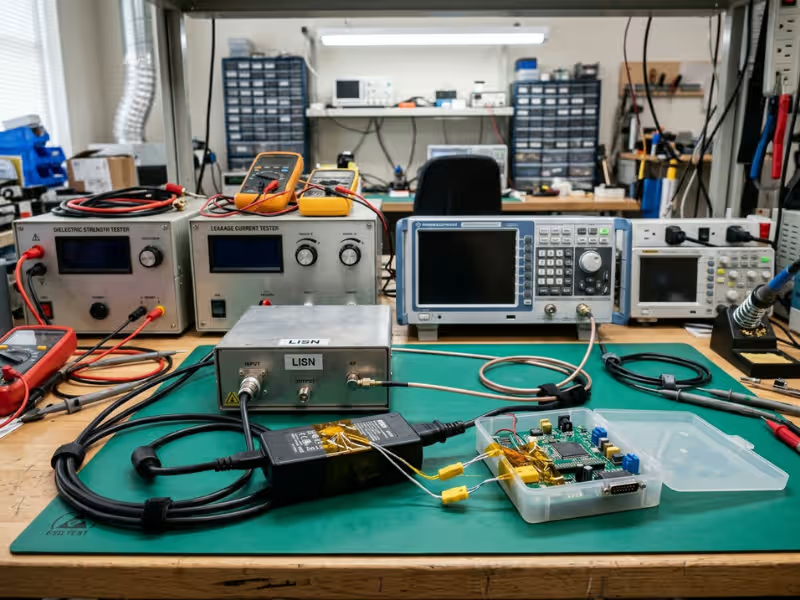
3. Assess Safety and EMC Engineering Capability
Certification is important, but engineering capability is what helps prevent certification problems during product development.
A capable supplier should be able to support issues related to:
- Electrical safety
- Insulation coordination
- Creepage and clearance
- Leakage current
- MOPP requirements
- Conducted emissions
- Radiated emissions
- ESD
- EFT
- Surge
- Immunity testing
- Thermal performance
For OEM projects, it is particularly valuable if the supplier has engineering resources that can investigate problems before formal certification testing.
An in-house or closely controlled EMC testing capability can help identify design issues earlier and reduce the number of redesign cycles.
When evaluating a supplier, ask:
- Can you perform pre-compliance testing?
- Can your engineers analyze EMC failures?
- Can you provide test data?
- How are design changes handled after testing?
- Can the same engineering team support the project through certification?
The objective is not simply to find a supplier that has passed a test. It is to find one that can help your product pass and remain compliant.
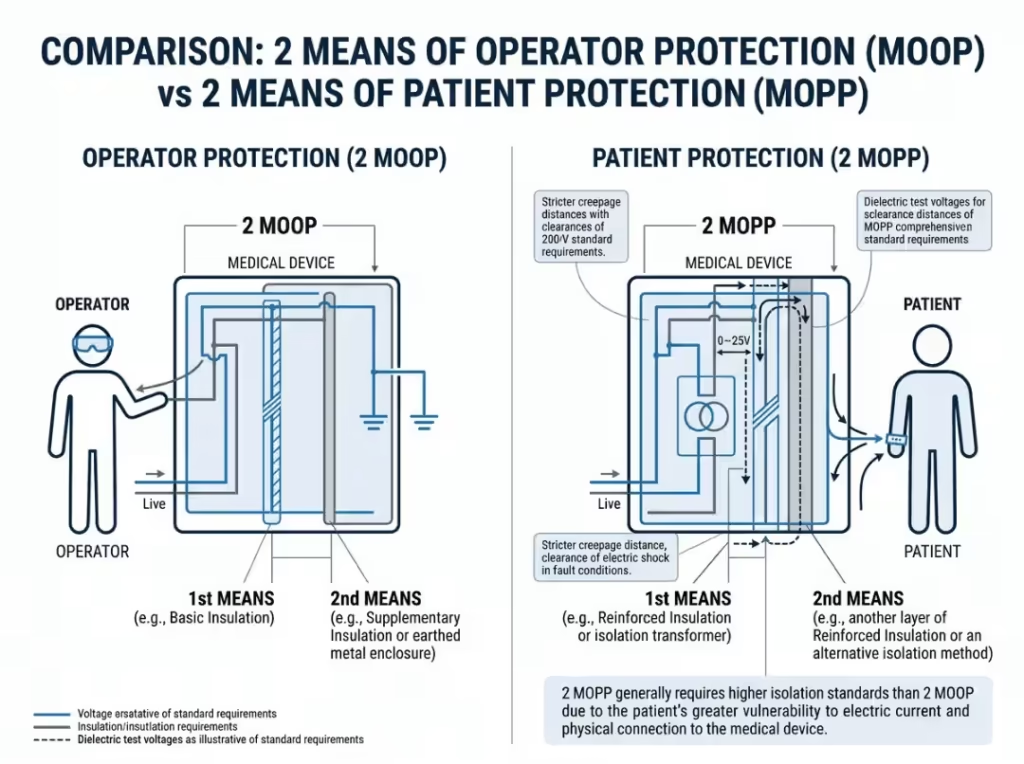
4. Verify MOPP and Leakage Current Capability
For medical devices that require patient protection, the power supply’s isolation and leakage-current performance must be evaluated against the requirements of the complete system.
Depending on the application, buyers may need to consider:
- MOOP
- MOPP
- 1×MOPP or 2×MOPP
- Touch current
- Patient leakage current
- Dielectric strength
- Insulation system
- Grounding architecture
Do not assume that every product described as a “medical power supply” provides the same level of protection.
The required protection depends on the medical device, applied part, system architecture, and applicable standard requirements.
Therefore, ask the supplier to provide the relevant safety specifications and test evidence for the exact model being evaluated.
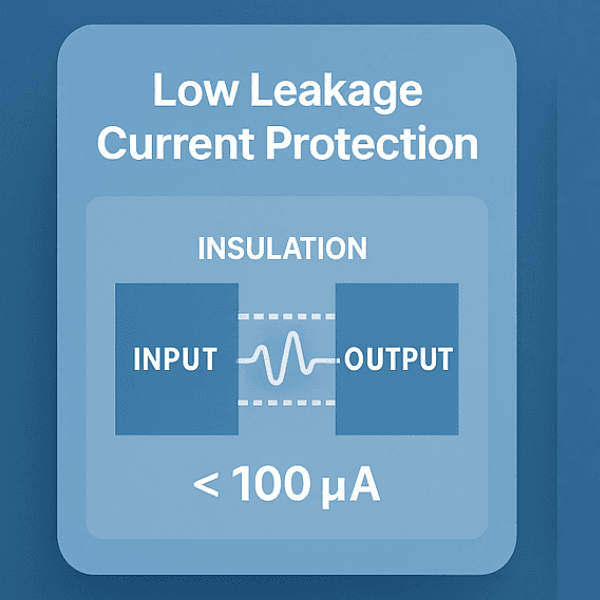
For detailed information about reducing leakage current in medical devices, refer to Quankang’s existing medical device leakage-current guide.
5. Request Model-Specific Certification Documentation
One of the most important supplier-qualification steps is verifying that documentation corresponds to the actual product.
A supplier may have an extensive certification portfolio, but that does not automatically mean every product has the same certification status.
Before approving a model, verify:
| What to Check | Why It Matters |
| Model number | Confirms the document applies to the product |
| Certification number | Allows verification of certification status |
| Standard and edition | Confirms the applicable requirements |
| Rated input/output | Ensures the tested configuration matches your application |
| Product construction | Confirms the certified design is representative |
| Test report | Provides technical evidence behind certification |
| Certification body | Establishes who performed or issued the assessment |
| Revision/date | Helps confirm documentation is current |
This is particularly important when a supplier offers several output ratings, connector configurations, or enclosure versions based on the same product family.
A Practical Rule
Do not qualify a supplier based solely on its company-level certification portfolio. Qualify the specific product and configuration that will be used in your medical device.
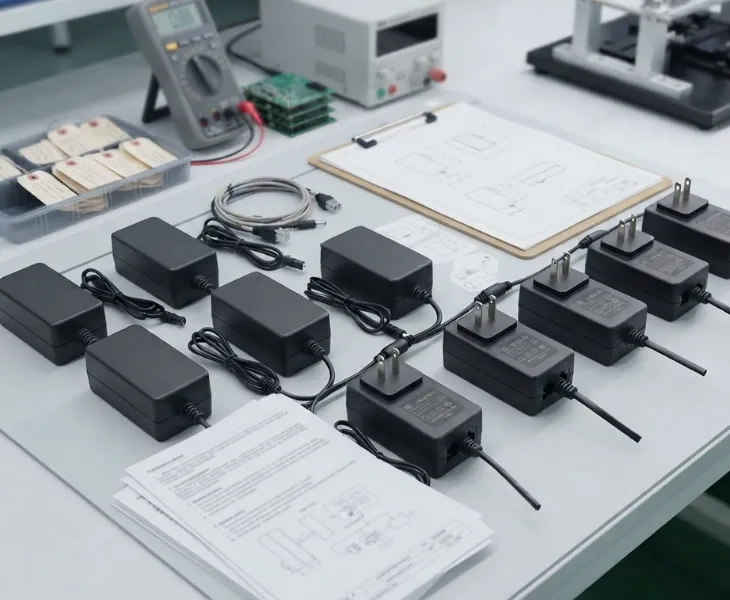
6. Evaluate Manufacturing Traceability and Production Testing
A medical power supply manufacturer should be able to demonstrate control over production, not just product development.
Important areas include:
- Incoming component inspection
- Lot or batch traceability
- Work-in-process controls
- Electrical safety testing
- Functional testing
- Aging or burn-in processes where applicable
- Final inspection
- Shipment records
For safety-critical products, production testing is particularly important.
Depending on the product design and manufacturing process, production controls may include tests such as:
- Hi-pot testing
- Insulation testing
- Grounding-related safety tests
- Output voltage verification
- Over-current protection verification
- Functional performance testing
The specific tests should be determined by the product design and applicable requirements.
What Buyers Should Ask
Rather than asking:
“Do you test every unit?”
ask:
“Which safety and functional tests are performed during production, and how are the results recorded and traced?”
The second question provides much better evidence of manufacturing control.
7. Evaluate OEM/ODM Engineering Capability
A medical device project often requires more than selecting an existing adapter.
The power supply may need changes to:
- Output voltage
- Output current
- Connector
- DC cable
- Plug configuration
- Enclosure
- Mechanical dimensions
- Labeling
- Protection settings
- Electrical characteristics
- Packaging
However, customization should not be treated as simple product modification.
Every significant change can potentially affect:
- Safety
- EMC
- Thermal performance
- Certification
- Reliability
- Production testing
Therefore, evaluate whether the manufacturer has a structured engineering process for customization.
Questions to Ask
- Does the supplier have an engineering review process?
- Can it evaluate your electrical and mechanical requirements?
- How are customized samples validated?
- How are certification implications assessed?
- How are engineering changes documented?
- Is the production version controlled against the approved sample?
For more detail about the engineering considerations involved in customization, see Quankang’s custom medical power supply guide.
8. Check Component Control and Engineering Change Management
A power supply can remain in production for years. During that period, components may become obsolete, suppliers may change, or specifications may need to be updated.
This makes engineering change management an important part of supplier qualification.
Ask how the manufacturer manages:
- Component substitutions
- End-of-life components
- Approved vendor lists
- Firmware or control changes, where applicable
- PCB revisions
- Transformer or magnetics changes
- Safety-critical component changes
- Customer notification
- Requalification after changes
A controlled engineering change process helps prevent an approved product from gradually becoming different from the product originally evaluated.
Red Flag
Be cautious if a supplier cannot clearly explain:
What happens when a critical component becomes unavailable?
A mature manufacturer should have a defined process for evaluating, approving, documenting, and validating substitutions.
9. Evaluate Production Capacity, MOQ, and Lead Time
Technical qualification is essential, but the supplier must also be able to support your commercial requirements.
Consider:
- Annual production capacity
- Current production load
- MOQ
- Sample lead time
- Pilot production lead time
- Mass-production lead time
- Capacity expansion
- Critical-component availability
- Supply continuity
- Geographic production risks
Do not evaluate lead time based only on the first sample.
A medical device manufacturer should understand the complete project timeline:
Engineering review → Sample → Verification → Certification → Pilot production → Mass production
A supplier that can provide samples quickly but cannot support stable mass production may create a larger problem later.
For OEM projects, ask the supplier to provide realistic lead times for both development and production rather than quoting only a standard catalog delivery time.
10. Assess Long-Term Product Lifecycle and Technical Support
Medical devices can remain in production for many years, so power supply lifecycle support should be considered before supplier approval.
Important questions include:
- How long will the product remain available?
- How are obsolete components managed?
- How are product changes communicated?
- Is technical support available after production launch?
- Can replacement samples be provided for validation?
- How are quality issues investigated?
- Can the manufacturer support future certification updates?
- Is there a defined process for handling field issues?
A supplier’s responsibility does not end when the first production order ships.
For medical device manufacturers, long-term support can be as important as the initial product price.
Medical Power Supply Manufacturer Qualification Checklist
The following checklist can be used during an initial supplier audit.
| Qualification Area | What to Verify | Evidence to Request | Potential Red Flag |
| IEC 60601-1 | Applicable safety requirements | Certificate and test report | Generic compliance claim |
| Quality System | Medical manufacturing controls | Relevant quality certificate | Scope is unclear |
| EMC | Testing and engineering capability | EMC reports or test capability | No failure-analysis capability |
| MOPP | Required protection level | Safety/test documentation | “Medical grade” without evidence |
| Leakage Current | Applicable leakage limits | Model-specific test data | No supporting data |
| Certification | Product-specific status | Model-specific reports | Certificate does not match model |
| Traceability | Production control | Batch/process records | No traceability process |
| Production Testing | Safety and functional tests | Test procedures/records | Testing not clearly defined |
| OEM/ODM | Engineering capability | Development process/sample workflow | Only relabeling |
| Change Control | Component and design changes | Change-control procedure | Uncontrolled substitutions |
| Capacity | Production scalability | Capacity/lead-time information | No clear production plan |
| Lifecycle | Long-term support | Lifecycle/change policy | No obsolescence strategy |
Red Flags When Evaluating a Medical Power Supply Manufacturer
Certain warning signs should trigger additional supplier investigation.
1. The supplier only provides a generic CE certificate
CE marking alone does not provide the same level of product-specific evidence as appropriate safety and EMC documentation.
2. The certification cannot be matched to the exact model
If the certificate, test report, and product label cannot be clearly matched, request clarification before approval.
3. The supplier uses “medical grade” as the main qualification
“Medical grade” is not a substitute for evaluating the actual safety, EMC, insulation, leakage-current, and certification requirements of your application.
4. The supplier cannot explain engineering changes
Uncontrolled component substitutions can affect safety, EMC, reliability, and certification.
5. No clear production testing process
A supplier should be able to explain what is tested during production and how test results are controlled.
6. No technical support during certification
If the supplier cannot support safety or EMC issues when your device enters formal testing, certification delays can become costly.
7. The sample and production version are not clearly controlled
The product used for verification should correspond to the product intended for mass production.
8. The supplier focuses only on unit price
The lowest initial purchase price does not necessarily produce the lowest total development cost.
A supplier that reduces redesign, certification, quality, and lifecycle risks may provide greater overall value.
Questions to Ask Before Selecting a Medical Power Supply Supplier
Before approving a supplier, procurement and engineering teams can use the following questions:
Certification
- Which medical safety standards does this model meet?
- Can you provide the model-specific certificate and test report?
- Which IEC 60601-1 edition was used?
- What EMC standards and test reports are applicable?
Engineering
- Can you review our device’s power requirements?
- Can you support MOPP and leakage-current requirements?
- Do you have EMC pre-compliance or troubleshooting capability?
- Can you support customized connectors, cables, or mechanical requirements?
Manufacturing
- Where is the product manufactured?
- How is component traceability maintained?
- Which safety tests are performed during production?
- How are production changes controlled?
Lifecycle
- How are component obsolescence and substitutions managed?
- How are engineering changes communicated?
- How long can the product be supported?
- What technical support is available after mass production?
These questions help shift supplier evaluation from a simple price comparison to a structured technical and quality assessment.

Quankang’s Approach to Medical Power Supply Qualification
Quankang approaches medical power supply projects from both product and manufacturing perspectives.
Depending on project requirements, supplier evaluation can involve:
– Review of the device’s electrical and safety requirements
– Selection of a suitable medical power supply platform
– Engineering review of safety, EMC, thermal, and mechanical requirements
– Verification of applicable certification documentation
– Sample evaluation and validation
– Controlled customization and engineering changes
– Production testing and traceability
– Long-term product and lifecycle support
Quankang’s medical power supply portfolio is supported by an established manufacturing and engineering infrastructure, including ISO 13485 quality management, IEC 60601-1 compliant product options, OEM/ODM engineering support, and EMC testing capability.
For project-specific qualification, customers should evaluate the certification documents, specifications, test reports, and manufacturing information for the exact model under consideration.
How Quankang Supports Medical Power Supply Qualification
Quankang provides medical power supply solutions for medical device manufacturers, with capabilities covering product development, certification, engineering support, manufacturing, and OEM/ODM requirements.
The company provides medical power supply products designed around requirements such as IEC 60601-1, MOPP protection, low leakage current, and EMC performance. Its portfolio covers external medical AC-DC adapters and other medical power supply configurations for different device architectures.
Quankang also provides engineering and customization support for projects that require specific electrical, mechanical, connector, cable, or labeling requirements.
For customers evaluating a medical power supply supplier, the relevant qualification evidence should be reviewed at the specific product and project level, including applicable certificates, test reports, technical specifications, and manufacturing controls.
Learn more about Quankang’s medical power supply solutions and custom medical power supply capabilities.
Medical Power Supply Manufacturer vs. Distributor: What Is the Difference?
The distinction can be important during supplier qualification.
A manufacturer typically has direct control over product engineering, manufacturing processes, testing, component selection, and production changes.
A distributor may provide access to products from one or more manufacturers but may have less control over:
- Product design
- Manufacturing processes
- Engineering changes
- Component substitutions
- Production testing
- Customization
- Certification updates
For standard catalog products, a distributor may be appropriate in some cases.
For a medical device requiring customization, certification support, long-term lifecycle management, or engineering collaboration, direct access to the manufacturer can provide additional control and technical support.
Remember: Power Supply Qualification Is Not Device Certification
A certified medical power supply does not automatically make the complete medical device compliant.
After integration, the device manufacturer may still need to evaluate system-level factors such as:
– Leakage current
– Protective earth and grounding
– Insulation
– Creepage and clearance
– Applied parts
– Enclosure and accessible conductive parts
– Cables and connectors
– EMC performance
– System-level safety testing
Therefore, supplier qualification should be considered one part of the overall medical device compliance process.
The power supply manufacturer should provide appropriate technical and certification documentation, while final system compliance remains dependent on the complete medical device design and applicable regulatory requirements.
Conclusion
Qualifying a medical power supply manufacturer should be treated as a technical, quality, and supply-chain evaluation, not simply a purchasing decision.
The key questions are not only:
“Does the power supply meet my voltage and current requirements?”
They are also:
“Can the supplier prove compliance?”
“Can it control production?”
“Can it support certification?”
“Can it manage engineering changes?”
“Can it maintain product consistency?”
“Can it support my device throughout its lifecycle?”
A structured qualification process based on certification evidence, engineering capability, manufacturing controls, traceability, OEM support, and long-term lifecycle management can significantly reduce development and supply-chain risks.
For medical device OEMs and ODMs, the best supplier is therefore not necessarily the one offering the lowest unit price, but the one that can provide documented compliance, controlled manufacturing, responsive engineering support, and reliable long-term product support.
FAQ
What certifications should a medical power supply manufacturer have?
The applicable certifications depend on the product, target market, and medical device architecture. For many medical applications, buyers should evaluate IEC 60601-1 safety compliance, applicable EMC requirements, and the manufacturer’s quality management system, such as ISO 13485 where applicable.
How do I verify an IEC 60601 power supply certificate?
Check that the certificate and test report correspond to the exact model, product configuration, applicable standard edition, ratings, and certification organization. Do not rely only on a general statement that the product is “IEC 60601 compliant.”
Is ISO 13485 required for a medical power supply manufacturer?
The requirement depends on the supply-chain arrangement, regulatory market, device manufacturer, and applicable quality requirements. Even where it is not strictly required for every supplier relationship, a medical-device-oriented quality management system can provide important evidence of controlled manufacturing and quality processes.
What documents should I request from a medical power supply supplier?
Depending on the project, useful documents may include certificates, safety and EMC test reports, datasheets, specifications, reliability information, quality-system certificates, and documentation related to engineering changes and production controls.
What should I check before approving a medical power supply supplier?
At minimum, evaluate certification, safety and EMC capability, quality management, manufacturing traceability, production testing, engineering support, customization capability, component control, production capacity, and long-term lifecycle support.
Should I choose a medical power supply manufacturer or distributor?
The appropriate choice depends on the project. A distributor can be suitable for some standard products, while direct manufacturer engagement can provide greater engineering, customization, certification, and lifecycle support for complex medical device projects.