A Complete ODM/OEM Design & Manufacturing Guide for Medical Device Manufacturers
Introduction
Medical devices rarely share identical power requirements.
While standard AC/DC medical power supply adapters are suitable for many applications, ODM/OEM medical equipment often requires customized power solutions to meet unique electrical, mechanical, regulatory, and environmental specifications.
Whether you’re developing a patient monitor, portable ultrasound system, infusion pump, surgical device, laboratory analyzer, or home healthcare equipment, selecting the right custom medical power supply directly impacts:
- Patient safety
- Regulatory approval
- Product reliability
- Device lifetime
- Manufacturing cost
- Time-to-market
Poor power supply selection frequently leads to redesigns during certification, EMC failures, thermal issues, and long-term field reliability problems.
This guide explains the critical engineering considerations when specifying a custom medical power supply and outlines what ODM/OEM manufacturers should evaluate before starting a development project.
Why Custom Medical Power Supplies Matter for ODM/OEM Medical Devices
Unlike consumer electronics, medical devices operate in highly regulated environments where power stability directly affects system safety, diagnostic accuracy, and equipment availability.
A standard power adapter may provide the required voltage and current, but it may not satisfy requirements for patient protection, leakage current, EMC performance, mechanical integration, or long-term component availability.
For ODM/OEM manufacturers, a customized medical power supply can deliver several important advantages:
- Better integration with device architecture
- Simplified regulatory approval
- Improved thermal and electrical performance
- Longer product lifecycle support
- Reduced total cost of ownership over the equipment’s service life
For this reason, custom power supply development is often viewed not as a component selection exercise, but as an integral part of medical device system design.
When Is a Custom Medical Power Supply Necessary?
Standard power supplies are often sufficient when power requirements, connectors, and enclosure dimensions match commercially available products.
However, customization becomes necessary when medical devices require specialized electrical performance or mechanical integration.
Typical customization scenarios include:
| Requirement | Why Customization Is Needed |
| Unique output voltage/current | Standard models unavailable |
| Multiple DC outputs | Complex medical systems |
| Custom enclosure dimensions | Space-limited equipment |
| Waterproof/IP-rated housing | Clinical environments |
| Low leakage current requirements | Patient-connected equipment |
| Medical certifications | IEC 60601-1 compliance |
| Special connectors | ODM/OEM device compatibility |
| Long product lifecycle | Medical equipment support for 7–10 years |
| Branding | ODM/OEM/private label products |
| Regional AC plugs | Global market deployment |
Custom power supplies are especially common in:
- Patient monitoring systems
- Ultrasound equipment
- Endoscopy systems
- Medical imaging devices
- Laboratory analyzers
- Respiratory equipment
- Dental equipment
- Surgical navigation systems
- Rehabilitation devices
- Home healthcare equipment
1. Define Electrical Requirements First
The electrical specification forms the foundation of every custom design.
Important parameters include:
Input Requirements
- Universal AC input (100–240 VAC)
- Wide input (80–264 VAC)
- DC input compatibility
- Frequency range
- Inrush current limitation
- Power factor correction (PFC)
Output Requirements
Specify:
- Output voltage
- Rated current
- Peak current
- Continuous power
- Ripple and noise
- Load regulation
- Line regulation
- Dynamic response
- Hold-up time
Avoid designing only around nominal operating power.
Medical devices often experience startup surges or transient loads that require additional power margin.
A common engineering practice is designing for approximately 20–30% power headroom to improve long-term reliability.
Why It Matters
Accurate electrical specifications establish the foundation for a reliable power supply design. Incomplete or changing electrical requirements often lead to repeated prototype revisions, longer development cycles, and unnecessary certification delays.
2. Understand IEC 60601-1 Safety Requirements
Unlike industrial or consumer power supplies, medical power supplies must comply with stringent electrical safety standards.
Key considerations include:
Means of Protection (MOP)
Determine whether the application requires:
- 1×MOPP
- 2×MOPP
- MOOP
Patient-connected devices almost always require 2×MOPP protection.
Isolation Voltage
Isolation requirements typically range from:
- 4,000 VAC
- 5,000 VAC
- Higher for specialized applications
The required isolation depends on the applied parts and system architecture.
Leakage Current
Leakage current is one of the most critical safety parameters.
Typical requirements include:
- Earth leakage current
- Touch current
- Patient leakage current
For many external medical adapters, leakage current is designed well below IEC limits to simplify final equipment certification.
Why It Matters
Meeting IEC 60601-1 requirements is not simply about passing certification. Safety architecture influences insulation design, PCB spacing, transformer construction, enclosure materials, and overall system risk management. Addressing these requirements during the early design phase helps avoid costly hardware redesigns later in development.
3. Consider EMC Early in Development
Many certification delays occur because electromagnetic compatibility (EMC) is considered too late.
A custom medical power supply should be designed to meet IEC 60601-1-2 requirements from the beginning.
Key design areas include:
- Conducted emissions
- Radiated emissions
- Electrostatic discharge (ESD)
- EFT immunity
- Surge immunity
- RF immunity
- Magnetic field immunity
Ignoring EMC during early design often results in:
- PCB redesign
- Additional shielding
- Filter modifications
- Delayed certification
- Increased development costs
Common Causes of EMC Test Failures
Typical EMC failures during medical device certification include:
- Insufficient input filtering
- Improper PCB grounding
- Cable radiation
- Poor enclosure shielding
- Transformer noise coupling
- Switching frequency harmonics
Most of these issues can be significantly reduced through early PCB layout reviews and pre-compliance testing before formal certification.
4. Optimize Thermal Management
Power supplies generate heat continuously.
Excessive internal temperatures shorten capacitor life, reduce efficiency, and increase failure rates.
Thermal optimization should include:
- Component spacing
- Transformer design
- MOSFET selection
- High-efficiency topology
- Ventilation strategy
- Enclosure airflow
- Heat sink optimization
For compact medical equipment, thermal simulation should be performed before tooling begins.
Engineering Tip: Design for Reliability, Not Just Rated Power
Many engineers select a power supply based solely on continuous output power. However, medical equipment often experiences startup surges, motor loads, battery charging cycles, or transient peaks.
Allowing approximately 20–30% power margin helps reduce thermal stress and improves long-term reliability.
When equipment operates continuously in clinical environments, lower internal temperatures can significantly extend component life.
5. Choose the Appropriate Form Factor
Mechanical integration affects both usability and manufacturing.
Common medical power supply configurations include:
| Form Factor | Typical Applications |
| Wall plug adapter | Portable medical devices |
| Desktop adapter | Patient monitors, ultrasound systems |
| Open-frame power supply | Embedded medical equipment |
| Enclosed power supply | Laboratory instruments |
| DIN rail power supply | Medical automation systems |
| Custom enclosed module | Specialized ODM/OEM equipment |
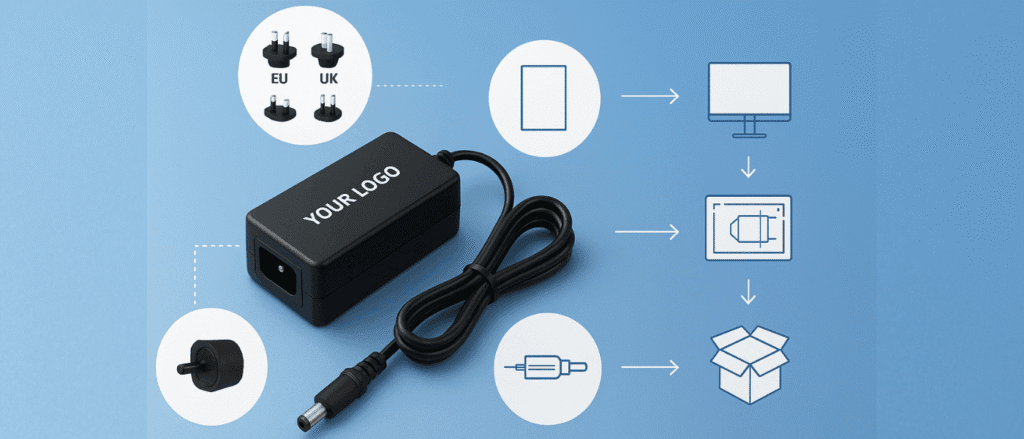
Customization may involve:
- Cable length
- Connector type
- Locking connectors
- Mounting holes
- Housing material
- IP protection level
- Color customization
- Logo printing
6. Improve Energy Efficiency
Many healthcare facilities operate equipment continuously.
Higher efficiency reduces:
- Heat generation
- Operating costs
- Fan requirements
- Internal temperatures
Look for designs supporting:
- DOE Level VI
- Energy efficiency regulations
- Low standby power
- High conversion efficiency
Energy-efficient designs also contribute to improved long-term reliability.
7. Plan for Global Regulatory Compliance
Medical devices are often sold internationally.
A custom power supply should support global approvals whenever possible.
Common certifications include:
| Certification | Market |
| IEC 60601-1 | Global |
| IEC 60601-1-2 | EMC |
| CE | Europe |
| UKCA | United Kingdom |
| UL | North America |
| cUL | Canada |
| FCC | United States |
| CB Scheme | International |
| RoHS | Global |
| REACH | Europe |
Using globally certified power supplies simplifies regulatory approval when entering multiple markets.
8. Design for Long Product Lifecycle
Medical equipment often remains in service for 7–15 years, significantly longer than consumer electronics.
Power supply suppliers should provide:
- Long-term component sourcing
- PCN (Product Change Notification)
- End-of-life management
- Alternate component validation
- Version control
- Traceability
- Spare part support
Lifecycle management is especially important for ODM/OEMs seeking to minimize redesigns during production.
Common Customization Options
| Custom Item | Typical ODM/OEM Requirement |
| Output Voltage | 5V–54V |
| Output Current | Customized |
| DC Connector | Barrel / DIN / Locking |
| AC Plug | US / EU / UK / AU |
| Cable Length | Custom |
| Enclosure Color | ODM/OEM Branding |
| Logo Printing | Silk Screen |
| Waterproof Rating | IP22/IP44/IP65 |
| Mounting | Wall / Desktop / Embedded |
The extent of customization depends on project requirements, certification scope, production volume, and target markets.
9. Manufacturing Quality Matters
Medical power supplies require consistent production quality, not just compliant designs.
Evaluate whether the manufacturer offers:
- ISO 13485 quality management
- Automated production lines
- 100% functional testing
- Burn-in testing
- HIPOT testing
- Leakage current testing
- Aging tests
- Reliability verification
- Incoming material inspection
- Traceability systems
These controls help ensure stable performance across large production volumes.
10. Select an Experienced Engineering Partner
A custom medical power supply project involves more than manufacturing.
The supplier should provide engineering support throughout the development process.
Look for capabilities such as:
- Electrical design review
- Thermal analysis
- EMC optimization
- Mechanical customization
- Safety pre-compliance testing
- Prototype validation
- Certification assistance
- DFM (Design for Manufacturability)
- Mass production support
- Change management
Early collaboration can significantly reduce development risk and shorten time-to-market.
Questions to Ask Before Choosing a Custom Medical Power Supply Supplier
Before selecting a supplier, consider asking:
- Can you design to IEC 60601-1 2×MOPP requirements?
- What is the maximum leakage current?
- What certifications are already available?
- Do you support EMC pre-compliance testing?
- Can the enclosure be customized?
- What connector options are available?
- What is the expected product lifecycle?
- How are engineering changes managed?
- Can you provide PPAP or validation reports if required?
- What testing is performed before shipment?
These questions help identify suppliers capable of supporting long-term medical device programs.
How to Evaluate a Custom Medical Power Supply Manufacturer
| Evaluation Criteria | Why It Matters |
| IEC 60601 Experience | Faster certification |
| ISO13485 Manufacturing | Better quality control |
| EMC Engineering | Lower redesign risk |
| Prototype Support | Shorter development cycle |
| Long Lifecycle | Stable supply |
| Global Certifications | Easier export |
| Engineering Team | Faster technical response |
| Custom Capability | Better product fit |
Common Mistakes to Avoid
Medical device manufacturers often encounter avoidable issues during power supply selection.
Common mistakes include:
- Selecting industrial power supplies instead of certified medical-grade models
- Underestimating startup or peak power requirements
- Overlooking leakage current specifications
- Addressing EMC only after hardware is finalized
- Failing to verify long-term component availability
- Choosing suppliers without medical manufacturing experience
- Ignoring global certification requirements during initial design
Addressing these factors early helps reduce certification delays and unexpected redesign costs.
Typical Medical Devices That Require Custom Power Supplies
| Medical Device | Typical Custom Requirements |
| Patient Monitor | Low leakage current, compact size |
| Infusion Pump | Compact enclosure, medical certification |
| Ultrasound System | High power output, low EMI |
| Endoscopy System | Multiple DC outputs |
| Laboratory Analyzer | Continuous operation |
| Dental Equipment | High reliability |
| Respiratory Device | Long lifecycle support |
Information to Prepare Before Requesting a Custom Power Supply
Before contacting a supplier, prepare:
✓ Input Voltage
✓ Output Voltage
✓ Rated Current
✓ Peak Power
✓ Connector Drawing
✓ Mechanical Dimensions
✓ Operating Temperature
✓ Medical Standard
✓ Certification Requirements
✓ Estimated Annual Quantity
Providing this information early helps suppliers evaluate feasibility and deliver more accurate quotations.
Conclusion
Developing a custom medical power supply involves balancing electrical performance, patient safety, regulatory compliance, manufacturability, and long-term reliability.
Rather than focusing solely on output power or cost, medical device manufacturers should evaluate the complete lifecycle of the power solution—from initial specification and certification through production, global deployment, and long-term support.
Partnering with an experienced medical power supply manufacturer that offers engineering collaboration, certified designs, and stable manufacturing processes can significantly reduce development risk while accelerating time-to-market.
Partner with an Experienced Medical Power Supply Manufacturer
Developing a custom medical power supply requires expertise in electrical design, safety compliance, EMC optimization, and manufacturing quality.
Whether you are designing a new medical device or upgrading an existing platform, working with an experienced engineering partner can help reduce development risks and accelerate certification.