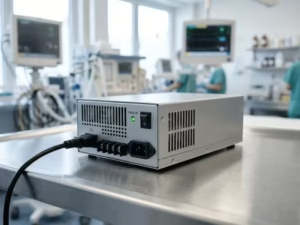
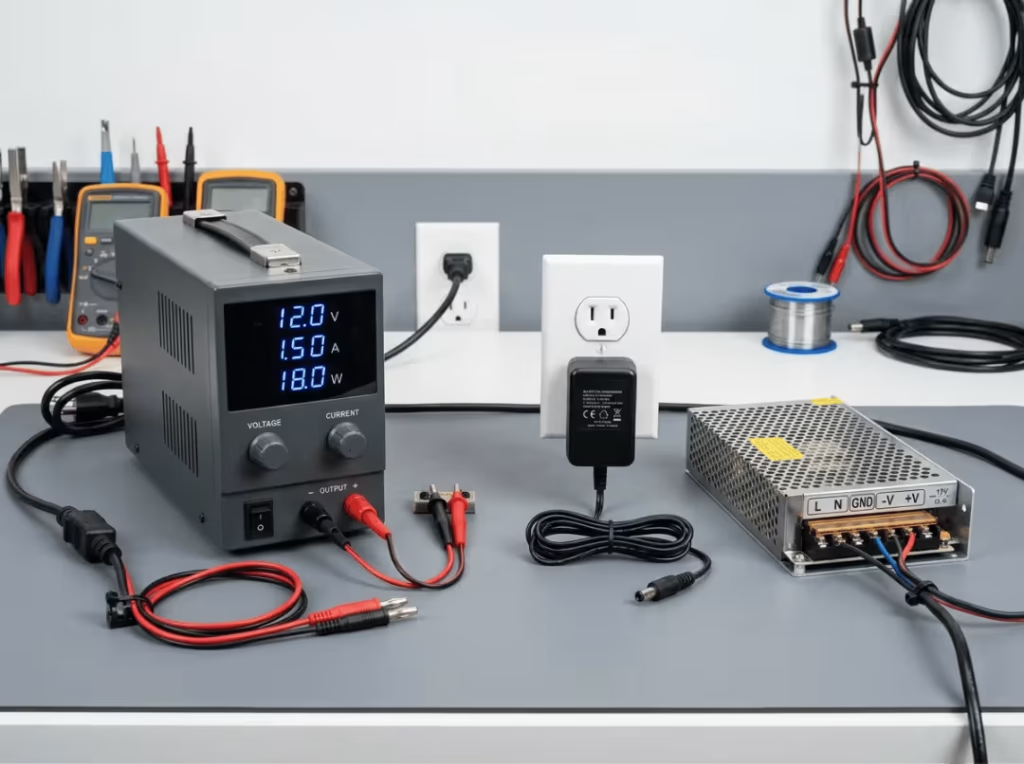
Most DC power supply problems don’t announce themselves clearly. A supply with too little current headroom drops its output under load — the circuit behaves oddly, and the supply never gets blamed. One with high ripple corrupts sensor readings or introduces hum into an audio stage. One without protection lets a fault travel downstream until something expensive stops working. Picking the wrong supply rarely causes an immediate failure. It causes an intermittent one, which is harder to find and fix.
This guide covers the decisions that actually move the needle: which type of DC power supply fits which application, which specs separate a supply that works from one that works reliably, and how to select the right unit without overbuying features you won’t use or underbuying capacity you will need.
What a DC Power Supply Actually Does
A Simple Definition
A DC power supply takes AC voltage from the mains and converts it into direct current at a specific output voltage. The connected load draws current from that output, and the supply’s job is to hold the output steady regardless of how much current the load pulls — within its rated limits. That stable, predictable output is what electronic circuits depend on.
Most of the time, this works invisibly. The problems show up when it doesn’t.
Why Stable Output Matters More Than the Label
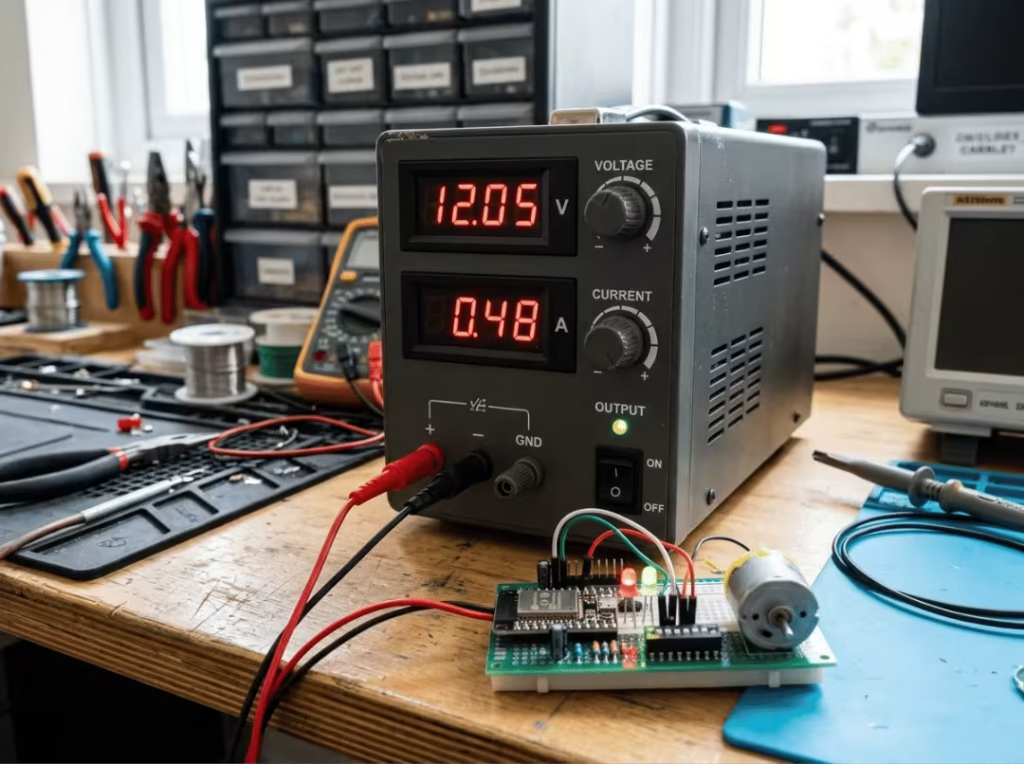
Electronic components are designed around a specific supply voltage. Drift outside that range and behavior changes: microcontrollers reset, analog circuits produce wrong readings, RF stages shift frequency. A supply that regulates well at light load but sags at full load is a classic source of intermittent failures that take hours to trace back to the power supply.
Noise compounds this. A supply can hold the correct average voltage while still putting high-frequency ripple on top of that DC level. In audio circuits, ripple becomes audible hum. In precision measurement, it raises the noise floor. In sensitive analog designs, it affects accuracy directly.
When comparing DC power supplies, output voltage is only one data point. Load regulation, line regulation, and output noise all determine whether a supply actually performs well in use — not just on a datasheet.
The Main Types of DC Power Supplies
Linear vs. Switching: The First Decision That Matters
Linear and switching supplies both produce regulated DC output, but through fundamentally different mechanisms — and that difference has real consequences depending on what you’re powering.
A linear supply uses a pass transistor that dissipates excess voltage as heat. The output is inherently clean: no high-frequency switching means no switching noise. Regulation is smooth and continuous. The cost is efficiency — a linear supply powering a 5V load from a 12V input burns 7V per amp as heat. That makes linear supplies heavier, physically larger, and impractical at high power levels. They remain the right choice for audio amplifiers, lab bench work, RF front ends, and any circuit where noise is the binding constraint.
A switching supply (SMPS) chops the rectified input at high frequency — typically 50 kHz to several hundred kHz — uses magnetics to transform the voltage, then rectifies and filters again. Efficiency runs 80–95%, which means far less heat and a much smaller, lighter unit. The trade-off is noise: switching always generates some ripple and EMI. Good design minimizes both, but a switching supply will always be noisier than a comparable linear one. For most industrial, IT, and general-purpose applications, that noise is well within acceptable limits. For noise-sensitive work, it requires more care in filtering or topology selection.
The practical rule: choose linear when noise is the primary constraint and efficiency is secondary. Choose switching when you need compact size, high efficiency, or meaningful power output and your load can tolerate a well-designed SMPS noise floor.
Bench Supplies vs. Fixed Power Supplies
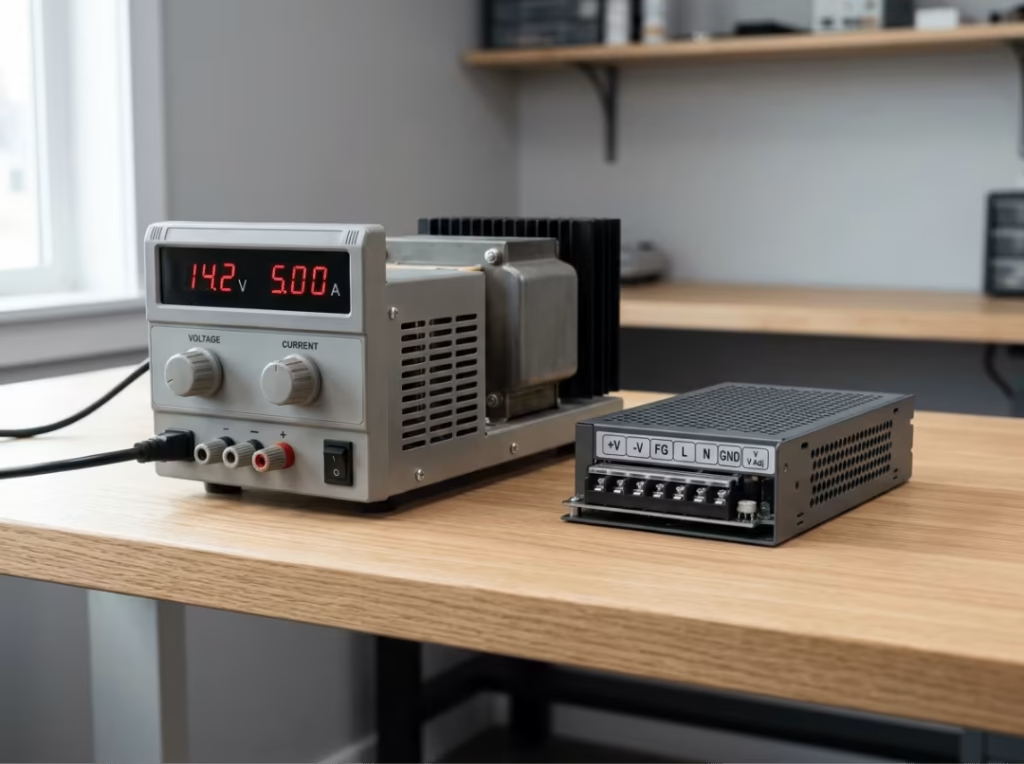
A bench supply is designed for active, manual use — development, testing, and repair. It has a front-panel display, adjustment controls, and switches between constant voltage (CV) and constant current (CC) mode based on load conditions. The user sets the output. Bench supplies are the standard tool for engineers who need to power different circuits at different voltages throughout a working day.
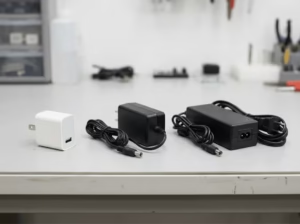
A fixed power supply is built around a specific voltage and current rating. It powers one type of load, runs without adjustment, and installs in a product or machine. This includes the external AC-DC adapters that power routers, cameras, and industrial devices, as well as open-frame supplies that mount inside equipment enclosures. For deployed products and production equipment, a fixed supply is almost always the right choice — it’s sized and certified for one application and doesn’t need operator attention. Quankang’s ITE power supply range covers this category across desktop, wall-mount, and open-frame formats from 5W to 1260W.
Adjustable vs. Programmable Supplies
An adjustable supply lets you set voltage and current manually, typically with front-panel knobs or a keypad. This covers most bench use cases: prototyping, component testing, and repair work where one person operates the supply and watches the result.
A programmable supply adds digital control over GPIB, USB, or Ethernet. Voltage and current are set by software, which enables automated test sequences, data logging, and integration into larger test systems. Programmable supplies make sense in production test environments — where the same sequence must repeat reliably across many units — and in research settings that require logged stimulus-response data. For everything else, an adjustable supply is simpler and usually less expensive.
Other Variants Worth Knowing
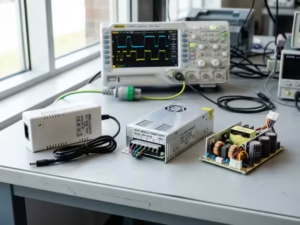
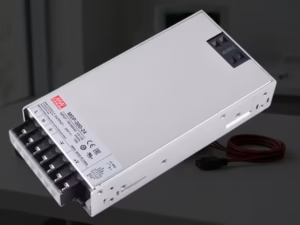
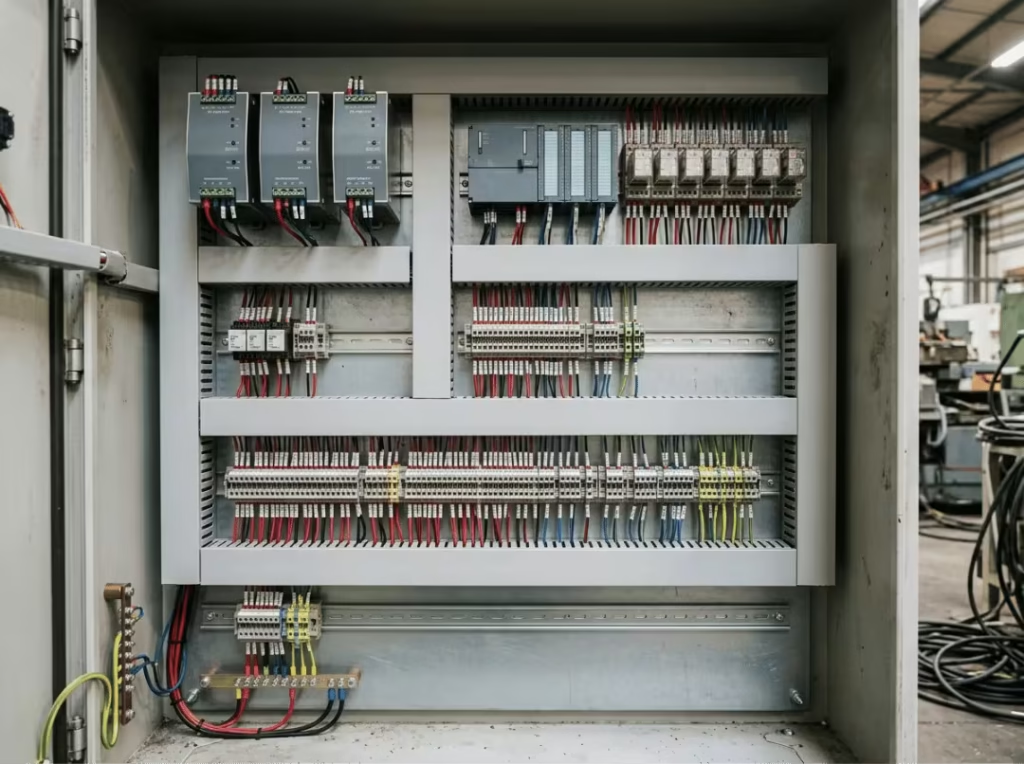
DIN-rail power supplies are fixed-output switching units that mount directly on standard DIN rail inside control cabinets — the standard form factor for industrial automation. Multi-output supplies provide two or more independent rails from a single unit, useful when a design needs both a logic supply and an analog supply. High-voltage DC supplies cover specialized applications like electrostatic equipment and vacuum tube circuits. These are worth knowing exist, but most selection decisions start with the categories above.
Where DC Power Supplies Are Commonly Used
Electronics Design, Prototyping, and Repair
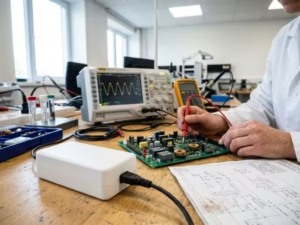
Bench DC power supplies are the daily tool in electronics work. During circuit bring-up, a bench supply with the current limit set conservatively protects a fresh PCB from damage if there’s a fault — the supply folds back rather than pushing fault current through the board. During troubleshooting, applying a controlled voltage to a suspect section while monitoring current draw can locate a short or excessive leakage without risking the rest of the circuit.
In production test, programmable bench supplies become part of the measurement chain: a test fixture applies defined voltages, logs current draw at each step, and flags out-of-spec units automatically. The supply is a test instrument, not just a power source.
Industrial Control and Automation
Industrial equipment — PLCs, motion controllers, sensors, actuators — typically runs on 24V DC from a regulated rail supply. These supplies live in control cabinets, run continuously, and face electrical environments that include transients, surges, and wide input voltage variation. The requirements here differ significantly from controlled lab use: the supply must tolerate worst-case mains conditions, sustain full-load operation in elevated ambient temperatures, and protect downstream equipment if a fault occurs. Protection features that are optional in a lab become non-negotiable in a production environment where a tripped supply shuts down an entire line.
Battery Charging and Power Electronics Development
Controlled DC sourcing is fundamental to battery work. A supply in CC mode delivers constant current during bulk charging, then transitions to CV mode as the cell approaches full charge and current tapers. Power electronics development — designing and testing DC-DC converters, inverters, and motor drives — depends on a clean, stable DC input at well-defined voltages. Some test setups require the supply to absorb regenerative energy from the device under test, which adds requirements not all supplies meet.
Audio, RF, and Precision Analog Circuits
Linear supplies remain standard in audio and RF work because switching noise is simply not acceptable. In a high-quality audio amplifier, supply noise couples into the signal path and sets a floor on what the circuit can achieve. In RF receiver and transmitter design, supply-borne noise appears as spurious signals or degrades sensitivity. Regulated linear bench supplies and linear wall supplies carry an efficiency penalty, but for this class of application the trade-off is worth it.
General Equipment and Dedicated Device Power
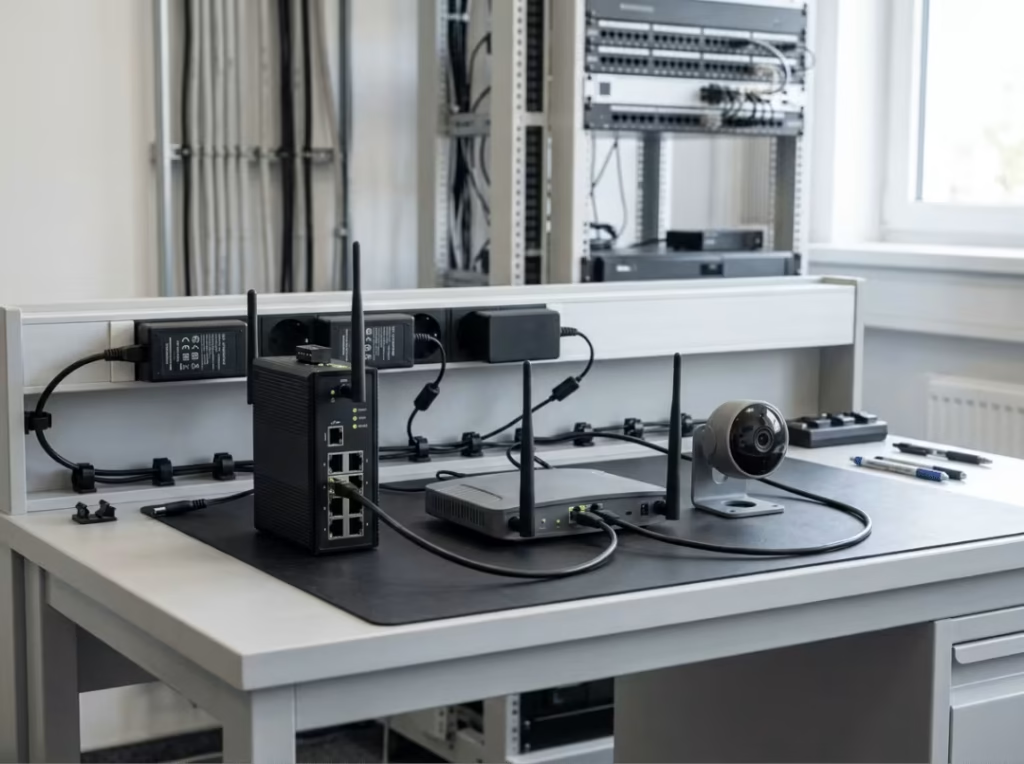
Most electronic products — routers, network switches, IP cameras, digital signage, industrial gateways — use dedicated fixed DC power supplies, either external or internally mounted. These are switching supplies, optimized for efficiency and sized to match the device’s specific voltage and current requirements. For OEM equipment developers, the choice is between standard catalog models that carry the required certifications and custom power adapters tailored to specific connector types, output voltages, or form factors that off-the-shelf units don’t cover.
The Specs That Matter When Comparing a DC Power Supply
Voltage, Current, and Power
Every supply has a rated output voltage, a maximum output current, and a power figure that is their product. Getting these right is the first filter, but the details matter more than the headline numbers.
Voltage must match what the load requires. For bench supplies, look at the full adjustable range — a 0–30V supply covers most low-voltage circuit work; 0–60V is needed for higher-voltage applications.
Current rating needs careful reading. A supply rated 30V/5A delivers a maximum of 5A, but some designs reduce available current proportionally at lower output voltages. Verify this in the datasheet before assuming a 5A rating holds at every output setting.
Power is voltage multiplied by current, but the number that matters is the continuous rating, not a peak or transient value. Many loads draw more current at startup than during steady-state operation — the supply must handle that startup demand without triggering protection or dropping its output voltage.
Constant Voltage and Constant Current Modes
Most bench supplies and many fixed supplies operate in either CV or CC mode, switching automatically based on load conditions.
CV mode is standard for powering circuits. CC mode is used for battery charging, LED testing (where forward voltage varies with temperature and current), and circuit protection during bring-up. When a CV supply reaches its current limit, it crosses over to CC automatically. This is normal behavior, but knowing which mode is active matters when diagnosing unexpected supply behavior — a supply that’s operating in CC when you expect CV is telling you the load is drawing more current than the limit allows.
Ripple and Noise
Ripple is the AC component that remains on the DC output after regulation. It is specified as peak-to-peak millivolts or as an RMS value. A linear supply typically produces under 1 mVpp; a well-designed switching supply typically runs 20–100 mVpp; a poor one, significantly more.
Noise encompasses higher-frequency components beyond the fundamental ripple. Both matter in analog and RF work. For digital circuits and most industrial applications, ripple and noise are less critical as long as they stay within the operating supply tolerance. For audio, RF, precision measurement, and medical sensing, specify ripple and noise explicitly when evaluating options — and verify the figures at the operating point you actually care about, not just at a single test condition.
Regulation, Accuracy, and Readback
Load regulation describes how much the output voltage changes as current draw increases from zero to full load. A supply with 0.5% load regulation holds its output within 0.5% across the full current range — a meaningful specification for any load that draws variable current, which is almost every real load.
Line regulation describes how much the output changes when the mains input voltage varies. Universal-input supplies must regulate cleanly across 100–240 VAC; verify this if the supply will operate across varying mains conditions.
Accuracy is how closely actual output matches the setpoint. Readback accuracy is how closely the displayed value reflects the actual output. On bench supplies, both matter because engineers use the display as a measurement. On fixed supplies, what counts is whether the output stays within the load’s specified range under all operating conditions.
Protection and Safety Features
A supply without protection delivers full current into a fault until something fails. The standard protection set for any serious supply includes:
- Overvoltage protection (OVP): Shuts down or clamps output if voltage rises above a threshold — protects the load if the regulator fails high.
- Overcurrent protection (OCP): Limits or shuts down current above a defined level — prevents wiring damage and protects against short circuits.
- Short-circuit protection (SCP): A specific form of OCP — the supply survives a direct output short without damage.
- Over-temperature protection (OTP): Shuts down when internal temperature exceeds safe limits, protecting the supply from thermal failure caused by poor ventilation or excessive ambient temperature.
Industrial and continuously-operated supplies add input surge protection against mains transients and, in some cases, output hold-up time — continuing operation for a defined interval after mains loss to allow downstream systems to shut down cleanly. For any supply running unattended, check how it recovers from a fault condition. Some auto-recover; others require a manual reset. That distinction matters in an installation where someone isn’t watching.
How to Choose the Right DC Power Supply for Your Application
Step 1: Define the Load Clearly
Before looking at any supply, write down what the load actually needs: required operating voltage and acceptable range, typical operating current, peak or startup current, and whether the circuit is noise-sensitive or can tolerate a standard switching supply noise floor.
Most selection errors trace back to this step. A load that draws 3A steady-state might draw 8A for the first 200 milliseconds at startup. A circuit nominally running at 12V might need to stay between 11.5V and 12.5V to remain in specification. Know those numbers before selecting a supply.
Step 2: Decide Between a Bench Supply and a Fixed Supply
This is usually the easiest decision. If you need to adjust parameters regularly — development, testing, repair — a bench supply is what you need. If a specific voltage is always required for a specific load, a fixed supply is correct. Using a bench supply as a permanent power source for installed equipment creates reliability and certification problems over time. They’re different tools for different jobs.
Step 3: Choose Between Linear and Switching
If your load is noise-sensitive — audio, RF, precision analog measurement — start with a linear supply unless efficiency or size constraints make it impractical. For industrial, IT, general electronics, and higher-power applications, a switching supply is the correct starting point.
Within switching supplies, quality varies significantly. A well-designed SMPS with properly measured ripple specs and full protection features performs very differently from a low-cost unit with no noise specification at all. The topology is only part of the evaluation.
Step 4: Check the Specs That Reflect Real Use
Rated wattage is the maximum available under ideal conditions. Most engineers apply a 20–30% current derating to account for thermal conditions, startup peaks, and real-world variation. A supply rated at 5A running at 4A continuously in a 40°C environment is a different product than one running 5A in a 25°C lab.
Check load regulation and ripple against what your circuit can tolerate. If the datasheet doesn’t specify these figures at the operating conditions you care about, treat that as a warning. A supply that holds regulation well at full load is more useful than one rated for more current but with poor regulation.
Step 5: Think About Certifications, Reliability, and Installation Conditions
Certifications are not optional for products going to market. North American products typically need UL or cUL listing. European products need CE marking. Medical applications require IEC 60601-1. These determine whether a product can be sold legally and whether customers will accept it.
For installed supplies, the relevant questions are: what is the operating temperature range, what is the expected service life at typical load, and how does the supply behave under fault conditions? A supply that shuts down safely is far preferable to one that fails in a way that damages downstream equipment. MTBF figures provide rough guidance, but real-world service life depends heavily on how close to rated limits the supply operates and what thermal conditions it faces.
Step 6: Buy for the Work You Actually Do
Buying more supply than an application needs — higher wattage, programmable interfaces, extra channels — is a common pattern. In some cases it adds useful headroom. In others, it adds cost and complexity without benefit. A supply with an excessively high current rating relative to its load may have worse regulation at the low currents it actually delivers. Programmable features add real value in automated test environments; they add nothing in manual bench work.
Match the supply to the application: the right voltage range, adequate current with reasonable margin, appropriate noise performance, and the protection features the installation requires.
Common Mistakes When Choosing a DC Power Supply
Ignoring Peak Current or Startup Demand
Sizing to average current draw without checking startup peaks is one of the most common mistakes. Motors, capacitive loads, and switching circuits all draw significantly more at startup than during steady-state operation. A supply that trips its overcurrent protection every time the load powers up is incorrectly sized, not defective.
Focusing on Wattage but Missing Voltage or Current Limits
A 300W supply rated at 24V/12.5A cannot deliver 48V/6A even though the watt total looks the same. Output voltage and current ratings are independent constraints. Always verify that the specific voltage and current combination the load needs falls within the supply’s actual operating envelope, not just its power headline.
Buying a Low-Cost Supply Without Adequate Protection
A supply without OVP that experiences a regulation failure applies full rail voltage to the load. One without OCP delivers fault current until something burns. Protection features are the mechanisms that prevent single failures from becoming system-level damage. Verify them before purchasing, especially when downstream components are expensive or hard to replace.
Overbuying Features You Won’t Use
Programmable interfaces, remote sense terminals, and LAN control add clear value in automated test environments. For manual bench work and basic repair, they add cost with no practical return. Buy for the work at hand, not for theoretical future flexibility.
Ignoring Noise Requirements in Sensitive Circuits
Using a switching supply to power a precision ADC reference or a low-noise amplifier without checking the ripple specification is a predictable failure path. Measure supply noise at the load — not at the supply output terminals — before assuming the circuit will behave as expected. Catching this at prototype stage is far less expensive than diagnosing it after a system is in the field.
Frequently Asked Questions
What is the difference between a DC power supply and a power adapter?
A power adapter is a fixed-output external unit — compact, with a specific voltage and current rating — designed to connect a device to the mains. A DC power supply is a broader category that includes adjustable bench supplies, open-frame units for internal installation, industrial rail-mount supplies, and external adapters. All power adapters are DC power supplies; not all DC power supplies are adapters.
Should I choose a linear or switching DC power supply?
Choose linear when output noise is the binding constraint — audio, RF work, precision analog measurement, or any application where eliminating supply-borne interference is critical. Choose switching for most other applications: industrial equipment, IT hardware, battery charging, and any situation where efficiency, compact size, or higher power levels matter. If noise sensitivity is unclear, a linear supply is the conservative starting point; if power exceeds roughly 50W or space is limited, switching is the practical one.
What does constant current mode mean on a DC power supply?
In CC mode, the supply holds output current at a fixed value while allowing output voltage to vary with the load. This is useful for battery charging, where current must be controlled during the bulk phase, and for protecting a circuit under test — setting a low current limit prevents excessive current from causing damage if there is a fault. Most bench supplies cross over between CV and CC automatically.
Do I need a programmable DC power supply?
Only if your application requires remote control or automated test sequences. Programmable supplies communicate over USB, GPIB, or Ethernet and let software control voltage and current, trigger measurements, and log data. For manual bench work, a standard adjustable supply with front-panel controls is simpler and less expensive. For production test or integrated test systems, programmable control is a genuine requirement.
How much extra current capacity should I allow?
A good working rule is to size the supply at 125–150% of expected continuous load current. If the circuit draws 4A under normal conditions, select a supply rated for at least 5–6A. The margin covers startup transients, component variation, worst-case operating conditions, and derating at elevated ambient temperatures. Supplies run continuously at or near their current limit tend to have worse regulation and shorter service lives than those operating comfortably within their range.
Are all DC power supplies regulated?
No. Unregulated supplies lack active feedback control and allow output voltage to vary with both load current and input voltage. They are less expensive but unsuitable for any load that requires stable voltage. Most modern applications use regulated supplies, where a control loop actively corrects the output to hold it close to the setpoint. How well it does that is described by the load regulation and line regulation figures in the datasheet.
Match the Supply to the Work
Choosing the right DC power supply comes down to a consistent sequence: understand what the load actually needs, pick the right form factor, choose the topology that fits the noise and efficiency requirements, check the specs that reflect real operating conditions rather than ideal ones, and confirm that protection features and certifications match the installation environment.
A supply selected that way runs reliably, protects downstream equipment under fault conditions, and meets whatever compliance requirements apply. A supply chosen on wattage alone, or on price without checking regulation and noise figures, tends to produce faults that are slow to trace — the kind that get attributed to the circuit long before anyone checks the power supply.