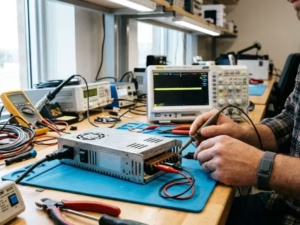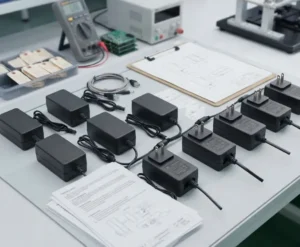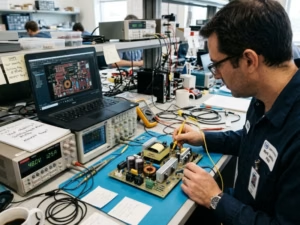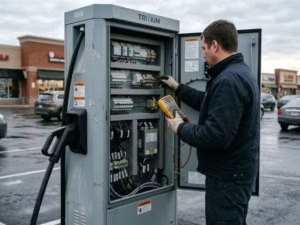
Most AC-DC converter problems don’t show up on the bench. They appear later. A controller resets every time a motor starts. A supply hits thermal shutdown once the enclosure lid is sealed. An EMC scan fails by 3 dB two weeks before launch. Or the unit meets every electrical spec but won’t fit the chassis.
An AC-DC converter turns mains or platform AC into regulated DC at the voltage, current, and noise level your load needs. It also has to work within your thermal and compliance limits, and that is where most selection mistakes happen. A datasheet headline such as “60 W, 12 V” tells you very little about whether the unit will survive your installation.
This guide follows the order experienced engineers use:
- Confirm the input.
- Define the output.
- Choose the architecture.
- Check thermal performance and reliability.
- Fit the form factor.
- Verify compliance.
- Match the result to your application.
Each step removes options, so the next decision has fewer candidates to judge. A checklist at the end puts the full sequence on one page.
Start With Your Input Power Source
Input compatibility is your fastest filter. If a converter can’t accept the AC it will actually receive, nothing else on the datasheet matters. Confirm voltage, phase, and frequency before you compare anything else.
Voltage Range and Phase
Universal input means a converter accepts roughly 85–264 VAC. Choose it for any product that ships globally, because one SKU then covers 100 V Japan, 120 V North America, and 230 V Europe. Fixed or switch-selectable inputs still exist. They make sense only for equipment that stays in one region, and a switch set to the wrong position is a common cause of field failures.
High-power industrial systems often use three-phase input, typically 340–575 VAC. This becomes practical once you pass about 1 kW. Three-phase input lowers the current per conductor and smooths the rectified bus.
Know the difference between the nominal rating and the tolerance range. A “230 VAC” supply may only tolerate ±10%. A wide-range unit is designed to keep running through deep sags. Look for the full operating range on the datasheet, then compare it with the nameplate of the equipment that feeds your system.
Frequency and Power Quality
Utility power runs at 50 or 60 Hz, and most converters are specified for 47–63 Hz. Aircraft power is different: many platforms supply 115 VAC at 400 Hz under MIL-STD-704. A “universal input” label does not guarantee 400 Hz operation. Input filters, PFC stages, and leakage current all change at higher frequency. If the platform runs at 400 Hz, the datasheet must say so explicitly.
Line quality matters just as much as frequency. Generator-fed sites, weak rural grids, and lines shared with large motors bring sags, surges, and frequency drift. Check two numbers:
- Hold-up time: Typically 10–20 ms at full load. This is how long the output stays in regulation after input power disappears, and it carries you through brief dropouts and transfer-switch events.
- Inrush current: Bulk capacitors can draw tens of amps at power-up. Several supplies switched on together can trip a breaker that handles their combined running load easily.
Define Your Output Requirements
Once the input is settled, translate your load into specific numbers. The goal is a power budget you can defend, with peak behavior and noise limits written down before you browse catalogs.
Voltage, Current, and Power Budget
Add up the steady-state load on each output rail. Then add 20–30% headroom. This margin absorbs component tolerance and future feature creep, and it keeps the supply out of the hot, stressed top of its operating range.
Rail | Voltage | Current | Power |
|---|---|---|---|
Main logic and motors | 12 V | 3 A | 36 W |
Sensors and MCU | 5 V | 2 A | 10 W |
Total load | 46 W | ||
With 25% headroom | ~58 W | ||
Shortlist | 60–75 W units |
Bigger isn’t automatically safer. Efficiency often drops sharply at very light load, and some multi-output supplies need a minimum load on the main rail to regulate properly.
For single vs. multiple outputs, a common approach is to use one well-regulated main output, such as 12 V or 24 V, plus small point-of-load DC-DC converters for the lower rails. This usually gives better regulation than a multi-output supply with cross-regulation problems. If the load sits at the end of a long cable, look for adjustable output trim or remote sense so you can compensate for voltage drop.
Peak Loads and Dynamic Response
Rated power is what the supply delivers continuously. Many loads briefly demand far more:
- Motors and solenoids at startup
- Large capacitive loads charging at power-on
- Processors or RF stages switching into burst mode
Look for a peak power rating with a stated duration, such as 150% for 3 seconds. Without one, the supply may enter overload protection every time the machine starts.
Also check the transient response spec. It tells you how far the output deviates during a load step and how fast it recovers, for example ±5% recovering within 500 µs for a 50–100% step. This number matters more than rated wattage for loads that switch hard.
Ripple, Noise, and Regulation Specs
Ripple and noise is the AC component left on the DC output. It is specified in mV peak-to-peak and usually measured at 20 MHz bandwidth. As a typical guide, about 1% of output voltage is fine for general digital logic, motors, and relays. ADCs, RF front ends, precision sensors, and audio circuits often need much tighter limits, sometimes in the tens of millivolts or lower.
Two regulation specs complete the picture:
- Line regulation: Output change across the full input range
- Load regulation: Output change from minimum to full load
Both are given as percentages, typically ±0.5% to ±1% for a good regulated supply.
Test conditions matter. A ripple figure measured at 25°C with a 0.1 µF and 10 µF capacitor at the output terminals may not match what you see at the end of a 2-meter cable in a 50°C enclosure.
Regulated vs. Unregulated, Linear vs. Switching: Which Do You Need?
Most modern electronics need a regulated switching converter. Linear supplies suit low-power, noise-critical loads where size and heat are acceptable. Unregulated supplies suit only simple, tolerant loads. These two decisions take minutes once you know what to check.
Regulated or Unregulated Output
An unregulated supply has no feedback loop. Its output voltage rises at light load and follows changes in line voltage. A “12 V” unregulated adapter can measure 16 V or more with nothing connected, which is high enough to stress downstream parts rated close to 12 V.
Unregulated output is acceptable for:
- Simple resistive loads such as heaters
- Some brushed DC motors and fans
- Devices with their own onboard regulators that tolerate the full voltage swing
Don’t use it for microcontrollers, sensors, communications equipment, or medical electronics. If you can’t confirm that the load tolerates the swing, choose regulated. The cost difference is small, and the risk is not.
Linear or Switching Topology
A linear supply drops voltage across a pass transistor and burns the difference as heat. A switching supply uses high-frequency pulse width modulation (PWM) and a small transformer. Switching supplies are far more efficient, but they leave some switching noise on the output.
Criterion | Linear | Switching |
|---|---|---|
Typical efficiency | 40–60% | 80–95% |
Size and weight | Large, heavy 50/60 Hz transformer | Compact, high power density |
Output noise | Very low, with no switching residue | Low, with some switching-frequency residue |
Heat generated | High | Low |
Cost at low power (<20 W) | Competitive | Competitive |
Cost at higher power | Rises steeply | Lower per watt |
Best fit | Lab instruments, audio, sensitive analog front ends | Nearly everything else |
Older guidance says switching supplies cost more. At most power levels today, the opposite is true.
For noise-sensitive circuits, a common solution is a switching supply on the main bus with a local low-dropout (LDO) regulator at the sensitive load. This gives you clean power where it matters without the bulk and heat of a full linear design.
Efficiency, Thermal Management, and Reliability
Every watt a converter wastes becomes heat inside your enclosure. Heat is the main factor that shortens component life. These three areas decide whether a supply delivers its rated power for the years you need, or only on the test bench.
Efficiency and Power Factor
Check efficiency at the load you’ll actually run, usually around 50% of rating, not just the peak figure. A supply with 92% peak efficiency at 75% load may fall to 85% at 20% load.
The heat difference can be large. Take a 100 W load:
- At 85% efficiency, the supply dissipates about 18 W.
- At 93% efficiency, it dissipates about 7.5 W.
In a sealed box, that gap can decide whether you need a fan.
External power supplies sold in the US must meet DoE Level VI efficiency limits. The EU applies similar requirements through its Ecodesign rules, which also cap no-load power draw.
Power factor correction (PFC) matters above modest power levels. Without it, a converter draws current in sharp pulses near the peak of each AC cycle, which injects harmonics into the supply. IEC 61000-3-2 sets harmonic limits that commonly apply to equipment above 75 W input, so active PFC is effectively standard on supplies above that level.
Cooling Method and Derating Curves
Converters use one of three cooling methods:
- Convection: No fan. Needs specified clearance above and below the unit.
- Forced air: Needs a minimum airflow, often stated in CFM or LFM, across the unit.
- Conduction-cooled: Moves heat through a baseplate into a chassis wall or cold plate. This is the right choice for sealed enclosures.
Every supply has a derating curve. A typical example is full power up to 50°C ambient, then a linear reduction to 50% of rated output at 70°C. A 100 W supply running at 60°C may only be good for 75 W.
Use the air temperature at the supply, not the room temperature. A 25°C office can produce 45°C air inside a sealed plastic housing, and a 35°C factory floor can mean 55°C near the top of a crowded cabinet. Above roughly 2,000–3,000 m altitude, thinner air carries away less heat, so most manufacturers specify additional derating.
Protection Features and Service Life
Require these four protections as a minimum:
- Over-voltage protection (OVP): Shields the load if regulation fails
- Over-current protection (OCP): Limits output during overload
- Short-circuit protection (SCP): Survives a dead short without damage
- Over-temperature protection (OTP): Shuts down before internal parts overheat
How the supply responds to a fault matters as much as the protection itself:
- Hiccup mode shuts down and retries repeatedly. It may never start a large capacitive load.
- Latch-off mode stays off until input power is cycled. This is safe, but someone has to intervene.
- Constant-current mode holds current at the limit and lets voltage sag until the load charges. It is often the best fit for capacitive and motor loads.
Service life is usually limited by electrolytic capacitors. Their life roughly doubles for every 10°C drop in operating temperature, so derating and airflow are the cheapest reliability upgrades you can make.
Treat MTBF carefully. Figures calculated under MIL-HDBK-217F and Telcordia SR-332 aren’t directly comparable, and neither is a lifespan. A 500,000-hour MTBF does not mean 57 years of operation. Ask for the method, temperature, and load behind the number. Warranty length is often a more honest signal of how long the manufacturer expects the unit to last.
Which Form Factor Fits Your Installation?
Form factor affects cooling, serviceability, certification scope, and total installed cost. The right choice depends on where the converter sits and who is responsible for the enclosure around it.
Form factor | Typical power range | Cooling | Best fit | Tradeoff |
|---|---|---|---|---|
Open-frame | 15–500 W | Convection or system airflow | Cost-sensitive OEM equipment | You provide the safety enclosure and thermal validation |
Enclosed | 50 W–3 kW | Convection or internal fan | Machine-integrated equipment | Fans wear out, so check rated fan life |
DIN rail | 30 W–1 kW | Convection | Control cabinets, automation | Wider footprint per watt |
PCB-mount module | 1–150 W | Conduction through the board | Board-level auxiliary power | Limited power, and heat stays on your PCB |
External adapter (wall or desktop) | 5–300 W | Convection | Consumer, medical, IT, networking | Heat stays outside the product, but the cable and plug become failure points |
Rack or chassis mount | 500 W–several kW | Forced air | Telecom, data, test systems | Higher cost, needs rack infrastructure |
Conduction-cooled | 50 W–1.5 kW | Baseplate to cold wall | Military, outdoor, sealed enclosures | Needs a properly designed thermal interface |
Open-frame units look cheapest on the bill of materials, but they shift creepage, clearance, enclosure, and thermal work onto you. For low-volume builds, an enclosed or external supply often costs less once you count engineering time.
Before you commit, run these integration checks:
- Connector type and mating part availability
- Wire gauge for the rated current over your cable length
- Clearance for airflow
- Access for replacement in the field
- Weight limits for wall-plug or panel mounting
An external adapter that sags out of a wall socket fails the job, however good its electrical specs are.
Safety Certifications and EMI/EMC Compliance
A certified converter speeds up approval of your end product because the test lab can accept the power stage as a known, compliant component. It doesn’t replace system-level testing. Your product is still tested as a whole, and your layout, cabling, and enclosure all affect the result.
Safety Standards by Industry
Start with the standard that governs your end equipment, then confirm the converter is certified to the same one, or to one your lab will accept. A supply certified to the wrong standard can force rework late in the schedule.
- IEC/UL 62368-1: IT, audio/video, and communications equipment. It replaced IEC 60950-1 and IEC 60065.
- IEC 60601-1: Medical electrical equipment. Patient-contact devices typically need 2×MOPP isolation and leakage limits measured in microamps.
- IEC 61010-1: Test, measurement, and laboratory equipment.
- UL 61010-2-201 / UL 508: Industrial control equipment.
- UL 1310 Class 2: Low-voltage, energy-limited circuits, common in LED lighting and building systems.
- CE and UKCA: Required markings for European and UK markets.
Medical is the category where a near-miss costs the most. Isolation grade, leakage current, and the means-of-protection level must match how the device touches the patient. If you’re specifying power for diagnostic, monitoring, or home-care equipment, start from certified medical power supplies rather than trying to adapt an ITE unit.
EMI Emissions and Immunity
Emissions standards set how much noise your product can conduct back into the mains or radiate into the air. CISPR 32 / EN 55032 defines two classes:
- Class A applies to commercial and industrial environments.
- Class B applies to residential environments and is stricter.
In the US, FCC Part 15 applies. Choose a Class B converter if there’s any chance your product ends up in a home, clinic, or office. The extra margin also gives you room to absorb noise from the rest of your design.
Immunity is the opposite question: can the product keep working when noise hits it? The IEC 61000-4 series covers ESD (-4-2), fast transients (-4-4), and surge (-4-5). Defense programs use MIL-STD-461 for both emissions and immunity.
A compliant converter can still fail once installed. Long unshielded output cables, poor grounding, or a noisy PCB layout can push the system over the limit, so plan a pre-compliance scan before formal testing.
How to Match an AC-DC Converter to Your Application
Each application puts its own pressure on the parameters above. The table below shows what a well-chosen converter typically looks like in five common sectors. Use it to set your starting specs, then refine them with the sections above.
Application | Typical output | Key specs | Common standards |
|---|---|---|---|
Industrial automation | 24 V | DIN rail, -25 to +70°C range, high surge immunity, DC-OK signal, peak power reserve | UL 61010-2-201 / UL 508, IEC 61000-6-2 / 6-4 |
Medical | 5–48 V | 2×MOPP isolation, low leakage current, Class B emissions, low ripple | IEC 60601-1, IEC 60601-1-2 |
Military and aerospace | 28 V and others | 115 VAC 400 Hz input, conduction cooling, wide temperature range, conformal coating | MIL-STD-704 / 461 / 810 |
Telecom and IT | 12 V or 48 V | Redundancy, hot-swap, high efficiency, digital monitoring | IEC/UL 62368-1, EN 55032 |
LED lighting | Constant voltage (12/24 V) or constant current | Correct driver mode, dimming compatibility, long life at high ambient | UL 1310 Class 2, IEC 61347 |
The LED row catches people out most often. Constant-voltage drivers feed LED strips with built-in resistors or drivers. Constant-current drivers feed bare LED arrays directly. Using the wrong type either under-drives the LEDs or destroys them.
Standard catalog units cover most needs. Consider a custom or modified design when your requirements include:
- An unusual input, such as 400 Hz or wide DC-plus-AC
- An odd combination of output voltages
- An extreme environment
- A form factor that has to fit an existing housing
- Branding or connector requirements for an OEM product
Modifying a proven platform is usually faster and lower risk than a clean-sheet design. For a closer look at how requirements differ by sector, see this overview of power supply applications across industries.
Common AC-DC Converter Selection Mistakes
Most power supply field failures don’t trace back to defective units. They trace back to specification decisions made months earlier. These seven come up again and again.
- Sizing to the load with no headroom. The supply runs hot at full rating and ages fast. Add 20–30% above the summed steady-state load.
- Ignoring derating at enclosure temperature. The unit delivers rated power on the bench but shuts down in the field. Apply the derating curve to the internal air temperature you measure or estimate.
- Overlooking startup and peak currents. Motors and capacitive loads trigger overload protection at every power-up. Choose a unit with a peak power rating or constant-current overload behavior.
- Assuming “universal input” covers 400 Hz. The supply overheats or fails on aircraft power. Confirm 400 Hz operation explicitly on the datasheet.
- Using unregulated output for electronics. Light-load voltage rise damages logic and sensors. Specify regulated output for anything with a semiconductor in it.
- Treating converter certification as end-product compliance. Your product still fails EMC or safety testing. Budget for system-level pre-compliance testing.
- Comparing MTBF figures calculated with different methods. You pick the “more reliable” unit based on numbers that were never comparable. Ask for the method, temperature, and load behind every figure.
AC-DC Power Converter FAQ
What size AC-DC converter do I need?
Add the steady-state power of every output rail, then add 20–30% headroom. For example, a 46 W load points to a 60–75 W supply. Next, check the derating at your enclosure temperature and confirm the unit can handle startup peaks. Size for the worst real condition, not the bench condition.
Is a switching power supply better than a linear one?
For most applications, yes. Switching supplies reach 80–95% efficiency and are much smaller and lighter. Linear supplies still win when you need extremely low output noise at low power, as in audio equipment, lab instruments, and sensitive analog front ends. Size, weight, and heat usually rule linear out above about 20–30 W.
Can I use a converter with a higher wattage rating than my device needs?
Yes, as long as the output voltage matches. A load draws only the current it needs, so extra wattage capacity doesn’t push excess power into it. The real risk is a voltage mismatch. Just note that a heavily oversized supply may run less efficiently at light load and costs more.
What does “universal input” mean?
It means the converter accepts roughly 85–264 VAC at 47–63 Hz without a selector switch. That range covers standard mains voltages worldwide, so one model can ship to any market. It does not automatically include 400 Hz aircraft power or three-phase industrial supplies. Those need explicit ratings on the datasheet.
When do I need a medical-grade power supply?
You need one when your end product falls under IEC 60601-1. That includes devices that contact patients or operate within the patient environment, such as monitors, diagnostic equipment, and home-care devices. Medical-grade supplies provide higher isolation, such as 2×MOPP, and much lower leakage current than ITE-rated units.
Is an AC-DC converter the same as a power supply?
In practice, the terms often describe the same product. Strictly speaking, “converter” can mean a board-level module, while “power supply” usually means a complete unit with an enclosure, terminals, and protections. A rectifier is different. It is only one stage inside a converter, and on its own it produces unregulated DC.
AC-DC Converter Selection Checklist: 8 Steps in Order
Follow these steps in sequence. Each one narrows the field for the next, and skipping ahead to brand or price usually sends you back to the start.
- Confirm the input: voltage range, phase, and frequency, including 400 Hz where it applies.
- Calculate the power budget: sum each rail, then add 20–30% headroom.
- Check peak and inrush demands: account for motor starts, capacitive loads, and shared breakers.
- Set ripple and regulation limits: write mV peak-to-peak and percentage targets for each rail.
- Choose the topology: regulated switching by default, linear only for low-power, noise-critical loads.
- Verify derating: use the enclosure’s internal temperature and your installation altitude.
- Select the form factor: match it to your space, cooling method, and service access.
- Confirm safety and EMC standards: use the standards that govern your end product and target markets.
Once you’ve worked through these steps, you should have a clear spec sheet and a shortlist of two or three candidates. From there, compare datasheets line by line against your numbers. You can browse Quankang’s AC-DC power supply range for certified medical, ITE, and adapter models. If your requirements don’t fit a standard unit, such as an unusual output voltage, a specific connector, or a tight housing, the engineering team can review your spec and modify or develop a design to match.