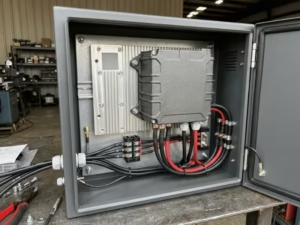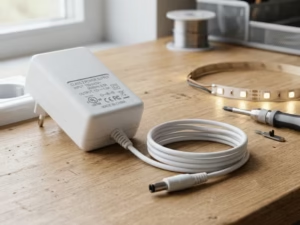
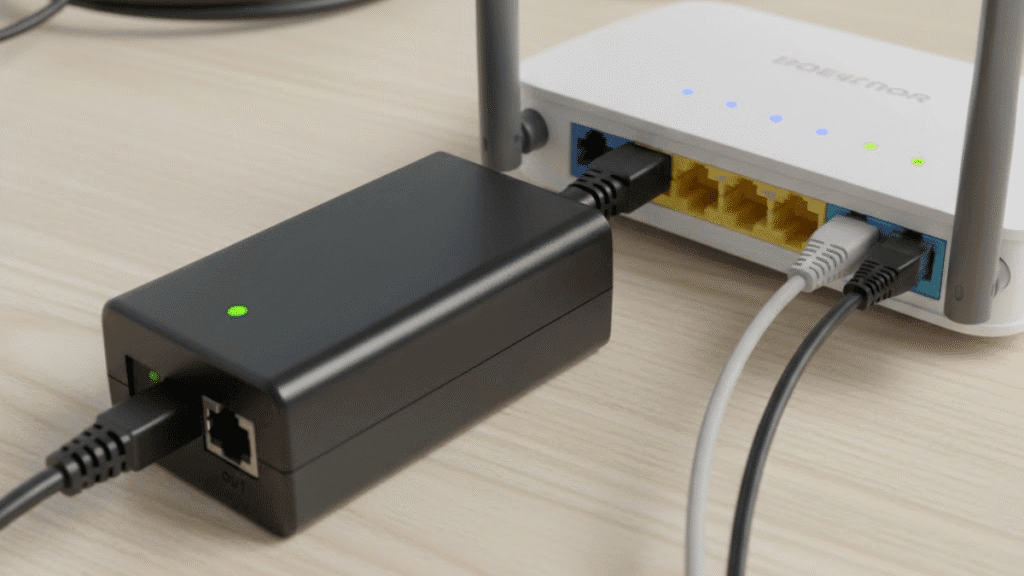
In this guide, “industrial PoE adapter” refers to an active PoE power solution that integrates the power supply and PoE injection function for compatible Ethernet devices. Terminology may vary among manufacturers, so the actual electrical and PoE specifications should always be verified.
Industrial Ethernet networks are increasingly used in factory automation, industrial IoT, machine vision, process monitoring, security systems, and other demanding applications. As more industrial devices require both network connectivity and reliable power, Power over Ethernet (PoE) provides a practical way to simplify system design by delivering power and data through a single Ethernet connection.
However, selecting an industrial PoE adapter is not the same as choosing a standard adapter for an office network.
Industrial applications may expose power equipment to wider temperature ranges, electrical noise, voltage fluctuations, transient disturbances, and continuous operation. The PoE adapter must therefore be evaluated not only by its output power, but also by its PoE standard, input requirements, protection functions, EMC performance, reliability, and long-term supply capability.
For industrial equipment manufacturers, OEMs, ODMs, and system integrators, the challenge becomes even more complex when the PoE adapter must be customized for a specific device.
This guide explains what an industrial PoE adapter is, how it differs from a standard PoE solution, which specifications matter most, and how to choose the right industrial PoE adapter for Industrial Ethernet and OEM applications.
What Is an Industrial PoE Adapter?
An industrial PoE adapter is a PoE power solution designed for use with industrial network equipment and other devices operating in demanding environments.
Depending on the system architecture, an industrial PoE adapter may provide power to compatible Ethernet devices while supporting the electrical, environmental, and reliability requirements of industrial applications.
Typical applications may include:
- Industrial Ethernet equipment
- Industrial IoT gateways
- Machine vision systems
- Industrial cameras
- Factory automation equipment
- Access control systems
- Networked sensors
- Edge computing devices
- Building automation equipment
- Industrial monitoring systems
The exact design of an industrial PoE adapter depends on the application.
For example, an industrial camera may have different power requirements from an IoT gateway, while a machine vision system may require a higher power output and stricter EMC performance.
Therefore, an industrial PoE adapter should be selected based on the complete application rather than simply choosing the highest available power rating.
Why Use PoE in Industrial Ethernet Applications?
Industrial systems often contain multiple distributed devices that require both network connectivity and electrical power.
Traditionally, power and data may require separate cables and infrastructure.
PoE can simplify this architecture by allowing compatible devices to receive power and data through Ethernet connectivity.
Potential benefits include:
Simplified Installation
Power and network connectivity can be integrated into the same Ethernet infrastructure, potentially reducing cabling complexity.
Flexible Device Deployment
PoE can make it easier to deploy network-connected devices in locations where installing a separate power connection is inconvenient.
Reduced Infrastructure Complexity
Using Ethernet for both communication and power can simplify certain system architectures.
Easier System Integration
For equipment manufacturers, integrating PoE into an industrial device can simplify the connection between the device and the network infrastructure.
Centralized Power Architecture
Depending on the network design, PoE can support centralized power management and distribution.
However, PoE is not automatically the best solution for every industrial application. The device power requirements, network topology, operating environment, cable distance, and required reliability should all be evaluated before selecting the power architecture.
Industrial PoE Adapter vs. Standard PoE Adapter: What Is the Difference?
A standard PoE adapter may be sufficient for typical office or commercial networking applications.
Industrial environments, however, can introduce additional challenges.
| Consideration | Standard Application | Industrial Application |
| Operating Temperature | Typical indoor range | May require wider temperature range |
| Electrical Noise | Relatively controlled | Potentially higher |
| Transient Disturbances | Lower exposure | Potentially higher |
| EMC Requirements | Application-dependent | Often more demanding |
| Reliability | Standard requirements | Continuous operation may be critical |
| Protection | Standard protection | May require additional protection |
| Product Lifecycle | Typical commercial lifecycle | Often longer |
| Customization | May use standard products | OEM/ODM customization may be required |
The exact requirements depend on the industry and application.
For example, an industrial PoE adapter used inside a controlled factory environment may have different requirements from one installed near heavy machinery or other sources of electrical interference.
The key point is:
An industrial PoE adapter should be selected according to the actual operating environment and system requirements, not simply because the application is labeled “industrial.”
What PoE Standard Does an Industrial Device Need?
The required PoE standard depends on the industrial device’s power consumption and compatibility.
Common IEEE PoE standards include:
| IEEE Standard | Common Name | PoE Type | Maximum PSE Power | Maximum PD Power |
| IEEE 802.3af | PoE | Type 1 | 15.4W | 12.95W |
| IEEE 802.3at | PoE+ | Type 2 | 30W | 25.5W |
| IEEE 802.3bt | PoE++ | Type 3 | Up to 60W | Up to approximately 51W |
| IEEE 802.3bt | PoE++ | Type 4 | Up to approximately 90W* | Up to approximately 71W* |
*Actual available power depends on the implementation and equipment specifications.
For example:
- A low-power industrial sensor or network device may require a lower-power PoE standard.
- An industrial camera may require PoE or PoE+ depending on its functions.
- A high-performance industrial camera or advanced edge device may require higher-power PoE.
The correct standard should always be determined by the powered device’s specifications.
For a detailed comparison of PoE standards, see:
802.3af vs. 802.3at vs. 802.3bt: Which PoE Standard Do You Need?
How Much Power Does an Industrial PoE Device Need?
Industrial equipment can have very different power requirements.
For example:
Industrial Cameras
Power consumption may increase when the camera includes:
- High-performance image sensors
- Infrared illumination
- Heaters
- Advanced image processing
- Machine vision functions
Industrial IoT Gateways
An IoT gateway may require additional power for:
- Multiple communication interfaces
- Edge computing
- Data processing
- Storage
- Wireless connectivity
Industrial Network Equipment
Industrial network equipment may require power for:
- Network processing
- Multiple Ethernet ports
- Communication modules
- Monitoring functions
Therefore, the PoE adapter should be selected based on the device’s:
- Typical power consumption
- Maximum power consumption
- Startup power
- Peak power
- Future expansion requirements
For multi-device systems, the overall PoE power budget should also be considered.
See:
How Much Power Does PoE Need? Understanding PoE Power Budget
8 Key Specifications to Consider When Choosing an Industrial PoE Adapter
Choosing an industrial PoE adapter requires a comprehensive evaluation of electrical, environmental, and reliability requirements.
1. Input Voltage
The first consideration is whether the adapter’s input is compatible with the available power source.
Depending on the application, requirements may include:
- AC input
- DC input
- Wide input voltage range
For OEM projects, the required input voltage should be defined early in the design process.
A mismatch between the power source and adapter input requirements can make the solution unsuitable for the final system.
2. PoE Output Power
The adapter must provide sufficient power for the connected device.
Consider:
- Nominal power
- Maximum power
- Peak power
- Startup requirements
- Cable losses
Avoid selecting a PoE adapter solely according to the device’s average power consumption.
If the connected device has motors, heaters, infrared illumination, or other power-intensive functions, peak power should also be considered.
3. PoE Standard Compatibility
Verify compatibility with the required:
- IEEE 802.3af
- IEEE 802.3at
- IEEE 802.3bt
The adapter and powered device must be compatible with the intended PoE architecture.
This is particularly important for OEM applications where the PoE adapter becomes part of a complete industrial product.
4. Operating Temperature
Temperature can significantly affect power electronics and long-term reliability.
Depending on the application, the PoE adapter may need to operate in:
- Cold environments
- Hot factory environments
- Equipment enclosures
- Outdoor industrial locations
The required operating temperature range should be defined according to the actual installation environment.
For OEM customers, it is important to verify the complete operating temperature specification rather than assuming that every “industrial” PoE adapter supports the same temperature range.
5. Protection Functions
Industrial environments may expose equipment to electrical disturbances.
Depending on the application, the PoE adapter may require:
- Overvoltage protection
- Overcurrent protection
- Short-circuit protection
- Overtemperature protection
- Surge protection
The required protection level should be determined by the system architecture and operating environment.
6. EMC Performance
Electromagnetic compatibility is an important consideration for industrial equipment.
Industrial environments may contain sources of electromagnetic interference, including:
- Motors
- Variable-frequency drives
- Switching equipment
- Industrial machinery
- High-power electrical systems
A suitable PoE adapter should be evaluated for its EMC performance and compliance with applicable requirements.
For OEM projects, EMC requirements should be considered during the early design stage rather than after the product has entered mass production.
7. Efficiency and Thermal Performance
Power conversion generates heat.
Higher efficiency can help reduce:
- Energy loss
- Heat generation
- Thermal stress
Thermal performance is particularly important when the PoE adapter is installed inside:
- Compact equipment
- Enclosures
- Control cabinets
- Industrial devices
For OEM designs, the adapter’s efficiency and thermal characteristics should be evaluated together with the final enclosure and operating environment.
8. Reliability and Product Lifecycle
Industrial equipment is often expected to operate continuously for extended periods.
Therefore, manufacturers should evaluate:
- Component quality
- Reliability testing
- Thermal design
- Quality control
- Production consistency
- Long-term product availability
For industrial OEM projects, product lifecycle management is particularly important.
Changing a power supply after a product has entered mass production can require:
- Hardware redesign
- Safety re-evaluation
- EMC testing
- Certification updates
- Production changes
Selecting a stable long-term supplier can therefore reduce lifecycle risk.
Industrial PoE Adapter Applications
Industrial PoE technology can be used across a wide range of applications.
Industrial IoT
PoE can provide power and network connectivity for:
- IoT gateways
- Edge devices
- Smart sensors
- Monitoring equipment
Factory Automation
Industrial Ethernet networks are widely used to connect equipment and control systems.
PoE may be considered for compatible devices that require both network connectivity and power.
Industrial Cameras and Machine Vision
Industrial cameras may require reliable network connectivity and power.
Applications include:
- Machine vision
- Quality inspection
- Production monitoring
- Process control
Depending on the camera’s features, power requirements may vary significantly.
Security and Surveillance
Industrial facilities may use networked cameras for:
- Perimeter security
- Facility monitoring
- Access control
- Production area surveillance
The required PoE solution should be selected according to the camera’s power consumption and environmental conditions.
Industrial Monitoring
PoE may support network-connected monitoring equipment used in:
- Manufacturing
- Energy
- Infrastructure
- Logistics
- Warehousing
The specific power and environmental requirements depend on the equipment.
How to Choose the Right Industrial PoE Adapter
A practical selection process can be divided into seven steps.
Step 1: Define the Application
Identify the actual industrial device and operating environment.
Step 2: Determine the Power Requirement
Confirm:
- Input voltage
- Maximum output power
- Peak power
- Startup power
Step 3: Confirm PoE Compatibility
Determine whether the application requires:
- 3af
- 3at
- 3bt
Step 4: Evaluate Environmental Conditions
Consider:
- Operating temperature
- Humidity
- Electrical noise
- Installation location
Step 5: Define Protection Requirements
Determine whether the application requires additional protection against:
- Overvoltage
- Overcurrent
- Short circuits
- Temperature
- Surges
Step 6: Verify EMC and Compliance
Confirm applicable safety and EMC requirements for the target market and application.
Step 7: Evaluate the Supplier
For industrial OEM applications, assess:
- Engineering capabilities
- Customization capabilities
- Quality control
- Testing
- Production capacity
- Long-term supply
This final step is often overlooked but can have a significant impact on the long-term success of an industrial product.
Standard Industrial PoE Adapter vs. Custom OEM/ODM Solution
Not every industrial application requires a customized PoE adapter.
A standard solution may be appropriate when:
- Power requirements are common
- Input voltage is standard
- The enclosure can accommodate an existing design
- Standard connectors are acceptable
- Certifications already match the target market
However, OEM and ODM projects often have more specific requirements.
A custom PoE adapter may be considered when the application requires:
- Custom input voltage
- Custom output power
- Custom connector
- Custom dimensions
- Custom mechanical design
- Specific protection functions
- Specific operating temperature
- Customized labeling
- Brand customization
- Product integration
For example, an industrial equipment manufacturer may need a PoE adapter designed around the electrical and mechanical requirements of a new product.
In this case, an OEM/ODM development process may include:
Application Requirements
↓
Electrical Specification
↓
Prototype Development
↓
Engineering Verification
↓
Testing
↓
Design Optimization
↓
Mass Production
A manufacturer with both engineering and production capabilities can help customers develop a PoE power solution that fits the final equipment rather than forcing the equipment to adapt to an off-the-shelf product.
What Should You Ask an Industrial PoE Adapter Manufacturer?
Before selecting a supplier, industrial equipment manufacturers should ask:
Can you support OEM and ODM projects?
This is important when standard products do not meet the equipment’s requirements.
Can you customize the electrical specifications?
Ask about:
- Input voltage
- Output power
- PoE standard
- Protection functions
Can you customize mechanical requirements?
Consider:
- Dimensions
- Connectors
- Enclosure
- Labels
- Packaging
Can you support product development?
Ask whether the supplier can assist with:
- Specification definition
- Prototype development
- Engineering samples
- Testing
- Design optimization
Can you support mass production?
Evaluate:
- Production capacity
- Quality control
- Supply stability
- Lead times
Can you support long-term product supply?
This is particularly important for industrial equipment with long product lifecycles.
Common Mistakes When Choosing an Industrial PoE Adapter
Mistake 1: Assuming Any PoE Adapter Can Be Used in Industrial Applications
A standard office-oriented adapter may not meet the environmental or EMC requirements of an industrial system.
Mistake 2: Choosing Based Only on Output Wattage
Power is important, but so are:
- PoE compatibility
- Input voltage
- Temperature
- Protection
- EMC
- Reliability
Mistake 3: Ignoring Peak Power
The device may consume significantly more power during startup or when additional functions are activated.
Mistake 4: Treating “Industrial” as a Specification
The term “industrial” alone does not define a product’s actual performance.
Always verify specific specifications such as:
- Temperature range
- EMC performance
- Protection
- Reliability
Mistake 5: Waiting Too Long to Involve the Power Supplier
For OEM products, power requirements should be discussed early in the development process.
Late changes may affect:
- Mechanical design
- PCB design
- Thermal management
- Safety testing
- EMC testing
- Certification
Early collaboration can reduce redesign risks.
Industrial PoE Adapter Selection Checklist
Before selecting an industrial PoE adapter, verify:
- Application and connected device
- Input voltage
- Maximum output power
- Startup power
- Peak power
- IEEE 802.3af / 802.3at / 802.3bt compatibility
- PoE class
- Operating temperature
- Protection requirements
- Surge protection
- EMC requirements
- Efficiency
- Thermal performance
- Safety certifications
- Reliability requirements
- Product lifecycle
- OEM/ODM requirements
- Custom connector requirements
- Custom mechanical requirements
- Long-term supply capability
Industrial PoE Adapter FAQ
What is an industrial PoE adapter?
An industrial PoE adapter is a PoE power solution intended for industrial network equipment and applications that may require additional environmental, electrical, EMC, or reliability considerations.
What is the difference between an industrial PoE adapter and a standard PoE adapter?
The main difference is not necessarily the PoE function itself, but the environmental and reliability requirements of the application.
Industrial applications may require wider operating temperatures, stronger protection, higher EMC performance, and longer product lifecycles.
The actual specifications should always be verified for the intended application.
What PoE standard is best for industrial applications?
There is no single PoE standard that is best for every industrial application.
The appropriate standard depends on the power requirements of the connected device.
IEEE 802.3af, 802.3at, and 802.3bt may all be suitable for different applications.
Can an industrial PoE adapter be customized?
Yes.
For OEM and ODM projects, PoE adapters may be customized according to requirements such as:
- Input voltage
- Output power
- PoE standard
- Connector
- Dimensions
- Protection functions
- Mechanical design
The available customization depends on the manufacturer’s engineering and production capabilities.
Do industrial PoE applications require surge protection?
Not every application has the same requirements.
However, applications exposed to electrical disturbances or transient events may require appropriate surge and protection measures.
The required protection should be evaluated based on the complete system design.
How do I choose an industrial PoE adapter manufacturer?
Consider:
- PoE technology experience
- Engineering capabilities
- OEM/ODM support
- Product customization
- Quality control
- Testing capabilities
- Certifications
- Production capacity
- Long-term supply stability
For OEM customers, the ability to support the complete development process can be particularly valuable.
Final Thoughts: Choosing the Right Industrial PoE Adapter
Selecting an industrial PoE adapter requires more than checking whether the adapter can provide enough power.
A reliable solution should be evaluated based on the complete application, including:
- Input voltage
- Output power
- PoE standard
- Peak power
- Operating temperature
- Protection functions
- EMC requirements
- Thermal performance
- Reliability
- Product lifecycle
For industrial equipment manufacturers and system integrators, the right supplier can be just as important as the right product specification.
Standard PoE adapters may be suitable for straightforward applications, while OEM and ODM projects may require a customized solution designed around the equipment’s electrical, mechanical, environmental, and compliance requirements.
If you are developing industrial Ethernet equipment, Industrial IoT devices, industrial cameras, factory automation equipment, or other PoE-enabled products, working with an experienced PoE adapter manufacturer early in the design process can help optimize the power solution and reduce development risks.
Looking for a PoE adapter manufacturer for an industrial OEM or ODM project?
Contact Quankang with your application requirements, input voltage, output power, PoE standard, operating environment, and customization needs to discuss a suitable PoE adapter solution.