Introduction
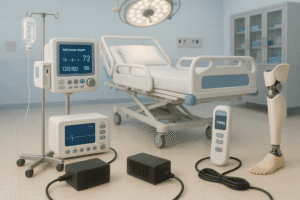
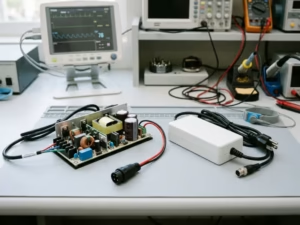
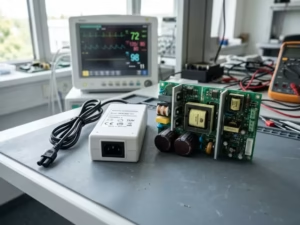
Medical devices require much more than simple AC-to-DC power conversion. A reliable power supply directly affects electrical safety, electromagnetic compatibility (EMC), system stability, and long-term product reliability.
Whether powering patient monitors, infusion pumps, ultrasound systems, laboratory analyzers, or home healthcare equipment, medical device manufacturers must select power supplies that meet strict safety requirements and provide stable performance throughout the product lifecycle.
Unlike standard commercial AC/DC adapters, medical AC-DC power supplies are designed specifically for healthcare environments where electrical protection and reliability are critical. They typically require compliance with international medical safety standards, low leakage current design, enhanced isolation, and improved EMC performance.
Selecting an unsuitable power supply may result in:
- Certification delays
- EMC testing failures
- Excessive leakage current
- Thermal issues during continuous operation
- Increased maintenance costs
- Product redesign risks
This guide explains how AC DC power supplies for medical applications differ from standard power adapters, the available product types, key selection factors, and how OEM medical device manufacturers can choose the right solution.
What Is a Medical AC DC Power Supply?
A medical AC-DC power supply converts AC mains input voltage into regulated DC output power required by medical equipment.
The basic conversion process includes:
AC Input
│
EMI Filter
│
Bridge Rectifier
│
Power Conversion Circuit
│
Isolation Transformer
│
Output Filtering & Regulation
│
Stable DC Output
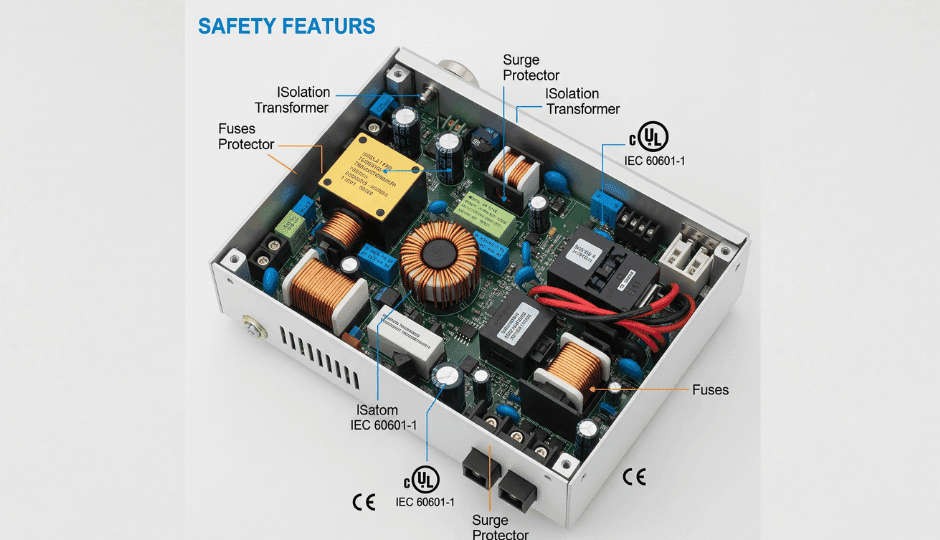
However, medical-grade AC-DC power supplies include additional design considerations compared with general-purpose adapters, including:
- Enhanced electrical isolation
- Lower leakage current
- Improved EMC performance
- Higher reliability
- Medical safety compliance
- Long-term product availability
These features help ensure safe operation when medical equipment is used near or directly connected to patients.
Why Medical Devices Require Specialized AC DC Power Supplies
Medical equipment operates in environments where electrical safety and reliability are essential.
A power supply failure or unsuitable electrical design may affect:
- Patient safety
- Measurement accuracy
- Equipment reliability
- Regulatory approval processes
For this reason, medical device manufacturers must evaluate more than just output voltage and power rating.
Key requirements typically include:
| Requirement | Importance |
| IEC 60601-1 Compliance | Ensures medical electrical safety requirements are considered |
| Medical Isolation (MOPP/MOOP) | Provides protection against electric shock |
| Low Leakage Current | Reduces electrical risk for patient-connected equipment |
| IEC 60601-1-2 EMC Performance | Helps prevent electromagnetic interference |
| High Reliability | Supports continuous medical operation |
| Energy Efficiency | Reduces heat generation and operating costs |
| Long Product Lifecycle | Supports long-term medical device availability |
For detailed information about specific medical safety requirements, please refer to:
- IEC 60601-1 Medical Power Supply Requirements
- What Is 2×MOPP in Medical Power Supplies?
- Low Leakage Current in Medical Power Supplies
Medical Applications Using AC DC Power Supplies
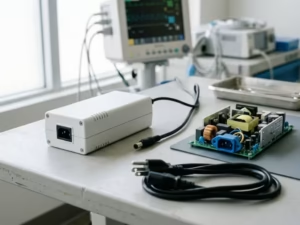
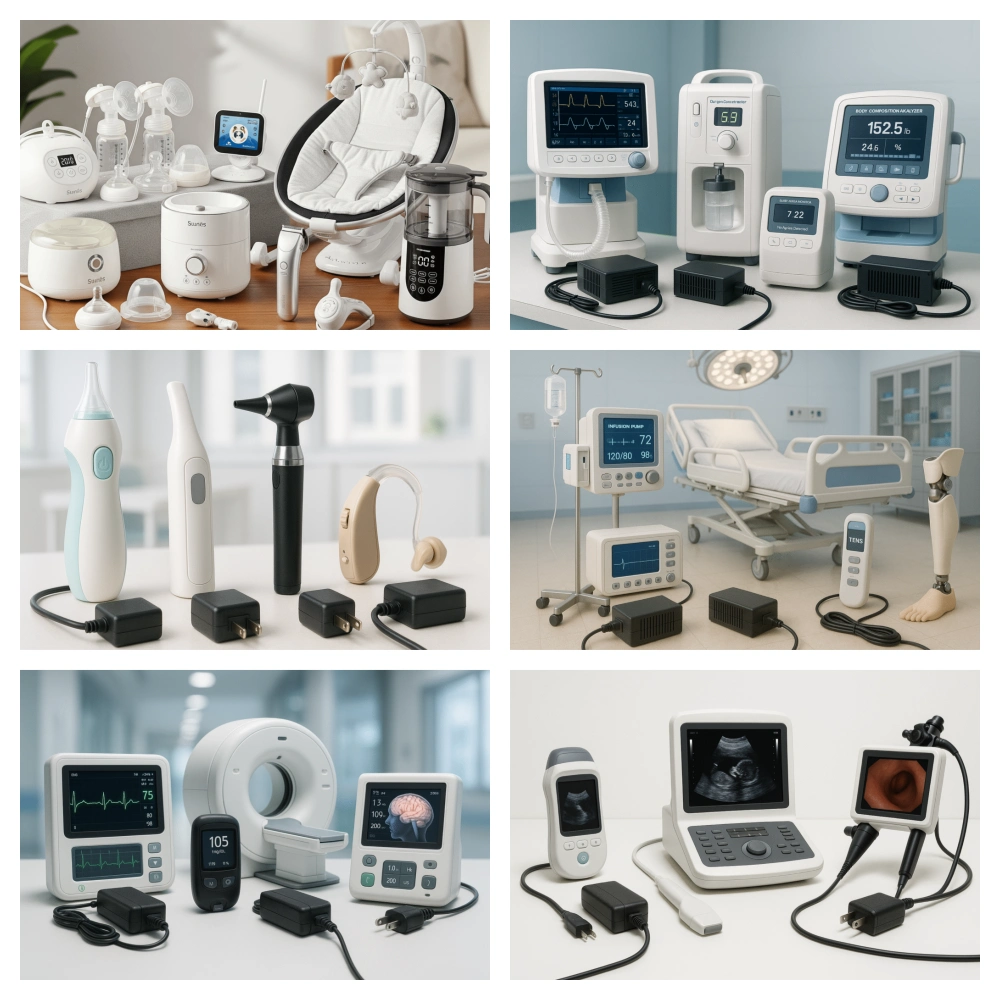
Medical AC-DC power supplies are widely used in different healthcare and medical equipment applications. Each application has different requirements for power output, mechanical design, safety protection, and reliability.
Patient Monitoring Equipment
Patient monitoring systems require continuous and stable power to measure important physiological parameters, including:
- ECG
- Blood pressure
- SpO₂
- Temperature
- Respiratory data
Because these devices often operate continuously in hospitals and healthcare facilities, the power supply must provide:
- Stable output voltage
- Low leakage current
- Reliable long-term operation
- Strong EMC performance
Typical solutions include desktop medical adapters and compact external medical power supplies.
Diagnostic Equipment
Diagnostic devices require precise and stable power performance to maintain measurement accuracy.
Common applications include:
- Ultrasound equipment
- Diagnostic analyzers
- Laboratory instruments
- Medical testing systems
A medical-grade AC-DC power supply helps minimize electrical noise and ensures consistent performance for sensitive electronic components.
Infusion Pumps and Patient-Connected Devices
Infusion pumps and other patient-connected devices require strict electrical protection because they directly interact with patients.
Important power supply considerations include:
- Medical safety certification
- Low leakage current
- Enhanced isolation
- Reliable operation under continuous load
For these applications, choosing a certified medical AC-DC power supply can simplify system-level compliance.
Laboratory and Healthcare Equipment
Laboratory equipment often operates for extended periods and requires dependable power solutions.
Typical applications include:
- Laboratory analyzers
- Testing equipment
- Research instruments
- Healthcare monitoring systems
Medical AC-DC power supplies provide stable power conversion and help improve equipment reliability during continuous operation.
Home Healthcare Devices
With the growth of remote healthcare and portable medical devices, compact medical power supplies are increasingly used in:
- Portable ECG devices
- Blood pressure monitors
- Home respiratory equipment
- Personal healthcare devices
These applications often require:
- Compact size
- High efficiency
- Easy installation
- International AC plug compatibility
Types of Medical AC DC Power Supplies
Different medical devices have different requirements for power output, installation method, thermal management, and system integration. Selecting the right AC-DC power supply type can improve equipment reliability, simplify certification, and optimize the overall product design.
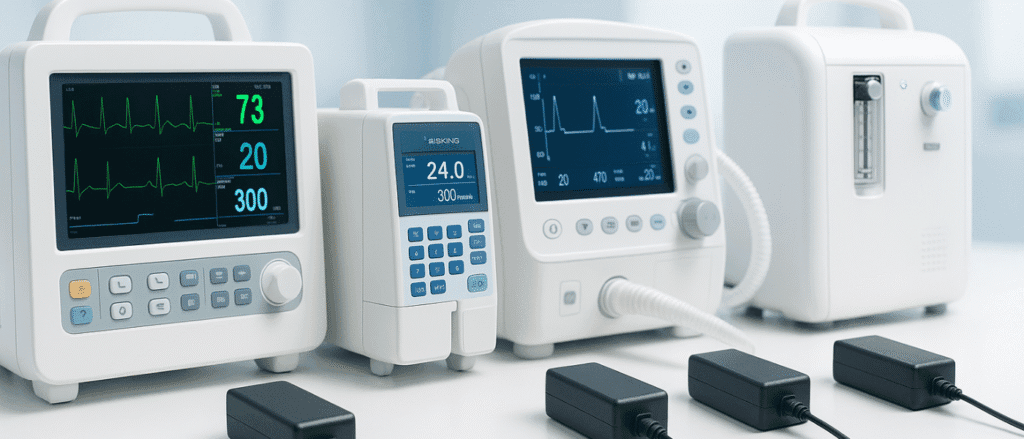
1. Desktop Medical Power Supplies
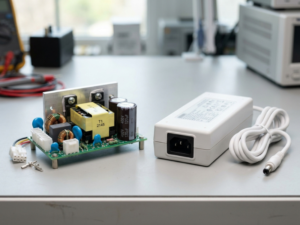
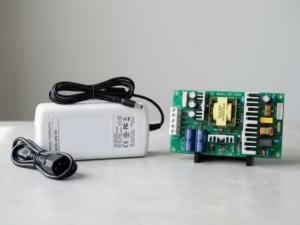
Desktop medical power supplies are external AC-DC adapters designed for medical equipment requiring moderate to high output power.
Typical Power Range
30W–300W
Common Applications
- Patient monitoring systems
- Ultrasound equipment
- Laboratory analyzers
- Medical imaging accessories
- Dental equipment
Advantages
- Higher power capability
- Better thermal performance
- Easy replacement and maintenance
- Flexible output voltage options
- Suitable for continuous operation
Desktop medical adapters are commonly selected for medical devices where space inside the equipment is limited but higher power output is required.
2. Wall Plug Medical Power Adapters
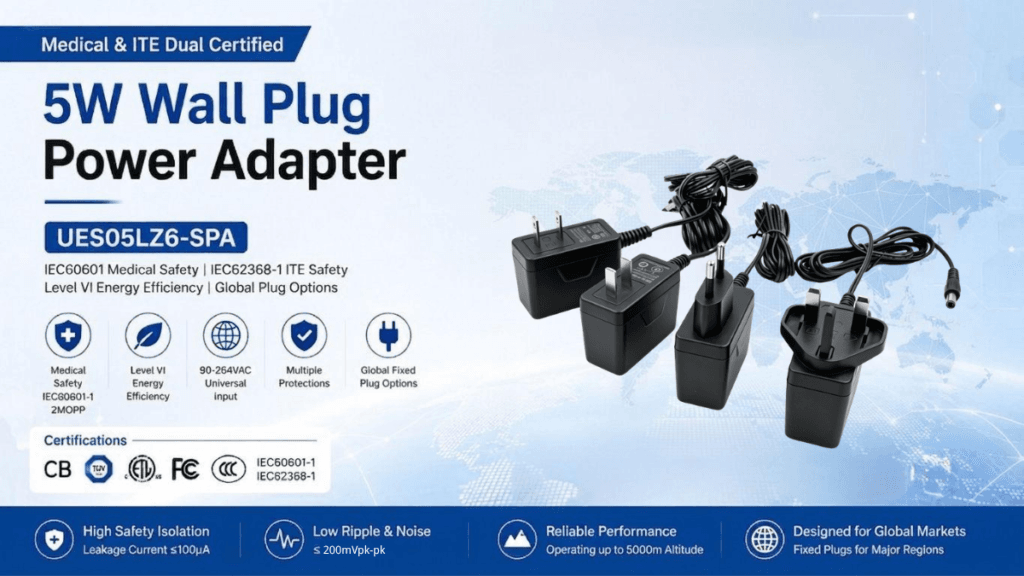
Wall plug medical power adapters integrate the AC plug directly into the power supply housing, providing a compact and convenient solution for portable medical equipment.
Typical Power Range
5W–65W
Common Applications
- Portable diagnostic devices
- Blood pressure monitors
- Portable ECG equipment
- Home healthcare devices
- Small medical instruments
Advantages
- Compact design
- Space-saving installation
- Easy global deployment with interchangeable AC plugs
- Lightweight and portable
Wall plug medical adapters are ideal for low-to-medium power medical devices where portability and simplicity are important.
3. Open Frame Medical Power Supplies
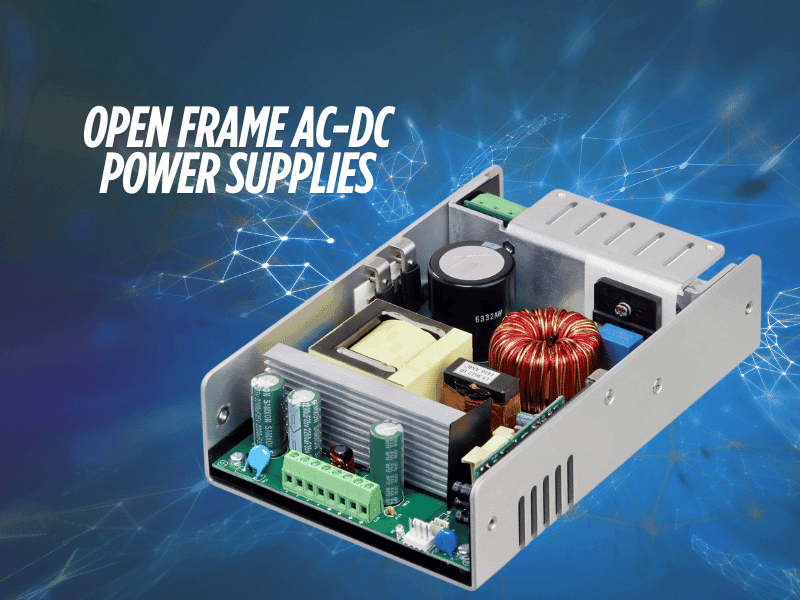
Open frame medical power supplies are designed for integration directly inside medical equipment.
Typical Power Range
40W–500W
Common Applications
- Ventilators
- Patient monitoring systems
- Surgical equipment
- Medical imaging systems
- Laboratory equipment
Advantages
- Easy integration into equipment enclosures
- Flexible mechanical design
- Improved system-level customization
- Suitable for OEM equipment development
Open frame designs are often preferred by medical equipment manufacturers that require internal power integration and customized mechanical solutions.
4. Enclosed Medical Power Supplies
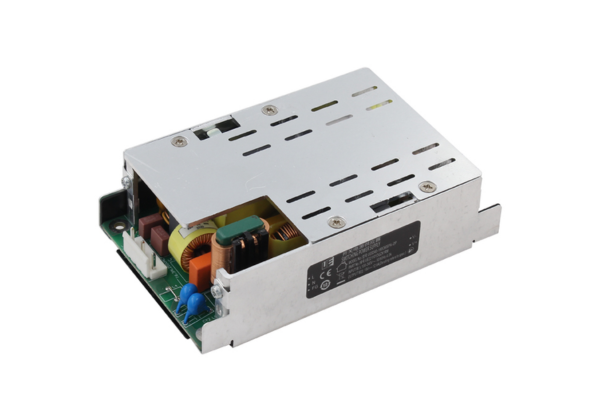
Enclosed medical power supplies provide additional mechanical protection and are suitable for larger medical systems.
Common Applications
- Medical carts
- Hospital equipment systems
- Larger diagnostic devices
- Industrial-medical hybrid equipment
Advantages
- Improved physical protection
- Easier installation
- Better protection against environmental conditions
These solutions are suitable for applications where the power supply requires additional mechanical protection.
5. USB-C PD and GaN Medical Power Supplies
Modern portable medical devices increasingly adopt USB-C Power Delivery (PD) and GaN technology to achieve higher efficiency and smaller form factors.
Key Advantages
- Higher power density
- Smaller size
- Lower heat generation
- Improved energy efficiency
- Flexible USB-C compatibility
For portable healthcare devices, properly certified USB-C PD and GaN medical power supplies can provide an efficient alternative to traditional adapters.
How to Choose the Right Medical AC DC Power Supply
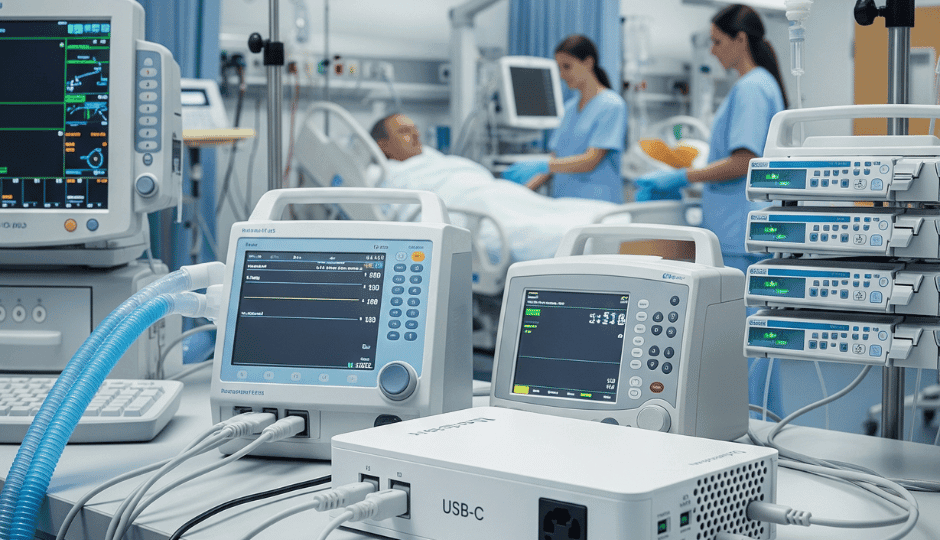
Selecting a medical AC-DC power supply requires more than matching voltage and current specifications. Engineers should evaluate electrical performance, safety requirements, mechanical design, and long-term reliability.
Step 1: Determine Output Voltage Requirements
The first step is confirming the required DC output voltage.
Common medical equipment voltages include:
- 5V
- 9V
- 12V
- 15V
- 19V
- 24V
- 48V
Engineers should verify:
- Required operating voltage
- Voltage tolerance range
- Voltage stability requirements
- Device power consumption characteristics
Using an incorrect output voltage may cause equipment malfunction or damage.
Step 2: Calculate Required Output Power
The power supply should provide sufficient output capability for both normal operation and transient conditions.
Important parameters include:
- Output voltage
- Maximum current
- Continuous load
- Peak load
- Startup requirements
A suitable power margin is recommended to improve reliability.
In many medical applications, selecting a power supply with approximately 15–30% additional power capacity helps:
- Reduce thermal stress
- Improve efficiency
- Extend component lifetime
- Handle temporary load variations
Step 3: Verify Medical Safety Certifications
Medical equipment manufacturers should verify that the power supply meets applicable safety requirements.
Common certifications and requirements include:
- IEC 60601-1
- IEC 60601-1-2
- 1×MOPP / 2×MOPP
- DOE Level VI
- ErP
- CE
- UKCA
- FCC
- RoHS
- REACH
Pre-certified medical power supplies can significantly reduce certification risks during product development.

Step 4: Evaluate Leakage Current Performance
Leakage current is one of the most important safety factors in medical power supply selection.
Lower leakage current helps:
- Improve patient protection
- Support medical certification
- Reduce electrical interference
- Improve system reliability
For patient-connected equipment, leakage current requirements should be reviewed during the early design stage.
More details:
Low Leakage Current in Medical Power Supplies
Step 5: Consider Operating Environment
Medical equipment may operate under different environmental conditions, including hospitals, clinics, laboratories, and home healthcare environments.
Important factors include:
- Operating temperature
- Storage temperature
- Humidity
- Altitude
- Vibration resistance
- Cooling method
- MTBF requirements
Selecting a power supply suitable for the actual operating environment helps prevent reliability issues.
Step 6: Select the Appropriate Mechanical Design
The physical design of the power supply should match the medical equipment structure.
Consider:
Desktop Adapter
Suitable for:
- External equipment
- Portable medical systems
- Higher power applications
Wall Plug Adapter
Suitable for:
- Compact devices
- Low-power healthcare products
Open Frame Power Supply
Suitable for:
- Internal integration
- OEM medical equipment
Enclosed Power Supply
Suitable for:
- Larger systems requiring additional protection
Additional considerations include:
- DC connector type
- Cable length
- Locking connector options
- AC plug requirements
- Mechanical dimensions
Common Engineering Challenges and Solutions
Selecting a medical AC-DC power supply is not only about electrical specifications. Many medical device projects experience delays due to improper power supply selection.
Challenge 1: EMC Test Failure
Possible Causes
- Insufficient EMI filtering
- Power supply does not meet IEC 60601-1-2 requirements
- Lack of system-level EMC consideration
Recommended Solution
Select a medical AC-DC power supply with verified EMC performance and allow sufficient design margin during equipment integration.
Challenge 2: Excessive Heat During Continuous Operation
Possible Causes
- Operating too close to maximum rated power
- Insufficient thermal management
- Low conversion efficiency
Recommended Solution
Choose an efficient power supply with appropriate power margin and suitable thermal performance.
Challenge 3: Certification Delays
Possible Causes
- Using non-medical power adapters
- Insufficient safety documentation
- Lack of required isolation performance
Recommended Solution
Select a pre-certified medical power supply that supports required safety standards and documentation.
Challenge 4: Connector Compatibility Issues
Possible Causes
- Incorrect connector size
- Wrong polarity
- Cable length mismatch
Recommended Solution
Work with a manufacturer that provides customization options including:
- DC connector selection
- Cable customization
- Labeling
- Packaging solutions

Recommended Medical AC DC Power Supplies by Application
Different medical devices have different requirements for power output, mechanical design, safety protection, and operating conditions. Selecting the right power supply according to the application can reduce development risks, simplify certification, and improve long-term product reliability.
The following table provides general recommendations for common medical equipment applications.
| Medical Device Application | Typical Power Requirement | Recommended Power Supply Type | Key Considerations |
| Patient Monitor | 12V / 3–5A | Desktop Medical Adapter | Low leakage current, continuous operation, EMC performance |
| ECG System | 12V / 2–3A | Wall Plug Medical Adapter | Compact design, medical isolation, portability |
| Infusion Pump | 12V / 24V | Desktop Medical Power Supply | Stable output, reliability, patient protection |
| Portable Ultrasound | 19V / 24V | High-Power Desktop Adapter | Thermal performance, efficiency, long operation |
| Dental Equipment | 24V | Desktop Medical Power Supply | EMC compliance, durability, continuous operation |
| Laboratory Analyzer | 24V / 48V | Open Frame Medical Power Supply | System integration, customization flexibility |
| Home Healthcare Device | 5V / 12V | Wall Plug Medical Adapter | Compact size, easy installation, global AC plugs |
| Medical Cart System | 24V / 48V | High-Power Medical Adapter | High efficiency, stable output, mobility requirements |
Actual power supply selection depends on:
- Output voltage
- Maximum current
- Power consumption
- Medical certification requirements
- Connector specifications
- Mechanical installation space
- Operating environment
Quankang engineers can support medical device manufacturers in selecting a suitable power solution based on their product requirements.
Common Mistakes When Selecting Medical Power Supplies
Many medical equipment development delays are caused not by the device design itself, but by choosing an unsuitable power supply at an early stage.
Understanding common mistakes can help OEM manufacturers reduce certification risks and development costs.
1. Selecting a Power Supply Based Only on Voltage
Matching output voltage alone is not sufficient.
Engineers should also consider:
- Output current capability
- Peak power requirements
- Isolation requirements
- Leakage current
- EMC performance
A power supply with the correct voltage but insufficient safety or reliability performance may fail during certification.
2. Ignoring Leakage Current Requirements
Commercial AC adapters may provide stable power output but may not meet medical safety requirements.
For medical applications, especially patient-connected equipment, leakage current must be carefully evaluated.
Choosing a medical-grade power supply with low leakage current helps improve patient protection and simplify regulatory approval.
3. Overlooking EMC Performance
A power supply may operate correctly during functional testing but still fail EMC testing.
Common causes include:
- Insufficient filtering
- Poor electromagnetic compatibility design
- Lack of system-level testing margin
Selecting a power supply with medical EMC compliance can reduce redesign risks.
4. Choosing Insufficient Power Margin
Operating continuously near maximum rated output can increase:
- Internal temperature
- Component stress
- Aging rate
Selecting an appropriate power margin improves reliability and product lifetime.
5. Ignoring Connector and Mechanical Compatibility
Incorrect connector selection may cause:
- Assembly problems
- Product delays
- Additional engineering costs
Medical power supply suppliers with customization capability can help provide:
- DC connector options
- Cable length customization
- Locking connectors
- Label and packaging customization
Benefits of Pre-Certified Medical Power Supplies
Using a pre-certified medical AC-DC power supply provides significant advantages for medical device manufacturers.
Shorter Certification Process
A certified medical power supply helps reduce additional testing requirements during system approval.
Reduced Engineering Workload
OEM engineers can focus on medical device development rather than redesigning power circuits and solving compliance issues.
Lower Compliance Risks
Pre-certified solutions help minimize risks related to:
- Electrical safety testing
- Leakage current failures
- EMC problems
Improved Product Reliability
Medical-grade power supplies are designed for:
- Continuous operation
- Stable output performance
- Long product lifecycles
For medical equipment manufacturers, selecting the right supplier at the beginning of the design process can significantly reduce development risks.
ODM & OEM Customization Services for Medical Power Supplies
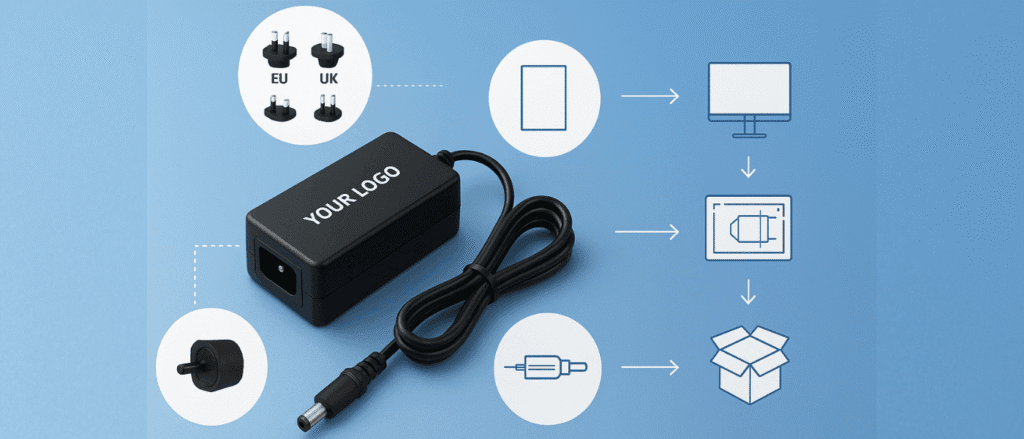
Medical device manufacturers often require more than a standard off-the-shelf power adapter.
Different medical devices may require customized solutions based on:
- Mechanical design
- Output requirements
- Connector specifications
- Certification requirements
- Regional market needs
Quankang provides OEM and ODM customization services, including:
Electrical Customization
- Custom output voltage
- Custom current ratings
- Power optimization
- Application-specific solutions
Mechanical Customization
- DC connector selection
- Cable length adjustment
- Connector locking options
- Product dimensions optimization
Branding and Packaging
- Private label service
- Logo printing
- Product labeling
- Customized packaging
Certification Support
Support for:
- International safety approvals
- Medical certification requirements
- Documentation preparation
By working closely with OEM customers during product development, Quankang helps reduce redesign cycles and accelerate time to market.
Why Choose Quankang Medical AC DC Power Supplies?
Quankang provides AC-DC medical power supply solutions for global medical device manufacturers.
Our product portfolio includes:
- Medical desktop power adapters
- Wall mount medical power supplies
- Open frame medical power supplies
- USB-C PD medical chargers
- GaN medical adapters
Key advantages include:
Medical Safety Compliance
- IEC 60601-1 compliant solutions
- 1×MOPP / 2×MOPP options
- Low leakage current design
Wide Product Range
- 5W–300W medical AC-DC power solutions
- Multiple output voltage options
- Various mechanical designs
High Efficiency and Reliability
- DOE Level VI efficiency
- Stable output performance
- Long product lifecycle support
OEM Engineering Support
- Power supply selection assistance
- Technical consultation
- Sample support
- Customization services
Whether developing portable diagnostic equipment, laboratory instruments, patient monitoring systems, or home healthcare products, Quankang can provide reliable medical power solutions.
Frequently Asked Questions
Can I use an industrial AC/DC power supply in a medical device?
Generally, industrial power supplies are not recommended for medical applications because they may not meet medical safety requirements related to patient protection, leakage current, and isolation.
Medical devices typically require power supplies designed and tested according to applicable medical standards.
What is the difference between a medical power supply and a standard adapter?
Medical power supplies provide additional protection features, including:
- Higher isolation requirements
- Lower leakage current
- Improved EMC performance
- Medical safety compliance
These features help ensure safe operation in healthcare environments.
What does 2×MOPP mean in medical power supplies?
2×MOPP (Means of Patient Protection) refers to an enhanced level of insulation protection designed to reduce the risk of electric shock for patients.
It is commonly required for medical devices with direct or indirect patient contact.
Learn more:
What Is 2×MOPP in Medical Power Supplies?
How much power margin should I reserve?
A power margin of approximately 15–30% above the maximum continuous load is commonly recommended.
This helps improve:
- Thermal performance
- Reliability
- Product lifetime
How do I choose between a desktop and wall plug medical power supply?
Wall plug adapters are suitable for compact, portable, and lower-power devices.
Desktop medical power supplies are better suited for:
- Higher power requirements
- Better heat dissipation
- Larger medical equipment
Can medical power supplies be customized?
Yes.
Medical power supply manufacturers can customize:
- Output specifications
- DC connectors
- Cable lengths
- Labels
- Packaging
- Regional AC plugs
What information should I provide when requesting a medical power supply?
To recommend a suitable solution, manufacturers typically need:
- Output voltage
- Maximum current
- Required power
- Medical application
- Connector type
- Certification requirements
- Annual demand
Conclusion
Selecting the right AC DC power supply for medical applications is a critical step in medical device development.
Beyond basic voltage and current requirements, engineers must evaluate:
- Medical safety standards
- Isolation requirements
- Leakage current
- EMC performance
- Thermal characteristics
- Reliability
- Long-term supply availability
A properly selected medical AC-DC power supply can reduce certification risks, shorten development cycles, and improve the overall reliability of medical equipment.
With experience in medical power solutions, Quankang supports OEM and medical device manufacturers with reliable AC-DC power supplies designed for healthcare applications.