Introduction
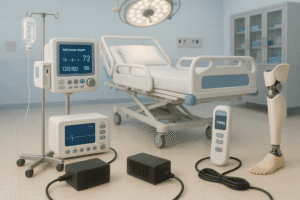
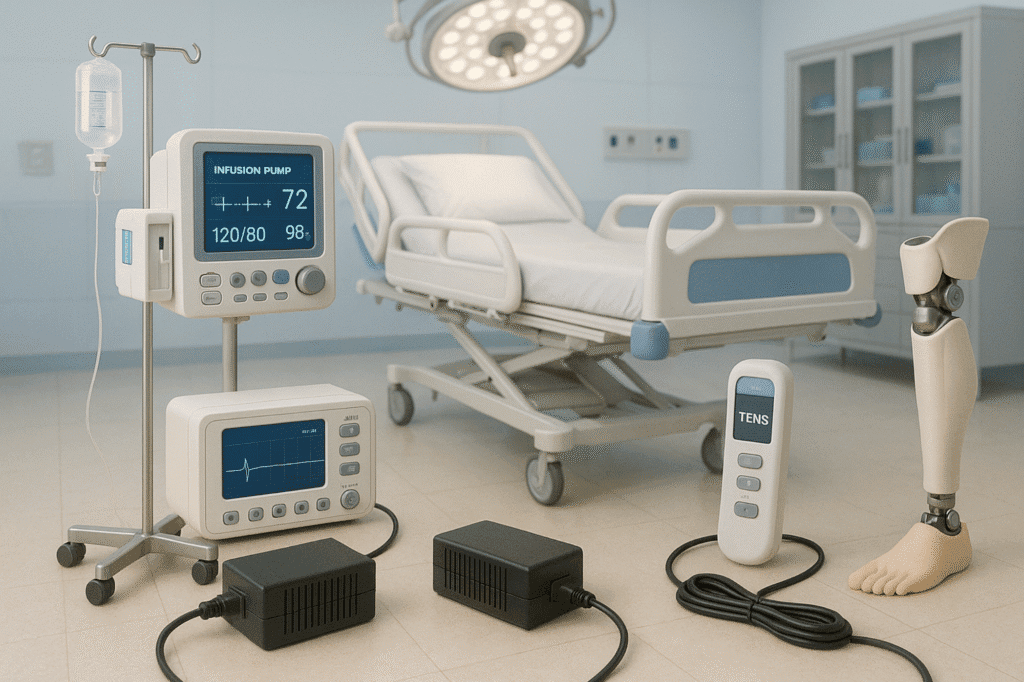
Many medical devices—including blood glucose analyzers, pulse oximeters, portable patient monitors, handheld diagnostic instruments, medical communication terminals, and home healthcare equipment—require a stable 5V DC power source.
At first glance, selecting a 5V 2A power adapter may seem straightforward. However, for medical applications, output voltage and current are only part of the selection process. Engineers and purchasing teams must also evaluate electrical safety, patient protection, electromagnetic compatibility (EMC), leakage current, long-term reliability, and regulatory compliance.
Choosing a consumer-grade adapter instead of a certified medical power supply can result in:
- Failure to meet IEC 60601 safety requirements
- Excessive leakage current
- EMC compliance failures
- Increased product development costs
- Delays in regulatory approval
- Higher field failure and warranty risks
This guide explains how engineers and medical device manufacturers can choose the right UL certified 5V 2A medical power supply while meeting international medical safety requirements and ensuring reliable long-term performance.
Why a Standard 5V Adapter Isn’t Suitable for Medical Devices
Many commercially available USB adapters provide a 5V output, but most are designed for smartphones, tablets, and other consumer electronics rather than medical equipment.
Although a consumer charger may provide the correct voltage, it is typically not designed to satisfy the stringent electrical safety and EMC requirements required for medical applications.
| Consumer Adapter | Medical Power Supply |
| Designed for consumer electronics | Designed for medical equipment |
| IEC 62368-1 | IEC 60601-1 |
| Higher leakage current | Ultra-low leakage current |
| Basic insulation | 2×MOPP protection |
| Standard EMC | Medical EMC requirements (IEC 60601-1-2) |
| Consumer-duty operation | Continuous medical operation |
Using a consumer-grade adapter may increase certification risks, especially for equipment used in patient-care environments or connected to patients.
Understanding UL Certification for Medical Power Supplies
Many engineers assume that UL certification alone guarantees medical safety, but this is a common misconception.
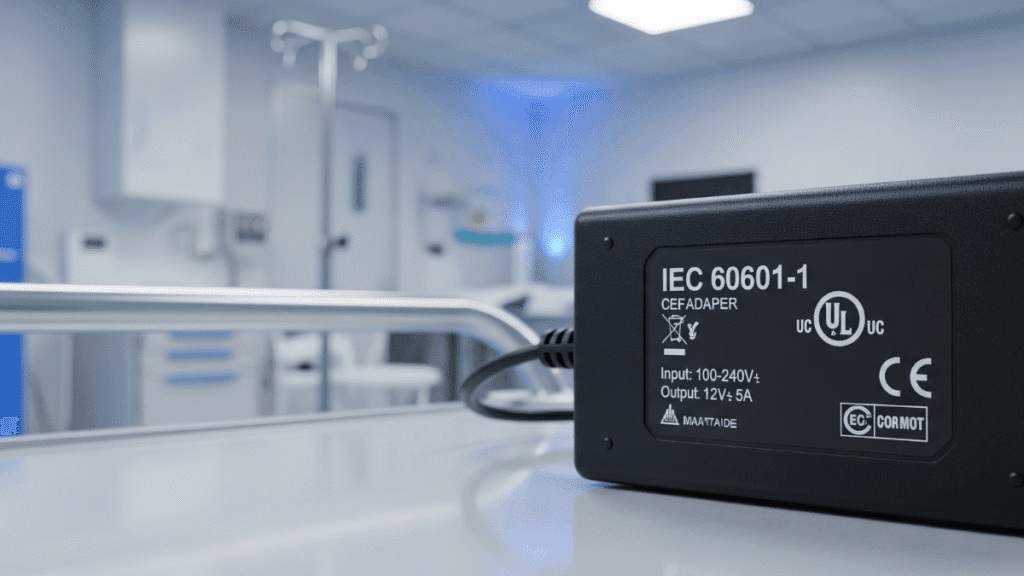
UL certification confirms that a power supply has been evaluated against applicable electrical safety requirements. However, medical devices generally require compliance with additional medical standards, particularly IEC 60601-1.
Depending on your target market and application, a qualified medical power supply may include:
- UL Recognition or UL Listing
- IEC 60601-1 certification
- IEC 60601-1-2 EMC compliance
- CB Scheme certification
- CE marking
- RoHS and REACH compliance
Why Both UL and IEC 60601 Matter
For products sold in North America, manufacturers often require both UL certification and IEC 60601-1 compliance.
UL certification supports market acceptance and electrical safety verification, while IEC 60601-1 addresses the additional safety requirements specific to medical electrical equipment, including patient protection, insulation, leakage current, and risk management.
When selecting a UL certified 5V 2A medical power supply, engineers should always verify that the product also complies with IEC 60601-1 rather than relying on UL certification alone.
Key Factors When Selecting a 5V 2A Medical Power Supply
1. Verify IEC 60601-1 Compliance
This should always be your first consideration.
Medical power supplies should comply with:
- IEC 60601-1
- ANSI/AAMI ES60601-1 (North America)
- EN 60601-1 (Europe)
These standards help ensure electrical safety for both patients and healthcare professionals.
2. Choose 2×MOPP Protection
MOPP (Means of Patient Protection) defines the insulation required between the AC mains and patient-accessible parts.
For many medical devices, 2×MOPP protection is essential to minimize electric shock risks.
Look for specifications such as:
- 4000VAC isolation
- Reinforced insulation
- Appropriate creepage and clearance distances
3. Check Leakage Current
Leakage current is one of the most critical specifications for medical power supplies.
A high-quality medical adapter typically provides:
- Leakage current within IEC 60601 limits
- Typical leakage current below 100μA
- Stable patient leakage performance
Lower leakage current improves patient safety and simplifies compliance testing.
4. Confirm Stable Output Performance
Medical equipment often operates continuously for extended periods.
Choose a power supply that offers:
- Stable 5V output
- Tight voltage regulation
- Low ripple and noise
- Fast transient response
- Reliable performance under varying loads
Stable output helps ensure accurate operation of processors, sensors, communication modules, and precision electronics.
5. Evaluate EMC Performance
Poor EMC performance may interfere with sensitive medical electronics.
Verify compliance with:
- IEC 60601-1-2
- CISPR 11 Class B emissions
- Immunity testing requirements
Good EMC performance helps reduce redesign cycles during regulatory certification.
6. Consider Energy Efficiency
A high-efficiency power supply offers several benefits:
- Lower operating temperature
- Longer capacitor lifetime
- Improved long-term reliability
- Reduced standby power consumption
- Lower operating costs
Look for products meeting DOE Level VI or equivalent energy-efficiency requirements.
7. Verify Mechanical Compatibility
Electrical performance alone is not enough.
Also confirm:
- AC plug type
- DC connector size
- Cable length
- Output polarity
- Wall-plug or desktop design
- Mounting requirements
Proper mechanical compatibility simplifies product integration and reduces customization costs.
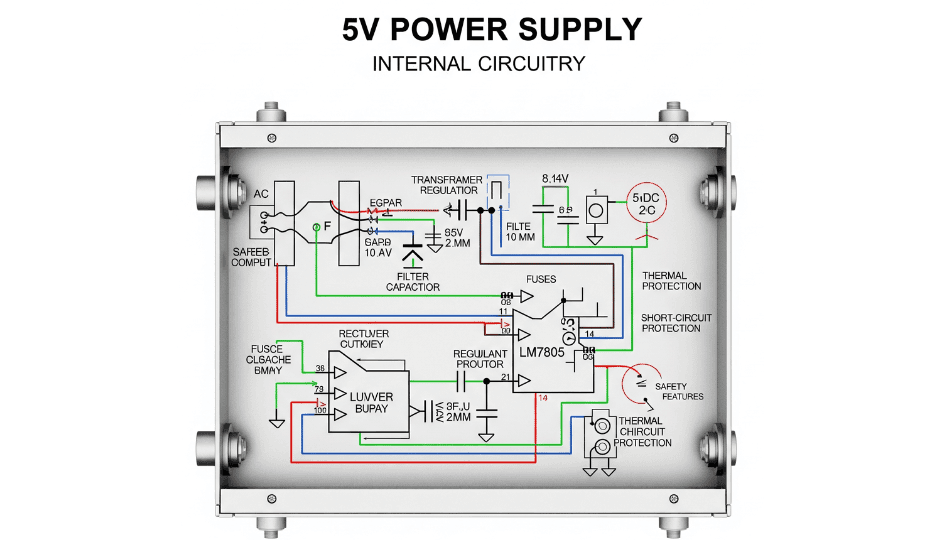
Which Medical Devices Typically Use a 5V 2A Power Supply?
Although higher-power adapters are becoming increasingly common, a 5V 2A (10W) medical power supply remains an excellent choice for many compact and portable medical devices.
| Medical Device | Typical Power Requirement | Is 5V 2A Suitable? |
| Blood glucose analyzer | 2–5W | ✔ Yes |
| Pulse oximeter | 2–5W | ✔ Yes |
| Portable ECG monitor | 4–8W | ✔ Yes |
| Portable patient monitor | 6–10W | ✔ Yes |
| Medical IoT gateway | 5–8W | ✔ Yes |
| Handheld diagnostic equipment | 5–10W | ✔ Yes |
| Portable ultrasound | 15–30W | ✖ Consider USB-C PD |
| Medical tablet | 18–45W | ✖ Higher-power adapter required |
Selecting the correct power rating improves system reliability while avoiding unnecessary costs associated with oversized power supplies.
Is a 5V 2A Medical Power Supply Enough for Your Device?
One of the most common engineering questions is whether 5V 2A (10W) provides sufficient power.
The calculation is straightforward:
Maximum Output Power = Voltage × Current
5V × 2A = 10W
If your medical device normally consumes less than 8–9W, a 5V 2A adapter usually provides sufficient design margin for stable operation.
However, consider a higher-power solution if your device includes:
- Large LCD displays
- Heating elements
- High-performance processors
- Multiple USB peripherals
- Wireless communication modules with high power consumption
- Motor-driven mechanisms
In these situations, a 12V medical power adapter or a USB-C PD medical charger may provide greater flexibility and future scalability.
5V DC Medical Adapter vs USB-C PD Medical Charger
Many next-generation medical devices are transitioning from traditional DC connectors to USB-C Power Delivery (PD).
Choosing the appropriate interface depends on your current power requirements and future product roadmap.
| Feature | 5V 2A Medical Adapter | USB-C PD Medical Charger |
| Maximum Power | 10W | Up to 240W (depending on PD version) |
| Typical Applications | Compact medical devices | High-performance portable equipment |
| Connector | Barrel connector or USB | USB-C |
| Cost | Lower | Higher |
| Future Expansion | Limited | Excellent |
| Best For | Existing low-power products | New product development |
For portable diagnostic devices and other low-power medical equipment, a 5V 2A medical adapter remains a practical and cost-effective solution. However, if future product upgrades may require multiple voltage profiles or higher power output, USB-C PD provides greater flexibility.
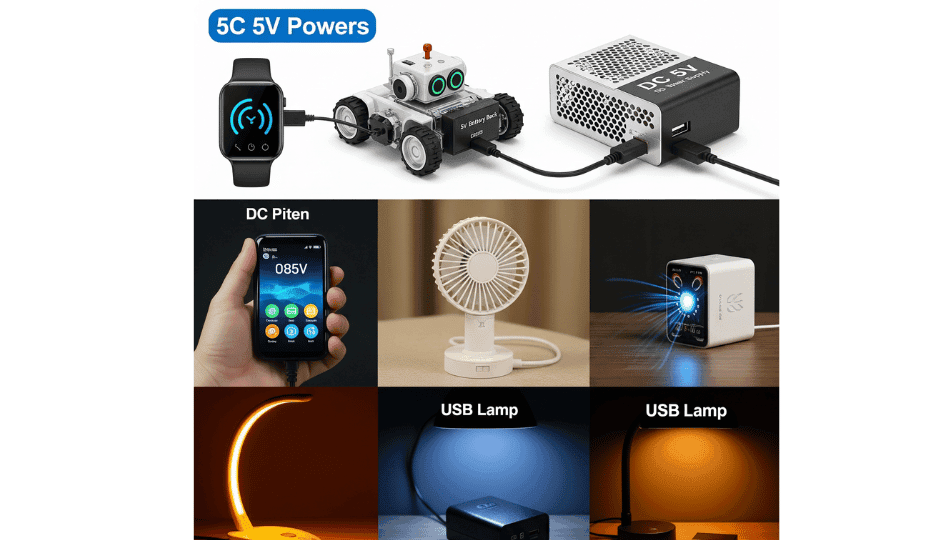
Common Medical Applications Requiring Certified 5V 2A Power Supplies
Certified UL certified 5V 2A medical power supplies are widely used in environments where electrical safety and regulatory compliance are critical.
Typical application scenarios include:
- Home healthcare devices
- Hospital bedside equipment
- Portable diagnostic instruments
- Point-of-care testing devices
- Clinical laboratory equipment
- Rehabilitation systems
- Dental equipment
- Medical communication terminals
Because these products often operate close to patients or healthcare professionals, selecting a certified medical-grade power supply helps improve electrical safety, simplify regulatory approval, and enhance long-term system reliability.
Common Mistakes When Selecting a Medical Power Supply
Avoid these common purchasing mistakes:
Selecting by Voltage Only
Matching voltage and current does not guarantee compliance with medical safety requirements.
Ignoring Leakage Current
A low-cost adapter may meet electrical specifications while failing medical safety testing.
Overlooking EMC Certification
Poor EMC performance can delay product launches and increase redesign costs.
Choosing Consumer USB Chargers
Consumer USB chargers are not designed to meet IEC 60601 requirements for medical applications.
Focusing Only on Purchase Price
Choosing the lowest-cost adapter may increase certification expenses, maintenance costs, warranty claims, and long-term supply chain risks.
How to Verify a Medical Power Supply Before Purchase
Selecting the right supplier is just as important as selecting the right specifications. Before placing an order, engineers and purchasing teams should verify that the power supply has the certifications, documentation, and performance characteristics required for medical applications.
Use the following checklist when evaluating potential suppliers.
| Verification Item | What to Check | Why It Matters |
| UL Certification | UL Listed or UL Recognized status | Supports regulatory acceptance in North America |
| Medical Safety Standard | IEC 60601-1 certification | Confirms compliance with medical electrical safety requirements |
| EMC Compliance | IEC 60601-1-2 test reports | Reduces the risk of EMC failures during product certification |
| Patient Protection | 2×MOPP isolation | Provides appropriate electrical isolation for patient-connected equipment |
| Leakage Current | ≤100μA (or lower, depending on application) | Improves patient safety and simplifies compliance testing |
| Isolation Voltage | Typically 4000VAC | Ensures adequate insulation between input and output |
| Energy Efficiency | DOE Level VI or equivalent | Reduces heat generation and operating costs |
| Global Safety Approvals | CE, CB, cULus, FCC, PSE, RCM, etc. | Simplifies global product approvals |
| Technical Documentation | Datasheet, test reports, certificates | Facilitates engineering evaluation and regulatory submissions |
| Manufacturer Support | OEM/ODM capability and engineering support | Supports product customization and long-term supply continuity |
A reliable supplier should be able to provide complete technical documentation, certification records, and engineering support during your product development process. Verifying these items before procurement can significantly reduce certification risks, redesign costs, and project delays.

Recommended Quankang Medical Power Supply Solutions
While this guide focuses on selecting a UL certified 5V 2A medical power supply, many medical devices evolve over time and eventually require higher output power or USB-C Power Delivery.
Quankang offers a complete portfolio of certified medical power solutions that support both today’s product requirements and future product upgrades.
| Product Series | Output Range | Recommended Applications |
| UES24LZ5-SPA | 5V–24V, up to 24W | Recommended for 5V medical devices, portable diagnostic equipment, blood glucose analyzers, pulse oximeters, small nebulizers, medical printers |
| UES60LCP-SPC | 5V–20V, up to 60W | Portable medical devices requiring USB-C Power Delivery and greater flexibility |
| UES100LCP2-SPC | 5V–20V, up to 100W | High-performance medical equipment, imaging accessories, therapy devices |
| UES140AZ-SPC | 5V–28V, up to 140W | Desktop medical systems, advanced diagnostic equipment, next-generation USB-C PD applications |
All of these product families are designed for demanding medical environments and offer features including:
- IEC 60601-1 medical safety compliance
- 2×MOPP patient protection
- Ultra-low leakage current (≤100μA)
- IEC 60601-1-2 EMC compliance
- DOE Level VI energy efficiency
- Universal AC input
- Global safety approvals
- OEM and ODM customization services
For most 5V 2A medical applications, the UES24LZ5-SPA Series is the most suitable choice because it combines medical safety certification, compact wall-plug design, multiple output options, and reliable long-term performance.
If your product roadmap includes higher-power devices or USB-C interfaces, the UES60LCP-SPC, UES100LCP2-SPC, and UES140AZ-SPC Series provide a scalable upgrade path without changing suppliers.
UE12D-SPA1-OP
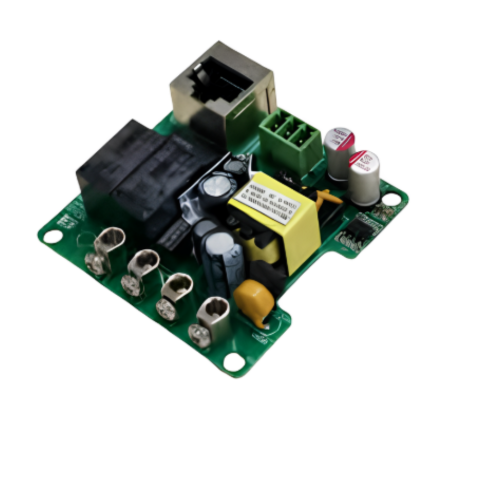
Why Engineers Choose Quankang
Medical device development requires more than a compliant power adapter—it requires a reliable engineering partner.
Quankang has extensive experience supporting medical device manufacturers worldwide with certified AC/DC power solutions for diagnostic equipment, patient monitoring systems, laboratory instruments, rehabilitation devices, and home healthcare products.
Our engineering team provides:
- Certified medical power supply solutions
- OEM and ODM customization
- Multiple enclosure and connector options
- Global safety certification support
- Stable long-term manufacturing capacity
- Technical assistance throughout product development
From compact 5V medical adapters to high-power USB-C PD chargers, Quankang helps manufacturers reduce development risks while accelerating product certification and commercialization.
Frequently Asked Questions
Is UL certification enough for a medical power supply?
No. UL certification demonstrates compliance with applicable electrical safety requirements, but medical devices generally also require compliance with IEC 60601-1 and, in many cases, IEC 60601-1-2 EMC requirements.
Can I use a regular USB charger for a medical device?
Generally, no.
Consumer USB chargers are designed for consumer electronics and typically do not provide the electrical isolation, leakage current limits, or patient protection required for medical equipment.
Why is leakage current important?
Leakage current directly affects patient and operator safety.
Medical standards specify strict leakage current limits to reduce the risk of electric shock, particularly for patient-connected equipment.
Is a 5V 2A power supply suitable for every medical device?
Not necessarily.
A 5V 2A power supply delivers up to 10W and is suitable for many portable medical devices. Equipment with higher power consumption may require a 12V medical adapter or a USB-C PD medical charger.
How can I verify whether a power supply is truly medical grade?
Review the supplier’s technical documentation and confirm that the product provides:
- IEC 60601-1 certification
- UL certification (where required)
- IEC 60601-1-2 EMC compliance
- 2×MOPP protection
- Low leakage current
- Complete safety reports and datasheets
Working with an experienced medical power supply manufacturer can significantly simplify product certification and reduce engineering risks.
Conclusion
Choosing the right UL certified 5V 2A medical power supply involves far more than matching voltage and current.
Engineers should carefully evaluate medical safety certifications, IEC 60601-1 compliance, UL certification, 2×MOPP protection, leakage current, EMC performance, mechanical compatibility, energy efficiency, and long-term reliability before making a purchasing decision.
For low-power medical devices such as blood glucose analyzers, portable patient monitors, pulse oximeters, handheld diagnostic instruments, and home healthcare equipment, a certified 5V 2A medical power supply provides a safe, reliable, and cost-effective solution.
As medical devices continue to adopt USB-C interfaces and higher power requirements, selecting a supplier with a complete portfolio of certified medical power solutions also provides greater flexibility for future product development.
Rather than choosing a generic adapter based solely on voltage and current, partnering with an experienced medical power supply manufacturer can reduce certification risks, shorten development cycles, and support the long-term success of your medical devices.