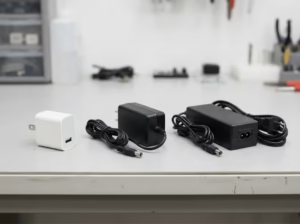
Designing power supplies for home healthcare equipment requires careful attention to electrical safety standards, environmental resilience, EMC compliance, and regulatory frameworks—particularly IEC 60601-1 and its collateral standard IEC 60601-1-11. The right power supply depends on the device’s architecture, patient contact type, and the specific home environment where it will be used.
Home healthcare is growing fast. Patients are managing chronic conditions, recovering from procedures, and receiving life-sustaining therapy outside of clinical settings—in living rooms, bedrooms, and kitchens. The medical devices supporting this shift range from infusion pumps and oxygen concentrators to portable ECG monitors and home dialysis systems.
For engineers and procurement managers who specify power supplies for these devices, the home environment presents a distinct set of challenges. Unlike a hospital, where trained biomedical staff monitor infrastructure and control conditions, a residential setting offers no such oversight. Power quality varies. Humidity fluctuates. Carpets generate static. Users may not understand the significance of a frayed cord or a tripped breaker.
That doesn’t automatically mean home healthcare power supplies face a universally higher safety bar than their hospital-grade counterparts—the requirements depend on the device classification, patient-contact type, and intended-use context. What it does mean is that the design criteria are different, and in some respects, more complex. The power supply must perform reliably across a wider range of conditions, with less margin for error when something goes wrong.
This post walks through the key design and compliance considerations for power supplies used in home healthcare equipment: electrical safety, environmental resilience, electromagnetic compatibility, regulatory standards, and physical design requirements. Whether you’re selecting an off-the-shelf supply or specifying a custom unit, these factors determine whether a product is fit for purpose.
Electrical Safety and Patient Protection: Understanding MOPP, Leakage Current, and Class II
The foundational standard for medical electrical equipment is IEC 60601-1. It establishes requirements for basic safety and essential performance, and it defines the framework most engineers work within when specifying a medical-grade power supply.
What does MOPP mean, and how does it apply to home healthcare devices?
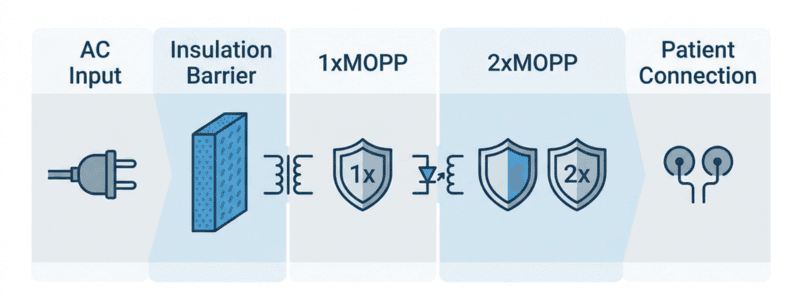
MOPP—Means of Patient Protection—is the unit of electrical isolation used in IEC 60601-1. A single MOPP provides a defined level of protection between a patient and a hazardous voltage source. Two MOPP (2xMOPP) doubles that protection and is required in situations where a single fault could expose a patient to electric shock.
The number of MOPP required depends on the device’s architecture and patient-contact classification, not on whether the device is used at home or in a hospital. Applied parts—the components that come into deliberate contact with a patient—are classified as Type B, Type BF, or Type CF, with CF representing the highest risk (direct cardiac contact). For CF-rated applied parts, the isolation requirements are more stringent than for Type B parts.
The common assumption that home healthcare devices uniformly require 2x MOPP oversimplifies the situation. A home blood pressure monitor with no direct physiological connection may have different isolation requirements than a home-use TENS device or a portable infusion pump. Engineers should evaluate MOPP requirements based on the specific device architecture and type of patient contact, in consultation with the full IEC 60601-1 framework.
How does leakage current affect medical power supply design?
IEC 60601-1 sets limits on leakage current—current that flows through unintended paths, including through a patient or user. Excessive leakage current poses risks that vary with the magnitude of the current, the path, and physiological conditions. The standard defines separate limits for earth leakage current, enclosure leakage current, and patient leakage current, which differ depending on the applied part classification.
For home healthcare power supplies, specifying a supply that meets IEC 60601-1 leakage current limits—not merely commercial-grade limits—is a baseline requirement. Standard IT or consumer power supplies are not designed to these thresholds and should not be used in patient-adjacent applications without thorough evaluation.
Is Class II always the right choice for home healthcare power supplies?
Class II power supplies—those that rely on double or reinforced insulation rather than a protective earth connection—are commonly used in home healthcare applications and offer real advantages. They eliminate dependence on a functional earth ground, which can be unreliable in older residential wiring, and they reduce the risk of earth leakage current affecting patients.
However, Class II is a design option, not a universal mandate. Class I supplies with proper grounding and isolation can also be appropriate depending on the device and its environment. The right choice depends on the device’s electrical architecture, the safety analysis, and how the supply integrates with the rest of the system. Specifying Class II without evaluating whether it suits the application is not a substitute for proper safety design.
Environmental Resilience: Designing for Uncontrolled Settings
What IP rating is appropriate for home healthcare power supplies?
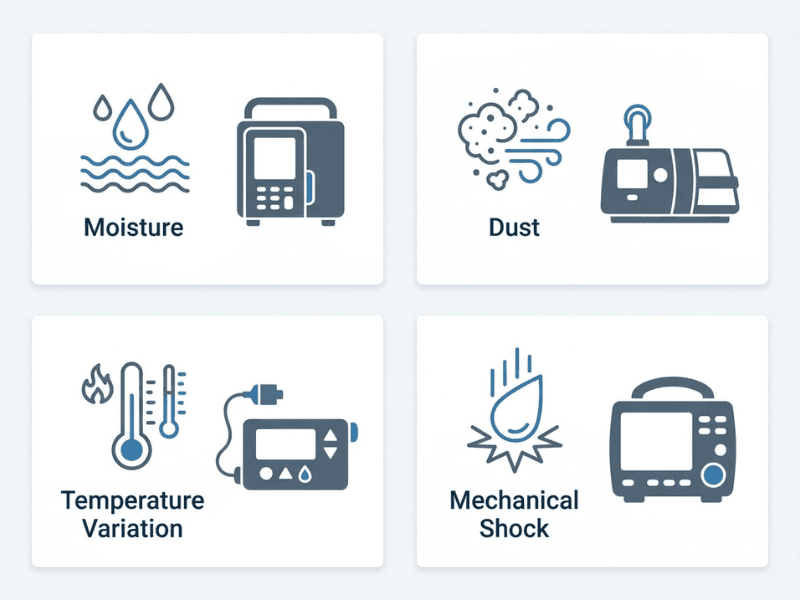
In a hospital, the environment is relatively controlled. At home, a power supply might sit on a bathroom shelf, be bumped off a bedside table, or operate near a humidifier. IEC 60601-1-11—the collateral standard for home healthcare equipment, applied alongside IEC 60601-1—addresses environmental conditions specific to residential use.
IP (Ingress Protection) ratings define resistance to dust and moisture. For home healthcare applications, an IPX4 rating (splash-proof from any direction) is commonly cited as a practical minimum for supplies used near sinks or in humid environments. IPX0 (no protection) is generally insufficient. That said, IP rating requirements should be matched to the specific use environment and device risk assessment—a desktop glucose meter charging station has different exposure risks than a portable nebulizer.
What altitude and temperature ranges should home healthcare power supplies support?
Home healthcare equipment may be used at elevation—in mountain communities, for example—where air density affects convective cooling efficiency, potentially reducing the performance of fan-cooled supplies. IEC 60601-1-11 requires evaluation of performance up to 3,000 meters above sea level under certain conditions.
Temperature and humidity ranges for home use are typically broader than those specified for hospitals. A power supply rated only for the narrow temperature band of a climate-controlled clinical environment may not perform reliably in a home without air conditioning during summer months. Specifying supplies that meet the environmental ranges outlined in IEC 60601-1-11 is advisable for any product intended for residential use.
What mechanical and chemical durability considerations matter most?
Home healthcare devices are handled by patients and caregivers who may not treat them with the care a clinical technician would. Connectors should withstand frequent insertion and removal cycles. Enclosures should resist impact. Power supply housings and cables should be evaluated for resistance to common household chemicals—such as cleaning agents, hand sanitizers, and surface disinfectants—that can degrade materials over time.
Electromagnetic Compatibility and Interference
What EMC requirements apply to home healthcare power supplies?
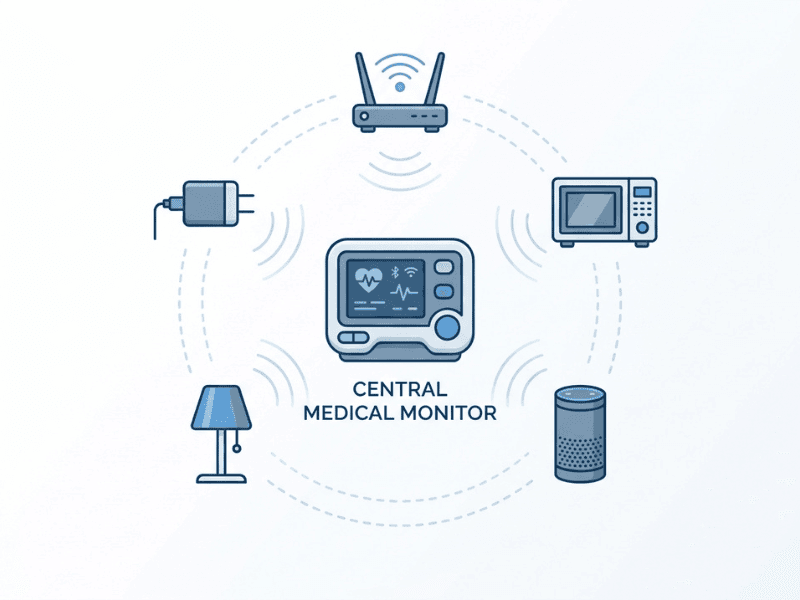
Electromagnetic compatibility (EMC) for medical devices is governed by IEC 60601-1-2, which addresses both emissions (interference generated by the device) and immunity (the device’s ability to function correctly when exposed to interference). Home environments introduce EMC challenges not present in shielded clinical facilities.
Residential power lines carry more noise and harmonic distortion than hospital power infrastructure. Consumer electronics—wireless routers, smart speakers, LED lighting—generate RF emissions that a home healthcare device must tolerate without performance degradation. A device that functions reliably in a controlled lab environment may behave differently in a home with multiple active wireless devices.
Power supply EMC design should account for:
- Conducted and radiated emissions that comply with applicable limits and do not interfere with other household electronics
- Immunity to electrostatic discharge (ESD), which is common in carpeted environments
- Immunity to conducted and radiated RF, reflecting the dense RF environment of modern homes
- Power-line surge and burst immunity, given the variable quality of residential electrical infrastructure
Shielding, filtering, and layout decisions at the power supply level directly affect system-level EMC performance. Treating EMC as a late-stage test rather than a design input typically results in costly revisions.
Critical Compliance and Regulatory Standards
How do IEC 60601-1 and IEC 60601-1-11 relate to each other?
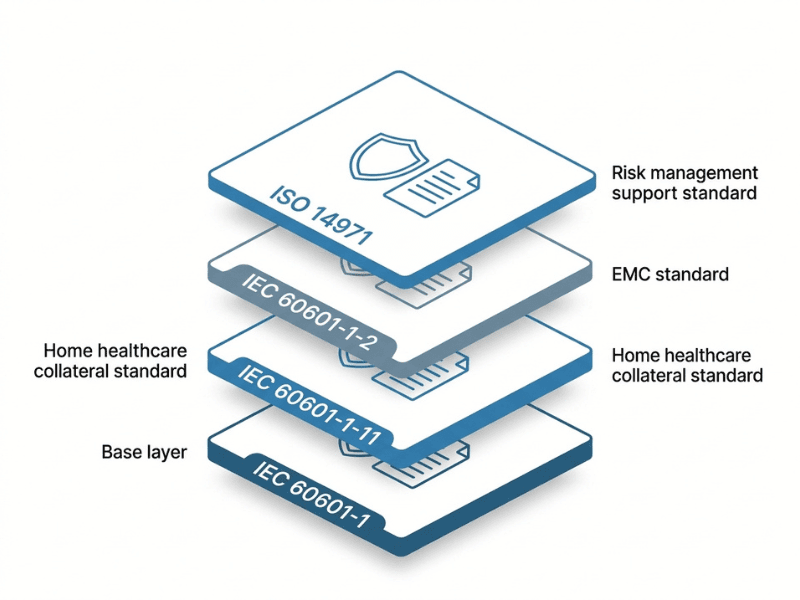
IEC 60601-1 is the base standard for medical electrical equipment safety. IEC 60601-1-11 is a collateral standard—it is applied alongside IEC 60601-1, not instead of it. IEC 60601-1-11 specifically addresses requirements for medical electrical equipment and systems used in home healthcare environments, covering environmental conditions, usability factors, and documentation requirements that are not fully addressed in the base standard.
Engineers specifying power supplies for home healthcare applications should understand that compliance with IEC 60601-1 alone is insufficient if the device is intended for residential use. IEC 60601-1-11 adds additional requirements that must be evaluated and documented as part of the regulatory submission.
What efficiency standards apply to medical power supplies?
Efficiency requirements vary by market and application. DOE Level VI is a mandatory efficiency standard for external power supplies sold in the United States, establishing minimum no-load and active-mode efficiency thresholds. Energy Star certification is a voluntary program with its own, often more stringent, efficiency criteria and additional requirements around power factor and standby power.
These two programs are not equivalent. DOE Level VI compliance is a legal requirement for applicable products in the US market; Energy Star is a voluntary certification that some customers specify for procurement or sustainability reasons. Not all medical power supplies are subject to DOE Level VI—exemptions exist for certain device categories. Engineers should verify which requirements apply to their specific product and market before assuming either standard is mandatory.
What documentation and risk management outputs are required?
Regulatory submissions for home healthcare devices typically require evidence of compliance with both IEC 60601-1 and IEC 60601-1-11, including test reports, risk management documentation in accordance with ISO 14971, and usability engineering files. For the power supply specifically, documentation should include leakage current test data, isolation test results, and EMC test reports from an accredited laboratory.
Procurement managers sourcing third-party power supplies should request this documentation from suppliers and verify that it covers the relevant standards and editions. A supply certified to an earlier edition of IEC 60601-1 may not meet current requirements without additional evaluation.
Usability and Physical Design Requirements
What connector and cable design considerations matter for home users?
Home healthcare devices are used by patients and family members—not biomedical engineers. Connectors should be easy to attach and remove without requiring fine motor control, yet secure enough to prevent accidental disconnection during use. Strain relief is critical: residential users are more likely to pull on a cable than grip the connector body, and repeated stress at the cable-connector junction can cause failures that may not be immediately visible.
Cord length and routing matter more than they might in a clinical setting. A power cord that requires the user to position the device near a wall outlet may create tripping hazards or limit placement options in a small room. AC inlet and DC output connector placement should account for how the device will actually be used in a home environment.
Why does fanless (convection) cooling matter in home healthcare power supplies?
Fan-cooled power supplies introduce failure modes—fan wear, dust accumulation, noise—that are more problematic in residential environments than in clinical ones. A fan failure in a hospital may be identified quickly by technical staff; at home, it may go unnoticed until the supply overheats and fails.
Fanless, convection-cooled designs eliminate the fan as a failure point and operate silently, which is important for devices used during sleep or in quiet living spaces. The trade-off is typically between a larger form factor and reduced power density, so the choice requires balancing thermal design with size and weight constraints.
What role do status indicators play in home healthcare power supply design?
In a clinical environment, equipment problems are often identified by trained staff before they affect patient care. At home, the patient or caregiver is the first line of detection. Clear, unambiguous status indicators—power on, fault, charging complete—help users identify when something is wrong and take appropriate action.
Indicator design should consider users with visual impairments or color vision deficiencies. Relying solely on a red/green LED distinction, for example, excludes a meaningful portion of users. Supplementing visual indicators with audible alerts or tactile feedback can improve usability across a broader population.
Summary of Best Practices
Selecting or specifying a power supply for home healthcare equipment involves more than choosing a certified medical-grade unit. The specific requirements depend on the device’s patient contact classification, architecture, intended environment, and target market. As a reference framework:
- Evaluate MOPP requirements based on device architecture and applied part classification—not on a default assumption about home use
- Specify IEC 60601-1 compliant supplies with leakage current performance appropriate for the device’s patient contact type
- Apply IEC 60601-1-11 as a collateral standard alongside IEC 60601-1 for any device intended for residential use
- Match IP ratings to the actual use environment and document the rationale in the risk management file
- Design for EMC in residential conditions, including variable power quality and dense RF environments
- Distinguish between DOE Level VI (mandatory for applicable US products) and Energy Star (voluntary)—verify which applies to your device category
- Prioritize fanless cooling where form factor allows, to improve reliability in unmonitored environments
- Design connectors, cables, and indicators for use by non-technical users, accounting for diverse physical abilities and low technical familiarity
The home healthcare market will continue expanding as healthcare systems look to shift care out of hospitals and into lower-cost settings. Power supply design decisions made early in the development process have downstream effects on regulatory timelines, product reliability, and—most importantly—patient safety. Getting these decisions right from the start is far less costly than revisiting them after design lock.
Frequently Asked Questions
Does IEC 60601-1-11 replace IEC 60601-1 for home healthcare devices?
No. IEC 60601-1-11 is a collateral standard that is applied alongside IEC 60601-1, not instead of it. Devices intended for home healthcare must comply with both standards, and regulatory submissions should include documentation that addresses the requirements of each.
Do all home healthcare power supplies require 2xMOPP isolation?
Not universally. MOPP requirements depend on the device’s applied part classification (Type B, BF, or CF) and its electrical architecture. A device with CF-rated applied parts (direct cardiac contact) has more stringent isolation requirements than a Type B device. Engineers should evaluate MOPP requirements through the safety analysis process rather than applying a blanket rule.
Is Class II always preferable to Class I for home use?
Class II supplies offer advantages in environments where the reliability of protective earth is uncertain, but they are not universally superior. The right choice depends on the device’s electrical design, safety analysis, and integration requirements. Both classes can be appropriate depending on the application.
What is the difference between DOE Level VI and Energy Star for medical power supplies?
DOE Level VI is a mandatory minimum efficiency standard for applicable external power supplies sold in the US market. Energy Star is a voluntary certification program with different—and often more stringent—efficiency criteria. Not all medical power supplies are subject to DOE Level VI; exemptions apply to certain categories. Engineers should verify applicability before treating either requirement as universal.
What IP rating should I specify for a home healthcare power supply?
There is no single correct answer. IPX4 (splash protection from any direction) is a reasonable starting point for supplies used in environments with potential exposure to moisture, such as near sinks or humidifiers. The appropriate IP rating should be determined based on the specific use environment and documented in the risk management file.
How does the home RF environment affect power supply EMC design?
Residential environments have higher RF noise levels than controlled clinical settings, due to wireless routers, smart devices, and consumer electronics. Power supplies for home healthcare devices should be evaluated for immunity to conducted and radiated RF interference under conditions that reflect actual home use, not just controlled lab environments.