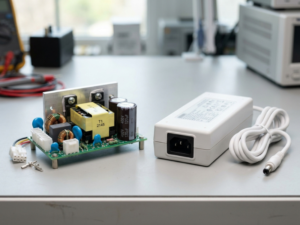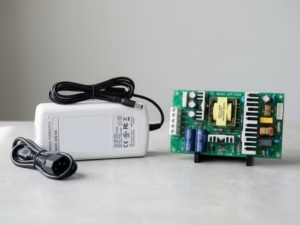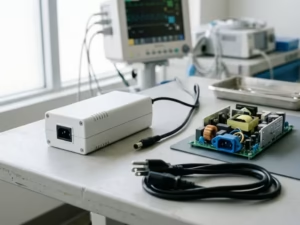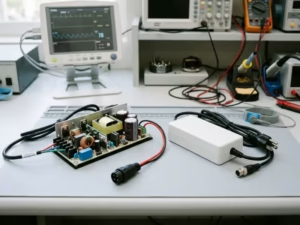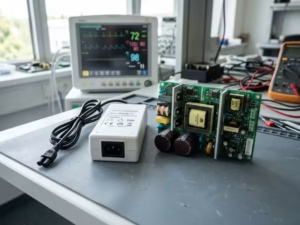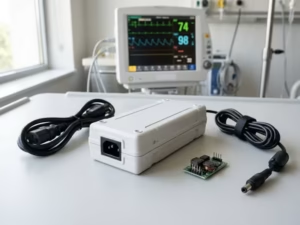
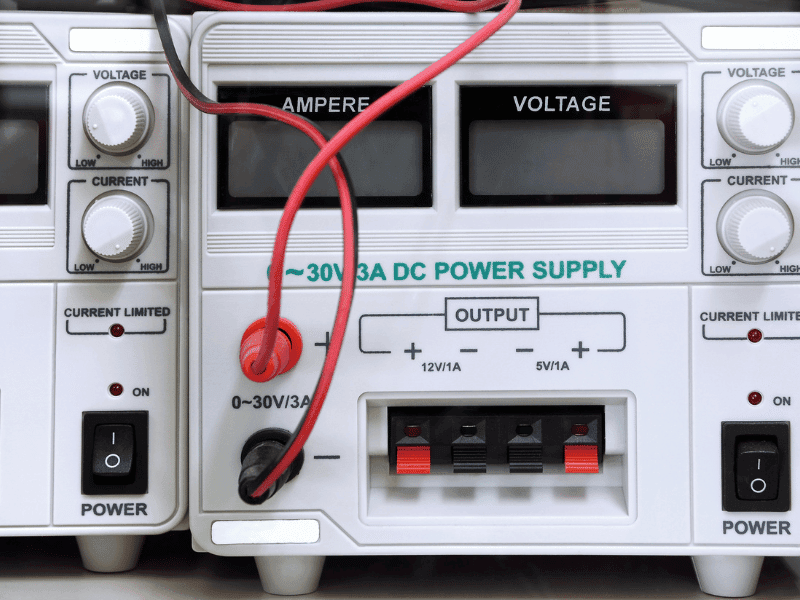
Selecting a medical power supply requires compliance with IEC 60601-1, careful evaluation of leakage current limits, isolation requirements (such as 2xMOPP), and device-specific power needs. The right choice depends on your applied part classification, target market certifications, form factor constraints, and reliability requirements. This guide walks engineers and procurement teams through every critical consideration.
Medical power supply selection sits at the intersection of regulatory compliance, electrical engineering, and patient safety. Get it right, and your device moves through certification efficiently. Get it wrong, and the consequences range from costly redesigns to market delays — or, in worst-case scenarios, regulatory rejection.
For engineers and procurement teams working on medical devices, the pressure is real. A power supply that would be perfectly adequate in an industrial setting may introduce unacceptable risks when used in patient-contact applications. The standards governing this space — particularly IEC 60601-1 — are detailed, evolving, and market-specific. Understanding what they require before you finalize a design saves significant time and cost downstream.
This guide covers everything you need to make an informed selection: what defines a medical grade power supply, how key standards apply, what different device types require, and a practical framework for narrowing down your options. Whether you’re specifying a power supply for a patient monitor, a ventilator, or a home healthcare device, the principles here apply.
What Is a Medical Grade Power Supply?
A medical-grade power supply is an AC-DC converter designed and tested to meet the safety, isolation, and electromagnetic compatibility (EMC) requirements set out in standards such as IEC 60601-1. Unlike commercial or industrial power supplies, medical-grade units must demonstrate controlled leakage current levels, sufficient isolation between mains and patient-accessible circuits, and the ability to operate safely in clinical environments.
The term “medical grade” is sometimes used loosely in the market. For regulatory purposes, a power supply should carry relevant third-party certifications — such as IEC 60601-1 approval from a recognized body like TÜV or Intertek — and be traceable to a specific certification scope. Certification markings alone are not sufficient; buyers should verify that certificates are active, cover the correct edition of the standard, and apply to the specific model being procured.
Medical grade power supplies typically cover a broad power range. Quankang’s medical power supply range, for example, spans 5W to 1000W, supporting applications from compact wearables to high-demand imaging systems.
Medical Grade vs. Industrial and Commercial Power Supplies
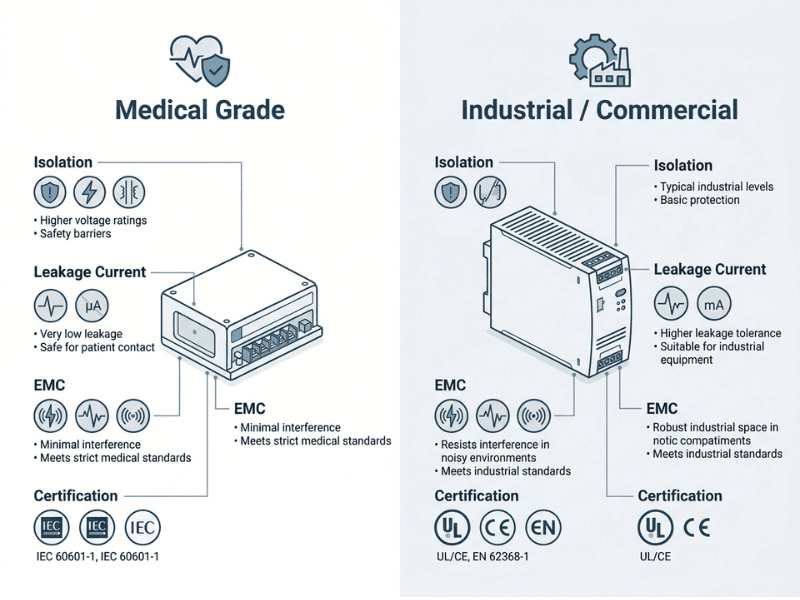
The differences between medical and non-medical power supplies go beyond labeling. The table below summarizes the key distinctions:
Parameter | Medical Grade | Industrial / Commercial |
|---|---|---|
Primary standard | IEC 60601-1 | IEC 62368-1 / IEC 61010-1 |
Isolation requirement | 2xMOPP (for patient-contact devices) | 1xMOPP or basic insulation |
Leakage current (earth/enclosure) | Typically ≤500µA (NC) / ≤1000µA (SFC) | Typically ≤3.5mA |
Leakage current (patient/applied part) | Typically ≤100µA (BF/CF NC conditions) | Not specified |
EMC standard | IEC 60601-1-2 (medical EMC) | CISPR 32 / EN 55032 |
Creepage and clearance distances | Higher — per reinforced/double insulation | Lower — per functional insulation |
Certification pathway | IEC 60601-1 + market-specific approvals | UL, CE, FCC |
Typical application | Patient monitoring, imaging, life support | Test equipment, industrial automation |
The leakage current gap between the two categories is significant. Industrial power supplies may be acceptable at current levels that would exceed the limits for patient-applied devices under IEC 60601-1. This distinction matters particularly when the power supply connects to circuits that may come into electrical contact with a patient — directly or indirectly.
Core Regulations and Standards for IEC 60601-1 Power Supplies
What Does IEC 60601-1 Actually Require?
IEC 60601-1 is the foundational international standard for the safety and essential performance of medical electrical equipment. The current widely adopted edition is the third edition (including amendments such as Amendment 1:2012), though some markets have also begun incorporating requirements from related standards and collateral standards. Engineers should confirm which edition and which market-specific deviations apply to their target certification territory.
The standard addresses construction requirements, protection against electrical shock, insulation, leakage current, and mechanical hazards. For power supply engineers, the most operationally relevant sections concern means of protection (MOP), leakage current limits, and dielectric strength testing.
Compliance also extends to collateral standards that address specific risk areas. IEC 60601-1-2 governs EMC. IEC 60601-1-6 addresses usability engineering. Depending on your device category and target market, additional requirements from standards such as IEC 60601-1-11 (home healthcare environments) may also apply.
What Is 2xMOPP and Why Does It Matter for Medical Power Supplies?
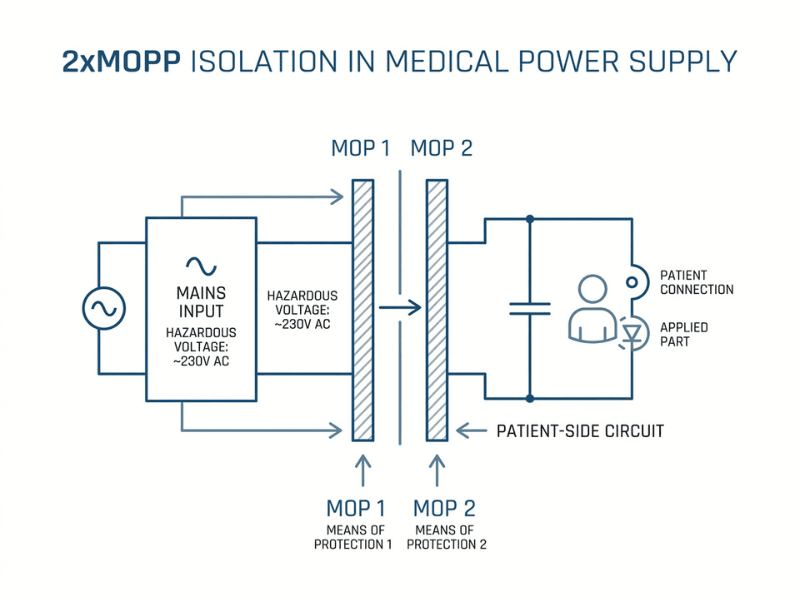
MOPP stands for Means of Patient Protection. IEC 60601-1 defines two levels: 1xMOPP and 2xMOPP. The number indicates how many independent protective means are applied between a hazardous voltage and the patient.
For devices where the applied part can come into contact with the patient — or where the patient circuit connects to mains-powered equipment — 2xMOPP is generally required. This means the insulation must withstand a dielectric test voltage that reflects the combination of working voltage and the insulation design, rather than a single fixed value. The exact test voltage required under 2xMOPP depends on the working voltage across the insulation and must be calculated per the standard’s tables — it is not a single universal number.
A common design error is assuming that any isolated power supply automatically satisfies 2xMOPP. It does not. The isolation must be independently verified to the correct dielectric test levels, creepage distances, and clearance distances specified for the applicable working voltage.
For an in-depth explanation of the 2xMOPP concept, see Quankang’s dedicated guide on 2xMOPP in medical power supplies.
Leakage Current Limits by Applied Part Classification (B, BF, CF)
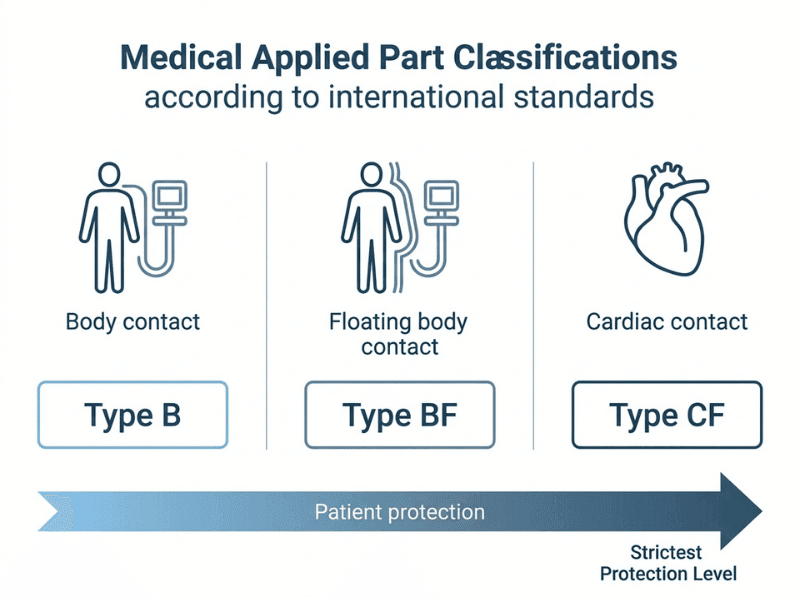
IEC 60601-1 defines three applied part classifications based on the degree of patient contact and electrical risk:
- Type B (Body): Applied parts that contact the patient but are not intended for connection to the heart. General contact only.
- Type BF (Body Floating): Applied parts with a floating connection, used where contact is more direct but not cardiac.
- Type CF (Cardiac Floating): Applied parts intended for direct cardiac contact, such as cardiac catheters. These have the most stringent leakage current limits.
Leakage current limits in IEC 60601-1 vary by applied part type, by measurement condition (Normal Condition vs. Single Fault Condition), and by the specific leakage current type being measured (earth leakage current, enclosure leakage current, patient leakage current, or patient auxiliary current). Below is a summary of typical patient leakage current limits under standard measurement conditions (note: always verify against the applicable edition of the standard for your specific design):
Applied Part Type | Patient Leakage Current — Normal Condition | Patient Leakage Current — Single Fault Condition |
|---|---|---|
Type B | ≤100µA | ≤500µA |
Type BF | ≤100µA | ≤500µA |
Type CF | ≤10µA | ≤50µA |
These limits apply to the complete medical electrical system, not just the power supply in isolation. The power supply’s contribution to total system leakage must be evaluated in the context of the full device design, including the isolation architecture and circuit topology.
EMC and EMI Requirements: IEC 60601-1-2 and CISPR 11
Medical devices operate in environments where other sensitive equipment — including imaging systems, telemetry, and patient monitors — is present. IEC 60601-1-2 (the EMC collateral standard to IEC 60601-1) sets both emission limits and immunity requirements specific to the healthcare environment.
Emission requirements for medical electrical equipment are generally governed by CISPR 11, which sets limits for conducted and radiated emissions. Immunity requirements in healthcare environments tend to be more demanding than in commercial settings, covering electrostatic discharge, radiated RF immunity, conducted RF immunity, electrical fast transient, and surge.
Power supplies used in medical devices must not only meet their own certification requirements but also not compromise the host system’s EMC performance. This makes EMC behavior — including conducted emissions, ripple, and the quality of internal filtering — a meaningful selection criterion, particularly for sensitive analog front-end applications.
Power Requirements by Medical Device Type
Different medical device categories present different power supply challenges. Here is how requirements typically vary:
Imaging Systems (CT, MRI, X-Ray)
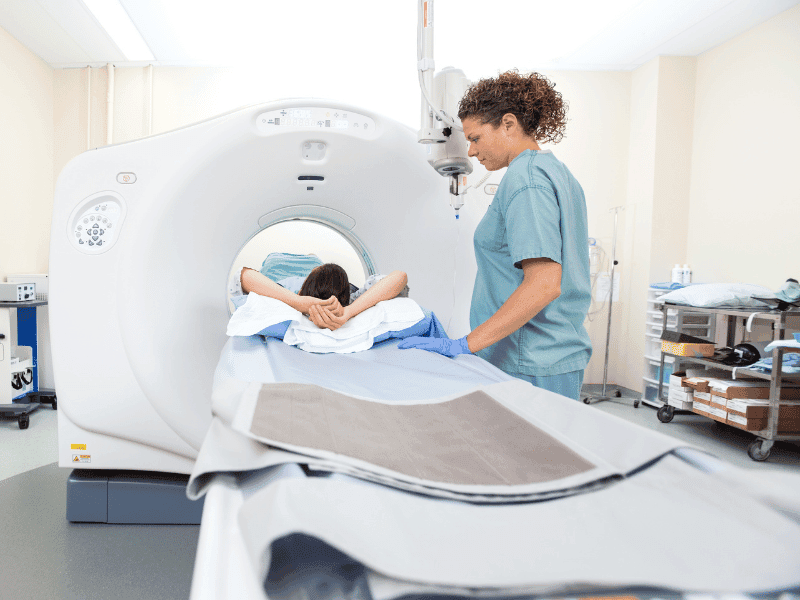
Imaging systems are among the most power-intensive medical devices, often requiring hundreds of watts to kilowatts of power. Key power supply requirements include high peak power delivery, tight output voltage regulation, and low electrical noise that could compromise image quality. Power factor correction (PFC) is typically required for higher-power units. EMC performance is especially critical in MRI environments due to the strong magnetic fields involved.
Medical Power Supply for Patient Monitoring Equipment
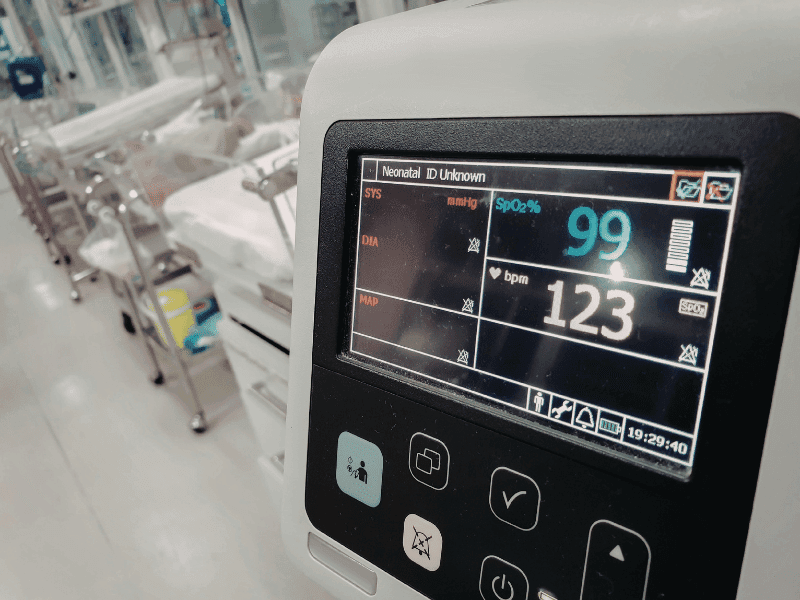
Patient monitors require stable, low-noise power across multiple output rails — typically for analog front ends, digital processing, and display subsystems. Leakage current is a central concern, as monitoring electrodes may be attached directly to the patient. Most patient monitors require BF or CF applied part compliance, demanding power supplies with verified low patient leakage current and appropriate isolation. Reliability is also key, as monitors are often in continuous operation.
Medical Power Supply for Ventilators and Life-Support Systems
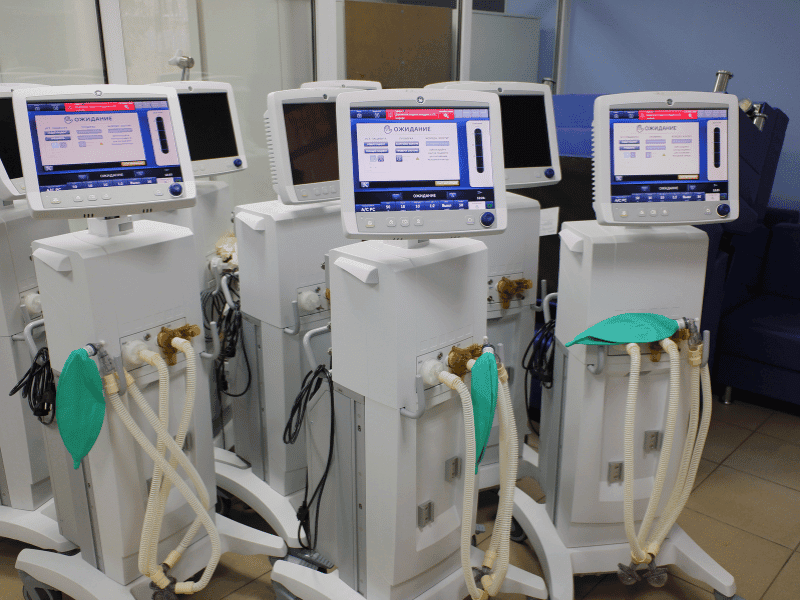
Ventilators and life-support devices place stringent demands on power supply reliability and stability. These devices may need to sustain operation during power fluctuations, and some configurations require redundant or hot-swap power architectures. Leakage current must comply with the BF or CF limits, depending on the specific part being applied. Battery backup integration and power supply hold-up time are often design considerations for systems that must remain operational during brief mains interruptions.
Surgical Systems

Powered surgical tools, electrosurgical units, and robotic surgical platforms have diverse power requirements. Electrosurgical systems, in particular, create significant EMI that power supplies must be immune to. CF classification is often required for cardiac applications. High reliability and precise voltage control are expected throughout.
Home Healthcare Devices
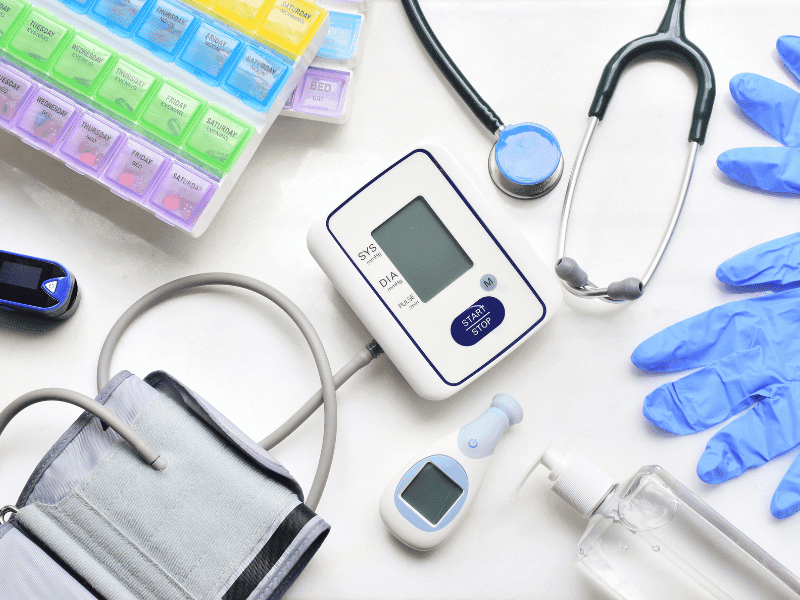
Home use devices — CPAP machines, portable oxygen concentrators, home dialysis equipment — are covered by IEC 60601-1-11, which adds requirements for operation in non-professional environments. Power supplies for home healthcare must tolerate a wider range of input voltage quality, potential misuse conditions, and higher operating temperatures. External adapter form factors are common in this category for user safety and replaceability.
Medical Beds and Rehabilitation Equipment

Electrically operated beds, lift chairs, and rehabilitation equipment typically operate at lower voltages but require robust, safety-rated power supplies that reliably drive motors and actuators. Applied part classification may be less stringent (Type B is common), but durability, mechanical robustness, and long-term reliability are key selection factors.
A Simple 5-Step Medical Power Supply Selection Process
A structured process helps avoid the common trap of selecting a power supply based on output voltage and power rating alone, without addressing compliance requirements early enough.
Step 1: Define Your Applied Part Classification and Leakage Current Budget
Determine whether your device involves patient contact, and if so, whether it is Type B, BF, or CF. This establishes your leakage current ceiling and isolation requirements before any other specification work begins.
Step 2: Establish Your Output Power and Voltage Requirements
Map all internal loads — processing, displays, sensors, actuators — across normal and peak operating conditions. Add appropriate derating margin. Define output voltage tolerances and stability requirements for each rail.
Step 3: Determine Your Target Certification Markets
IEC 60601-1 provides the international baseline, but market-specific approvals (UL 60601-1 for the US, EN 60601-1 for the EU, CCC for China) have specific national deviations. Identify which markets your device will be sold in and which certifications your power supply must carry.
Step 4: Select Form Factor and Thermal Architecture
Choose among open-frame, enclosed, external-adapter, or modular/redundant configurations based on your system design, enclosure constraints, thermal budget, and serviceability requirements.
Step 5: Verify Supplier Certification Documentation
Before finalizing a supplier, request third-party certification reports, verify certificate validity with the issuing body, and confirm that the certification scope matches your specific model and application. Assess the supplier’s ability to provide documentation traceable to FDA and MDR regulatory submissions.
8 Key Selection Criteria for Medical Grade Power Supplies
1. Safety Certification
Verify that the power supply holds active, market-appropriate IEC 60601-1 certification from a recognized third-party body. Confirm the certification covers the correct edition, includes any required national deviations, and is applicable to the specific output configuration you intend to use. For US market devices, UL 60601-1 approval is required. Devices for the EU market must comply with EN 60601-1 as part of the CE marking process.
2. Output Power
Specify the power supply’s output power based on your system’s worst-case load, including simultaneous operation of all subsystems, plus a derating margin — typically 20–30% — to account for thermal variation, component aging, and transient loads. Undersizing is a common design error that surfaces late in testing.
3. Leakage Current
Confirm leakage current specifications for both Normal Condition and Single Fault Condition, and verify they are measured per IEC 60601-1 test methods rather than general-purpose measurement approaches. The power supply’s leakage-current contribution must fall within the overall system budget for your applied part classification.
4. Efficiency
Higher efficiency reduces heat generation, thereby improving reliability and simplifying thermal management. Regulatory requirements such as DoE Level VI and EU ErP Lot 7 set minimum efficiency thresholds for external power supplies in many markets. For internal power supplies, efficiency directly affects operating temperature and cooling system design.
5. Thermal Design
Operating temperature range, thermal derating curves, and cooling method (convection vs. forced air) must all match your system’s thermal environment. Medical devices may need to operate across a wide ambient temperature range, and power supplies in enclosed casings may see higher internal temperatures than open-frame units.
6. Form Factor
Physical dimensions, connector placement, and mounting configuration must align with your system’s PCB and mechanical design. Open-frame units offer flexibility and lower cost; enclosed units provide better protection in harsh environments; external adapters simplify user interface and reduce in-device isolation requirements; modular/redundant architectures address high-availability requirements.
7. Reliability / MTBF
Mean Time Between Failures (MTBF), typically expressed in hours calculated per MIL-HDBK-217 or Telcordia standards, provides a comparative indicator of long-term reliability. For critical-care and continuous-use devices, MTBF should be evaluated alongside field return data and operating condition assumptions, as MTBF calculations vary significantly with the assumed stress conditions.
8. Noise and EMC Performance
Output ripple, conducted emissions, and radiated emissions from the power supply can degrade the performance of sensitive downstream circuits — particularly analog sensor front ends and RF communication modules. Request conducted emission test data at the application load point, and evaluate how the power supply’s noise profile interacts with your circuit architecture before finalizing the design.
Comparison of Common Medical Power Supply Types
Type | Advantages | Limitations | Best For |
|---|---|---|---|
Open-Frame | Compact, cost-effective, flexible integration | Requires host enclosure for user protection | Internal power supplies in OEM medical equipment |
Enclosed | Self-contained, dust/moisture protection options, complete unit | Larger footprint, higher cost | Desktop instruments, clinical workstations |
External Adapter | User-replaceable, simplifies host device isolation requirements, compact host design | Power limited by connector/cable ratings, external cable management | Home healthcare, portable devices, low-to-mid power applications |
Redundant / Modular | Supports N+1 redundancy, hot-swap capability, high availability | Higher cost, larger footprint, complex thermal design | Life-support systems, critical infrastructure, high-availability platforms |
Common Mistakes in Medical Power Supply Procurement and Design
- Relying on a standard industrial power supply without verifying IEC 60601-1 compliance. Industrial power supplies may physically fit and electrically function in a medical device, but they rarely meet the leakage current limits or isolation requirements for patient-contact applications.
- Selecting a power supply based on output voltage and wattage alone. Compliance scope, leakage-current performance, and form factor are equally important — and harder to change once the design is locked.
- Assuming “isolated” means “2xMOPP compliant.” Isolation is necessary but not sufficient. The isolation must be verified against specific test levels defined by the working voltage and insulation design, rather than a generic isolation specification.
- Verifying certificates only by label. Certificate numbers should be checked against the certifying body’s online database. Expired, withdrawn, or incorrectly scoped certificates have caused significant compliance issues in regulatory submissions.
- Underestimating the impact of power supply EMC on system-level compliance. A power supply that passes its own EMC tests can still cause system-level failures if its emissions interact with other circuit elements. Early-stage EMC pre-scan testing — using an in-house lab if available — significantly reduces this risk. Quankang’s on-site EMC laboratory provides pre-compliance testing that has contributed to a 98.3% first-pass EMC compliance rate across more than 10,000 OEM projects.
- Selecting a supplier without evaluating documentation traceability. FDA 510(k) submissions and EU MDR Technical Files require traceable records for critical components. A power supply supplier that cannot provide auditable certification documentation creates downstream regulatory risk.
Medical Power Supply Selection Checklist
Use this checklist to verify that your selection covers the critical compliance and engineering requirements:
Compliance and Certification
- IEC 60601-1 certification confirmed for the specific model and output configuration
- Market-specific approvals verified (UL 60601-1, EN 60601-1, CCC as applicable)
- Certificate validity confirmed via certifying body database
- Applied part classification defined (B, BF, or CF)
Electrical Performance
- Output power specified with appropriate derating margin
- Leakage current (NC and SFC) within applied part limits
- 2xMOPP isolation confirmed (if required for applied part classification)
- Output ripple and noise within system tolerance
- EMC pre-scan data reviewed for conducted and radiated emissions
Design and Integration
- Form factor compatible with PCB layout and enclosure
- Thermal derating curve reviewed for operating environment
- Cooling method (convection or forced air) defined and matched to system design
- Connector type and cable routing verified
Supplier Qualification
- Supplier holds ISO 13485 certification
- Full certification dossier available prior to purchase order
- MTBF data available for target operating conditions
- Documentation traceability confirmed for regulatory submissions
- Long-term supply continuity and obsolescence management policy understood
Frequently Asked Questions
What makes a power supply medical grade?
A medical grade power supply is one that has been designed and tested to meet the requirements of IEC 60601-1 (and applicable collateral standards) for use in medical electrical equipment. This includes controlled leakage current levels, appropriate isolation (typically 2xMOPP for patient-contact devices), and compliance with IEC 60601-1-2-specific EMC requirements. Third-party certification from a recognized body — with a verifiable, active certificate — is required to substantiate the claim.
Do all medical devices require 2xMOPP isolation in the power supply?
Not necessarily. 2xMOPP is required when the power supply’s secondary circuit connects to, or may electrically contact, an applied part that is in contact with the patient. Devices without patient-applied parts — such as certain data management systems or non-contact equipment — may not require 2xMOPP in the power supply, though they still must comply with the IEC 60601-1 general construction requirements. The specific isolation requirement depends on the device’s intended use, applied part classification, and system architecture.
What is the difference between BF and CF applied parts in IEC 60601-1?
Both BF and CF applied parts have floating connections (electrically isolated from earth ground), but they differ in their intended use and leakage current limits. BF (Body Floating) applied parts are used for body surface contact — ECG electrodes, for example — while CF (Cardiac Floating) applied parts are intended for direct cardiac application, such as intracardiac catheters. CF-applied parts face significantly stricter patient leakage current limits (typically ≤ 10 µA under Normal Condition vs. ≤ 100 µA for BF), reflecting the increased physiological sensitivity of direct cardiac electrical pathways.
How do leakage current limits differ between Normal Condition and Single Fault Condition?
Normal Condition (NC) limits apply when the device operates as intended and has no faults. Single Fault Condition (SFC) limits allow for higher leakage current under a defined fault scenario — such as an open protective earth conductor — and are therefore less stringent than NC limits. IEC 60601-1 tests both conditions to ensure the device remains safe even if one protective measure fails. The specific limits vary by current type (earth, enclosure, patient) and applied part classification.
Can I use a commercial or industrial power supply in a medical device if the voltage and wattage match?
Generally, no — not for patient-contact applications. Commercial and industrial power supplies are designed to different isolation and leakage current standards. Even if a unit physically fits and provides the correct output voltage, it is unlikely to meet the leakage current limits required for compliance with the applicable part, and it will not carry the IEC 60601-1 certification required for regulatory approval. Using a non-certified power supply in a medical device typically requires the device manufacturer to take on full responsibility for demonstrating safety, which significantly increases compliance burden and risk.
What certifications should I look for when sourcing a medical power supply for the US market?
For the US market, the power supply should hold UL 60601-1 certification (or equivalent recognition through a Nationally Recognized Testing Laboratory, or NRTL) in addition to the IEC 60601-1 baseline. FDA 510(k) or PMA submissions for medical devices generally require demonstrated compliance with recognized consensus standards, and IEC 60601-1/UL 60601-1 is the primary reference for power supply safety. Suppliers should be able to provide complete certification documentation traceable through the certifying laboratory.
How does the choice of power supply form factor affect regulatory compliance?
Form factor itself does not determine compliance — certification does. However, form factor does affect system-level compliance considerations. External adapters, for example, often simplify internal isolation requirements for the host device because the mains isolation is handled externally. Open-frame internal power supplies require the host enclosure to provide appropriate user protection. The form factor decision interacts with the overall system protection architecture and should be evaluated as part of the system-level risk management process.
Ready to Specify Your Next Medical Power Supply?
Medical power supply selection rewards those who engage compliance requirements early. The engineers who treat power supply selection as a parallel-path activity — running alongside system architecture decisions rather than after them — consistently see shorter certification timelines and fewer late-stage design surprises.
Quankang has supported medical device OEMs on more than 10,000 projects over 36 years, with an ISO 13485-certified facility, 212 active patents, and an in-house EMC laboratory that supports pre-compliance testing prior to formal submission. Our medical power supply range spans 5W to 1000W, covering open-frame, enclosed, external-adapter, and custom configurations — with OEM customization available and no MOQ restrictions for modifications.
To request an engineering consultation, share the following details with our team via the contact page:
- Input voltage range and target markets (US / EU / other)
- Output voltage(s) and current requirements
- Applied part classification (B, BF, CF, or not applicable)
- Preferred form factor (open-frame, enclosed, external adapter, modular)
- Target certifications and regulatory pathway
Our field application engineers respond within 24 hours with a compliance gap analysis and product recommendations matched to your specification. Browse our medical power supply range to explore available configurations, or contact our engineering team directly to begin the selection process.