
PoE switches have made it easy to power multiple Ethernet devices from one place. So when a new product needs power over Ethernet, the obvious choice seems to be a PoE switch.
But that answer changes when there is only one powered device.
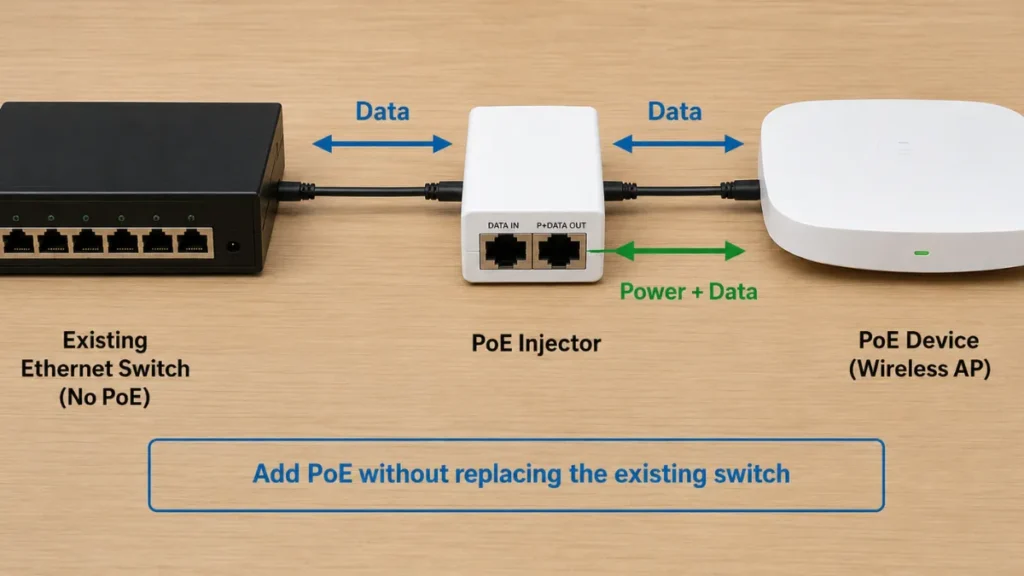
Imagine a network that is already running through a conventional Ethernet switch. Most of the equipment is powered locally. Only one remote unit needs power through its network cable.
Changing the switch would solve the problem, but it would also change something that was not actually causing a problem.
A small injector can be a better fit.
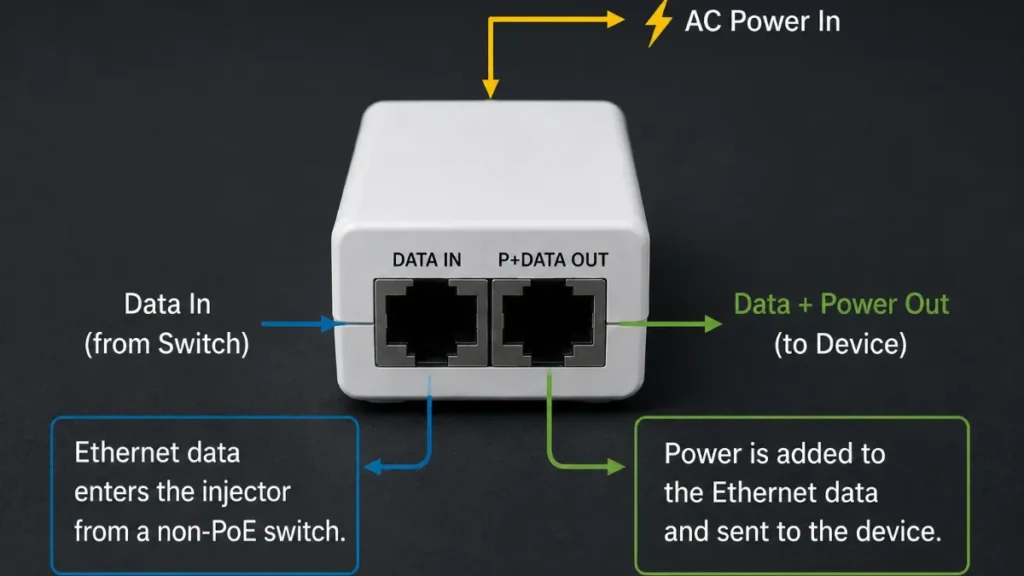
It can be added to the Ethernet link between the existing switch and the remote device, leaving the rest of the network alone.
That sounds like a minor difference. In product development, it can be a fairly important one.
A PoE Switch Is Not Always the Starting Point
There is a tendency to look at PoE from the network side first:
Which switch will power the device?
That makes sense when a new network is being built. It is less useful when the network already exists.
Legacy installations are a good example. A site may have a working Ethernet switch installed in a cabinet, while a new wireless unit, controller, security device, or other remote product needs power at the far end of an existing cable.
Replacing the switch is possible. It is just not necessarily the most sensible change.
The same situation occurs in smaller deployments. If one endpoint needs PoE and the remaining ports do not, the value of adding PoE to the whole switch can be limited.
This is one reason separate injectors continue to show up in real installations. Discussions from networking users repeatedly come back to the same practical issues: using injectors with existing switches, passing PoE through patch panels, supporting Gigabit connections, and dealing with older passive-PoE equipment.
The injector is useful precisely because it does not require the rest of the network to change.
That is the part worth considering before deciding that a PoE switch is automatically the better architecture.
What Happens When Only One Product Needs Power?
Suppose a manufacturer is building an Ethernet-connected device for a system where the customer’s network equipment is not known in advance.
One customer may have a PoE switch.
Another may have a standard Ethernet switch.
A third may already have cabling installed and simply need a way to power the device at the remote end.
If the product depends entirely on a PoE switch, those differences become part of the deployment problem.
A separate injector changes the boundary.
The customer’s network can remain the network.
The injector handles the power function for the particular endpoint that needs it.
This can be useful for products sold into different installations because the Ethernet interface does not have to dictate the entire network architecture.
It is a relatively simple idea, but it gives the product developer more room to work with.
And there is another advantage that is easy to miss: the power component can evolve independently from the switch.
A product revision may require a different power level or a different input arrangement without forcing the customer to replace the network infrastructure at the same time.
That is not always necessary. But when it is necessary, keeping the two functions separate can save a surprising amount of redesign.
Then Why Not Just Use Any Injector?
This is where the “simple” part of the injector starts to disappear.
An injector has two things going on at once.
It is carrying Ethernet data.
It is also putting electrical power onto that connection.
Those two functions have to coexist.
A common assumption is that an injector either supports a network speed or it does not. In reality, the injector is not normally negotiating the Ethernet link speed itself. What matters is whether the hardware allows the Ethernet signal to pass through properly at the required speed.
This question comes up frequently in field discussions, particularly around Gigabit and 2.5GbE. Users have specifically asked whether PoE injectors can be used with 2.5GbE equipment and whether an injector can reduce network speed.
That makes the Ethernet section of the design worth paying attention to.
A manufacturer cannot reasonably test only:
Output voltage: correct.
Device powers on: yes.
The more useful test is whether the complete connection behaves as intended.
The switch, injector, cable, connector and powered product are working together. If the product is expected to maintain a particular Ethernet connection while drawing power through the same cable, that combination needs to be considered during validation.
This becomes even more relevant when the product moves beyond a single prototype.
A prototype that works on the engineer’s bench is one thing.
A product that has to work repeatedly with different network equipment and cable conditions is another.
Power Compatibility Can Be More Complicated Than the Voltage
There is another trap with injectors: two products can have similar-looking electrical specifications and still not be interchangeable.
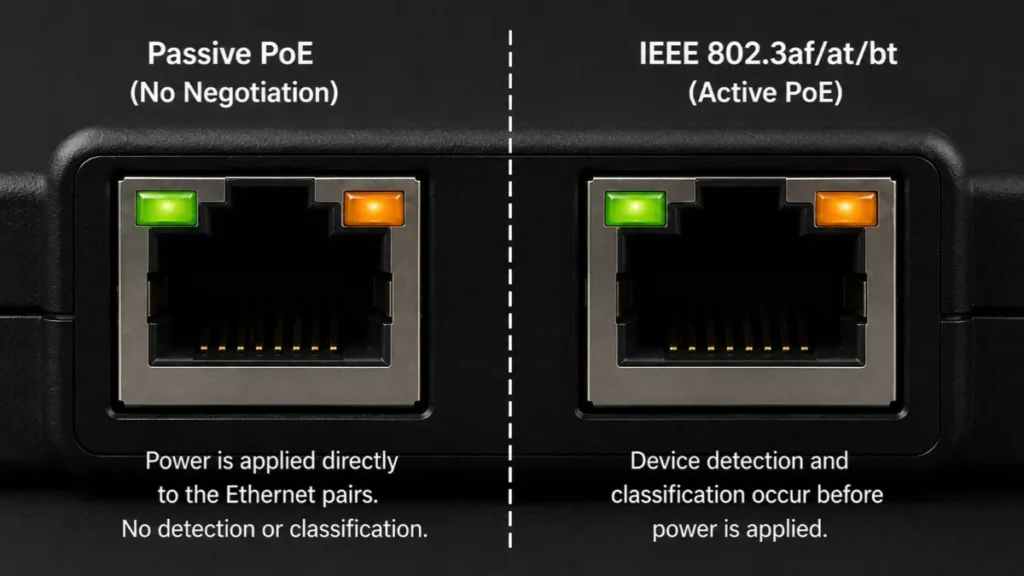
Passive PoE is a good example.
A passive injector applies power without the same detection and classification process used by active IEEE PoE systems. The receiving equipment therefore needs to be designed for the particular passive PoE arrangement.
This is not just a theoretical concern.
In the discussions collected for this project, users ask whether an old passive injector can be used with newer access points, whether a particular passive voltage can be used with another device, and whether different PoE arrangements can be mixed.
Those questions exist because the label “PoE injector” does not tell you enough.
The product developer needs to know what the powered device is actually designed to accept.
For a controlled product design, this can be an advantage rather than a disadvantage. Instead of leaving the installer to work out compatibility, the manufacturer can define the intended power interface from the beginning.
That information then becomes part of the product specification.
A Small Injector Still Has to Survive Real Conditions
The power circuit itself may be compact, but it still has to deal with the same unpleasant events as other power electronics.
Loads change.
Connections are made and removed.
Short circuits happen.
Input conditions vary.
A fault in the powered device should not automatically turn into a failure somewhere else in the system.
That is why protection features such as over-current, over-voltage, and short-circuit protection can matter even in a relatively small injector.
There is also the physical environment.
An injector sitting in an office cabinet has a different thermal problem from one installed inside industrial equipment. A unit mounted next to other heat-producing electronics has less room to dissipate heat than the same unit sitting in open air.
These details are easy to overlook when the component is treated as an accessory.
They become harder to ignore when the injector is part of a finished product.
What Does the Manufacturer Actually Need to Validate?
The temptation is to make the test plan very short.
Check the output.
Connect the Ethernet cable.
Confirm that the device boots.
Done.
That may be enough for an initial prototype. It is not a particularly strong production validation method.
The more useful approach is to test the injector in the conditions in which the final product will actually operate.
Start with the power side. Check startup and steady-state behavior under the expected load rather than testing at only one convenient operating point.
Then look at the Ethernet connection. If the product is designed for Gigabit Ethernet, test the complete link at that speed. If a higher-speed interface is required, test that configuration instead of assuming that a lower-speed result proves everything.
Then introduce the conditions that are likely to expose weaknesses: different cable lengths, repeated power cycling, load changes, and relevant fault conditions.
The goal is not to produce an impressive laboratory number.
It is to find out whether the injector behaves predictably when it becomes part of the actual product.
That distinction matters in volume manufacturing. A design that is sensitive to a small change in components, cable characteristics, or assembly conditions can become much harder to control once hundreds or thousands of units are being built.
When Does a Standard Injector Stop Being Enough?
There is nothing wrong with a standard injector if it fits the application.
In fact, starting with an existing platform is often the sensible approach.
The trouble starts when the product has requirements that the standard unit was never designed around.
Maybe the enclosure does not fit.
Maybe the required power configuration is unusual.
Maybe the product has to meet a particular environmental requirement.
Maybe the Ethernet performance needs to be validated with a specific product interface.
Or perhaps the customer needs several related versions of the same product rather than one off-the-shelf configuration.
At that point, continuously searching for another catalog injector may not be the best use of engineering time.
The better question is whether the injector should be treated as part of the product architecture.
That does not necessarily mean developing everything from zero.
It may simply mean taking an existing design and changing the parts that actually matter to the application.
Where Does ODM Make a Difference?
This is where an ODM partner can be useful.
The value is not simply having another supplier for an injector.
It is being able to discuss the power component together with the equipment it is supposed to support.
For example, the starting information might be the product’s Ethernet interface, required power, input conditions, enclosure limitations, operating environment, and target deployment.
From there, the injector design can be evaluated around the actual product rather than around a generic specification sheet.
That may involve the power stage, protection circuit, Ethernet section, PCB layout, thermal design, enclosure, and validation.
Sometimes very little needs to change from an existing design.
Sometimes the mechanical or electrical requirements justify a more substantial modification.
This is one reason ODM development can be more practical than treating every project as either “buy a standard injector” or “develop a completely new one.”
The engineering work can stay focused on the parts of the product that actually need to be different.
A Practical Example: Passive PoE for a Single Endpoint
Consider a product that communicates through Gigabit Ethernet but is designed to receive power through a passive PoE connection.
The network switch does not necessarily need to provide PoE.
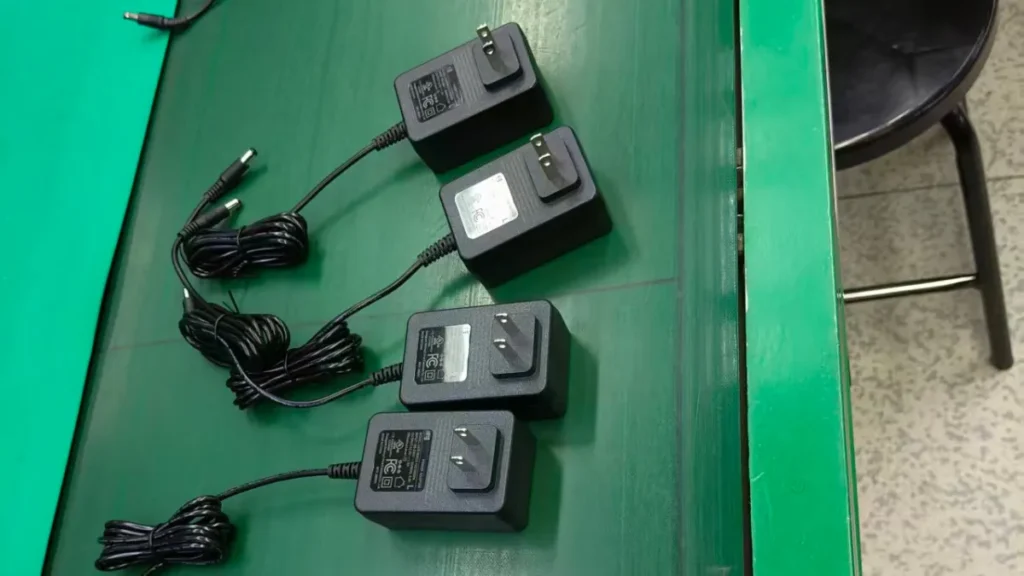
A separate passive injector can be placed between the switch and the product, allowing the existing Ethernet infrastructure to remain in place.
This type of arrangement fits the same situations seen in legacy upgrades, single-device deployments, temporary networks, and installations where replacing network hardware would create more work than it solves.
A product such as the UE PoE24 is an example of this type of separate passive PoE approach.
The important part is not the physical size of the injector or the fact that it is easy to connect.
It is the boundary between the injector and the powered product.
The receiving equipment has to be designed for the intended passive PoE configuration. A passive injector should not be assumed to be interchangeable with an IEEE 802.3af/at/bt powered device simply because both products are described as “PoE.”
That requirement should be settled during product development, not discovered after installation.
So, Are PoE Injectors Still Relevant?
Yes—but not because they are somehow better than PoE switches.
They solve a different problem.
A PoE switch makes sense when PoE needs to be part of the network infrastructure.
An injector makes sense when power needs to be added to a particular Ethernet connection without making the whole network PoE-capable.
For a manufacturer, that difference can influence much more than the installation method.
It affects how the product interfaces with the customer’s network, how much of the system has to change during deployment, and how the power architecture can evolve between product versions.
It also changes what needs to be tested.
The injector has to deliver power reliably, but it also has to coexist with the Ethernet signal and the powered device. If passive PoE is involved, the compatibility boundary needs to be explicit. If the product is going into a different environment or a larger production run, those conditions need to be reflected in validation as well.
So the useful question is not:
“Why would anyone still use a PoE injector?”
It is:
“Does this product really need PoE to be built into the network switch?”
When the answer is no, keeping power injection separate can be a perfectly reasonable engineering decision.
And when the injector becomes part of the product rather than an afterthought, working with an ODM partner can make that decision easier to turn into a repeatable production design.