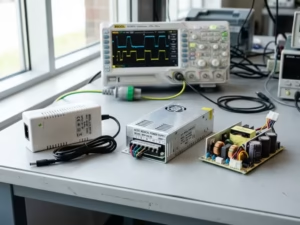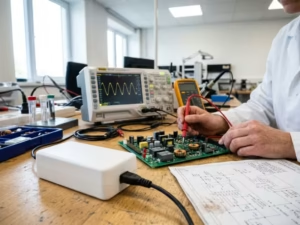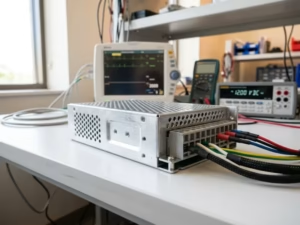
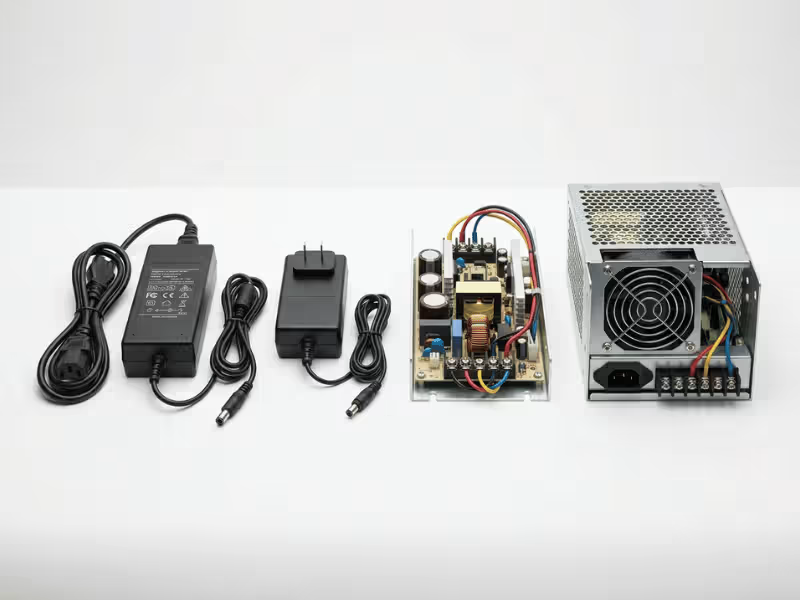
Choosing a medical power supply is rarely a single decision. It’s several at once: where the supply sits relative to the device, how it’s built, how it mounts, how it handles protective earth, and whether you buy it off the shelf or have it developed. Each axis carries real trade-offs in cost, thermal design, serviceability, and your path to IEC 60601-1 compliance. In practice, “types” of medical power supplies are defined across several selection dimensions rather than a single fixed category — so this guide treats “types” in the practical sense buyers and engineers actually use.
Get the classification right and you specify a supply that fits your enclosure, meets your leakage targets, and clears audit without redesign. Get it wrong and you inherit heat problems, a bulkier product, or a certification path longer than it needed to be. This guide breaks down the major ways medical power supplies are classified, explains how each type differs in practice, and gives you a framework to decide which fits your device. As a manufacturer of medical AC-DC power supplies and adapters, Quankang sees these trade-offs resolved across device programs every week.
The Main Ways Medical Power Supplies Are Classified
“Medical power supply” is an umbrella term covering several overlapping categories. A single unit can fit several at once—for example, an external, enclosed, desktop, Class II, standard supply. These axes don’t compete; each answers a different design question.
Here are the five practical axes this guide covers:
- External vs. embedded — decides integration: does the supply live outside the device or inside it?
- Open-frame vs. enclosed — decides construction and who owns cooling and safety spacing.
- Desktop vs. wall-mount — decides installation and form factor for external supplies.
- Class I vs. Class II — decides the shock-protection method and whether you need protective earth.
- Standard vs. custom — decides your sourcing model, cost, and lead time.
Keep these axes in mind as you read. Most real designs combine one answer from each, and the best specification comes from matching every axis to your device’s actual constraints.
External vs. Embedded Medical Power Supplies
The first and most consequential split is where the supply lives relative to the device. This choice ripples through thermal budget, certification scope, product size, and how the unit gets serviced.
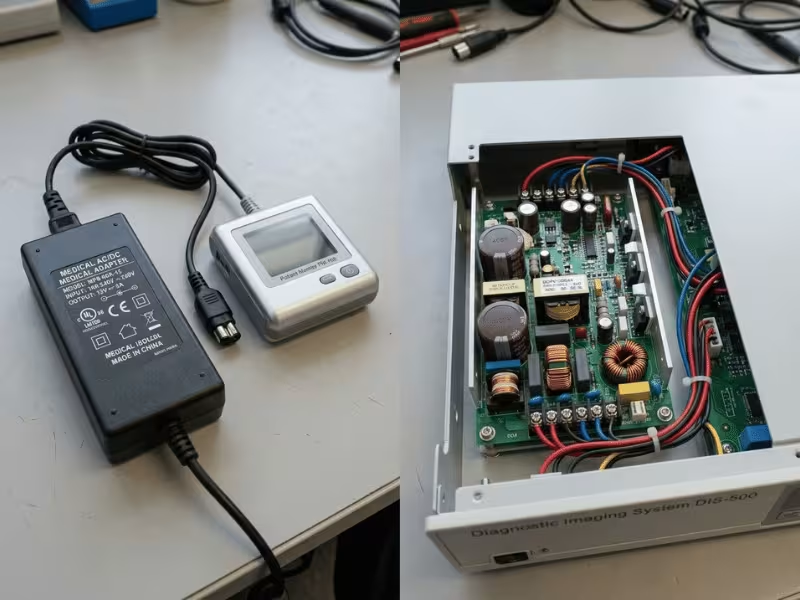
External supplies are adapters that sit outside the device. They move the mains-conversion heat out of your enclosure entirely, which protects temperature-sensitive electronics inside. They also come with their own safety certification, which can simplify integration and reduce part of the mains-related evaluation burden at the device level, depending on the system architecture. A field failure is solved by swapping the adapter in seconds, with no need to open the device. A portable patient monitor that runs on a certified external medical adapter is a typical example — slim, cool-running, and easy to service.
Embedded supplies (internal or on-board) integrate inside the device. They deliver a cleaner single-unit form factor, scale better to higher power, and make it easier to reach high IP sealing since there’s only one enclosure to protect. The trade-off is that all the conversion heat now sits inside the product, and the whole device typically falls under mains-level certification. A benchtop analyzer or imaging subsystem that needs higher power and a sealed housing often leans toward an embedded supply.
The takeaway: external tends to favor thermal simplicity, a narrower device-level evaluation, and easy field replacement; embedded tends to favor integration, higher power, and sealing. Match the choice to your power level, enclosure constraints, and service model.
Construction and Mounting: Open-Frame vs. Enclosed, Desktop vs. Wall-Mount
Two more axes shape how the supply physically integrates: how it’s constructed and how it mounts. Both decide where responsibility for safety and cooling sits.
Open-Frame vs. Enclosed Designs
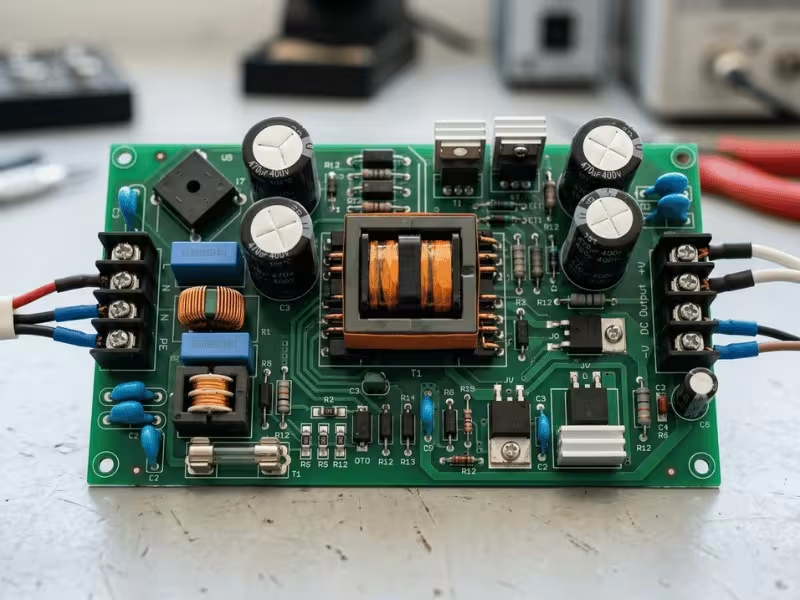
An open-frame supply is a bare printed circuit board, sometimes with a partial cover, designed to be built into a host device. It’s smaller and lower cost, but it shifts responsibility to the OEM. Your device’s enclosure must provide the airflow the board needs and maintain the creepage and clearance spacing that keeps the mains section safe. That’s a genuine engineering consideration: the surrounding enclosure design, airflow path, and spacing validation all become part of your work.
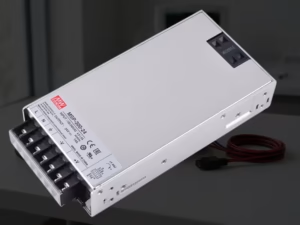
An enclosed supply carries its own protective case, so it manages its own cooling and safety spacing. It’s often a better fit for standalone use, exposed mounting, or any design where you don’t want to own the thermal and spacing burden. You pay more per unit and use more space, but you inherit less risk. For low-volume or fast-turnaround projects, that trade often makes sense.
Desktop vs. Wall-Mount Adapters
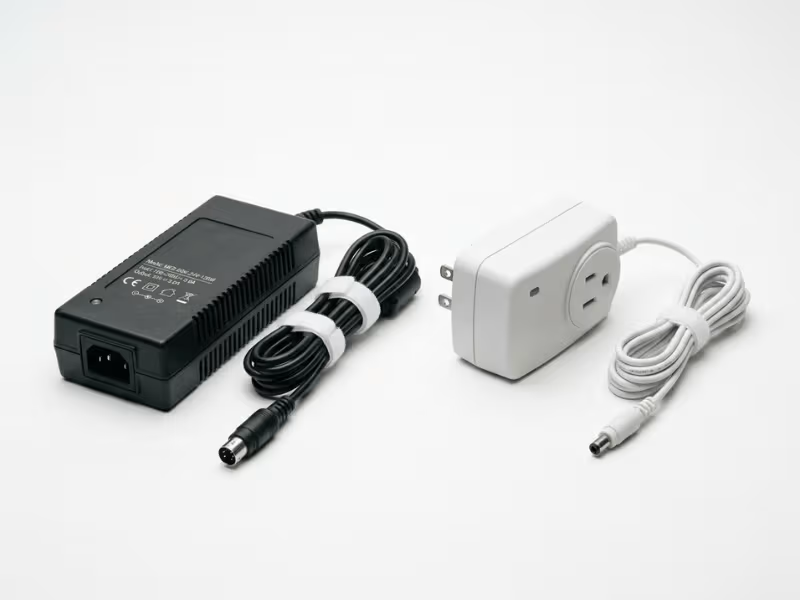
These are the two common external form factors, separated mainly by power range and use context. A desktop adapter is the familiar in-line brick, suited to mid-power benchtop and cart-based devices, typically from around 30 W up to a few hundred watts. Its weight sits on the desk or floor, not on the outlet, so cable strain is easy to manage.
A wall-mount adapter plugs directly into the outlet, saving desk space for low-power, portable, or space-constrained devices — usually under 30 W. The trade-off is outlet strain and cable routing: the adapter’s weight hangs on the socket, and nearby outlets can be blocked. Match the form factor to the device’s power draw and where it’s used.
Class I vs. Class II Medical Power Supplies
This axis describes how the supply protects against electric shock — and it’s frequently confused with device risk categories, so read carefully.
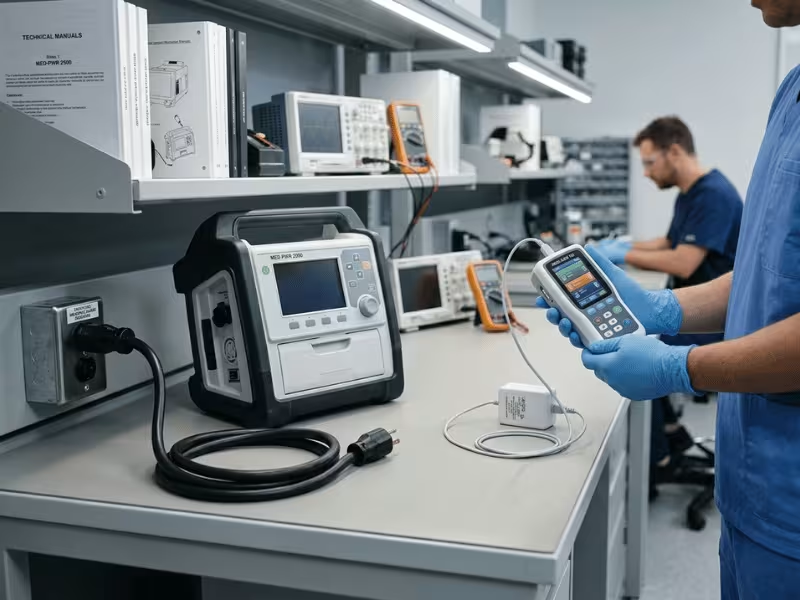
A Class I supply relies on a protective earth (ground) connection as part of its shock protection. If basic insulation fails, the earth conductor carries fault current safely away. Class I typically uses a three-prong cord and needs a grounded installation. It’s common in higher-power equipment where the chassis is bonded to earth.
A Class II supply uses double or reinforced insulation instead of a protective earth. Because it doesn’t depend on ground, it can run on a two-prong cord and simplifies installation. This often suits portable and home-use devices where a reliable earth connection can’t be assumed. Where a reliable protective-earth connection is not available or not desirable, Class II is often more practical. A grounded metal chassis, especially in higher-power equipment, often aligns well with Class I designs. The choice interacts with your patient-leakage targets and enclosure grounding strategy, so decide it alongside your applied-part context, not in isolation.
One critical clarification: power-supply Class I and Class II describe the supply’s shock-protection method. They are not the same as FDA device risk classes (Class I, II, III), which rank a medical device by patient risk and regulatory control. A Class II power supply can sit inside a Class I, II, or III medical device. Never let the shared numbering conflate the two.
Comparison Table: Medical Power Supply Types at a Glance
The table below summarizes how the main types compare across the factors that drive selection. These categories overlap rather than exclude one another, so treat the table as a selection aid rather than a strict taxonomy — and treat the power ranges as defensible guidance, since your exact figures depend on the specific model and design.
Type | Typical power range | Thermal handling | Integration effort | Serviceability | Best-fit context |
|---|---|---|---|---|---|
External (adapter) | 5–250 W | Heat exported outside device | Low — plug and connect | High — swap in seconds | Portable, benchtop, home-use devices |
Embedded / open-frame | 20 W–1 kW+ | OEM manages internal airflow | High — OEM owns spacing & cooling | Low — requires opening device | Integrated, higher-power, sealed systems |
Enclosed (standalone) | 20–500 W | Self-contained cooling | Medium — self-protected unit | Medium — replaceable module | Standalone or exposed installations |
Desktop adapter | 30–250 W | Heat exported; brick on surface | Low | High | Mid-power benchtop and cart devices |
Wall-mount adapter | 5–30 W | Heat exported at outlet | Low | High | Low-power, portable, space-constrained |
How to read this: most designs combine several rows — an embedded supply is often open-frame, and an external supply is either desktop or wall-mount. Use the table to narrow candidates, then confirm the specific model’s certified figures against your device’s real requirements.
Which Type Fits Which Medical Device
Mapping types to device categories makes the decision concrete. In each case, the fit driver is a mix of power, portability, sealing, and who uses the device.
Portable and handheld diagnostics tend to favor a wall-mount or compact external adapter, usually Class II. The driver is portability and simplicity: low power draw, no reliable earth to depend on, and a form factor that travels well.
Benchtop analyzers and monitors typically use a desktop external adapter or an enclosed embedded supply. The driver is mid-range power plus bench stability — heat can be exported with an adapter, or contained internally when a single-unit design matters.
Imaging and higher-power systems often lean toward embedded, higher-wattage supplies, frequently Class I. The driver is power scale and chassis grounding: an external brick becomes impractical above a few hundred watts, and the earthed chassis suits Class I protection.
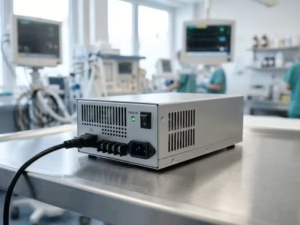
Sealed or cart-based equipment tends to favor embedded enclosed supplies. The driver is ingress protection — every cable entry is a sealing risk, so integrating the supply behind one sealed housing simplifies the IP design.
Home-use medical devices often point to external Class II supplies. The driver is user safety and simplicity: keeping mains conversion outside the device, with double-insulated protection, reduces risk for a non-technical operator.
Verify this: identify your device’s power draw, use environment, and operator type first, then let those drivers point you to the type rather than starting from a preferred form factor.
Standard vs. Custom Medical Power Supplies
The final axis is your sourcing model, and it shapes cost, timeline, and how tightly the supply fits your device.
Standard (catalog) supplies offer the fastest lead time, the lowest unit cost, and certification that’s already proven in the field. The trade-off is fit: you may have to compromise on form factor, connector, mounting, or leakage targets to use what exists. For many projects, that compromise is acceptable and the speed is worth it.
Custom (ODM) custom power adapters are developed to your exact mechanical, thermal, and compliance needs — the right footprint, the connector you want, and leakage figures tuned to your applied-part context. The cost is development time and a volume commitment to justify the tooling. Between the two sits a modified-standard path: an existing platform adjusted in output, connector, or mechanicals, which balances fit against timeline.
A simple heuristic: standard tends to make sense when volume is low to moderate and a catalog unit fits your envelope. Custom tends to win when volume is high and the supply must integrate tightly, or when no standard part meets your leakage or form-factor targets. When you’re close on both, modified-standard often bridges the gap fastest.
How to Choose the Right Medical Power Supply
Work through these steps in order. Each one narrows the field and ties to a concrete parameter you can verify.
- Power and voltage. Define continuous output current, voltage rails, and peak load. Size to real demand with headroom, not the theoretical maximum alone.
- Thermal headroom. Decide whether your enclosure can absorb conversion heat. If not, favor an external supply that exports it.
- Protective earth and protection class. Confirm whether your installation provides a reliable earth. No earth points toward Class II; a grounded chassis tends to suit Class I.
- Leakage targets. Match earth and patient leakage limits to your applied-part type, under both normal and single-fault conditions.
- IP and use environment. For sealed or wet environments, favor embedded enclosed designs and minimize cable entry points.
- Serviceability. If fast field replacement matters, lean external. If a sealed single unit matters more, lean embedded.
- Certification path. Confirm the supply is tested to the IEC 60601-1 edition your target markets require, including any national deviations.
- Sourcing model. Apply the standard / modified-standard / custom heuristic based on volume and integration tightness.
Don’t stop at “consider your needs.” Each step above names a specific parameter and the decision it drives — document your answer to each before you request quotes.
How Quankang Supports Medical Power Selection
Because these choices interact, the most useful supplier is one that can work across every axis instead of pushing a single format. Quankang manufactures medical AC-DC power supplies and adapters across the full range of types — external and embedded, open-frame and enclosed, desktop and wall-mount — on an OEM/ODM basis. That breadth means we can match the supply to your device rather than bending your device around a fixed part.
Our engineering team supports form-factor fit, protection-class selection, patient and earth leakage-current targets, thermal design, and alignment to the relevant IEC 60601-1 edition. We work across standard, modified-standard, and full-custom paths, matched to your volume and timeline, so the isolation and integration land where your device actually needs them — without paying for capability you don’t use.
FAQ
What makes a medical power supply different from a standard one?
Medical supplies are designed and certified to IEC 60601-1, which enforces tighter leakage-current limits — patient leakage is typically held to the microamp range, depending on the applied-part type and test condition — and stricter isolation than commercial or industrial standards like IEC 62368-1. A standard supply may share a form factor but won’t carry the isolation and leakage guarantees a patient-connected device requires.
Is Class II always better than Class I for medical devices?
No. Class II simplifies installation by removing the protective-earth dependency, which often suits portable and home-use devices. But Class I is frequently the right choice for higher-power equipment with a grounded chassis, where the earth connection is part of a robust protection scheme. Match the class to the installation and power level, not to a blanket preference.
When should I choose an external adapter over an embedded supply?
Choose external when thermal headroom inside the enclosure is tight, when you want a narrower device-level evaluation, or when fast field replacement matters — typically below a few hundred watts. Choose embedded when you need higher power, a sealed single-unit form factor, or high IP protection with minimal cable entry points.
Does “open-frame” mean the supply isn’t safe?
No. Open-frame means the supply has no protective case of its own, so the host device’s enclosure must provide the airflow and maintain the creepage and clearance spacing that keep the mains section safe. It’s fully safe when the OEM designs the surrounding enclosure to meet those requirements — the responsibility simply shifts to the integrator.
Do I need a custom medical power supply, or will a standard one work?
A standard supply works when volume is low to moderate and a catalog unit fits your footprint, connector, and leakage targets. Custom tends to make sense when volume is high enough to justify development cost, or when no standard part meets your mechanical or leakage requirements. If you’re close on both, a modified-standard platform often bridges the gap faster than full custom.
Key Takeaways and Next Step
- Medical power supplies are described by several overlapping axes — external vs. embedded, open-frame vs. enclosed, desktop vs. wall-mount, Class I vs. Class II, and standard vs. custom — not by one label.
- The right type follows your device’s power, thermal budget, use environment, and compliance path.
- Power-supply Class I and Class II describe shock-protection method — they are not FDA device risk classes.
- Verify certification edition and leakage targets against your applied-part context before you commit.
Specifying medical power is a decision about fit, protection, and compliance made concrete through parameters you can verify. To match the right type, protection class, and leakage targets to your device and target markets, explore Quankang’s power solutions or contact us for OEM/ODM specification support.