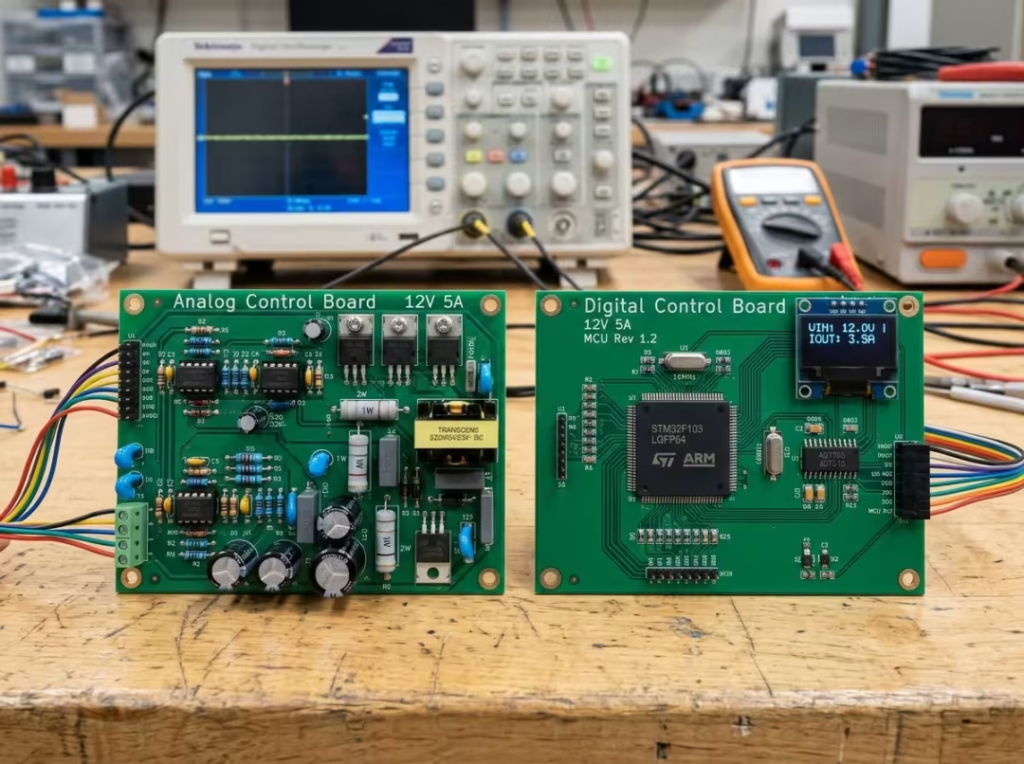
Quick answer: Neither one wins across the board. Analog gives you the fastest loop, the quickest bring-up, and the cheapest bill of materials at volume. Digital gives you configurability, telemetry, and a single hardware platform you can reuse across an entire product line. Which one you want depends on your transient budget, your build volume, whether anything upstream needs to read the rail, and how much firmware your team can actually own.
You pick a converter off the datasheet numbers, and the part fits. Then you close the loop and find that the control method — barely a footnote during part selection — is setting your phase margin, deciding how far the rail droops on a load step, and quietly claiming a chunk of your BOM you didn’t budget for.
So let’s go through what actually separates analog and digital control, which of those differences show up on a real board, and how to line a control method up against the constraints you already have. No trophy for either side — the right answer depends entirely on what you’re building.
What Every Control Loop Is Trying to Do
Strip out the implementation, and both approaches chase the same thing: hold the output at setpoint while the load and input refuse to sit still. A processor slams a current step. The input rail sags in a brownout. The loop sees the error and drives the duty cycle to haul the output back. That job never changes. Only the machinery does.
Analog runs continuously. An error amplifier compares the output to a reference, an RC network shapes the gain and phase, and a modulator sets the duty cycle. Nothing gets sampled. The loop responds as the output moves, bounded by component bandwidth and the switching frequency.
Digital runs sampled. An ADC grabs the output, a controller — MCU, DSP, or a dedicated digital core — computes the correction, and a digital PWM stage drives the switch. Between samples, the loop is blind. You inherit sampling delay plus computation delay before any correction lands.
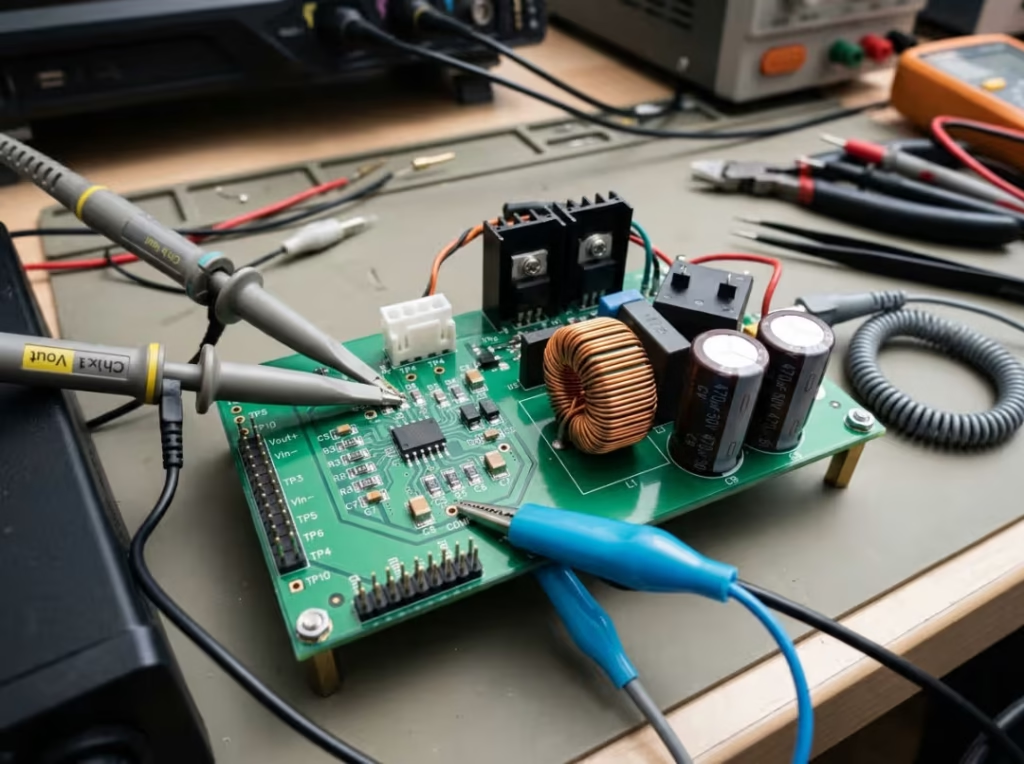
Continuous versus sampled. Hold that thought, because almost everything below traces straight back to it.
Analog vs. Digital: The Differences That Actually Bite
Skip the spec parade. These are the questions you actually ask at the bench.
Which responds faster to a load transient?
Analog. And it’s physics, not marketing. A continuous-time loop starts correcting the instant the output moves. A digital loop can’t do anything until the next sample lands, the algorithm runs, and the DPWM updates — typically one to two switching-cycle latency — and that latency caps your crossover frequency hard. Rough rule from the bench: sampling and compute delay force you to keep control bandwidth well under a tenth of the switching frequency to hold phase margin, tighter than the same analog topology usually needs.
You can see the cost in the scope and the BOM. Slower loop, bigger droop on the step, more bulk and ceramic to hold the rail in spec through the response window. On a high-di/dt CPU or GPU rail, that capacitor bank is real money and real board area. Digital narrows the gap with feedforward, nonlinear, and predictive schemes, and the modern dedicated controllers close it further — but you pay in sample rate, silicon cost, and firmware hours. When transient speed dominates, analog gets there with less fuss.
Which is easier to stabilize and tune?
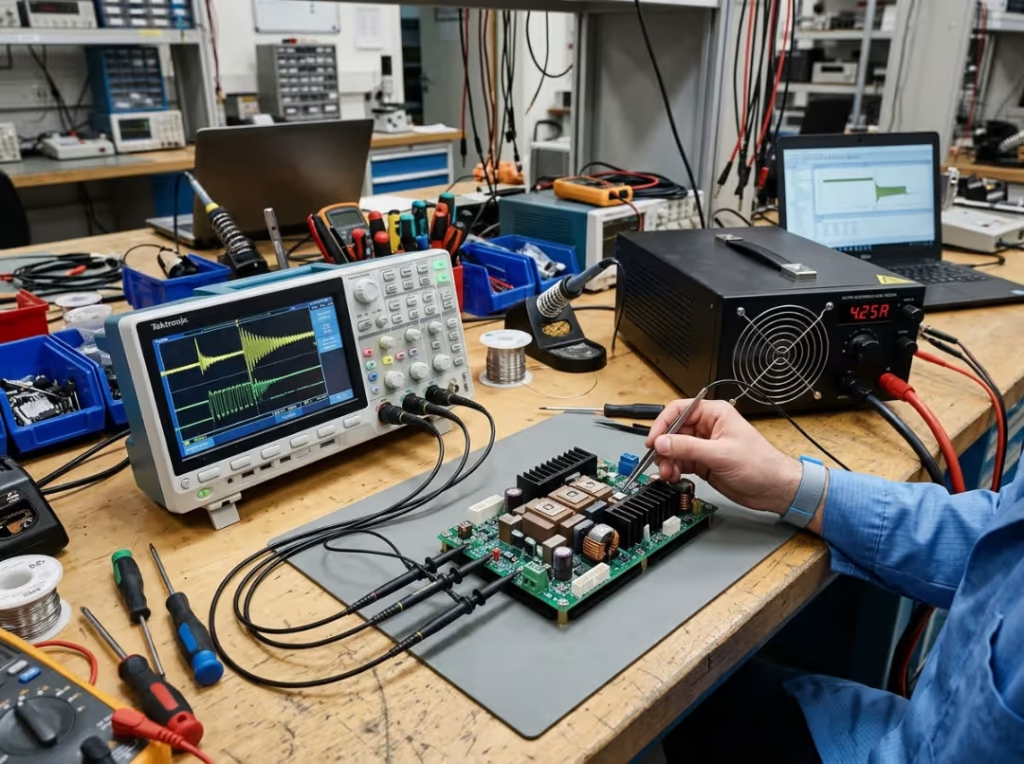
Analog, and it’s not close for most teams. Decades of tooling sit behind it — averaged small-signal models, Bode plots, compensator design that’s been walked a thousand times. You put a network analyzer on the real loop, trim an RC network on the bench, and watch the phase margin move while you do it. Short path between “change a part” and “see what happened.”
Digital hands you software coefficients, which may sound like a shortcut but often isn’t. Now you’re designing in discrete time, where sample rate, ADC latency, and compute delay all fold into stability. Two things trip teams up. First, finite ADC resolution and DPWM step size introduce quantization — and if the output lands between two DPWM codes, the loop hunts between them. That’s a limit cycle: a small, stubborn oscillation with no analog equivalent, and you kill it by making DPWM resolution finer than ADC resolution or adding dither. Second, turning a gain coefficient is trivial. Knowing what that turn does across load, line, and temperature is not. Easier knob, harder understanding.
Which stays flexible after the hardware is frozen?
Digital, no contest. Once the copper’s committed, firmware can still move the setpoint, reshape the compensator, shift protection thresholds, flip operating modes. Ship identical boards, differentiate by firmware — one assembly, several SKUs, or a per-customer trim set on the line. Analog bakes those calls into components. Want different behavior? New BOM, board spin, requalification, and schedule you didn’t plan for.
That’s the whole difference between a design that shrugs off a late requirement change and one that punishes you for it. If your spec is genuinely locked, the flexibility is dead weight. If it isn’t, it’s insurance — and that’s exactly the kind of flexibility that drives teams toward custom power adapters built around a configurable platform rather than a fixed one.
Which is better for monitoring and management?
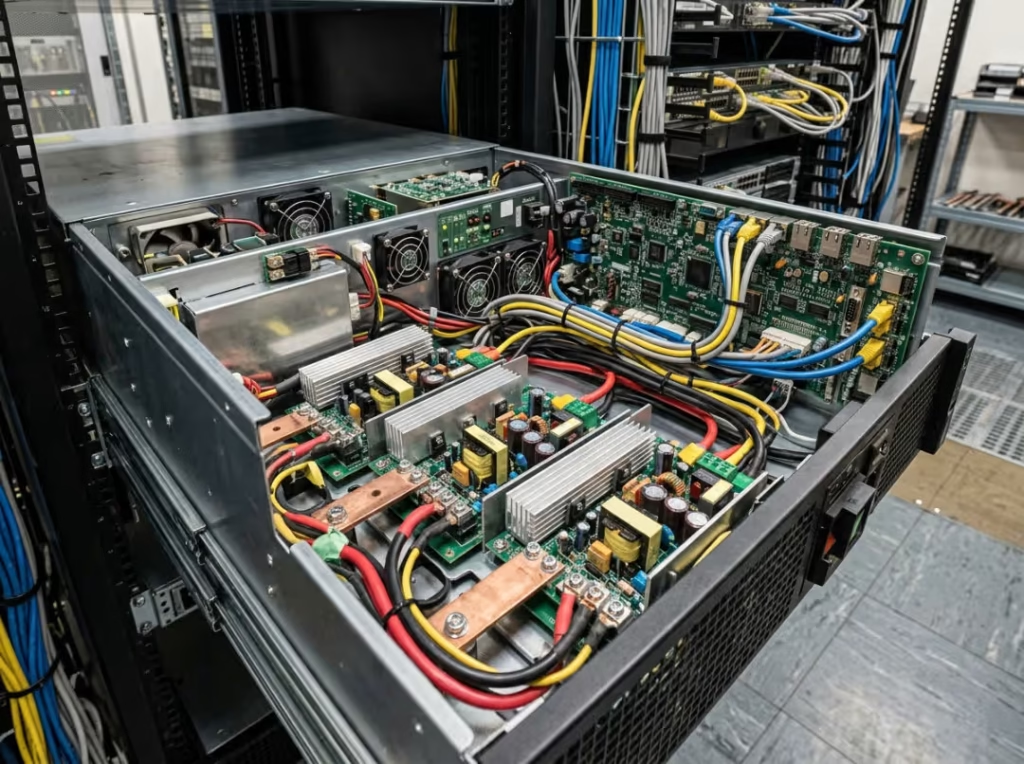
Digital, and in some markets it isn’t a choice. Voltage, current, temperature, and fault-history telemetry, plus PMBus or I²C control, come native. In a server or telecom rack that’s concrete: the BMC polls each rail over PMBus for margins, a hot-swap event has to be sequenced and reported, firmware pushes a margining command during system test, a field fault gets logged with a timestamp instead of guessed at. None of that exists on a plain analog rail unless you bolt on a monitor IC, a temp sensor, and interface logic — more parts, more board area, more failure points, more integration work.
If nobody upstream is ever going to read the rail, analog’s silence costs you nothing. The moment someone expects visibility, digital stops being a luxury.
Which is cheaper?
Analog, at volume, when the feature set is nailed down. Fewer parts, no firmware, a controller that boots into regulation and stays there.
But price the whole system, not the controller line. Once a design actually needs telemetry, remote config, and multi-rail coordination, the analog BOM sprouts a monitor chip, an interface, and glue logic — and the total lands a lot closer to digital than the two part numbers ever suggested. The controller price is the easiest number to compare and the most misleading to base decisions on.
Which is more robust?
No clean verdict here, and anyone handing you one is selling something. Analog has fewer failure modes — no firmware to hang, no boot sequence to stall, no corrupted flash to brick the rail. Digital adds those vectors and adds defenses analog can’t touch: it detects, classifies, logs, and reports faults, and it drops to a safe state under supervision. Analog fails simply and rarely. Digital fails in more ways but sees more coming. Pick the failure model that fits your reliability strategy, not the one that sounds safer in a sentence.
Side-by-side
Design factor | Analog control | Digital control |
|---|---|---|
Transient response | Fastest; no sampling delay; higher crossover | Sampling + compute delay caps bandwidth; predictive schemes help |
Loop tuning path | Network analyzer + RC trim; short feedback | Software coefficients + discrete-time analysis |
Quantization/limit cycles | Not applicable | Possible; needs DPWM finer than ADC or dither |
Post-freeze flexibility | Fixed in hardware; change = board spin | Firmware-retargetable setpoint, comp, protection |
Telemetry & management | Requires added monitor/interface ICs | Native PMBus / I²C, fault logging |
Multi-phase / multi-rail | Hard to scale with discrete parts | Built for phase balancing and sequencing |
Unit cost (high volume, fixed spec) | Lower | Higher |
Total system cost (feature-rich) | Rises with add-on chips | Often competitive |
Platform reuse | Limited | Strong |
Firmware burden | None | Development, validation, lifecycle |
Failure profile | Few modes, simple | More modes, strong diagnostics |
Where Analog Still Wins
Analog isn’t the thing you settle for when the money runs out. Inside the right constraints, it’s the better engineering answer, and calling it legacy is how teams overspend.
High-volume, cost-sensitive designs are its territory — consumer point-of-load rails, fixed-spec industrial bricks, anything shipping in the millions with a locked feature set. When the spec won’t move, and every cent of BOM multiplies across a production run, firmware overhead and telemetry silicon buy you nothing but cost.
It wins where the loop has to be genuinely fast, too. High-frequency converters and rails feeding spiky loads can’t spare a cycle or two of sampling latency, and continuous-time is the straightest line to a tight transient without an oversized output cap bank.
And it fits any design with stable requirements and no appetite for visibility — no remote config, no fault logging, no field updates, no multi-SKU ambitions. If none of Digital’s strengths map to your product, paying for them is a self-inflicted cost.
Where Digital Makes More Sense
Digital earns its keep the moment complexity starts outrunning what a fixed analog design can absorb without getting ugly.
Servers, telecom line cards, data-center rails, industrial fleets — anywhere operators expect to read every rail over PMBus and pull a fault log without a truck roll. That’s a hard requirement in those markets, not a feature you can defer to rev B. It’s also why ITE power supplies in these segments increasingly lean toward digital or hybrid control architectures rather than purely analog ones.
Then there’s platform reuse. One board, several products, separated only by the firmware image and a production trim. That compresses your NRE across a portfolio instead of respinning silicon for every variant, and for a product family, it’s often the whole argument in itself.
Coordinated control is where digital really pulls ahead. Multi-phase VRMs in which a dozen-plus phases must remain current-balanced and shed phases at light load. Multi-stage battery charging that walks a CC/CV profile and adapts to cell state. Multi-loop systems that need orchestration a pile of discrete analog parts handles badly, if at all.
And it pays off on products that live and improve in the field — firmware that retunes behavior after ship, fault analytics gathered across a deployed fleet, operational data feeding the next revision. The value was never the algorithm. It’s software soaking up complexity as the demands climb.
Why Many Real Products Go Hybrid
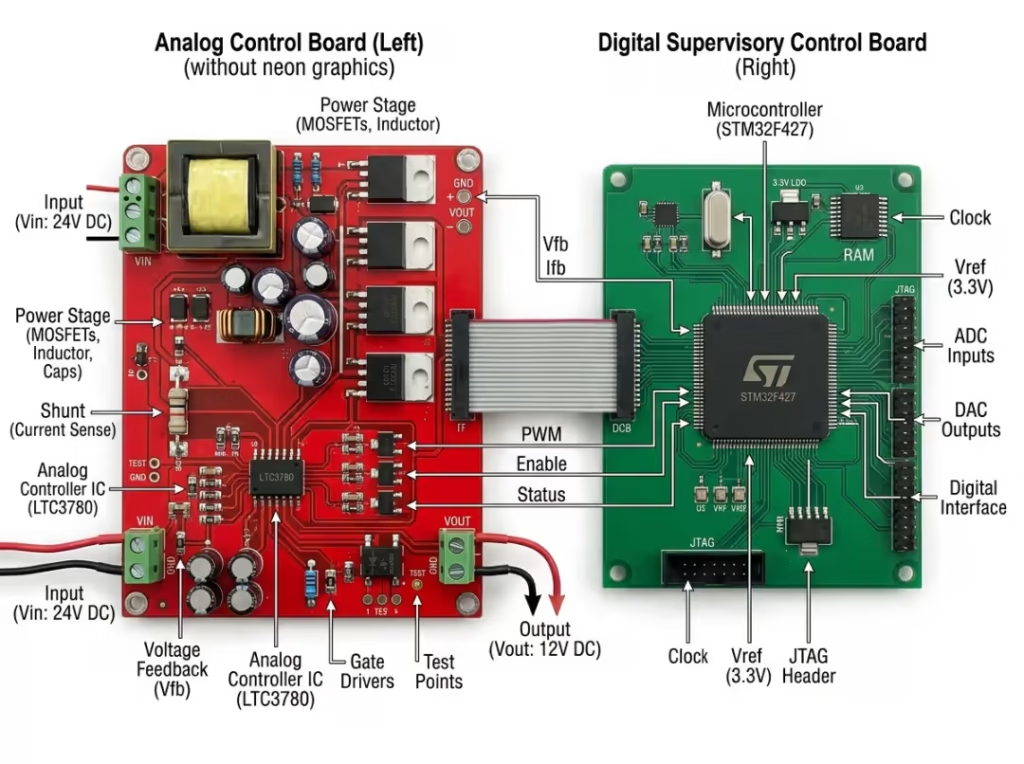
Open up a lot of shipping supplies, and you won’t find a purist. You’ll find an analog regulation loop paired with a digital management layer — a deliberate architecture, not a team splitting the difference.
The logic is clean. Keep the fast dynamics where they perform: an analog inner loop handles cycle-by-cycle regulation with no sampling penalty, so transient response and phase margin stay strong. Then hand a digital supervisor everything analog does awkwardly — power sequencing, output trimming and margining, telemetry, protection thresholds, the comms bus. Each domain does the job it’s actually good at.
You get things neither pure approach delivers alone. Analog transient speed without losing field visibility. A mature, reliable regulation core without losing configurability. PMBus management and fault logging without dragging the full weight of a digital control loop into the fast path — no discrete-time compensator to model, no limit-cycle risk where it hurts, less firmware sitting in the critical regulation path where a bug does the most damage. And it scales: the digital layer coordinates sequencing and monitoring across many rails while each rail keeps its own tight analog loop.
You’ll see it in data-center point-of-load and multi-rail modules, in industrial supplies with a management interface, all over the place. Hybrid is a top-tier design choice with a track record, and for a big slice of commercial products it’s simply the architecture that ships.
How to Choose
Run the design through this before you commit to a controller. Each question kills options fast.
- What’s the target unit cost, and at what volume? High volume against a frozen spec pulls hard toward analog — every avoided part multiplies across the run. Low volume or high mix weakens that pull and lets firmware NRE amortize differently.
- What’s the transient budget, in numbers? Write down the load-step size, the di/dt, and the allowed droop. The tighter that window, the more analog’s zero sampling delay earns its place — and the more a slow digital loop costs you in output capacitance.
- Does anything upstream need to read or command this rail? Telemetry, PMBus/I²C control, margining, hot-swap coordination, fault logging. Any yes moves digital or hybrid to the front and starts loading parts onto a pure-analog BOM.
- Will the requirements move after the hardware freezes? Field updates, per-customer trim, multiple SKUs off one board. Expect change, and digital’s flexibility is insurance; if the spec’s truly locked, it’s dead weight.
- Can your team honestly carry the digital load? Discrete-time loop design, DPWM/ADC resolution planning, limit-cycle avoidance, firmware validation, long-term maintenance. If that skill set isn’t on the bench, a digital decision is a schedule risk before it’s a technical one.
Where the answers land:
Analog — spec is fixed, cost and volume dominate, nothing upstream needs visibility, the loop has to be fast, and you want the shortest route to a proven, low-risk design.
Digital — telemetry, remote control, or fault logging — is on the table; one platform has to support many configurations; the topology requires coordinated multi-phase or multi-loop control; and your team can own the firmware and validation.
Hybrid — you genuinely need a fast regulation loop and digital management, and you won’t trade transient performance for visibility or the other way around. For many real products, that “both” is just the honest requirement.
Where Teams Get It Wrong
A few traps separate a reasoned choice from a reflex.
Defaulting to digital because it sounds advanced. The word scans as modern, so teams reach for it without checking whether the design needs the flexibility or telemetry at all. If the requirements never call for it, you’ve bought firmware complexity and controller cost the product will never spend.
Comparing controller prices instead of system cost. The analog part looks cheaper on the line item while the design quietly needs a monitor IC, a temp sensor, an interface, and glue logic to reach parity. Compare the full BOM plus firmware effort against the full BOM on the other side. Never two part numbers in a vacuum.
Underestimating the digital engineering load. Dropping in the controller is the easy hour. Discrete-time modeling, DPWM and ADC resolution planning, limit-cycle avoidance, tuning across corners, firmware validation — those are the real hours, and the teams that budget for the chip but not the work get surprised late, when surprises cost the most.
Going pure analog on a product that quietly needed management. Single-board BOM thinking pushes a team toward analog on a design that actually wanted telemetry and multi-SKU reuse. You save cents per unit and pay it back with interest in redesigns and field limits a little digital supervision would have prevented.
FAQ
Is digital control more efficient than analog?
Not inherently, and betting on it is a common misread. Efficiency comes from topology, switching frequency, device choice, and how well the loop is built — not from whether the compensator lives in an RC network or in firmware. A well-designed analog supply matches or beats digital on peak efficiency all day. Where digital genuinely helps is light load, because it can flip operating modes — into burst or diode emulation — on the fly. Its real edge is flexibility and observability, not raw efficiency.
Can digital match analog transient response?
Close, with feedforward and predictive control, and modern dedicated controllers narrow the gap a lot. But sampling and compute delays are baked into a sampled loop, and they cap the bandwidth at a given switching frequency. For the tightest transient targets, analog usually hits the number with a cheaper controller, less firmware, and no oversized capacitor bank covering a slower response. If transient speed is your hardest spec, start analog.
Which is cheaper in high-volume production?
Analog, when the feature set is fixed — fewer parts, no firmware, no interface silicon. Digital only pulls ahead once the design also needs telemetry, remote config, or multi-rail coordination that analog would need extra chips to match. Decide on total system cost plus engineering effort, not the controller price.
Do digital power supplies always need firmware?
Yes. The control algorithm, the protection logic, the comms stack — all firmware, which means development, validation across line and load and temperature, and maintenance for the life of the product. Those hours are part of the real cost of going digital. Put them in the decision up front, not as a discovery halfway through the schedule.
What happens if the firmware fails in a digital supply?
Depends on how hard you built it. A properly hardened digital or hybrid supply has a watchdog, safe-state defaults, and hardware-level overcurrent and overvoltage protection that fire independently of the control firmware. If the firmware hangs or the flash becomes corrupted, those layers take the rail somewhere safe. This is exactly why fault handling and validation aren’t optional in digital designs — and one more reason hybrid keeps critical protection out of the firmware path. How well that protection holds up in practice depends as much on in-house testing and validation capability as it does on the control architecture itself.
Can one product use both?
Yes, and plenty do. The standard hybrid runs an analog inner loop for fast, cycle-by-cycle regulation while a digital layer handles sequencing, telemetry, trimming, protection thresholds, and comms. Proven, widely shipped, and it gets you analog loop speed with digital manageability in the same box.
Making the Call
This was never new versus old. It’s constraint-matching, and the constraints belong to your design, not to a trend.
Analog buys speed, simplicity, and the lowest cost per unit. Digital buys flexibility, observability, and platform reuse. Hybrid blends both, and for a big slice of real products it’s the most honest answer to what the system actually needs.
Do this now, before you spec a controller. Open the requirements doc and put four things on one line: your load step and allowed droop, your target unit cost, your build volume, and a plain yes-or-no on whether anything upstream has to read or command the rail. Then rank those against an honest read of your team’s firmware chops. Those five inputs will steer you to analog, digital, or hybrid faster and more reliably than any datasheet comparison — and they turn the pick from a guess into a call you can defend in a design review.