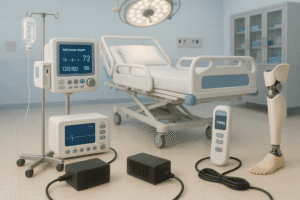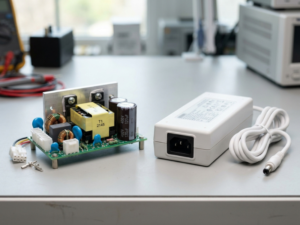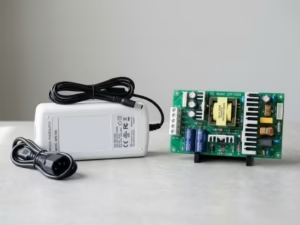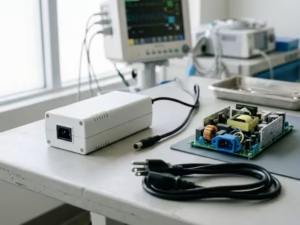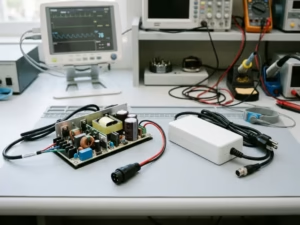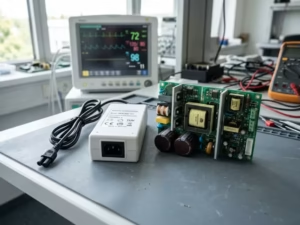
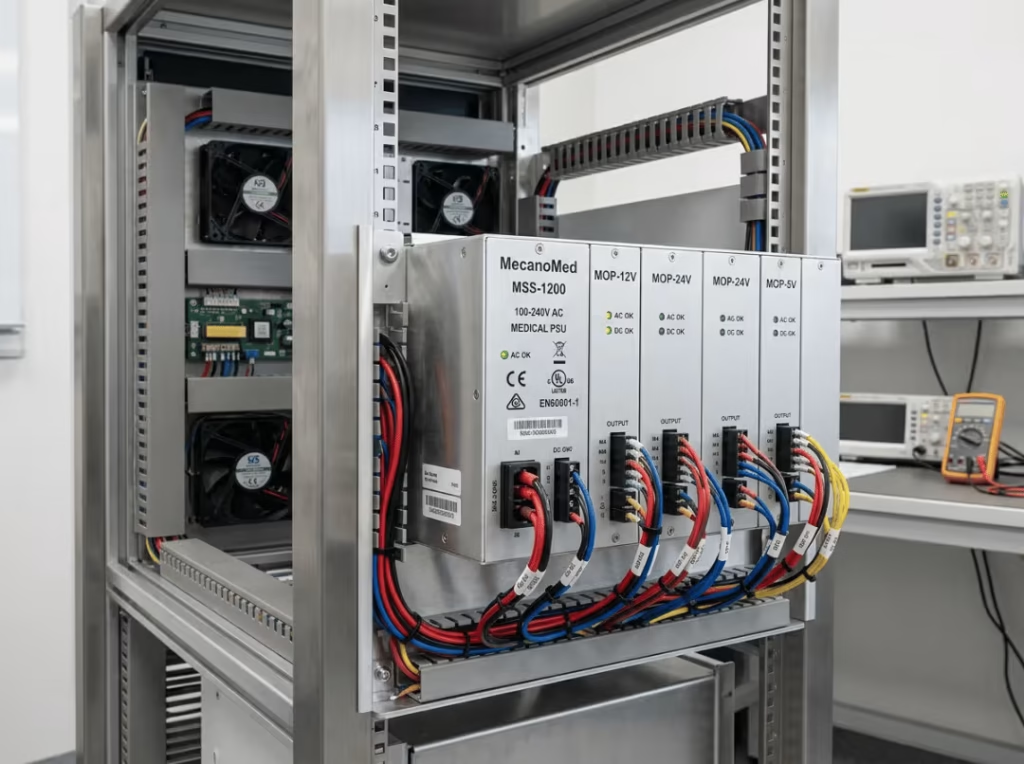
A modular medical power supply is a configurable AC-DC system that pairs a standard front-end stage with interchangeable output modules on a shared backplane. It lets you match specific voltage and current needs while inheriting most of a platform’s pre-approved safety and EMC compliance. For medium-power medical equipment built in low-to-medium volumes, it usually sits at the sweet spot between a full custom design and a fixed off-the-shelf unit.
The real question is not what a modular supply is, but when it’s the right call — and how to spec one so you don’t discover a compliance gap during certification. This article works through that decision: when modular beats custom, what IEC 60601 actually demands from your supply, and which parameters matter for the equipment you’re building.
When Should You Choose a Modular Medical Power Supply?
Choose modular when you need several isolated outputs, IEC 60601 compliance, and a fast path to market at volumes that can’t absorb custom NRE. That single sentence covers most medium-power medical programs.
The tension in medical power design comes from stacking constraints that rarely appear together. You need multiple isolated rails at odd voltages, you can’t trade safety for schedule, and you’re building hundreds or low thousands of units a year — not enough to amortize a ground-up custom design, but enough that the certification burden is just as heavy as a high-volume product.
A modular platform resolves that tension. You pick a chassis sized to your peak load, populate it with the output modules your device needs, and inherit a certification story that’s already been through the lab. If a rail changes late in the project, you swap a module instead of respinning a board.
Where modular stops making sense: extreme size or weight targets, per-unit cost pressure at high volume, or an output profile so unusual that no module fits. Those cases push you toward custom — more on that below.
What Makes a Modular Medical Power Supply Different From a Fixed Supply?
A modular supply is configured, not designed, and not simply purchased as-is. That distinction drives the cost, risk, and flexibility tradeoffs that follow.
The architecture has three parts. A front-end PFC stage converts AC mains to an intermediate DC bus, typically around 400 V, and carries the primary safety isolation. Interchangeable output modules connect to that front end and produce the rails your device needs, often with adjustable voltage to hit unusual targets. A shared backplane links the modules to the front end, distributing the bus and control signals.
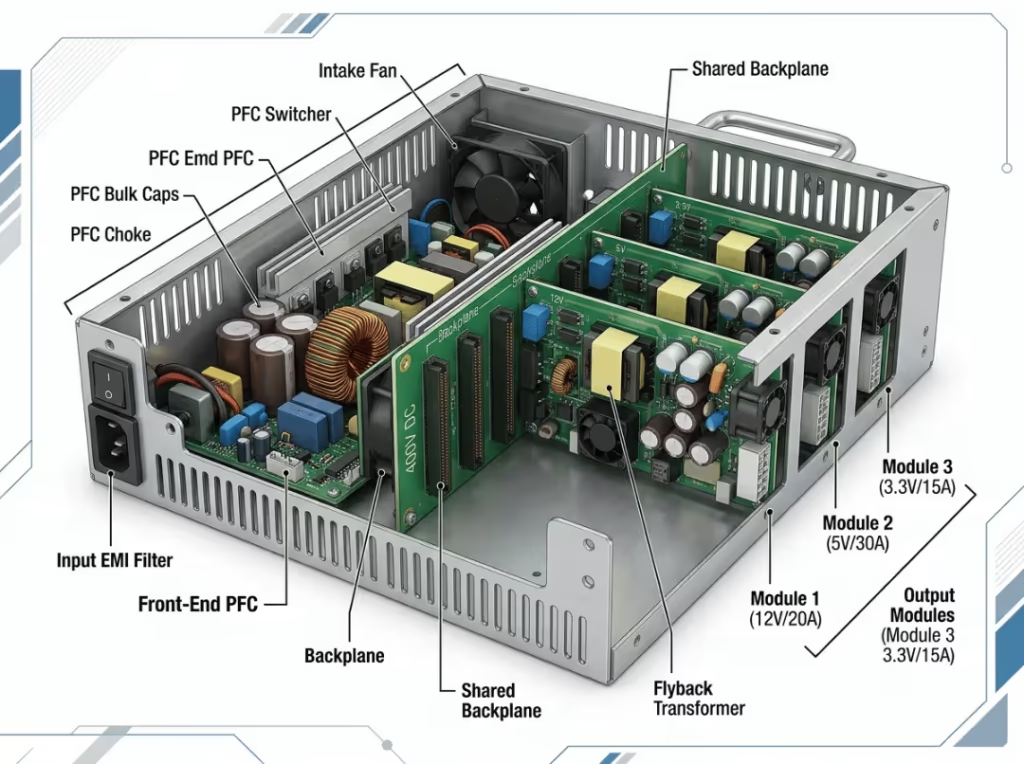
Protection lives at the module level — overvoltage, overcurrent, and short-circuit protection come standard, and many modules add remote sensing. Most platforms expose a PMBus interface and a GUI, so you can watch voltage, current, and temperature during development and read system health in the field. That visibility matters more than it sounds: a marginal rail you catch on the bench is far cheaper than one you find during design validation.
A standard supply gives you fixed outputs and no room to move. A custom supply is built exactly to spec but carries high NRE, long lead times, and a full certification cycle. Modular keeps most of the flexibility of custom while reusing a platform that’s already been approved, and the same chassis can serve several projects, which flattens the learning curve for your design team.
Modular vs Custom vs Standard: How Do You Decide?
The right choice depends on how your volume, output complexity, and timeline weigh against per-unit cost and physical constraints. There’s no universal winner — there’s a best fit for your program.
Factor | Modular / Configurable | Custom | Standard (Off-the-Shelf) |
|---|---|---|---|
Development time | Short — configure chassis + modules | Long — full design cycle | Shortest — buy and integrate |
Certification effort | Low — platform pre-approved to IEC 60601 | High — certify from scratch | Low, but may not meet medical needs |
NRE cost | Low | High | None |
Per-unit cost | Moderate | Low at high volume | Lowest |
Scalability across projects | High — reuse platform | Low — locked to one design | Moderate |
Design & compliance risk | Low — proven building blocks | High — unproven until tested | Moderate — fit and margin risk |
Best fit | Low-to-medium volume, multi-output, tight timeline | High volume or extreme size/cost targets | Simple, non-critical single rail |
Read the table as a decision tree, not a scorecard. Here’s the logic I’d apply.
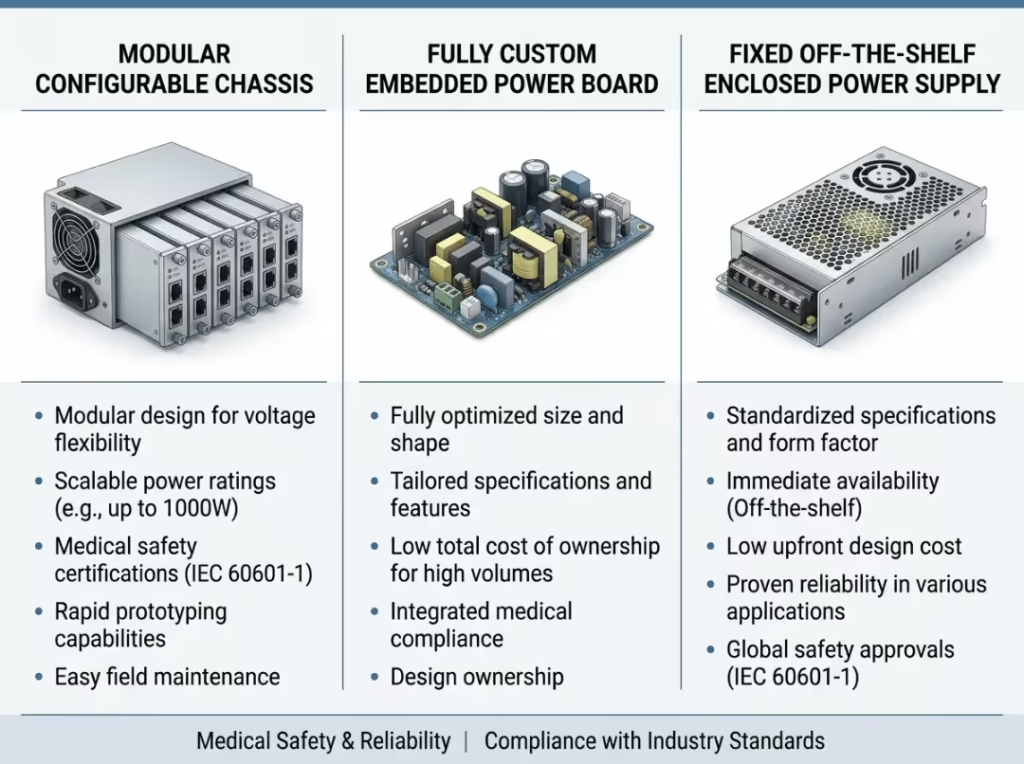
Go modular when annual volume sits in the hundreds to low thousands, you need three or more isolated rails, and your launch window can’t absorb a full certification cycle. This is the default for most imaging, diagnostic, and surgical subsystems.
Go custom when volume is high enough that amortized NRE drops below the per-unit premium of a modular platform — often tens of thousands of units per year — or when size, weight, or a specialized output profile leaves no configurable option that fits. Custom also earns its keep when you need to integrate the supply mechanically into a tightly packaged system. If you’re weighing this path, the key considerations for custom medical power supplies are worth working through before you commit the NRE.
Go standard only for simple, non-critical rails where a single fixed output covers the need and the supply isn’t in the patient-contact path. In practice this is rare in medical devices, because the multi-rail, multi-isolation requirement usually rules it out.
The mistake I see most often is teams choosing custom by reflex because “medical needs custom,” then absorbing months of certification risk they didn’t have to. At low-to-medium volume, that math almost never works in custom’s favor once you count engineering time, test cycles, and the cost of a slipped launch.
What Does IEC 60601 Actually Require From Your Power Supply?
IEC 60601 sets the safety limits your supply must meet to protect patients and operators, and three of them directly shape your selection: means of protection, leakage current, and the scope of any pre-certification. Get these framed correctly before you shortlist products, because they determine which supplies are even eligible.
How Many Means of Protection Do You Need?
Decide your MOPP requirement first, because it drives isolation, creepage, and clearance — and therefore physical size. IEC 60601 classifies protection into two levels. Means of Patient Protection (MOPP) covers parts in the patient-contact path and is the stricter level, demanding larger creepage and clearance and higher dielectric withstand. Means of Operator Protection (MOOP) covers the operator and allows looser limits.
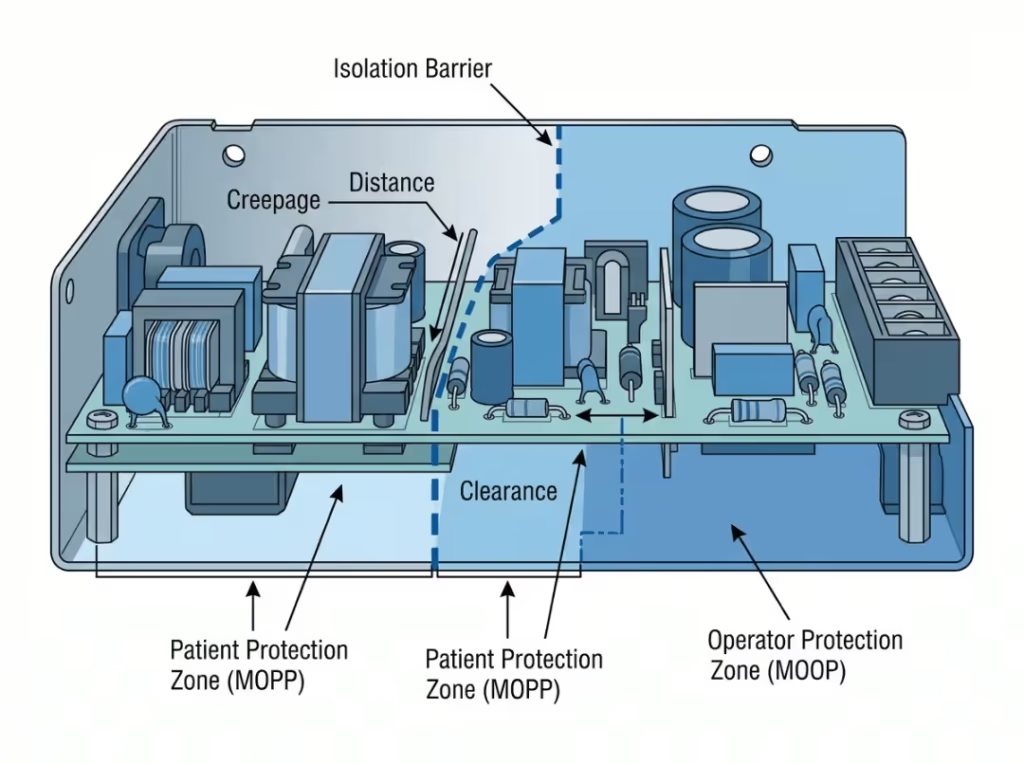
The practical consequence: a 2 × MOPP barrier needs roughly 8 mm creepage and 4000 VAC dielectric withstand, against 5 mm and 3000 VAC for 2 × MOOP. Larger barriers mean a larger supply. Many platforms are designed to 2 × MOPP precisely because it clears the bar for most applications worldwide and simplifies the certification argument. If your supply touches the patient path, specify MOPP and don’t relitigate it later. The full breakdown of these levels lives in this explainer on IEC 60601-1 safety standards for power supplies.
Why Does Leakage Current Constrain Your Options?
Leakage current is the small current that flows to ground or the enclosure under normal and single-fault conditions, and IEC 60601 caps it tightly — especially near the patient. This limit narrows your candidate list faster than almost any other spec.
Applied-part classification sets the ceiling. Type BF allows more leakage than Type CF, and CF — used for direct cardiac contact — is the strictest, with patient leakage often held to around 10 µA in normal condition. That constraint ripples into design choices you’d otherwise make freely: larger Y-capacitors improve EMI performance but raise leakage, so a supply tuned for a CF application has to balance the two. If your device is CF-rated, confirm the supply’s leakage figures against your applied-part class before anything else, because a supply that’s fine for BF can be disqualified outright for CF.
What Does Pre-Certification Actually Cover?
A supply pre-certified to IEC 60601-1 and IEC 60601-1-2 removes a large block of test risk — but it certifies the supply, not your finished device. This is the single most misread point in medical power, so be precise about it.
Pre-approval means the isolation, creepage, clearance, and EMC performance of the supply itself have been demonstrated. It does not mean your end product passes. Your enclosure, grounding scheme, cable routing, and layout all affect final safety and EMC results, and the complete device still needs its own testing. What you gain is a known-good starting point and far fewer surprises during EMC — treat it as a head start, not a finish line, and engage your test lab early regardless.
Which Medical Devices Benefit Most From Modular Power?
Modular power fits equipment that needs several isolated rails and rigorous compliance without high volume — but the reason each device type benefits differs, and that shapes how you spec the supply.
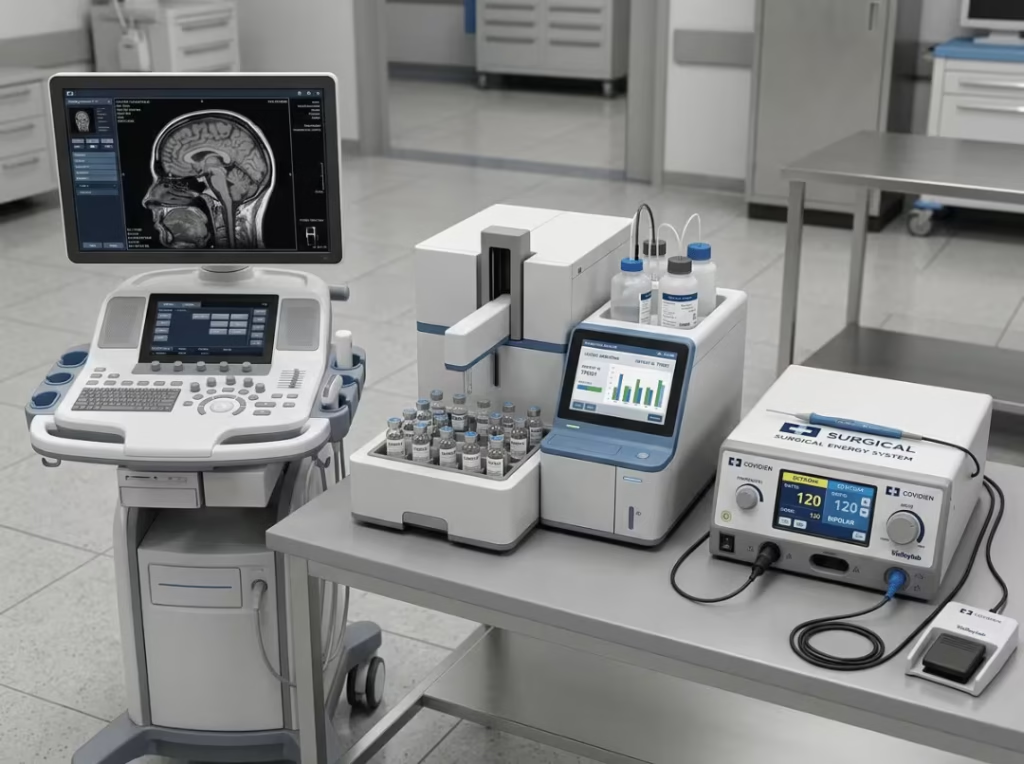
Imaging Systems (MRI, CT): Why Output Count and EMC Margin Dominate
Imaging systems benefit from modular power because they run many isolated rails at high total power in an electrically hostile environment. A single subsystem might need logic rails, gradient and control electronics, and sensor supplies at once, spanning roughly 600 W to 3000 W or more.
Two things drive the spec here. First, output count — you need enough isolated modules to feed every rail without cross-coupling. Second, EMC margin: gradient switching and RF generate significant interference, so a supply with comfortable emissions and immunity headroom keeps you off the edge during 60601-1-2 testing. High efficiency matters too, because every wasted watt becomes heat you have to remove from a dense cabinet.
Diagnostic and Lab Equipment: Why Low Noise and Fanless Design Matter More
Diagnostic and life-science instruments benefit because they pair multi-rail needs with sensitivity to noise and vibration, usually at moderate power — roughly 200 W to 1000 W. Here the priorities invert relative to imaging.
Measurement front-ends and optics are sensitive to both electrical noise and mechanical vibration, so low-ripple rails and, where the power budget allows, fanless operation carry real weight. Fanless design removes an acoustic and vibration source sitting next to precision sensors, and it eliminates a moving part that can fail or draw in dust. Adjustable outputs help too, because specialized sensors often want non-standard voltages.
Surgical and Laser Systems: Why Power Density and Control Visibility Become Critical
Surgical generators and medical lasers benefit because they demand well-regulated, higher-power rails in a controlled thermal envelope, typically 300 W to 3000 W depending on the modality. Regulation and thermal management move to the front of the queue.
Lasers need tight regulation on high-voltage, high-current rails, and electrosurgical systems need clean isolated power with strong immunity and tightly controlled leakage for patient safety. At these power levels a variable-speed fan is often the more reliable choice than fanless, and PMBus telemetry earns its place — real-time visibility into rail health during continuous clinical use lets you catch degradation before it becomes downtime.
How Do You Spec a Modular Medical PSU?
Match the supply to your electrical, thermal, mechanical, and regulatory needs at once — optimizing one axis while ignoring the others is how programs end up with a supply that passes on the bench and fails in the cabinet. Work through these before you shortlist.
Outputs and voltage range. Map every rail, confirm the platform supports that many isolated outputs across your voltage span, and leave one module slot of headroom. A rail you didn’t anticipate should cost you a module swap, not a redesign. Leading platforms support a dozen or more isolated outputs from roughly 2.5 V to 200 V.
Power and efficiency. Size the chassis to peak system load with margin. High efficiency — often up to about 93% — reduces the heat you have to manage and is what makes fanless operation viable at meaningful power.
Thermal management. Fanless improves reliability and removes acoustic noise, which suits lower-power or noise-sensitive equipment. Fan-cooled with variable-speed control handles higher power in a smaller volume. Choose on power level and environment, not preference — fanless is not automatically better.
Size and form factor. Medical enclosures are tight, and stricter MOPP isolation increases size, so check footprint and height against your MOPP requirement rather than against the datasheet’s smallest configuration.
Digital control. PMBus and a GUI let you monitor and adjust the supply through development and in the field. This is where you catch thin margins early.
Reliability. Check MTBF and, more importantly, understand how it relates to service life — the two are not interchangeable, and confusing them leads to bad maintenance assumptions. This breakdown of MTBF vs lifetime in power supplies is worth reading before you treat a high MTBF figure as a longevity guarantee.
Global certifications. Confirm the supply carries approvals for every region you’ll sell into. A platform with broad global coverage saves you a region-specific redesign later.
Where Modular Power Gets Misjudged
A few assumptions lead teams to the wrong supply. Worth clearing up.
Modular does not mean weaker performance — modern platforms deliver high efficiency, tight regulation, and high power density; the modularity is in packaging and configuration, not in the electrical design. Pre-approved modules do not make your system compliant on their own, as covered above. Fanless is not always the better call — above a certain power density in a small volume, a variable-speed fan is the more reliable option. And custom is not always more expensive; at high enough volume, amortized NRE can undercut modular on per-unit cost. The decision always comes back to volume, output complexity, and physical constraints, not rules of thumb.
FAQ
Is a modular power supply cheaper than a custom one?
Usually, at low-to-medium volume. Modular avoids the high NRE, tooling, and full-certification cost of a custom build, so total cost of ownership tends to be lower once you count engineering and test time. Custom wins on per-unit price only at high volume, where the upfront investment spreads across enough units to amortize down.
Does every medical power supply need IEC 60601 approval?
Yes, if the supply is part of a medical electrical device used in a patient or operator environment. The standard sets minimum isolation, creepage, clearance, and leakage current requirements. Choosing a supply already certified to IEC 60601 greatly simplifies your end-system compliance, though it never replaces device-level testing.
When should I choose a fully custom solution instead?
Choose custom when volume is high enough that amortized NRE drops below the modular per-unit premium, or when size, weight, or an unusual output profile leaves no configurable platform that fits. Custom justifies its NRE and longer schedule only when per-unit savings or unique requirements clearly outweigh the added certification risk.
How can I shorten certification timelines?
Start with a supply already certified to IEC 60601-1 and IEC 60601-1-2 to remove a large test block and reduce EMC surprises. Then design your enclosure, grounding, and layout carefully, and engage your test lab early so end-system testing runs cleanly instead of triggering redesign loops.
What’s the difference between MOPP and MOOP?
MOPP (Means of Patient Protection) protects the patient and is the stricter level, requiring larger creepage and clearance and higher dielectric withstand. MOOP (Means of Operator Protection) protects the operator and allows looser limits. Specify MOPP whenever the supply sits in the patient-contact path.
Getting the Decision Right
Choose modular when you need multiple isolated outputs, IEC 60601 compliance, and a fast, low-risk path to market at low-to-medium volume. Reserve custom for high volume or extreme size and cost targets, and use standard supplies only for simple, non-critical rails. And whichever path you take, remember that pre-certified power is a head start on compliance — never a substitute for testing your finished device.
If you’re specifying a supply now, the fastest way to de-risk the decision is to fix three things early: your MOPP level, your leakage-current ceiling by applied-part class, and your peak load with headroom. Get those right, and the shortlist narrows itself. Talk to a power engineer about your rail map if you want a second set of eyes before you commit.