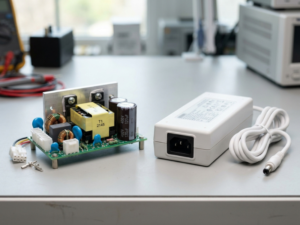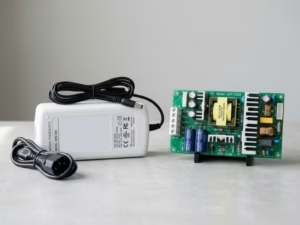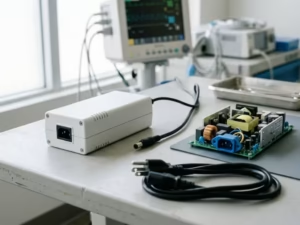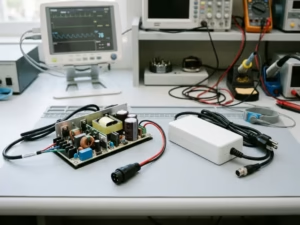
Introduction — Understanding DC 5V Voltage & DC Output
A DC 5V charger refers to a power device that outputs 5 volts of direct current (DC), commonly used to charge or power today’s electronic devices. Unlike alternating current (AC), which periodically changes direction, DC provides a constant voltage level, and 5V DC has become a de facto standard for USB power delivery because most portable electronics are designed to operate at this voltage.
When checking a charger for compatibility with your device, the first thing to confirm is that the output specification clearly indicates “5V DC”, often labeled on the charger itself or its packaging.

Charger Output Requirements
Voltage (5V) and Current Ratings (mA/A)
For a charger to be compatible with a device, the voltage must match exactly (i.e., 5V DC). The current rating (in amperes, A) indicates the maximum current the charger can supply — the device will draw only what it needs. If the charger’s current rating is less than the device’s requirement, charging can be slow or may fail entirely. Conversely, using a charger with equal or higher current rating than required is generally safe.
For example:
A charger rated at 5V/1A can supply up to 1 amp of current.
A charger rated at 5V/2.4A can supply up to 2.4 amps — useful for devices with higher current draw.
USB-A vs USB-C Compatibility
The physical connector also matters, but USB-A and USB-C use different mechanisms to establish power capability.
USB-A power ports commonly provide 5V DC, although the available current depends on the USB specification, charger design, and applicable charging protocol.
USB-C also uses 5V as its basic VBUS voltage. USB-C uses the CC (Configuration Channel) pins to establish the source and sink relationship and communicate the available current capability.
USB Power Delivery (USB PD) is used when supported devices need higher power levels or negotiated voltages such as 9V, 12V, 15V, or 20V. A USB-C to USB-C connection therefore does not inherently require USB PD negotiation simply to provide 5V.
For compatibility, check the device input requirements, USB-C configuration, available current, cable rating, and charging protocol rather than assuming that USB-A to USB-C is always more compatible than USB-C to USB-C.
Cable & Connector Types
Why Connector Matters (USB A, USB C)
The type of cable you use impacts whether the 5V DC output actually reaches the device correctly:
USB A to USB C cables are common and usually compatible with devices that expect simple 5V charging.
USB C to USB C cables may need power negotiation between charger and device to begin supplying power (especially if PD or multiple voltage levels are supported).
Cable Quality Impact on Charging
Cable quality can influence both charging speed and safety. Poor quality or non compliant cables may not reliably deliver the expected current, can cause voltage drops, or may even damage devices. Look for cables with certifications (CE, FCC, RoHS) and appropriate current ratings for your charger’s output.
Other practical considerations include cable length and build quality — shorter, well shielded cables tend to provide better performance.
What to Check for 5V Compatibility
| Compatibility Factor | What to Check |
|---|---|
| Voltage | 5V DC or the device’s specified input voltage range |
| Current | Charger can provide the required current |
| Connector | USB-A, USB-C, Micro-USB, DC barrel, or custom connector |
| Polarity | Required for DC barrel and other non-USB connectors |
| Cable | Current rating, length, conductor quality, and connector quality |
| Charging Protocol | USB-C Current, USB PD, USB BC, or proprietary protocol where applicable |
| Power Source | Stable and regulated output suitable for the device |
Device Power Needs
Matching Charger Output to Device Input
To ensure compatibility:
Check the device’s required input voltage and current ratings (often printed on the device or in its manual).
Confirm the charger’s output matches 5V DC and that its amperage rating meets or exceeds what the device requires.
For example, if a device expects 5V/2A, a charger rated 5V/2A or higher will work, while a 5V/1A charger may be insufficient and result in slow charging or failure to power the device.
Safety Implications of Mismatch
Using a charger with mismatched specifications can lead to problems:
Insufficient current: Slow charging or no charging.
Connector incompatibility: The device may not draw power if the connector physically doesn’t match.
Poor cable quality: Can cause overheating, voltage drop, or even safety hazards.
5V USB vs. 5V DC Barrel Power
Not all 5V DC power sources use USB connectors. A device may also use a DC barrel plug or a custom DC connector.
For USB-powered devices, compatibility typically involves voltage, current capability, connector configuration, cable rating, and charging protocol.
For DC barrel-powered devices, additional factors such as plug dimensions and polarity are critical. A 5V adapter with the wrong connector size or polarity may not work even when its voltage and current ratings appear correct.
Therefore, do not determine DC 5V compatibility from voltage alone.
| Power Connection | Key Compatibility Checks |
|---|---|
| USB-A | 5V output, current capability, USB charging standard |
| USB-C | 5V VBUS, CC configuration, current capability, USB PD if applicable |
| Micro-USB | Voltage, current, connector, cable |
| DC Barrel | Voltage, current, plug size, polarity |
| Custom DC Connector | Voltage, current, pinout, polarity |
DC 5V Charger Compatibility Examples
| Device Requirement | Power Source | Result |
|---|---|---|
| 5V / 500mA | 5V / 1A | Generally suitable |
| 5V / 1A | 5V / 2A | Generally suitable |
| 5V / 2A | 5V / 1A | Not recommended |
| 5V / 2A | 5V / 2A | Suitable |
| 5V / 2A | 5V / 3A | Generally suitable |
| 5V fixed input | 9V fixed output | Not suitable |
| 5V USB-C device | USB-C PD charger | Depends on device and charging protocol |
| 5V DC barrel device | 5V adapter with wrong polarity | Not suitable |
Common Compatibility FAQs
Can One Charger Fit Many Devices?
Yes — if the charger’s voltage is 5V DC and its connector type fits the device, it can work with multiple devices. Many USB A chargers and basic USB C chargers that default to 5V output are compatible with a wide range of devices.
However, not all USB C ports will output 5V by default without proper negotiation, so compatibility may vary with USB C connectors depending on how the device and charger handle power protocols.
What to Avoid
Using the wrong connector type (e.g., USB C to USB C without power negotiation on devices that expect USB A 5V).
Using low quality or uncertified cables/chargers, which may fail to deliver stable power or pose safety risks.
Connecting a charger with current rating lower than device needs, leading to slow charging or overload conditions.
Can I Use a 5V/2A Charger for a 5V/1A Device?
Generally, yes. A 5V/2A power source can provide up to 2A, while the device normally draws only the current it requires, subject to the applicable charging or power-delivery standard. The voltage, connector, cable, and charging requirements must still be compatible.
Can I Use a 9V Charger for a 5V Device?
Not if the charger provides a fixed 9V output. A 5V-only device should not be connected directly to a higher fixed-voltage source. Higher voltages may only be used when the device is specifically designed to accept them through an appropriate power-delivery protocol.
Conclusion
To ensure reliable DC5V compatibility:
Always verify the charger clearly states “Output: 5V DC” and meets or exceeds your device’s current requirements.
Choose cables and connectors that match your device’s port (USB A, USB C) and are rated for the intended current.
Prefer certified chargers and cables to avoid power delivery issues or safety hazards.
By understanding charger output, connector types, and device requirements, you can confidently select compatible chargers and cables that safely power your electronics.
For OEM and industrial applications, compatibility should be verified from the complete electrical specification rather than voltage alone. Quankang can provide customized power adapter solutions based on required voltage, current, connector, cable, certification, and application requirements.