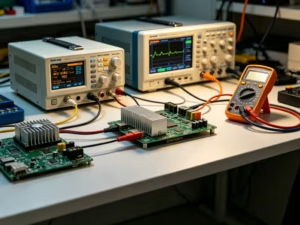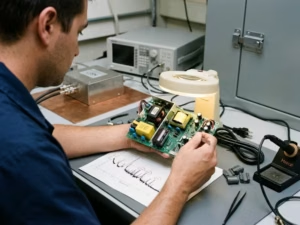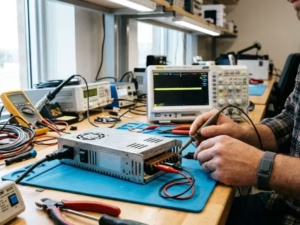
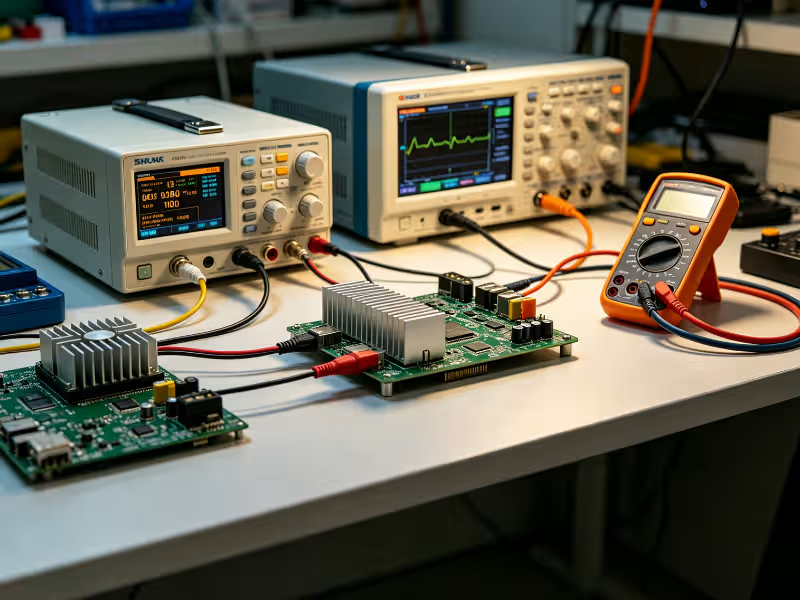
A 240 W supply passes every bench test. Eighteen months later, units start coming back from the field. The cause is hard to see on the bench: the cabinet runs at 55°C, but the supply was rated for full power only up to 50°C. Its electrolytic capacitors aged far faster than anyone planned. The fix costs a redesign, a new compliance test cycle, and some customer trust. In many systems, the power supply is the first part to fail. It is also one of the cheapest parts to get right at the start.
Avoiding that outcome comes down to five decisions, made in a sensible order: form factor, electrical specs, reliability, certifications, and application fit. Work through them below and you’ll end up with a selection process you can reuse on any project.
What Is an AC/DC Switching Power Supply?
An AC/DC switching power supply converts mains AC into a regulated DC output in four steps:
- It rectifies the AC into high-voltage DC.
- It switches that DC on and off at tens to hundreds of kilohertz.
- A small high-frequency transformer passes the energy across an isolation barrier.
- It rectifies and regulates the output.
The switching frequency is the whole point. A linear supply does the same job with a large 50/60 Hz transformer and burns off excess voltage as heat. Its output is quiet, but efficiency stays around 40–60%. Switching designs reach 85–95% in a fraction of the size. The price you pay is switching noise. A good design filters it out. A poor one passes it straight into your system, which is one reason two supplies with the same wattage can behave very differently once installed.
Common Form Factors and Where Each Fits
Before you open a single datasheet, decide on the format. Mounting space, cooling path, and enclosure design will rule out more options than any electrical spec.
Enclosed Power Supplies
A perforated metal case makes these supplies touch-safe and easy to bolt to a chassis plate. That’s why they are the usual choice for industrial machines, kiosks, and test equipment, where the supply sits inside a larger cabinet.
Open-Frame Power Supplies
Here the PCB is exposed, so your enclosure has to provide the protection. You save space and cost. In return, airflow and safety clearances become your problem, not the supplier’s. Open-frame units show up often in medical devices, displays, and OEM equipment.
DIN-Rail Power Supplies
These clip onto standard 35 mm rails in control panels, and many are rated from -25°C to +70°C. Pair two of them with a redundancy module and they run in parallel. If one fails, the PLC or production line keeps going.
Board-Mount and External Adapters
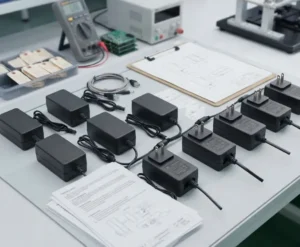
Board-mount modules solder directly onto your PCB and suit compact embedded designs under about 60 W. External adapters take a different approach. Products such as desktop and wall-mount ITE power supplies keep mains voltage and much of the heat outside your product. That can greatly simplify your own safety certification, which often matters more than the adapter’s price.
Key Electrical Specifications to Verify
Once the format is settled, the datasheet becomes easier to read. Sort it into three groups: input, output, and power quality. Then check every value against worst-case conditions: lowest line voltage, highest temperature, and peak load. Typical values describe a good day. Your design has to survive a bad one.
Input Voltage Range and Power Factor
Universal input (85–264 VAC, 47–63 Hz) lets one part number ship to every major market. It also buys margin during brownouts, when a 100 VAC line can sag below 90 V. Fixed-range supplies cost less, but they tie you to one region.
Power factor correction is the next check, and it’s easy to miss. IEC 61000-3-2 sets harmonic current limits that apply above 75 W input for most equipment classes, with a lower threshold for lighting. In practice, most designs above 75 W sold into the EU use active PFC to meet those limits. If you skip this now, adding it later means choosing a new supply.
Output Voltage, Current, and Power Headroom
Undersizing is the most common selection error, and the math to prevent it is simple. Add up the continuous load on every rail. Then pick a supply where that total sits at 70–80% of rated power. A 200 W load calls for a 250–300 W supply. That headroom lowers internal temperature and leaves room for the features your team will add in the next revision.
Averages only tell half the story. Motors, solenoids, and large capacitor banks can draw several times their running current at startup. When those peaks last only a few seconds, a supply with a peak-power rating (for example, 150% for 3 seconds) costs less than oversizing the whole unit.
Multiple voltages raise a different question. A multi-output supply saves parts, but cross-regulation becomes an issue: when the loads on different rails are uneven, voltages can drift. A single-output supply feeding point-of-load DC/DC converters gives you tighter control at each rail.
Ripple, Noise, and Regulation
Ripple and noise are listed in mVp-p, and the number means little without context. Always confirm the measurement bandwidth, which is usually 20 MHz. A figure measured at a narrower bandwidth looks better than it really is. General-purpose units typically land around 1% of output voltage. ADCs, RF circuits, sensors, and medical measurement are less forgiving. They often need 50 mVp-p or less, plus line and load regulation within ±0.5–1%.
Reliability Factors That Determine Service Life
A supply that meets every spec on day one can still fail in year two. The usual culprit is heat. Efficiency decides how much heat the supply produces, derating decides how much it can tolerate, and protection decides what happens when either limit is crossed.
Efficiency and Thermal Derating
Every lost watt turns into heat inside your enclosure. A 300 W supply at 88% efficiency dissipates about 41 W. At 94%, it dissipates about 19 W. That gap alone can decide whether you need a fan.
This is where the field failure in the opening example began. Read the derating curve against the air temperature around the supply, not the room temperature. A unit rated for full power to 50°C may deliver only 50% at 70°C, and inside a sealed cabinet, local air often runs 15–20°C above ambient.
Temperature also sets component life. Electrolytic capacitor life roughly doubles for every 10°C drop. Convection cooling removes the fan as a wear part. Forced air delivers more power per cubic inch, but it brings filters and maintenance with it.
How to Read MTBF Figures
MTBF is a prediction, not a measurement. The result depends on the standard used, such as Telcordia SR-332 or MIL-HDBK-217F, and on the assumed temperature and load. Change those inputs and the same supply can show figures that differ several-fold.
So compare MTBF only when the standard, temperature, and load match. Also keep in mind that MTBF isn’t lifetime. A 500,000-hour MTBF does not mean 57 years of service. For a realistic picture, check capacitor lifetime data and warranty length alongside it.
Built-In Protection Features
Even a well-sized, well-cooled supply will eventually see a fault. What matters is how it responds. A reliable supply should include:
- Overvoltage protection (OVP): Caps the output if regulation fails, protecting downstream ICs.
- Overcurrent and short-circuit protection: Limits current so a wiring fault doesn’t turn into a fire.
- Overtemperature protection (OTP): Shuts down before components exceed safe limits.
Recovery behavior deserves equal attention. Hiccup mode retries automatically after a fault, while latch-off mode stays off until power is cycled, which is safer for some loads. Hold-up time, typically 10–20 ms, decides whether your system rides through a brief dropout or resets.
Safety Certifications and Compliance
Everything so far has been engineering judgment. Certification is different: it’s a gate, not a preference. A supply without the right approval for your industry can stop your entire product from shipping.
- IEC/UL 62368-1: IT, audio/video, and communications equipment. It replaced IEC 60950-1.
- IEC 60601-1: Medical electrical equipment. Patient-contact designs need 2×MOPP isolation and tight leakage current limits, which is why medical-grade power supplies are designed to this standard from the start.
- IEC 61010-1: Laboratory, test, and measurement equipment.
- Regional marks: CE for the EU, UKCA for Great Britain, and CCC for China.
EMC adds one more layer. Class B limits cover residential environments and are stricter than Class A limits for industrial sites. A pre-certified supply with a full CB report can cut weeks from your end-product approval.
Matching the Power Supply to Your Application
Each of the criteria above carries a different weight depending on where the supply ends up. This table is a starting profile, not a final answer:
Application | Top Priorities | Typical Form Factor | Key Certification |
|---|---|---|---|
Industrial automation | Wide temperature range, peak power, redundancy | DIN-rail | IEC/UL 62368-1 or 61010-1 |
Medical | Low leakage current, 2×MOPP isolation, low noise | Open-frame or enclosed | IEC 60601-1 |
LED lighting and signage | Constant current or voltage, IP rating, PFC | Enclosed, potted | IEC 61347, UL 8750 |
Telecom/IT | High efficiency, hot-swap, N+1 redundancy | Enclosed or front-end modules | IEC/UL 62368-1 |
Some systems don’t fit neatly into one row. Take a diagnostic device used on a factory floor. The safe approach is to meet the stricter requirement on every line of the table. Downgrading later costs less than upgrading.
Common Selection Mistakes to Avoid
Most field failures trace back to a short list of shortcuts:
- Sizing to the nameplate rating. A supply running at 100% load runs hot and ages fast.
- Ignoring derating at enclosure temperature. Full power on the bench can mean half power in the cabinet.
- Comparing MTBF across different standards. The higher number may only reflect a more generous calculation.
- Overlooking inrush current. Motor and capacitive loads can trip protection at every startup.
- Choosing the wrong certification. A 62368-1 supply won’t pass in a patient-contact medical device.
- Buying on unit price. A $5 saving disappears with one field return or recertification.
None of these is new information if you’ve read this far. That’s the point. Run through the list one last time before you sign off on a part.
Final Thoughts: Building a Reliable Power Foundation
Order matters more than most teams expect. Define the application first, then confirm the required certification, choose the form factor, verify electrical specs at worst case, and finish with thermal performance and reliability data. Each step removes options before the next one begins, so you end up comparing fewer parts with more confidence.
Before you commit, ask your supplier for three documents: the derating curve, the MTBF calculation basis, and the safety test reports. How quickly a supplier produces all three tells you a lot about how they’ll support you after the order. If you’d like help applying these steps to a specific design, Quankang’s engineers can match a power supply to your application.