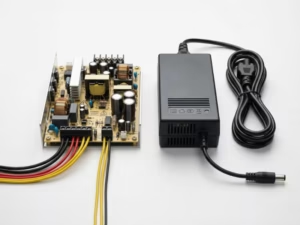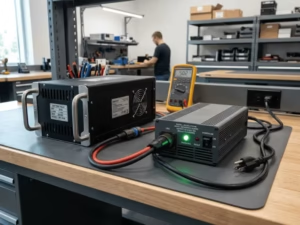
ITE stands for Information Technology Equipment — a defined class of electronic equipment built to process, store, transmit, or display data. The category isn’t a marketing label. It’s a safety and compliance classification that strongly influences which standard governs your product, which certification marks it needs, and which power supply is legally and technically appropriate.
That matters more than it sounds. Pick a power supply certified for the wrong category and you inherit a compliance gap, a failed market-entry review, or an over-specified unit that quietly inflates your BOM. This guide defines ITE precisely, gives you recognizable examples, draws the boundaries against medical, household, and industrial equipment, and connects the whole thing to power-supply selection. As a manufacturer of AC-DC adapters and power supplies, Quankang sees these classification decisions shape product programs every week.
What ITE (Information Technology Equipment) Actually Means
An ITE device is equipment whose primary job is handling information — processing, storing, transmitting, or displaying data. That functional definition is the anchor. A server processes data. A switch transmits it. A monitor displays it. All three are ITE because information handling is what they do.
Two things together tend to define equipment as “ITE”: its function and its operating environment. The function is data handling. The environment is typically dry, indoor, and operator-accessible — an office, a data center, a retail counter, a home desk. In most standard commercial cases, equipment designed to sit in those conditions and move information around falls squarely in the ITE class. This definition works well as a starting point, but final classification still depends on intended use and the standards that govern the finished product.
Historically, ITE safety was governed by IEC/EN 60950-1. That standard has been withdrawn and replaced by IEC 62368-1, which now covers both information technology equipment and audio/video equipment under one hazard-based framework. The key point for a buyer or engineer: “ITE” is a regulatory classification tied to what the equipment does and where it operates — not to its brand, size, or how modern it looks. That classification generally shapes your compliance path, so getting it right usually comes before any power decision.
Common Examples of ITE Devices
The category becomes concrete once you see it grouped by function. Each cluster below typically qualifies as ITE for the same reason: it handles information and is built for indoor, operator-accessible use.
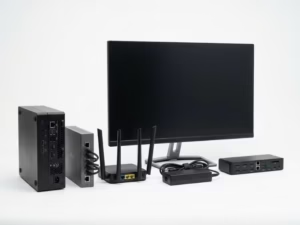
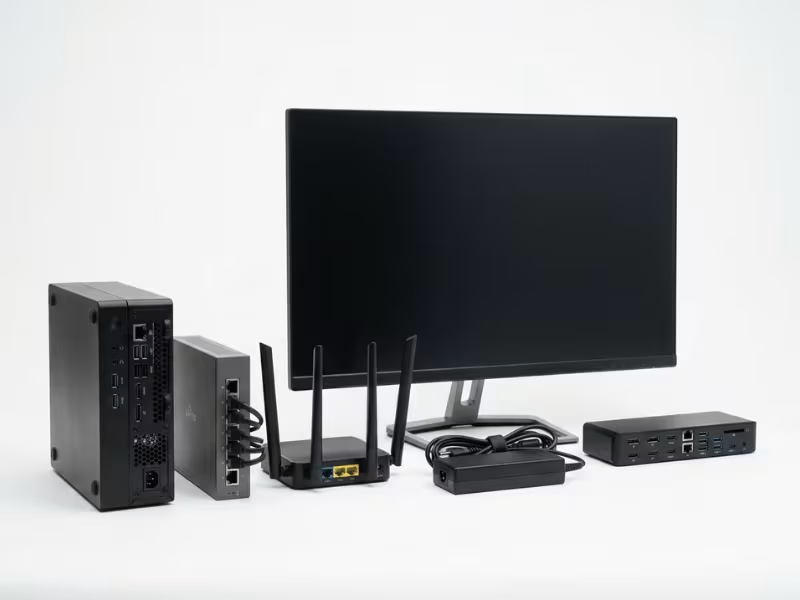
- Computing equipment — desktops, laptops, servers, workstations, and thin clients. These are among the clearest ITE devices, since data processing is their entire purpose and they live in offices and data centers.
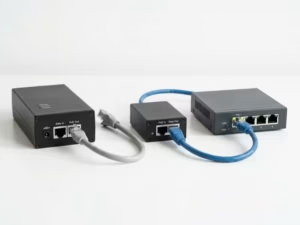
- Networking equipment — routers, switches, wireless access points, modems, and gateways. They generally qualify because their job is transmitting and routing data, typically from a rack, wall, or desk in a controlled indoor space.
- Data storage devices — network-attached storage (NAS), external drives, and storage arrays. Storing and retrieving information is their defining function, which usually places them in the ITE class.
- Peripherals — monitors, printers, scanners, docking stations, and keyboards with active electronics. These support data input, output, and display, and they share the same indoor, operator-accessible environment as the systems they connect to.
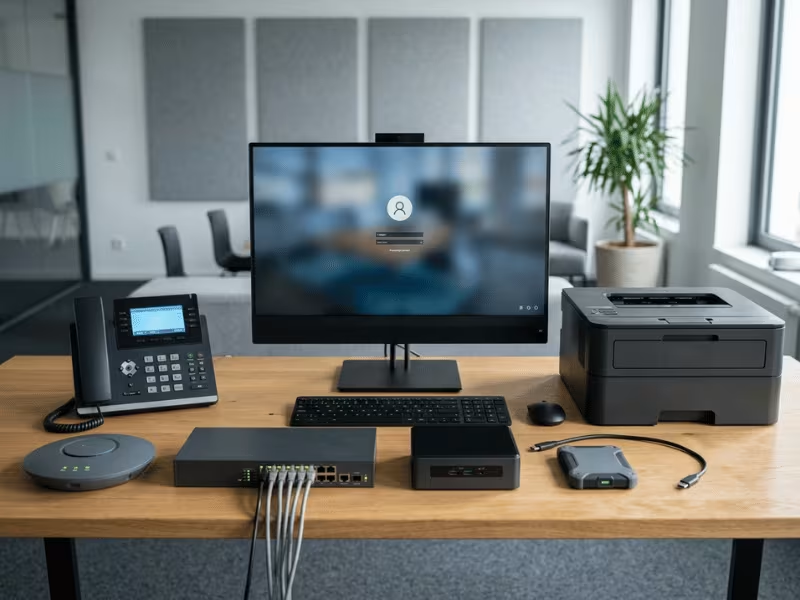
- Telecom and office equipment — IP phones, POS terminals, and multifunction office machines. They process and communicate data in commercial indoor settings, which fits the typical ITE profile.
The pattern holds across every cluster: information handling plus a dry, operator-accessible environment. When you can name both traits for a device, you have a strong starting point for classifying it — and that classification points toward the power supply and standard it is likely to need.
Where the ITE Boundary Ends: Edge Cases and Convergence
Modern equipment rarely stays in one lane, which is where classification gets genuinely tricky. Many products carry ITE-style electronics but serve an end use that changes the governing rules.
Take a patient monitor with built-in networking. Internally it looks a lot like ITE, but its intended use — connection to a patient — tends to pull it under medical device standards rather than ITE. Or consider an industrial PC bolted to a factory floor: the electronics resemble a standard computer, yet the harsh operating environment often shifts the relevant requirements. A smart display sits in a third grey zone, blending AV and ITE functions — which is precisely why IEC 62368-1 merged the two former standards into one.
So how do you decide? Three factors usually settle it: intended use, operating environment, and primary function. A device’s internal components rarely determine its category on their own — its purpose and where it operates carry more weight. When a product serves a regulated end use, such as medical or heavy industrial applications, that end-use standard typically overrides the ITE classification, and the power supply usually needs to follow suit.
The practical rule: before you spec power, confirm which category actually governs the finished product. Assuming “it has a circuit board, so it’s ITE” is how compliance problems start.
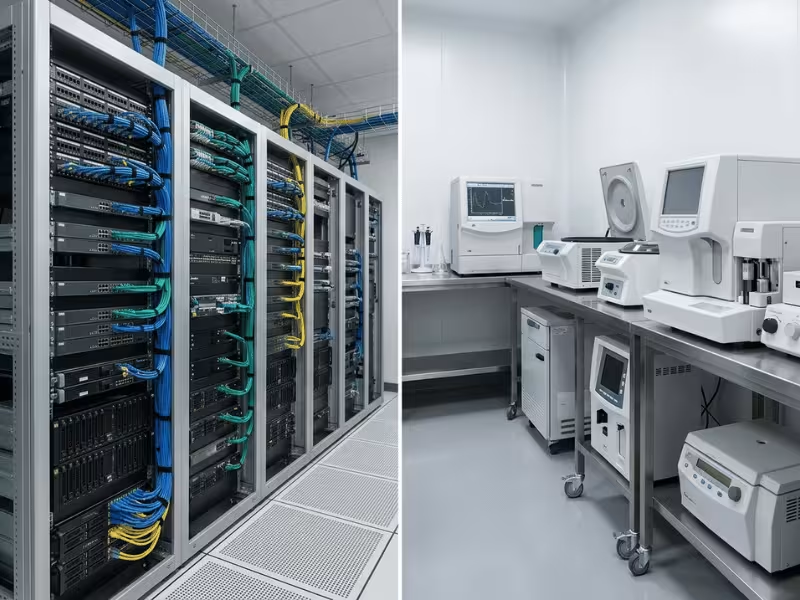
ITE vs. Medical, Household, and Industrial Equipment
Buyers most often confuse ITE with three adjacent classes. Each tends to carry a different governing standard, a different operating environment, a different safety priority — and, often, a different power-supply pedigree.
Comparison Table: ITE vs. Adjacent Equipment Categories
The standards below are broad directional references rather than an exhaustive classification map, since final requirements depend on the finished product and its application.
Category | Typical governing standard context | Typical operating environment | Primary safety concern | Power-supply implication |
|---|---|---|---|---|
ITE | IEC 62368-1 | Indoor, dry, operator-accessible | Energy-source hazards to operators | ITE-rated supply, CE/UL, standard indoor conditions |
Medical | IEC 60601-1 | Clinical / patient-connected | Patient and operator protection | Tight leakage limits, MOPP/MOOP isolation |
Household appliance | IEC 60335 family | General consumer / domestic | Consumer-use hazards, misuse tolerance | Appliance-rated supply, different hazard focus |
Industrial | IEC 61010 / 60204-type | Harsh, dusty, wide temperature | Robustness, fault tolerance | Rugged supply, wide input, higher IP protection |
How to read this: the category on the left generally drives the standard context in the second column, which in turn tends to shape the power supply in the final column. As a rule of thumb, you shouldn’t lift a medical-grade supply into an ITE product and assume it’s automatically more appropriate, and you shouldn’t drop a standard ITE adapter into an industrial enclosure and expect it to survive. Match the supply’s pedigree to the device’s actual category, not to a general sense of quality.
Why the ITE Classification Matters for Power Supply Selection
Here is the chain that makes this whole topic practical: category → standard → certification → power supply. Once a device is classified as ITE, it generally needs a power supply certified to IEC 62368-1, carrying the marks its target markets require.
Mismatches tend to cost money in both directions. Fit a medical-rated supply into an ITE product and you often pay for isolation and leakage performance the device never needs — dead weight in your BOM. Fit a household-appliance supply into an ITE device and you may create a compliance gap, because the supply was tested against a different hazard model. Either way, the finished product’s certification scope can suffer.
The classification also points to the certification marks that unlock markets. CE conformity is generally required for the EU/EEA. UL or cUL listing addresses North American safety. An ITE product bound for both markets typically needs a supply that carries both, tested to the right standard. Skip this and your product can stall at the border, not the lab.
Finally, “ITE” signals the operating conditions the supply usually needs to meet: indoor use, a defined ambient temperature range, and operator accessibility. A compliant ITE supply is engineered for those conditions — which is why using one well outside its intended environment tends to invite failure.
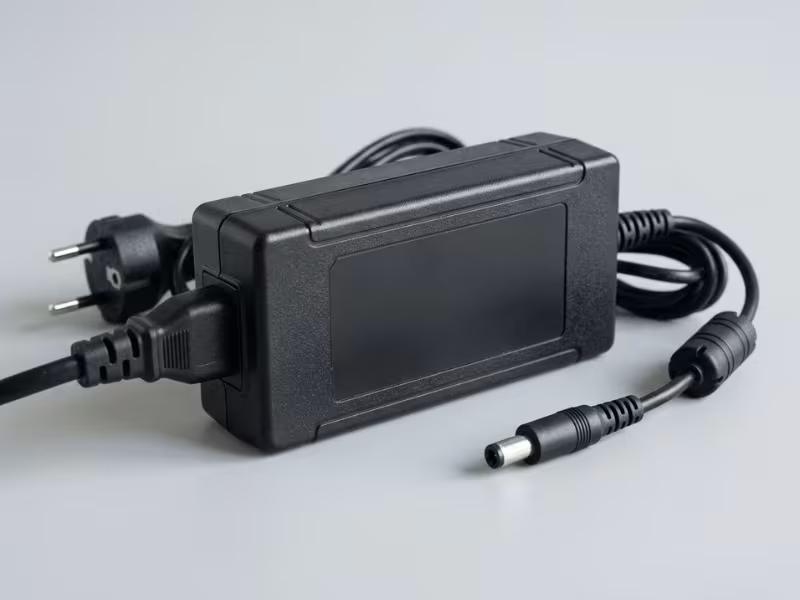
Certification and Compliance: IEC 62368-1, CE, and UL
A buyer doesn’t need to memorize clause numbers, but should understand what each standard and mark does — enough to verify a supplier’s claim.
IEC 62368-1 is the current global safety standard for ITE and AV equipment. It replaced the older IEC 60950-1 with a hazard-based approach that classifies energy sources and the protection between them and the user. When a supplier says a product is “ITE-compliant,” this is generally the standard that should back the claim. Verify the edition tested, since editions evolve and some markets require the latest.
CE marking indicates conformity with EU/EEA requirements. It’s a declaration that the product meets the applicable directives, including safety. For an ITE power supply headed to Europe, CE is usually the entry ticket — but confirm it covers the relevant safety standard and isn’t a bare, unsupported logo.
UL and cUL listing address safety for the United States and Canada respectively. North American buyers and many procurement teams treat a genuine UL listing as a baseline requirement.
One caution on top of all three: national deviations and edition differences can affect where a product can legally ship. A supply certified for one market may need additional approvals for another. Before you commit, verify the standard edition and the specific marks against every target market — not just your primary one.
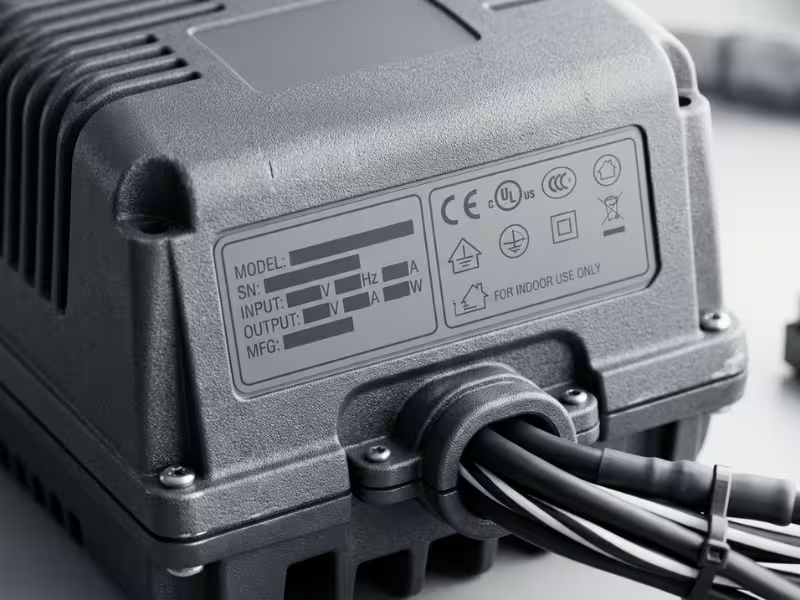
How to Choose an ITE Power Supply or Adapter
Turn the classification logic into a repeatable selection process. Work through these steps before requesting quotes:
- Confirm the device is genuinely ITE for your use case. Apply the intended-use-plus-environment test. If a regulated end use governs, you may need a different category of supply entirely.
- Match the electrical spec. Confirm output voltage, continuous current, and connector type against the device, sizing to real demand with headroom rather than the theoretical maximum alone.
- Verify IEC 62368-1 compliance. Check the standard edition and confirm the supply carries CE and UL/cUL as required for your target markets.
- Check operating conditions. Confirm the ambient temperature range and any efficiency requirements. Depending on your target market, energy-efficiency rules such as DoE Level VI or CoC Tier 2 may also apply, so it’s worth confirming which ones are relevant early.
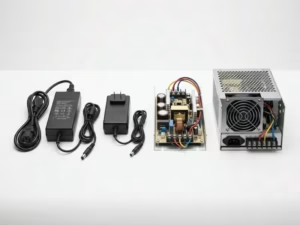
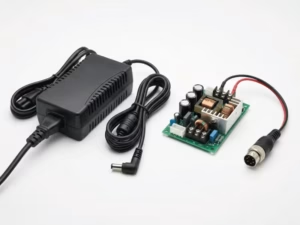
- Choose external adapter vs. embedded supply. Decide by form factor, thermal budget, and serviceability: external often suits easy replacement and a simpler certification scope, while embedded tends to fit tighter integration and higher power.
- Decide standard vs. custom. Let volume and fit make the call — catalog units for speed and cost, custom or modified-standard designs when the mechanical, thermal, or connector fit has to be exact.
Quankang manufactures ITE-compliant AC-DC adapters and power supplies on an OEM/ODM basis, with engineering support to match electrical spec, IEC 62368-1 certification, and the CE and UL marks your target markets require — so the supply fits your device, your compliance path, and your regions without paying for capability you don’t need.
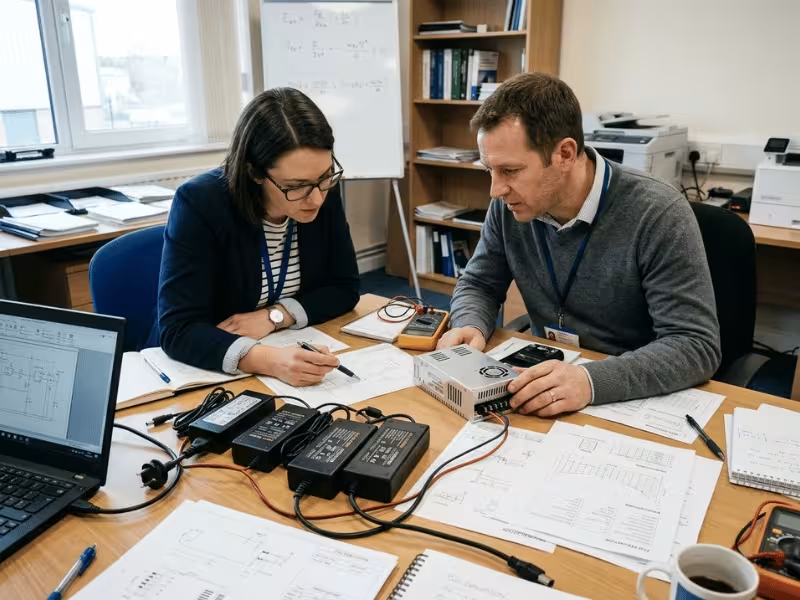
Common Misunderstandings About ITE Equipment
A handful of recurring errors often lead directly to wrong power-supply or compliance choices. Clear these up early:
- “ITE just means computers.” It covers far more — networking gear, storage, peripherals, and telecom equipment typically qualify too. Scoping ITE to desktops alone leads buyers to misclassify half their product line.
- “Any CE-marked adapter works.” The mark should cover the correct standard and be genuine. A CE logo that doesn’t reference IEC 62368-1, or that isn’t backed by real testing, offers little real compliance protection.
- “ITE and medical supplies are interchangeable.” They generally are not. Medical supplies meet far tighter leakage limits and different isolation requirements under IEC 60601-1. Swapping them in either direction tends to create cost or compliance problems.
- “IEC 62368-1 is optional.” It’s the current requirement, having replaced 60950-1. Specifying against the withdrawn standard risks rejection at certification.
- “The category is decided by the device’s internals.” Intended use and operating environment usually decide it — not the circuit board inside. Two devices with similar electronics can fall into different categories based on how and where they’re used.
Each correction points to the same discipline: classify by function and environment first, then verify the standard and marks before trusting any supply.
FAQ: ITE Devices and Power Supplies
What does ITE stand for?
ITE stands for Information Technology Equipment — a class of electronic equipment that processes, stores, transmits, or displays data, typically in indoor, operator-accessible environments. It’s a safety and regulatory classification governed today by IEC 62368-1.
Is a laptop charger an ITE power supply?
In most cases, yes. A laptop is a clear ITE device, and its charger is typically an ITE-rated power supply certified to IEC 62368-1, carrying the CE and UL/cUL marks for the markets where the laptop is sold.
What standard applies to ITE equipment today?
IEC 62368-1 is the current global safety standard for ITE and AV equipment. It replaced the older IEC 60950-1, using a hazard-based approach to classify energy sources and the protection between them and the user.
What’s the difference between an ITE and a medical power supply?
A medical power supply meets IEC 60601-1, with far tighter leakage-current limits and stricter isolation to protect patients. An ITE supply meets IEC 62368-1 for indoor, operator-accessible use. The two generally aren’t interchangeable — medical requirements are stricter and target a different risk.
Do ITE power supplies need CE and UL?
It depends on the market. CE is generally required for the EU/EEA, and UL or cUL addresses the US and Canada. A supply headed to multiple regions should carry the marks each region requires, tested to the correct standard edition.
Can I use an ITE adapter for an industrial or outdoor device?
Usually not without checking. ITE adapters are engineered for indoor, defined-temperature conditions. Industrial or outdoor equipment often needs a rugged supply with wider input tolerance and higher ingress protection, governed by a different standard.
Key Takeaways and Next Step
- ITE means Information Technology Equipment — defined by its data-handling function and typical indoor, operator-accessible environment, not by brand or size.
- The category strongly influences the governing standard (IEC 62368-1) and the certification marks (CE, UL/cUL) your product is likely to need.
- Classification usually turns on intended use and environment — not on the device’s internal electronics.
- The category shapes which power supply and compliance path apply, so an ITE device generally needs an ITE-rated supply rather than a medical, household, or industrial one.
- Match the supply to the device’s spec, operating conditions, and target markets before you commit — never assume any adapter fits.
Classifying a device correctly is the first step in specifying safe, compliant, cost-appropriate power. To match an ITE-compliant AC-DC adapter or power supply to your device’s spec, certification path, and target markets, explore Quankang’s power products or contact us for OEM/ODM support.