WiFi access points (APs) are widely used in enterprise networks, commercial buildings, schools, hotels, hospitals, warehouses, and industrial facilities. As wireless networks become more demanding, selecting a suitable power solution for each access point is an increasingly important part of network infrastructure design.
Power over Ethernet (PoE) allows network devices to receive electrical power and network data through a single Ethernet cable. This simplifies installation, reduces the need for dedicated power outlets, and makes it easier to deploy access points in locations such as ceilings, corridors, and large commercial spaces.
However, choosing a PoE power supply for a WiFi access point requires more than matching a wattage rating or identifying the WiFi generation.
Different access points may have significantly different power requirements, even when they support the same WiFi standard. Radio configurations, Ethernet interfaces, USB ports, operating modes, and additional features can all affect power consumption.
For network equipment engineers, system integrators, and OEM/ODM manufacturers, the key question is:
How do you select a PoE power solution that meets the access point’s actual power requirements while supporting reliable operation and the intended network architecture?
This guide explains how to evaluate WiFi AP power requirements, understand IEEE PoE standards, calculate power budgets, and identify important factors when selecting a PoE power solution for network equipment.
What PoE Power Supply Does a WiFi Access Point Need?
The appropriate PoE power solution depends on the access point’s electrical specifications, required power delivery method, and network architecture.
Some lower-power access points can operate with IEEE 802.3af PoE, while many enterprise access points require IEEE 802.3at PoE+. Higher-performance models may require IEEE 802.3bt, depending on their hardware configuration and power requirements.
However, WiFi generation alone does not determine the required PoE standard or power level.
Before selecting a power solution, engineers should review the access point’s technical documentation and confirm the following specifications:
| Parameter | Why It Matters |
| Maximum power consumption | Establishes the upper operating power requirement |
| Required PoE standard | Determines compatibility with the power sourcing equipment |
| PoE power class | Helps identify the device’s power classification |
| PoE input requirements | Defines the required power delivery method |
| Ethernet interface speed | Ensures compatibility with the network architecture |
| USB and auxiliary power requirements | Identifies additional power loads |
| Number of radios | Helps assess the device’s overall power requirements |
| Operating temperature | Influences system reliability and thermal design |
| Cable length | Affects power delivery and voltage drop |
| Installation environment | Determines environmental and protection requirements |
Maximum Power vs. Typical Power Consumption
An access point’s power consumption may vary depending on its operating conditions.
For example, power demand may change when:
- Multiple radios are active.
- Wireless traffic increases.
- Transmit power changes.
- USB or auxiliary interfaces are in use.
- Additional IoT functions are enabled.
- The device operates in a high-performance mode.
Typical power consumption helps engineers understand normal operating conditions and energy use.
Maximum power consumption is more relevant when evaluating whether the power delivery system can support the access point under its specified operating conditions.
However, the maximum figure must be interpreted correctly. Engineers should determine whether the published value represents:
- Power consumed by the AP itself.
- Maximum power drawn from the PoE input.
- Power supplied by the PSE.
- A particular operating mode or hardware configuration.
These values are not necessarily interchangeable.
Quick Reference: Matching AP Requirements with a PoE Solution
The following table provides a preliminary selection framework rather than a universal power specification.
| Access Point Configuration | Key Power Considerations |
| Basic indoor AP | Verify maximum power consumption and 802.3af/at compatibility |
| Enterprise WiFi 6 AP | Check the required PoE standard, power class, and maximum input power |
| Tri-radio WiFi 6E AP | Evaluate the complete radio configuration and maximum power requirement |
| High-performance WiFi 7 AP | Verify whether 802.3at or 802.3bt is required |
| AP with USB or IoT modules | Confirm whether auxiliary power consumption is included in the published rating |
| Outdoor AP | Evaluate power requirements together with temperature, surge, and environmental conditions |
The most reliable approach is to match the power solution to the specific AP model and its documented requirements rather than relying on general assumptions about its WiFi generation.
How to Match PoE Standards with WiFi Access Points
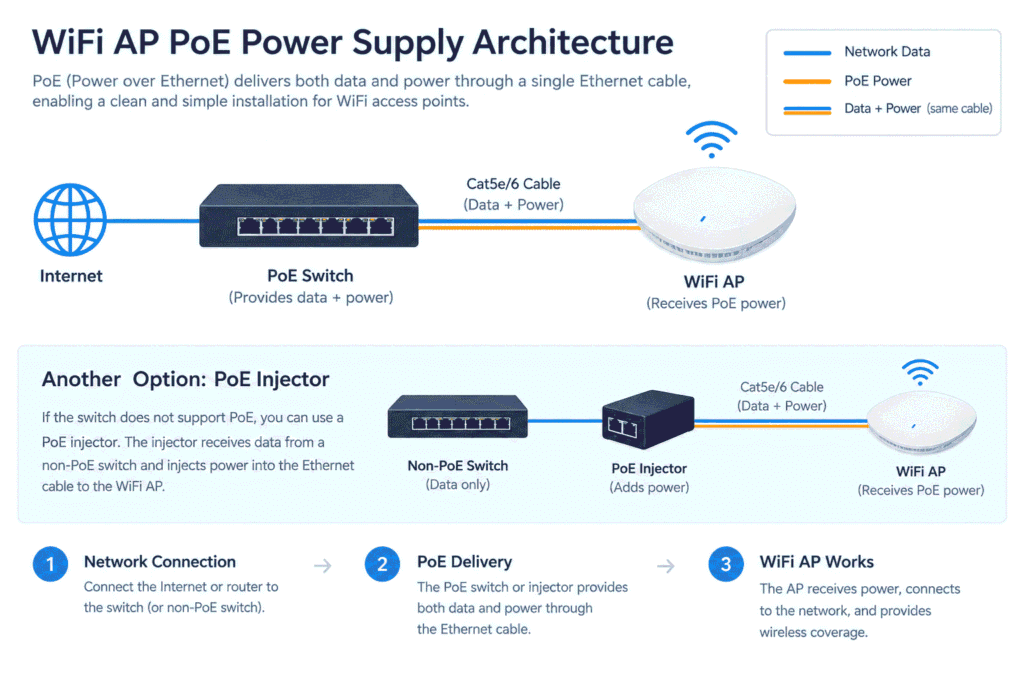
IEEE PoE standards define important aspects of power delivery between power sourcing equipment (PSE) and powered devices (PD).
A network switch with PoE functionality and a standalone PoE injector are examples of PSE equipment. A WiFi access point that receives power through Ethernet is a typical PD.
The power available to the AP depends on the PSE’s capabilities, the applicable PoE standard, and the power requirements of the connected device.
IEEE 802.3af PoE
IEEE 802.3af is commonly referred to as standard PoE.
It is designed for lower-power network devices and may be suitable for certain basic wireless access points.
Typical applications may include:
- Lower-power indoor access points.
- Basic wireless network equipment.
- Network devices with limited auxiliary power requirements.
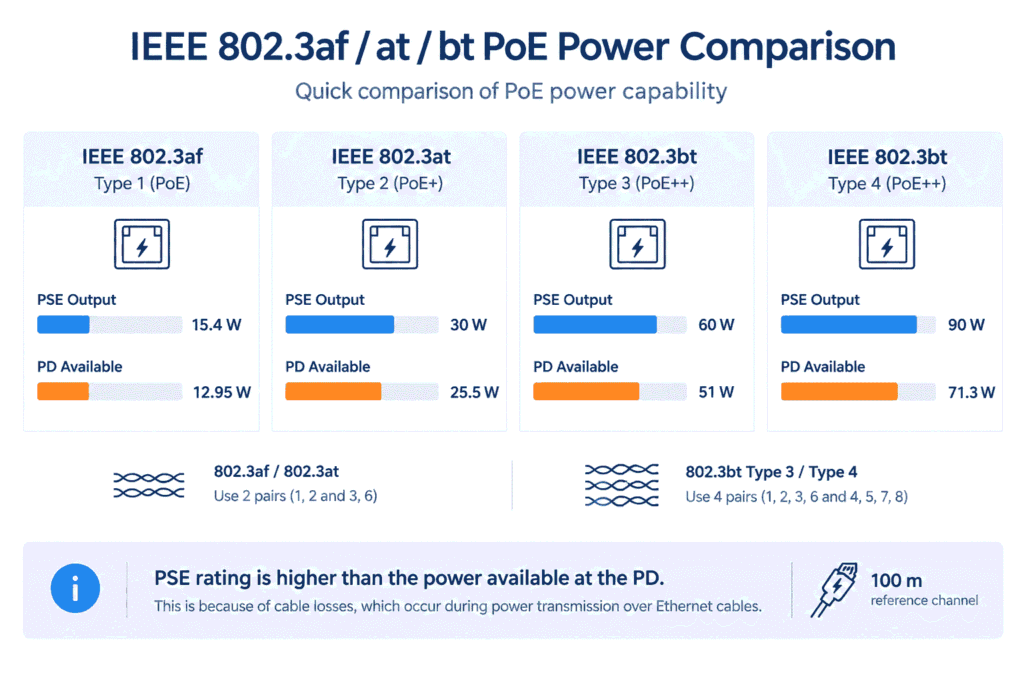
Under the IEEE 802.3af framework, the nominal maximum PSE output power is 15.4W per port, while the powered device can receive up to 12.95W under the standard’s specified conditions.
Actual available power depends on the equipment and operating conditions.
Before selecting 802.3af, engineers should confirm that the AP can operate within its available power range and that all required features remain supported.
IEEE 802.3at PoE+
IEEE 802.3at, commonly known as PoE+, provides a higher power level than 802.3af.
It is frequently used for network devices with greater power requirements, including many enterprise access points.
Potential applications include:
- Enterprise WiFi 5 access points.
- Many WiFi 6 access points.
- Multi-radio wireless equipment.
- Access points with additional power requirements.
IEEE 802.3at specifies a nominal maximum PSE output power of 30W per port and up to 25.5W available at the powered device under the standard’s specified conditions.
Whether PoE+ is sufficient depends on the AP’s actual power requirements and operating mode.
A device that supports WiFi 6, for example, may require either 802.3af or 802.3at depending on its hardware configuration.
IEEE 802.3bt PoE
IEEE 802.3bt expands PoE power delivery capabilities by using additional pairs in the Ethernet cable.
It includes higher-power operating types that can support network devices with greater power requirements.
IEEE 802.3bt may be relevant to:
- High-performance wireless access points.
- Certain WiFi 6E and WiFi 7 access points.
- Multi-radio network equipment.
- Devices with additional powered interfaces.
- Network equipment requiring higher input power.
The nominal PSE output power depends on the IEEE 802.3bt type.
| PoE Standard | Typical Maximum PSE Output Power per Port | Typical Maximum PD Input Power |
| IEEE 802.3af | 15.4W | 12.95W |
| IEEE 802.3at | 30W | 25.5W |
| IEEE 802.3bt Type 3 | 60W | 51W |
| IEEE 802.3bt Type 4 | 90W | 71.3W |
Note: These are standard reference values under defined conditions. Actual equipment specifications may vary. The applicable IEEE standard and manufacturer documentation should be consulted when making a product selection.
For a detailed comparison of IEEE PoE standards and their power delivery capabilities, see our guide to [802.3af vs. 802.3at vs. 802.3bt].
PSE vs. PD: What Is the Difference?
Understanding the relationship between PSE and PD is essential when evaluating a PoE power architecture.
| Term | Definition | Example |
| PSE | Power Sourcing Equipment that supplies power through Ethernet | PoE switch or PoE injector |
| PD | Powered Device that receives power through Ethernet | WiFi access point |
| PoE power budget | Total power available for connected PDs | A switch’s total allocated PoE capacity |
The PSE must support the power requirements of the connected PD.
For example, a switch may have enough total power capacity to support several access points but still lack sufficient per-port output capability for a particular AP.
How to Select the Appropriate PoE Standard
A practical selection process is:
- Identify the exact AP model.
- Check its required PoE standard.
- Confirm its maximum PoE input power.
- Verify its power class and supported operating modes.
- Check the PSE’s per-port and total power capabilities.
- Confirm that the complete network architecture meets the AP’s requirements.
Do not select a PoE standard solely because an AP supports WiFi 6, WiFi 6E, or WiFi 7.
WiFi 6, WiFi 6E & WiFi 7: What Changes in Power Requirements?
Newer WiFi generations can introduce more advanced hardware and additional functions. However, the WiFi generation itself does not establish a fixed power requirement.
Two access points supporting the same WiFi generation may have different power specifications because of differences in their hardware and intended applications.
Hardware Features That May Affect AP Power Consumption
Depending on the product design, the following factors may influence power requirements:
| AP Feature | Potential Impact on Power Requirements |
| Multiple active radios | May increase total operating power |
| Higher radio processing capability | May affect device power consumption |
| Wider channel bandwidth | May be associated with more demanding hardware configurations |
| Multi-Link Operation | May affect power requirements depending on implementation |
| Higher-speed Ethernet interfaces | May be integrated into higher-performance hardware designs |
| USB interfaces | May introduce additional power loads |
| Bluetooth and IoT functions | May contribute to auxiliary power consumption |
| Edge computing functions | May increase the device’s processing requirements |
| Higher transmit power | May affect radio power consumption |
These factors should be evaluated together with the AP manufacturer’s specifications.
WiFi 6 Access Points
WiFi 6 access points are available in a wide range of configurations.
A basic dual-band AP may have different power requirements from a high-density enterprise model with multiple radios, additional interfaces, or more advanced processing capabilities.
When selecting a PoE solution for a WiFi 6 AP, review:
- Maximum PoE input power.
- Required IEEE PoE standard.
- Power class.
- Radio configuration.
- Ethernet interface speed.
- USB and auxiliary power requirements.
- Supported operating modes.
The correct power solution should be selected according to the AP’s documented electrical requirements, not its WiFi 6 designation alone.
WiFi 6E Access Points
WiFi 6E extends WiFi 6 capabilities into the 6 GHz band.
Depending on the product design, WiFi 6E access points may include additional radio functionality or hardware features that affect their power requirements.
However, not every WiFi 6E AP requires the same power level.
When evaluating a WiFi 6E AP, engineers should check:
- The number of active radios.
- Maximum power consumption.
- Required PoE standard.
- Supported Ethernet data rate.
- Additional interfaces.
- Maximum power requirements under the intended operating mode.
WiFi 7 Access Points
WiFi 7 introduces advanced wireless capabilities, including Multi-Link Operation and support for wider channel configurations.
Some WiFi 7 access points may also incorporate higher-performance processors, multiple radios, and faster Ethernet interfaces.
These design choices can affect overall power consumption.
However, WiFi 7 does not automatically mean that an access point requires IEEE 802.3bt.
The appropriate PoE solution must be determined from the actual product specification.
For OEMs developing WiFi 7 access points, power requirements should be evaluated during the early design stage. This helps ensure that the selected power architecture supports the complete device configuration.
Does Higher Ethernet Speed Mean Higher PoE Power?
Not necessarily.
An access point with a 2.5GbE or 10GbE interface does not automatically require a higher PoE power level.
Ethernet data speed and PoE power delivery are separate technical considerations.
However, high-performance APs may combine higher-speed Ethernet interfaces with more demanding hardware configurations.
Engineers should therefore evaluate both requirements independently:
- Network compatibility:Does the equipment support the required Ethernet data rate?
- Power compatibility:Can the PSE deliver the required power under the AP’s specified operating conditions?
How to Calculate the PoE Power Budget for Multiple WiFi Access Points
When deploying multiple access points, the available PoE power budget becomes an important part of network design.
The power budget determines whether the PSE can provide sufficient power to all connected devices under the expected operating conditions.
Step 1: Identify the AP Power Requirement
Begin by determining the maximum power requirement of each AP.
For example, assume an enterprise network uses:
- 20 WiFi access points.
- Maximum PoE input power per AP: 30W.
A preliminary estimate of the total AP input power is:
20 × 30W = 600W
This provides an initial estimate of the power required by the connected APs.
However, the result should not automatically be treated as the required input rating of an AC-DC power supply.
The designer must determine where the 30W figure is measured and how the PoE system is architected.
Step 2: Check the PSE Power Budget
The PSE must have sufficient total power capacity to support the connected APs.
For example:
| Parameter | Example |
| Number of APs | 20 |
| Maximum AP PoE input power | 30W |
| Preliminary total AP load | 600W |
| Available PSE power budget | 720W |
| Required per-port capability | At least the AP’s specified requirement |
In this example, a 720W PSE budget provides more capacity than the preliminary 600W AP load.
However, the final suitability assessment must also consider the PSE’s actual specifications, power allocation rules, and system architecture.
Step 3: Verify Per-Port Power Capacity
A PSE may have a large total power budget but insufficient power capacity on individual ports.
For example, a system may provide:
- 720W of total PoE power.
- 24 available PoE ports.
- A lower per-port power limit than required by a particular AP.
In this case, the total power budget alone does not guarantee compatibility.
Both the total power budget and the per-port power capability must meet the AP requirements.
Step 4: Consider Operating Conditions and Design Margin
The power system should also be evaluated under the intended operating conditions.
Relevant considerations include:
- Maximum continuous load.
- Startup behavior.
- Transient power requirements.
- Power conversion efficiency.
- Thermal conditions.
- Cable-related power losses.
- Power allocation policies.
- Planned system expansion.
The appropriate design margin depends on the equipment specifications and the system architecture.
A generic percentage margin should not replace a proper engineering assessment.
A Practical Power Budget Formula
For an initial system-level estimate:
Total AP Power Requirement = Number of APs × Maximum Power Requirement per AP
The required PSE capacity must then be evaluated against:
- The AP’s actual PoE input requirement.
- The PSE’s available power budget.
- Per-port power limits.
- System operating conditions.
- Planned expansion requirements.
For an AC-DC power supply supporting a PoE system, the designer must additionally consider conversion efficiency and the electrical requirements of the complete PSE architecture.
For a more detailed explanation of PoE power budgeting and system capacity calculations, see our guide to [calculating a PoE power budget].
Other Factors That Affect PoE Power Selection
Power consumption and PoE compatibility are essential, but other technical factors can influence the selection of a suitable power solution.
Cable Length and Power Delivery
Ethernet cable resistance can result in voltage drop and power loss during PoE transmission.
For standard Ethernet installations, the typical maximum channel length is approximately 100 meters, including the relevant cable and connection components.
Actual power delivery depends on factors such as:
- Cable category.
- Conductor resistance.
- Cable length.
- PoE power level.
- Installation conditions.
- Ambient temperature.
- Connection quality.
For higher-power AP deployments, engineers should verify that the cable infrastructure complies with the relevant requirements.
Cable selection should be evaluated as part of the complete PoE system rather than treated as an isolated network consideration.
Operating Temperature
The operating environment can affect power supply performance, thermal behavior, and long-term reliability.
For example, an AP installed in a temperature-controlled office may have different environmental requirements from one installed in:
- An industrial facility.
- A warehouse.
- An outdoor enclosure.
- A hot ceiling space.
- A poorly ventilated equipment cabinet.
When selecting a power solution, review:
- Rated operating temperature.
- Thermal derating requirements.
- Ventilation conditions.
- Installation location.
- Expected continuous load.
The power supply should be capable of operating within the specified environmental conditions at the intended load.
USB and Auxiliary Interfaces
Some access points include USB ports, Bluetooth functionality, IoT modules, sensors, or other auxiliary interfaces.
These features may introduce additional power requirements.
When reviewing an AP datasheet, determine whether the published maximum power consumption includes power supplied to these interfaces.
If additional loads are excluded, they may need to be considered separately when evaluating the power budget.
For OEM projects, auxiliary power requirements should be defined during the product specification stage.
Indoor vs. Outdoor Deployment
The installation environment can influence both the electrical and environmental requirements of a PoE system.
| Consideration | Indoor Deployment | Outdoor Deployment |
| Operating temperature | Usually defined by the building environment | May require a wider temperature range |
| Surge protection | Depends on the installation | May require additional protection measures |
| Environmental exposure | Generally limited | May involve moisture, dust, and temperature variations |
| Cable routing | Typically within a building | May involve longer or exposed cable runs |
| Enclosure requirements | Depends on the installation | May require additional environmental protection |
Outdoor AP systems should be evaluated as complete installations, including the AP, PSE, cabling, and protection equipment.
Network Architecture
The appropriate power solution also depends on how the AP is connected to the network.
Possible architectures include:
- PoE switch supplying power directly to the AP.
- PoE injector installed between a non-PoE switch and the AP.
- Dedicated PoE equipment integrated into a network infrastructure system.
- Custom power modules designed for specific network equipment.
Before selecting a power supply, confirm how power is generated, converted, and delivered to the AP.
PoE Power Supply vs. PoE Injector: Understanding the Difference
The terms PoE power supply, PoE adapter, and PoE injector are sometimes used interchangeably in product descriptions. However, they may refer to different types of equipment.
Understanding the distinction is important when specifying a power solution for a WiFi access point.
AC-DC Power Supply
An AC-DC power supply converts AC input power into DC output power.
Depending on its design, it may provide power to:
- A network equipment circuit.
- A PoE power module.
- An integrated PSE system.
- Other electronic equipment.
A conventional AC-DC power supply does not necessarily include the circuitry required to inject power into an Ethernet connection.
Therefore, it should not automatically be considered a complete PoE injector.
PoE Injector
A PoE injector is a PSE device that combines network data and electrical power onto an Ethernet connection.
It is commonly used when a network switch does not provide PoE but the connected access point requires power through Ethernet.
When selecting an injector, verify:
- Supported IEEE PoE standard.
- Available output power.
- Input voltage.
- Ethernet data rate.
- Compatibility with the AP.
- Operating environment.
- Protection and compliance requirements.
PoE Switch
A PoE switch combines network switching functionality with PoE power delivery.
It can provide data connectivity and power to multiple compatible devices through separate Ethernet ports.
When selecting a PoE switch for multiple APs, engineers should evaluate:
- Number of PoE ports.
- Total PoE power budget.
- Per-port power capacity.
- Supported PoE standards.
- Ethernet interface speed.
- Network management functions.
- Expansion requirements.
PoE Power Module
A PoE power module may be integrated into a larger equipment design to support power delivery within a PoE architecture.
Its specific function depends on the product design.
For OEM applications, engineers should clarify whether the required product is:
- An AC-DC power source.
- A DC-DC power module.
- A complete PoE PSE.
- A PoE injector.
- Another type of integrated power solution.
How to Select the Right Solution
The appropriate solution depends on the network architecture and the electrical requirements of the equipment.
| Application | Potential Solution |
| AP connected to a PoE switch | Compatible PoE switch |
| AP connected to a non-PoE switch | Suitable PoE injector |
| Custom network equipment requiring a dedicated power stage | AC-DC or DC-DC power solution, depending on the architecture |
| OEM equipment requiring integrated PoE functionality | A suitably designed PSE or power module |
Before purchasing a product, confirm whether it provides power conversion only or also includes the required PoE power delivery functions.
For a detailed comparison, see:
PoE Adapter vs. PoE Injector: What Is the Difference?
PoE Power Supply Requirements for WiFi AP OEM/ODM Projects
For OEM and ODM manufacturers developing WiFi access points, power requirements should be evaluated early in the product development process.
A power solution that meets the basic wattage requirement may still be unsuitable if its electrical, mechanical, thermal, or compliance characteristics do not match the equipment design.
The objective is to develop a power architecture that supports the complete AP configuration and the intended production requirements.
Define the Electrical Requirements
The first step is to establish the electrical specifications.
Depending on the architecture, the project may require information such as:
- AC input voltage range.
- DC input voltage.
- Required output voltage.
- Continuous output power.
- Maximum output current.
- Peak power requirements.
- Power conversion efficiency.
- Startup requirements.
- PoE compatibility requirements.
For example, an OEM project may require a power module that supplies a specific DC voltage to an integrated PoE circuit.
In this situation, the power module’s output requirements should be determined by the complete PSE design rather than by the AP’s input power alone.
Evaluate Thermal and Mechanical Requirements
Power density, enclosure dimensions, and installation conditions can affect the selection of a suitable power solution.
Important considerations include:
| Requirement | Questions to Address |
| Power density | Can the solution deliver the required power within the available space? |
| Thermal design | Can the system dissipate heat under the intended load? |
| Dimensions | Does the power solution fit within the equipment enclosure? |
| Mounting | Are the mounting and installation methods compatible? |
| Connectors | Are the input and output connectors suitable for the design? |
| Cable routing | Is there sufficient space for the required connections? |
| Operating temperature | Can the solution operate within the specified temperature range? |
For compact wireless equipment, thermal design should be considered alongside electrical performance.
Review Safety and EMC Requirements
Network equipment may be deployed in different regions and application environments.
Depending on the target market and product classification, the power solution may need to meet specific safety and electromagnetic compatibility requirements.
The actual requirements should be determined according to:
- Product category.
- Target markets.
- Applicable regulations.
- Equipment architecture.
- End-product certification strategy.
Potential considerations may include electrical safety, conducted and radiated emissions, immunity, insulation, and protection against abnormal operating conditions.
The applicable standards should be confirmed with the relevant compliance and engineering teams rather than assumed based on the AP’s WiFi generation.
Consider Reliability and Product Lifecycle
For OEM applications, the power solution must support the intended production and service requirements.
Relevant considerations include:
- Expected operating conditions.
- Reliability targets.
- Component availability.
- Product lifecycle.
- Manufacturing consistency.
- Quality control.
- Maintenance requirements.
- Long-term supply stability.
A power solution that performs well in a prototype may require additional validation before it is suitable for mass production.
OEM/ODM Project Requirement Checklist
Before discussing a customized power solution with a manufacturer, the project team should prepare the following information:
| Requirement | Information to Provide |
| Target application | Indoor AP, outdoor AP, industrial gateway, or another network device |
| Input specification | AC input range or DC input voltage |
| Output requirement | Required voltage, current, and power |
| PoE architecture | Integrated PSE, external PSE, or power module |
| Maximum load | Continuous and peak power requirements |
| AP configuration | Radio configuration and auxiliary functions |
| Mechanical design | Dimensions, mounting, and connector requirements |
| Environmental conditions | Operating temperature and installation environment |
| Protection requirements | Relevant overvoltage, overcurrent, and other protection needs |
| Compliance requirements | Applicable safety and EMC requirements |
| Production requirements | Target production volume and product lifecycle |
| Customization requirements | Electrical, mechanical, or functional modifications |
Providing these details at the beginning of the project can help the engineering team evaluate power, thermal, and compatibility considerations more efficiently.
WiFi Access Point PoE Power Supply Selection Checklist
The following checklist can help network equipment engineers and system integrators evaluate a power solution before purchase or integration.
| Item | What to Verify |
| AP model | Exact model and hardware configuration |
| Maximum power consumption | Maximum specified power requirement |
| Typical power consumption | Normal operating power, where relevant |
| PoE input requirement | Required power delivery method |
| IEEE PoE standard | 802.3af, 802.3at, 802.3bt, or another supported standard |
| PoE class | Required or supported power class |
| Per-port power | Whether each port can provide sufficient power |
| Total power budget | Whether the system can support all connected APs |
| Startup and peak power | Whether transient requirements are supported |
| Ethernet data rate | 1GbE, 2.5GbE, 5GbE, 10GbE, or another requirement |
| USB and auxiliary interfaces | Additional power loads |
| Cable length | Potential voltage drop and power loss |
| Cable category | Compatibility with the intended PoE application |
| Operating temperature | Rated environmental conditions |
| Thermal design | Heat dissipation and derating requirements |
| Surge protection | Protection requirements for the installation |
| Overvoltage protection | Applicable equipment protection requirements |
| Overcurrent protection | Protection against excessive current |
| Short-circuit protection | Required fault protection |
| Safety and EMC | Applicable product and market requirements |
| Future expansion | Additional APs or increased power requirements |
| OEM/ODM requirements | Mechanical, electrical, and production specifications |
This checklist can be used during equipment selection, system design, supplier discussions, and OEM project evaluation.
Frequently Asked Questions
Do All WiFi Access Points Support PoE?
No.
Some WiFi access points support PoE, while others require a separate power adapter or another power connection.
The required power method depends on the AP model and its design.
Always check the manufacturer’s specifications before selecting a power solution.
What PoE Standard Does a WiFi 6 Access Point Need?
It depends on the specific AP model.
Some WiFi 6 access points may operate with IEEE 802.3af, while others require IEEE 802.3at or a higher-power PoE solution.
Check the AP’s maximum PoE input power, required standard, and power class before selecting the PSE.
Do WiFi 7 Access Points Require PoE++?
Not necessarily.
Some WiFi 7 access points may require IEEE 802.3bt, while others may operate with IEEE 802.3at.
The required PoE standard depends on the AP’s hardware configuration, maximum power requirements, and operating modes.
Can I Use a PoE Injector to Power a WiFi Access Point?
Yes, provided that the injector supports the AP’s required PoE standard, power level, and network connection requirements.
Before installation, verify compatibility between the injector and the AP.
How Many WiFi Access Points Can One PoE Switch Support?
The number depends on:
- Number of available PoE ports.
- Total PoE power budget.
- Per-port power capacity.
- Maximum power requirement of each AP.
- Power allocation rules of the switch.
Both the number of ports and the available power budget must be sufficient for the intended deployment.
Does Higher WiFi Speed Mean Higher PoE Power Consumption?
Not necessarily.
WiFi performance, Ethernet data rate, and PoE power requirements are separate technical considerations.
However, high-performance APs may include more advanced hardware and additional features that increase power consumption.
The actual power requirement should always be determined from the AP’s specifications.
Does Ethernet Cable Length Affect PoE Power Delivery?
Yes.
Cable resistance can cause voltage drop and power loss during PoE transmission.
Cable length, conductor characteristics, installation conditions, and the applicable PoE standard should be considered when designing the system.
What Information Should I Provide When Requesting a Customized PoE Power Solution?
For an OEM/ODM project, provide the AP’s power requirements, input voltage, maximum load, PoE architecture, operating environment, mechanical constraints, and applicable compliance requirements.
Additional information about production volume and product lifecycle can also help the manufacturer evaluate the project.
Need Help Choosing a PoE Power Solution for Your WiFi Access Point?
Selecting a power solution for a WiFi access point requires more than matching a wattage rating.
The AP’s maximum power requirement, PoE architecture, network compatibility, operating environment, and system design should all be considered before making a selection.
For OEM and ODM projects, the power solution should also meet the equipment’s electrical, mechanical, thermal, safety, and production requirements.
Quankang provides power supply solutions for electronic equipment and supports customized power supply requirements according to product specifications and application needs.
If you are developing a WiFi 6, WiFi 6E, or WiFi 7 access point, or evaluating a power solution for network equipment, our team can discuss your requirements and help determine whether our capabilities match your project.
When contacting Quankang, consider providing the following information:
- AP model or technical specification.
- Required input voltage.
- Maximum power consumption.
- PoE architecture.
- Operating environment.
- Mechanical requirements.
- Customization requirements.
This information can help establish the technical requirements for an initial evaluation.