The rated output printed on a power supply label looks like a simple number. It rarely is. That single figure hides a set of assumptions about temperature, airflow, load behavior, and duty cycle—and when those assumptions don’t match your application, a supply that looks perfectly sized on paper can sag, overheat, or fail in the field.
For engineers and procurement teams specifying supplies for medical, industrial, or communications equipment, the real skill isn’t reading the wattage. It’s understanding what that wattage actually guarantees, and under what conditions it stops being true. This article works through that distinction the way a design review would: what the rating means, how continuous and peak capability differ, why derating usually matters more than the headline number, and how to translate all of it into a sound selection decision.
What does max output rating mean in a power supply?
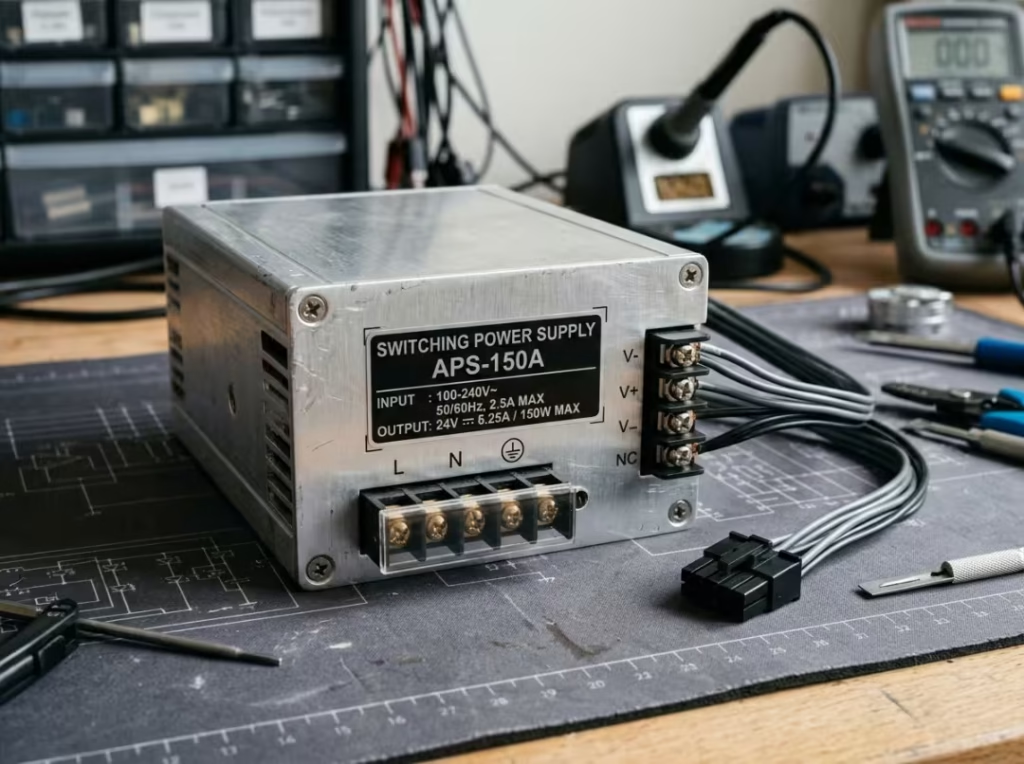
A power supply unit converts AC input into regulated DC output. The max output rating defines the highest power—typically stated in watts—that the unit can deliver continuously and safely under a defined set of operating conditions.
Two words in that definition carry most of the weight: continuously and defined conditions. The rating is a continuous-duty figure, not a momentary one, and it is valid only within the temperature, airflow, and input assumptions the manufacturer used to establish it. Read the headline wattage in isolation, and you learn very little about whether the supply suits your load.
From a selection standpoint, treat the max output rating as a ceiling you design beneath, never a target you run against. A supply operating continuously at its rated limit runs hotter, ages faster, and leaves nothing in reserve for the load variation every real system produces. The rating tells you where the wall is. Good design keeps you well clear of it.
How do voltage, current, and wattage work together?
The three core numbers on any datasheet are bound by one relationship:
Watts = Volts × Amps
A 24 V supply rated for 10 A can deliver up to 240 watts. That much is arithmetic. What matters more in practice is how the rating is distributed.
- Voltage (V): The regulated output your load requires—commonly 5 V, 12 V, 24 V, or 48 V. This is fixed by your equipment, not negotiable.
- Current (A): The maximum current available at that voltage. On multi-output supplies, current is often specified per rail, and the sum of the rails may be lower than the arithmetic total. Missing this is a frequent cause of undersizing.
- Wattage (W): Total deliverable power. Useful as a headline, but meaningless until you confirm it’s available at your voltage and your rail configuration.
Consider a system running at 12 V that draws a combined 8 A. The load is 96 W. Specifying a 96 W supply leaves zero margin—a poor decision for reasons the next sections make clear. A 120 W or 150 W unit gives you room for startup behavior, component aging, and future load growth.
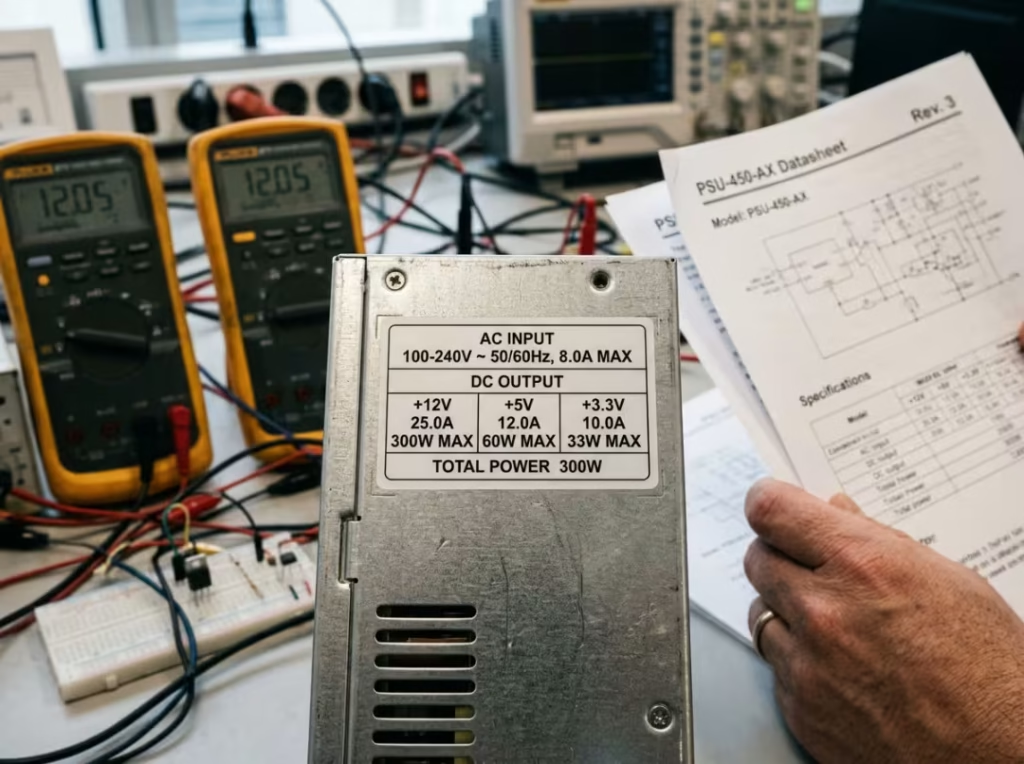
One check should be routine: confirm whether a stated figure refers to continuous output or a short-term peak. That single distinction separates a robust design from one that trips or overheats.
Rated power vs peak power — what actually differs?
This is the distinction that catches most engineers, and it deserves close attention because misreading it can lead to both nuisance failures and needlessly expensive over-specification.
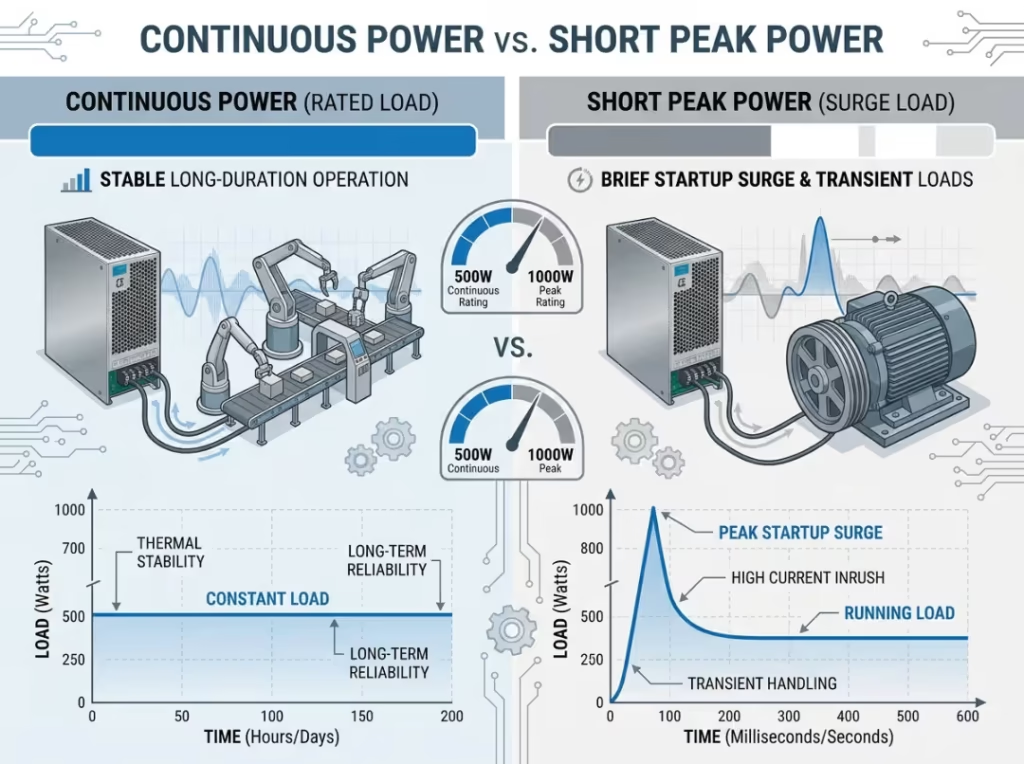
Rated (continuous) power is what the supply delivers indefinitely under normal operating conditions. For any equipment that runs for extended periods—and that describes nearly all medical, industrial, and communications hardware—this is your true working limit. Design your steady-state load around this number, not the one beside it.
Peak power is the highest output the supply can sustain for a very short window, often well under a second, and typically two to three times the rated figure. It exists to absorb transients, not to power a load.
Why the difference is more than semantics
The gap between the two ratings maps directly onto the physics of your load. Several categories draw far more current at the instant they start than they do in steady operation:
- Motors, pumps, and fans draw heavy inrush current at startup—often several times their running current—before settling.
- Compressors and actuators produce sustained startup surges as they overcome mechanical load.
- LED drivers and capacitive front ends draw a sharp inrush as capacitors charge.
- Communications hardware can present transient bursts during transmission or link negotiation.
A supply with adequate peak headroom absorbs these events, then returns to continuous operation once the transient passes. A supply sized only to the continuous load may trip its overcurrent protection or drop its output voltage the moment the motor starts.
The trap that runs the other way
The reverse mistake is just as costly. Some adapters advertise an impressive peak or “maximum” figure that the unit cannot sustain thermally. Design a continuous load around that number and the supply will overheat within minutes. When you read a datasheet, separate three things explicitly: continuous output, peak output, and the duration and duty cycle over which peak is permitted. A reputable specification states all three. If the surge allowance isn’t documented, that silence is itself information—ask the manufacturer before you commit.
The practical rule is straightforward. Size rated power for the load that runs all day. Confirm peak capability covers your worst-case inrush. Never let one substitute for the other.
What affects a power supply’s usable output in real conditions?
Two supplies carrying identical wattage labels can behave very differently once installed. The label describes potential; several design factors determine how much of it you actually get.
- Topology and component quality: Transformer design, capacitor grade, and PCB layout govern how reliably a unit holds its rating under stress. Understanding how a modern switching power supply manages conversion and thermal load helps explain why two units of the same wattage can differ so sharply in actual output. Lower-grade builds derate aggressively the moment conditions tighten.
- Efficiency: A more efficient supply dissipates less energy as heat, allowing it to run closer to its rating without reaching thermal limits. Efficiency isn’t just an operating-cost figure—it directly affects how much of the rated output remains usable.
- Voltage regulation: A quality supply maintains output voltage steady under varying load conditions. Poor regulation shows up as sag under load or overshoot on release, both of which stress connected devices and can force you to over-specify to compensate.
- Thermal design: Heat is the limiting factor in nearly every power supply. The thermal path—heatsinking, component placement, and cooling method—determines how much power the unit can deliver before temperature forces it to back off.
The common thread is that usable output is a function of the supply and its environment together. Which brings us to the specification that most often separates a sound selection from a marginal one.
Why derating matters more than the label value
Here is where paper specifications and field performance part ways. A supply rated for 200 W at 25 °C may deliver only 140 W at 60 °C. That reduction is power derating, and for anything installed in an enclosure or a warm environment, it matters more than the headline rating ever will.
Derating is the deliberate reduction of a supply’s maximum output as operating conditions become harsher—most commonly rising ambient temperature, but also higher altitude and reduced airflow. Manufacturers establish the headline rating under favorable lab conditions. Your installation is rarely that kind.
Reading the derating curve
Any reputable datasheet includes a derating curve: output capability plotted against ambient temperature. It typically shows full rated output up to a corner temperature, then a steady decline above it. That curve, not the headline number, is your actual design ceiling.
Read it against the temperature your supply will actually see—not room temperature or the factory-floor average, but the local ambient inside the enclosure at the hottest point of the duty cycle, in the warmest season the equipment will operate in. Design to that worst case. A supply that clears every other requirement but sits above its derating curve at peak temperature is undersized, regardless of what the label claims.
Enclosure and airflow effects
Ambient temperature on an open bench is one thing. The temperature surrounding a supply sealed inside a tight enclosure is another entirely. Trapped heat raises the local ambient the supply experiences, pushing it further down its derating curve—sometimes dramatically. When you specify the room temperature rather than the internal enclosure temperature, you consistently overestimate the available output.
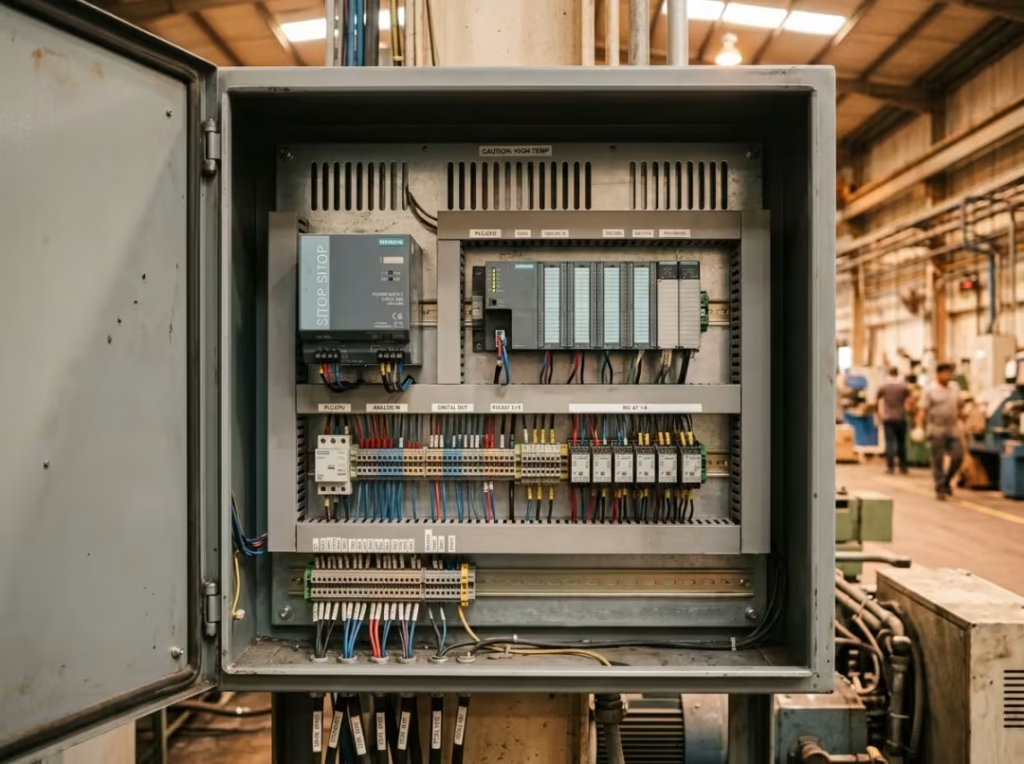
Cooling method compounds this:
- Convection-cooled (fanless) units rely on natural airflow. In a confined or poorly ventilated space, they derate steeply because the heat has nowhere to go. They’re attractive for reliability and acoustics—no fan to fail, no noise—but they demand generous thermal margin and real attention to airflow.
- Fan-cooled units maintain output at higher ambient temperatures because forced air actively moves heat away. The trade-off is an added mechanical part with its own service life, plus filter maintenance and noise—considerations that matter in medical and clinical settings.
A worked case
Take a 200 W convection-cooled supply rated for full output up to 40 °C, declining above that point. Install it in a sealed cabinet that runs at 55 °C internally, and you may have only around 150 W to work with. Nothing has failed, and nothing is defective—the supply is behaving exactly as its curve predicts. The failure, if it comes, is a specification failure: someone designed to the label instead of the curve. In medical and industrial builds, that gap is precisely where field problems originate.
The discipline is simple to state and easy to skip: design around the derated value for your worst-case conditions, never the lab-rated peak.
How much headroom should you leave when sizing a PSU?
Once you know your continuous load and your derated ceiling, the remaining question is margin. The common guidance is to specify 20–30% above your calculated continuous load. That’s a reasonable starting point, but treating it as a fixed rule misses what the margin is actually protecting against.
When 20% is enough
A 20% margin generally suffices when conditions are well controlled and predictable:
- Stable, well-characterized loads with little variation
- Resistive or lightly reactive loads with minimal inrush
- Controlled ambient temperature with reliable airflow
- Equipment with no planned expansion
Under those conditions, 20% covers normal load variation, modest component aging, and routine tolerance stack-up.
When to go higher
Push the margin to 30% or beyond when any of the following apply:
- Significant startup surges from motors, pumps, compressors, or capacitive loads
- Pulsed or highly variable loads where average draw understates peak demand
- Elevated or uncertain ambient temperature, where derating already consumes part of your headroom
- Planned expansion—additional boards, sensors, or channels added over the product’s life
- High-reliability applications where the cost of failure far exceeds the cost of a larger supply
Two of these deserve emphasis. First, headroom and derating are not independent—if your environment already forces the supply down its curve, the 20–30% you thought you had is partly spent before the load even connects. Account for both together. Second, aging is real: capacitors and other components drift over years of service, and a supply sized tight when new can become marginal well before end of life.
Why headroom is more than a safety cushion
Margin isn’t only about surviving surges. A supply running with reasonable headroom operates cooler, more efficiently, and with steadier regulation, and it lasts longer for exactly those reasons. In high-reliability sectors, no competent designer specifies to run near full load continuously—not because the supply couldn’t do it briefly, but because doing so trades away service life, thermal margin, and stability for a marginal saving on the bill of materials. That’s rarely a trade worth making.
How do power supply requirements differ by application?
Max output is a starting constraint. Which specifications become decisive depends heavily on where the supply is used, and the right selection strategy looks different in each sector.

Medical equipment
Medical devices bring requirements that override raw wattage. Compliance with IEC 60601-1 is non-negotiable, and it drives everything: certified isolation, controlled leakage current (patient-contact applications typically require ≤100 µA), and defined means of patient protection, with 2× MOPP common for applied parts. Reliability and low noise matter as much as output capability—ripple that would be irrelevant in an industrial controller can corrupt a sensor reading in a diagnostic device.
Here, generous derating margins and proven safety certifications outweigh the pursuit of the last watt. Selecting AC-DC power supplies for medical applications is as much about the certification dossier and long-term stability as it is about the output rating on the label.
Industrial automation
Factory environments combine heat, dust, and heavy inductive loads from motors, solenoids, and actuators. Three factors dominate here:
- EMI/EMC performance, because a supply that fails emissions or immunity testing stalls your product’s launch and forces redesign
- Inrush handling, since inductive loads present demanding startup transients
- Conservative derating, because ambient temperatures on a factory floor run high and vary
DIN-rail supplies with strong peak capability and conservative thermal margins are the usual fit, and continuous-duty reliability is the priority over compactness.
Communications equipment
Networking and communications hardware runs continuously, which makes always-on efficiency central—small efficiency gains compound into meaningful energy and thermal savings over years of uptime. PoE applications add their own layer, with power-class negotiation (802.3af/at/bt) determining available output per port. Thermal management for continuous operation and stable regulation under transient traffic loads round out the priorities.
Common mistakes when selecting by max output rating
Most sizing failures trace back to a short list of avoidable errors:
- Sizing to the load with no headroom. A supply matched exactly to calculated load has nothing left for surges, aging, or derating.
- Reading peak power as continuous. Designing a steady-state load around a short-term peak figure guarantees thermal trouble.
- Ignoring the derating curve. Specifying to the room-temperature rating rather than the enclosure worst-case is the single most common cause of field undersizing.
- Judging supplies on wattage alone. Two identical wattage labels can hide very different regulation, efficiency, and thermal behavior.
- Overlooking protection behavior. How a supply responds to a fault—and whether the design is coordinated with proper overcurrent protection—determines whether an overload event is a shutdown or a failure.
- Treating certifications as an afterthought. In medical and regulated markets, a supply that can’t produce a verifiable compliance dossier is unusable regardless of its output.
How to choose the right power supply — practical checklist
Bringing the pieces together, a sound selection follows a consistent order:
- Confirm voltage and current, per rail. Fix your output voltage from the load, then verify current availability at that voltage—and on multi-output units, check per-rail limits, not just the total.
- Calculate continuous load, then add headroom. Start from your true steady-state draw and add 20–30% (more if surges, variable loads, or expansion apply).
- Identify your worst-case peak. Confirm the supply’s documented peak and surge allowance cover your largest inrush event.
- Apply the derating curve to your real environment. Use the local enclosure temperature at the hottest point of the duty cycle—not room temperature—and confirm the supply still meets your load there.
- Match the specification to the application. Weight certification, EMC, leakage current, or efficiency, depending on whether the end product is medical, industrial, or communications hardware.
- Verify certification and traceability. Confirm that the supply meets the standards your market requires, with documentation you can provide to an auditor.
This is where sourcing decisions become as important as engineering ones. A supplier that provides complete certification dossiers, verifiable test reports, and consistent batch quality removes an entire category of risk from the process. Quankang builds AC-DC and medical-grade supplies to this standard—IEC 60601-1 compliance, controlled leakage current, on-site EMC pre-compliance testing, and full traceability—so the specification you validate on the bench is the one that ships to your line. For teams specifying for regulated markets, consistency between the datasheet and the delivered unit is often what separates a smooth product launch from a delayed one.
FAQ
What does the max output rating of a power supply mean?
It’s the highest continuous power—usually stated in watts—that a supply can safely deliver under a defined set of operating conditions. It’s a continuous-duty ceiling, valid only within the temperature and airflow assumptions the manufacturer used to establish it.
How do I calculate a power supply’s max output?
Multiply output voltage by maximum current: Watts = Volts × Amps. A 24 V supply rated for 5 A provides up to 120 W. On multi-output units, check the per-rail limits, since their sum may be lower than the arithmetic total.
What’s the difference between rated power and peak power?
Rated power is what the supply delivers continuously and indefinitely. Peak power is a short burst—often two to three times higher and sustainable for under a second—meant to absorb transients such as motor inrush. Size continuous loads to the rated figure; never rely on peak for steady-state operation.
What is power derating and why does it matter?
Derating is the reduction in a supply’s maximum output as conditions worsen, most often as ambient temperature rises. It matters because the headline rating is set under favorable lab conditions; inside a warm enclosure, your usable output can be substantially lower. Always design around the derated value for your worst-case environment.
How much headroom should I leave above my load?
Start with 20–30% above your calculated continuous load. Stay near 20% for stable, well-cooled, well-characterized loads; move toward 30% or higher when you face startup surges, variable loads, elevated temperatures, planned expansion, or high-reliability requirements. Remember that derating consumes part of your margin before the load connects.
Why do medical power supplies need tighter specifications?
Medical applications require IEC 60601-1 compliance, controlled leakage current (typically ≤100 µA for patient contact), defined means of patient protection such as 2× MOPP, and low output noise. These requirements, along with verifiable certification, generally outweigh the need to maximize raw output.
The max output rating is a useful starting point, but it was never meant to be the whole answer. A supply that’s genuinely right for your application is one you’ve evaluated against continuous load and worst-case surge, checked against its derating curve at the temperature it will actually see, given sensible headroom, and matched to the certification your market demands. Get those judgments right and you specify a supply that performs reliably for years—not one that meets its label on the bench and disappoints on the first hot afternoon in the field.