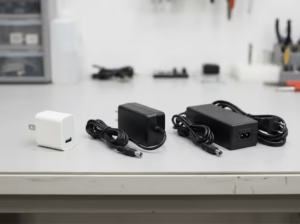
Understanding IEC 60601 Patient Leakage Limits, Isolation Protection, and Medical Power Design
Leakage current is one of the most critical safety parameters in medical electrical equipment.
During IEC 60601 certification, many medical OEM manufacturers discover that a device which operates normally functionally may still fail compliance testing because patient leakage current exceeds allowable limits.
This problem becomes especially important in:
- ECG systems
- patient monitoring equipment
- ultrasound devices
- electrophysiology systems
- wearable medical devices
- patient-connected diagnostic equipment
Understanding the difference between BF and CF medical equipment classifications is essential for selecting the correct medical power architecture, isolation strategy, and IEC 60601-certified power supply.
This guide explains:
- BF vs CF leakage current requirements
- IEC 60601 isolation concepts
- why many medical devices fail leakage current testing
- how external adapters affect patient leakage current
- engineering methods used to reduce leakage current risk
This article is part of our medical power engineering series:
→ Related Guide:
“Medical Power Supply Failures: Causes, IEC 60601 Risks, and Engineering Solutions”
→ Related Guide:
“How to Reduce Leakage Current in Medical Devices”
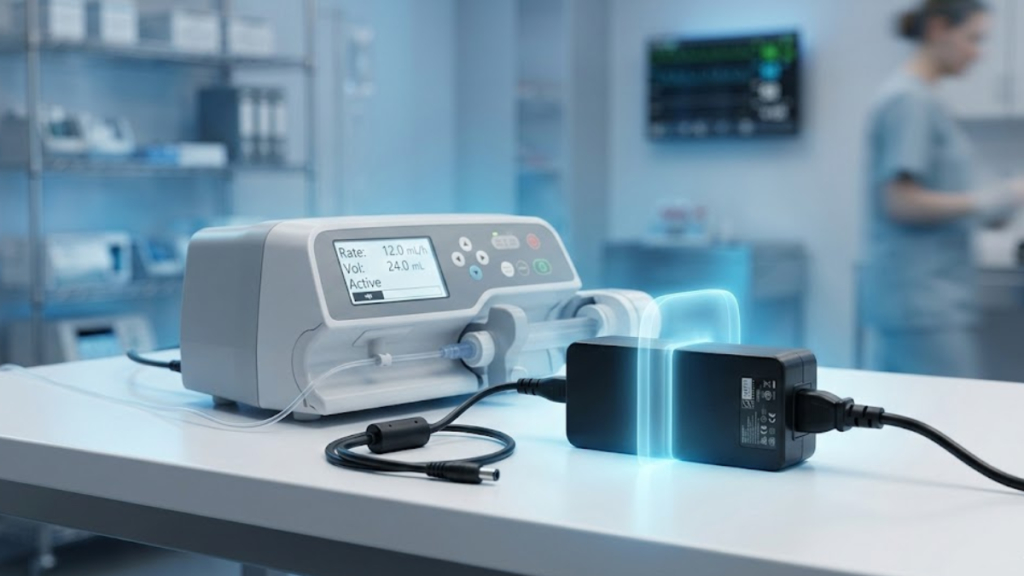
What Is Leakage Current in Medical Devices?
Leakage current is unintended electrical current flowing from the power system to:
- protective earth
- enclosure surfaces
- patient-connected circuits
In medical devices, excessive leakage current may create:
- patient safety risk
- ECG signal instability
- certification failure
- EMC interaction problems
Leakage current becomes especially critical when devices establish electrical contact with patients.
Why BF and CF Classifications Matter
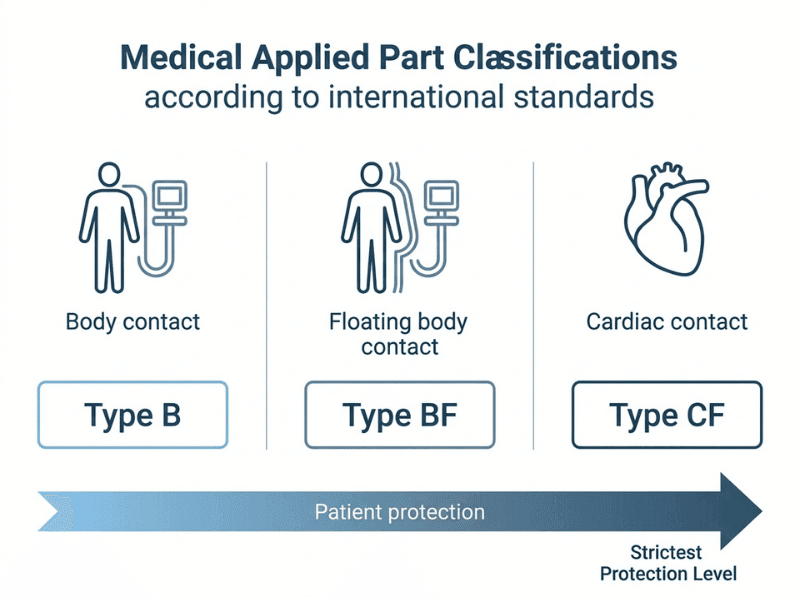
IEC 60601 classifies medical applied parts based on the level of patient protection required.
The two most common categories are:
| Classification | Typical Application | Protection Level |
| BF (Body Floating) | Ultrasound, patient monitors | High |
| CF (Cardiac Floating) | ECG, intracardiac applications | Highest |
CF applications require significantly stricter leakage current control because they may establish direct conductive pathways near the heart.
As a result, CF systems demand the highest level of electrical isolation and leakage current suppression.
BF vs CF Leakage Current Limits
IEC 60601 defines strict patient leakage current limits under different operating conditions.
Typical reference values are:
| Applied Part Type | Normal Condition (NC) | Single Fault Condition (SFC) |
| BF | ≤100 μA | ≤500 μA |
| CF | ≤10 μA | ≤50 μA |
CF limits are extremely strict.
For comparison:
A typical commercial adapter may easily generate several hundred microamps of leakage current because of Y-capacitor coupling and transformer parasitic capacitance.
This is why CF-level medical systems require specialized system-level power architecture rather than standard industrial power solutions.
Real-World OEM Problem: CF Leakage Current Failure During Certification
A portable ECG monitor manufacturer encountered repeated IEC 60601 certification failures during patient leakage current testing.
The device operated correctly during:
- functional validation
- battery-powered testing
- internal EMC evaluation
However, once connected to external AC power during CF-type patient simulation testing, leakage current exceeded allowable IEC 60601 limits.
Initial investigation showed:
- ECG analog front-end design was stable
- PCB isolation spacing met design expectations
- EMC performance was acceptable
- leakage current increased significantly during AC-powered operation
The root cause was traced to a commercial external adapter using aggressive Y-capacitor EMI filtering optimized for consumer electronics rather than ultra-low patient leakage applications.
Why the Adapter Alone Could Not Solve CF Leakage Limits
In medical power engineering, external AC-DC adapters connected directly to the mains power system rarely achieve true CF-level patient leakage current alone.
Industry-standard CF architectures typically use:
- a 2×MOPP IEC 60601 medical adapter
- followed by an additional isolated DC-DC stage inside the medical device
This approach allows:
- the external adapter to provide ultra-low enclosure leakage and reinforced isolation
- the internal isolated stage to achieve the extremely low patient leakage required for CF applications
Quankang System-Level Engineering Solution
Instead of redesigning the entire ECG acquisition board, the OEM implemented a Quankang IEC 60601-certified medical power architecture featuring:
- optimized low-leakage EMI filter design
- controlled common-mode current
- reinforced transformer insulation
- reduced parasitic capacitance
- 2×MOPP isolation protection
Combined with internal isolated DC-DC architecture refinement, the system achieved sufficient leakage current margin to comfortably pass strict CF-level IEC 60601 testing.
This significantly reduced redesign cost, laboratory retesting fees, and certification delays.
Understanding BF (Body Floating) Medical Equipment
BF-type applied parts are electrically isolated from earth and provide a high level of patient protection.
Typical BF devices include:
- portable ultrasound systems
- infusion pumps
- patient monitors
- sleep therapy devices
- rehabilitation equipment
BF applications still require:
- reinforced isolation
- low leakage current
- IEC 60601-certified power systems
However, BF leakage limits are less restrictive than CF requirements.
Understanding CF (Cardiac Floating) Medical Equipment
CF-type equipment provides the highest level of patient protection.
These systems may establish conductive paths directly connected to the heart or highly sensitive cardiac monitoring circuitry.
Typical CF applications include:
- ECG systems
- electrophysiology equipment
- intracardiac monitoring systems
Because even extremely small leakage current may affect cardiac tissue, IEC 60601 imposes very strict limits.
CF systems are among the most difficult medical power architectures to certify successfully.
Why Leakage Current Increases in AC-Powered Operation
Many OEM manufacturers notice:
- battery-powered operation passes testing
- AC-powered operation fails leakage limits
This occurs because AC-powered systems introduce:
- common-mode switching current
- Y-capacitor coupling
- transformer parasitic capacitance
- grounding interaction
Leakage current may flow through:
- patient electrodes
- shielding structures
- cable capacitance
- grounding paths
This is why external adapter selection strongly affects medical leakage performance.
Common Causes of Leakage Current Failure
1. Excessive Y-Capacitor Coupling
Large Y-capacitors improve EMI suppression but increase leakage current.
2. Poor Transformer Isolation
Weak insulation increases capacitive coupling between primary and secondary circuits.
3. Improper Grounding Strategy
Ground loops and unstable shielding may create unintended leakage paths.
4. Commercial-Grade Adapters
Commercial adapters prioritize:
- cost reduction
- EMC suppression
- compact size
rather than:
- ultra-low leakage
- patient-connected safety
- medical isolation architecture
Why 2×MOPP Isolation Matters
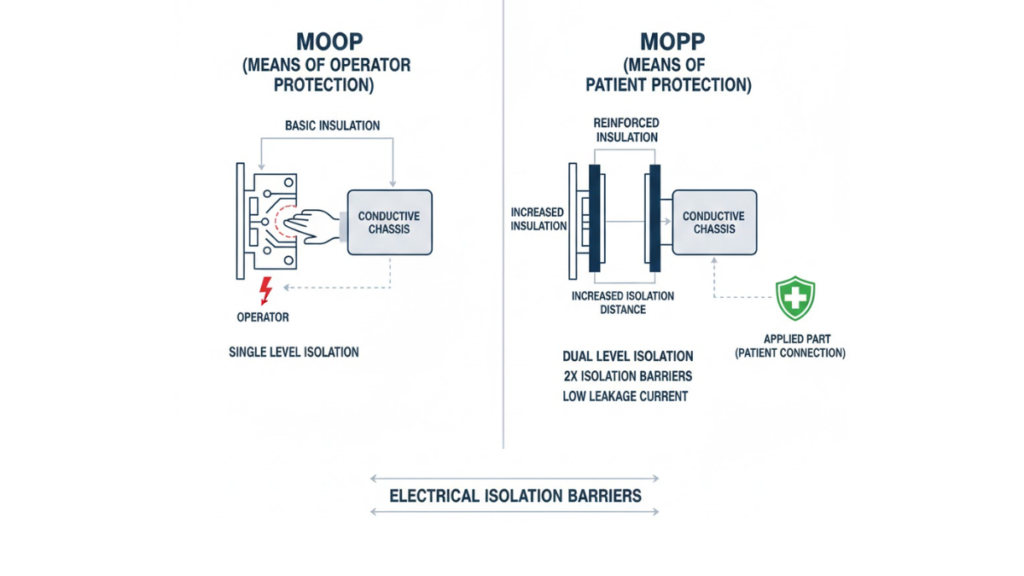
2×MOPP (Means of Patient Protection) is one of the most important IEC 60601 safety requirements.
It requires reinforced isolation between:
- AC mains input
- patient-accessible circuits
2×MOPP protection typically includes:
- reinforced transformer insulation
- increased creepage and clearance
- high-isolation testing
- controlled leakage architecture
Without proper 2×MOPP design, medical systems may fail:
- leakage current testing
- hi-pot testing
- insulation verification
→ Related Resource:
“What Is 2 × MOPP in Medical Power Supplies?”
BF vs CF Medical Power Architecture Differences
| Design Factor | BF Application | CF Application |
| Leakage Requirement | Low | Extremely low |
| Isolation Complexity | High | Very high |
| Internal Isolated DC-DC | Sometimes used | Commonly required |
| Patient Connection Sensitivity | Moderate | Extremely sensitive |
| EMC vs Leakage Tradeoff | Important | Critical |
| Certification Difficulty | Moderate | Very high |
CF systems often require significantly more complex isolation architecture than BF devices.
Why EMC and Leakage Current Are Closely Related
One of the most difficult engineering tradeoffs in medical power design is balancing:
- low EMI emissions
- low leakage current
Increasing Y-capacitor values may improve EMC suppression while simultaneously increasing patient leakage current.
Reducing leakage too aggressively may worsen EMC performance.
This balance becomes especially critical in:
- ECG systems
- wireless monitoring devices
- compact portable medical systems
→ Related Resource:
“Medical Power Supply EMI Troubleshooting Guide”
→ Related Resource:
“IEC 60601 EMC Testing Problems and Solutions”
Typical Commercial Adapter vs IEC 60601 Medical Adapter
| Parameter | Commercial/Industrial Adapter | IEC 60601 Medical Adapter |
| Leakage Current | 250–500 μA+ | <100 μA (BF) |
| Isolation Protection | Basic insulation | 2×MOPP |
| Patient Application Support | Limited | BF/medical applications |
| EMC vs Leakage Optimization | Consumer-oriented | Medical optimized |
| Ripple Stability | Higher ripple | Low ripple medical design |
| Lifecycle Support | Shorter availability | Long-term OEM support |
Many leakage current failures originate from system-level power architecture limitations rather than the main control board itself.
How Quankang Medical Power Supplies Reduce Leakage Current Risk
Quankang medical power solutions are specifically engineered for IEC 60601 patient safety requirements.
Key features include:
Low-Leakage EMI Filter Architecture
Balances:
- EMC suppression
- leakage current control
Reinforced Transformer Isolation
Reduces parasitic coupling current.
Controlled Common-Mode Current
Improves patient signal stability.
2×MOPP Certified Isolation
Supports IEC 60601 medical safety compliance.
Low Ripple Medical Power Design
Improves ECG and imaging signal integrity.
How to Reduce Leakage Current Risk During Development
Medical OEM manufacturers can significantly improve certification success through early system-level planning.
Select Medical Power Architecture Early
Avoid replacing power systems late in development.
Evaluate AC-Powered Leakage Performance
Not only battery-powered operation.
Plan Isolation Architecture Carefully
Especially for CF applications.
Consider EMC and Leakage Together
They are strongly interconnected.
Use IEC 60601-Certified Medical Power Supplies
Medical-certified adapters provide significantly better leakage current control than commercial power solutions.
Engineering Support for BF and CF Medical Power Systems
Medical OEM manufacturers frequently encounter challenges involving:
- BF/CF leakage current testing
- IEC 60601 certification failure
- EMC vs leakage tradeoffs
- ECG signal instability
- common-mode current problems
- patient isolation architecture
Quankang engineering teams support medical device manufacturers with:
- IEC 60601-compliant medical power supplies
- low-leakage AC-DC adapters
- 2×MOPP medical power architecture
- low-noise medical power systems
- OEM and ODM engineering collaboration
- system-level leakage current optimization
Whether you are developing ECG systems, portable monitors, ultrasound devices, or cardiac-related medical equipment, selecting the correct medical power architecture is essential for patient safety and certification success.
For technical consultation regarding BF/CF leakage current requirements or medical power supply selection, contact Quankang engineering teams.
FAQ
What is the difference between BF and CF medical equipment?
CF equipment requires stricter leakage current protection because it may connect directly to cardiac-related patient circuits.
Why is CF certification more difficult?
CF applications require extremely low patient leakage current and more advanced isolation architecture.
Can an external adapter alone achieve CF leakage limits?
Typically no. Most CF systems also require internal isolated DC-DC stages.
Why does leakage current increase during AC operation?
AC-powered systems introduce common-mode switching current and capacitive coupling from the mains power system.
Why are commercial adapters unsuitable for medical systems?
Commercial adapters are usually not optimized for low patient leakage current or IEC 60601 isolation requirements.