Quick Answer
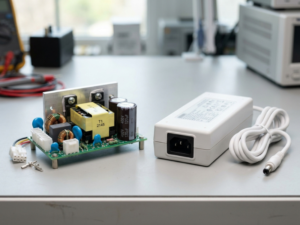
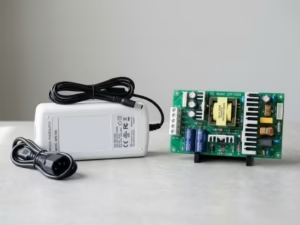
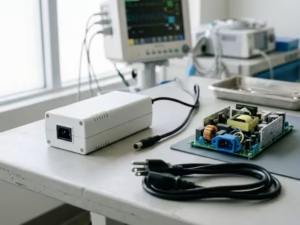
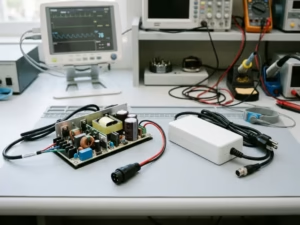
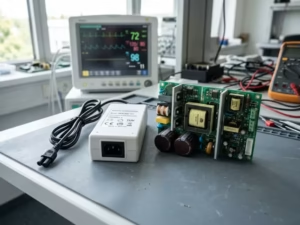
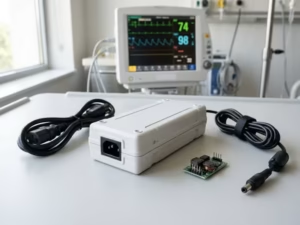
A custom medical power supply is a specialized AC-DC or DC-DC power solution engineered to meet the electrical, mechanical, EMC, and regulatory requirements of a specific medical device. Unlike standard off-the-shelf adapters, custom medical power supplies can be optimized for ultra-low leakage current, 2×MOPP isolation, compact enclosure integration, thermal management, and IEC 60601-1 compliance.
Medical device manufacturers commonly choose customized power solutions for patient monitors, ventilators, ultrasound systems, infusion pumps, laboratory analyzers, portable healthcare equipment, and home medical devices where reliability, patient safety, and certification are critical.
What Is a Custom Medical Power Supply?
A custom medical power supply is an AC-DC or DC-DC converter specifically designed around the operational and regulatory requirements of a medical device.
Unlike commercial or industrial power adapters, medical-grade power supplies must meet significantly stricter requirements related to:
- Patient safety
- Leakage current
- Isolation protection
- Electromagnetic compatibility (EMC)
- Reliability under continuous operation
- Regulatory certification
In real medical device projects, standard adapters frequently create integration problems during EMC testing, thermal validation, or final certification. Custom power solutions help manufacturers eliminate these risks early in development.
Typical customization areas include:
- Output voltage and current
- Connector type
- Cable length
- PCB dimensions
- Enclosure size
- 2×MOPP isolation
- EMC optimization
- Fanless thermal design
- Waterproof protection
- Branding and labeling
Why Standard Power Adapters Often Fail in Medical Applications
Many startups and medical OEMs initially attempt to reduce development cost by using commercial off-the-shelf power adapters.
However, this often creates major problems later in certification and production.
Common Problems with Standard Adapters
| Problem | Typical Result |
| Leakage current too high | IEC 60601-1 failure |
| Poor EMC immunity | Device instability in hospitals |
| Inadequate insulation | Safety compliance issues |
| Large enclosure size | Mechanical integration problems |
| Unstable component sourcing | Supply chain risk |
| Connector incompatibility | Field failures |
| Excessive temperature rise | Reliability concerns |
In actual hospital environments, devices are exposed to:
- Electrosurgical equipment
- RF systems
- Imaging equipment
- Wireless communication systems
- Electrostatic discharge
- Continuous 24/7 operation
Commercial-grade adapters are usually not designed for these conditions.
When Should OEMs Choose a Custom Medical Power Supply?
1. When Leakage Current Requirements Are Extremely Strict
Patient-connected devices such as ECG monitors, infusion pumps, and diagnostic systems require ultra-low leakage current.
We often see certification failures when OEMs attempt to use modified industrial power supplies instead of true medical-grade designs.
For BF and CF medical applications, leakage current design becomes especially critical.
2. When Device Space Is Limited
Portable medical equipment increasingly requires:
- Compact mechanical dimensions
- Lightweight structure
- Fanless operation
- Low thermal accumulation
In portable ultrasound projects, enclosure height limitations frequently force redesigns of transformer layout and heat dissipation structure.
3. When EMC Performance Is Difficult
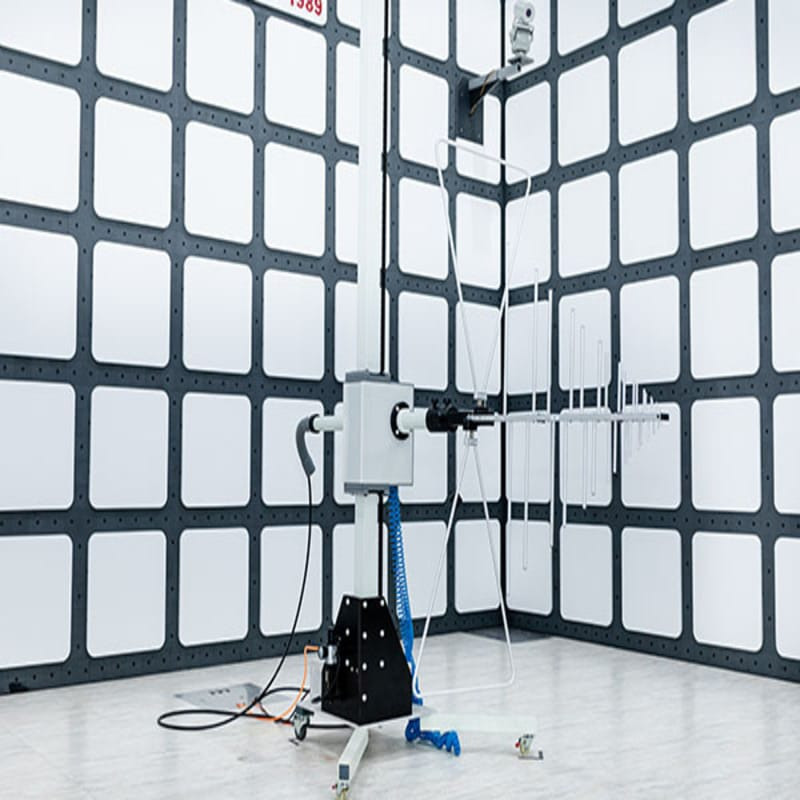
Hospital EMC environments are far more demanding than ordinary commercial electronics.
Typical EMC issues include:
- Radiated emission failure
- Conducted emission failure
- EFT instability
- Surge immunity failure
- Electrostatic discharge malfunction
In many projects, EMC redesign consumes more development time than the original electrical design itself.
4. When Global Certification Is Required
Medical OEMs selling internationally may require:
- International Electrotechnical Commission IEC 60601-1
- IEC 60601-1-2 EMC
- Underwriters Laboratories UL
- Conformité Européenne CE
- Federal Communications Commission FCC
- CSA Group CSA
- Restriction of Hazardous Substances Directive RoHS
Custom power supply manufacturers with existing medical certification platforms can significantly shorten approval timelines.
Key Engineering Challenges in Medical Power Supply Design
This is where real medical power supply development becomes difficult.
Thermal Management in Compact Enclosures
Portable medical devices often operate continuously inside sealed plastic enclosures with minimal airflow.
Common problems include:
- Transformer overheating
- MOSFET temperature rise
- Electrolytic capacitor aging
- Reduced power density reliability
In several portable monitor projects, thermal hotspots near secondary rectification stages caused long-term instability after burn-in testing.
Custom thermal optimization often includes:
- Transformer redesign
- PCB copper balancing
- Airflow simulation
- Heat sink optimization
- Potting materials
- Higher efficiency topology
EMC Optimization Challenges
Many OEMs underestimate EMC complexity during early development.
Typical issues include:
| EMC Problem | Common Cause |
| Radiated emission failure | Transformer coupling noise |
| Conducted noise | Inadequate filtering |
| ESD malfunction | Poor grounding design |
| Surge failure | Weak protection topology |
| RF susceptibility | PCB layout issues |
Experienced medical PSU suppliers usually perform pre-compliance EMC testing before formal certification.
This significantly reduces redesign risk.
Long Lifecycle Component Management
Medical equipment often remains in production for:
- 5 years
- 10 years
- Sometimes over 15 years
Component obsolescence becomes a major supply chain risk.
Reliable OEM/ODM suppliers typically implement:
- PCN management
- Alternative BOM strategy
- Lifecycle monitoring
- Long-term sourcing agreements
- Traceability systems
What Can Be Customized?
Electrical Parameters
- Input range
- Output voltage
- Output current
- Dual or multiple outputs
- Ripple and noise
- Hold-up time
- Battery charging
- Protection functions
- Power factor correction
Safety Performance
- 2×MOPP isolation
- 2×MOOP isolation
- Leakage current
- Creepage distance
- Clearance distance
- Isolation voltage
Mechanical Design
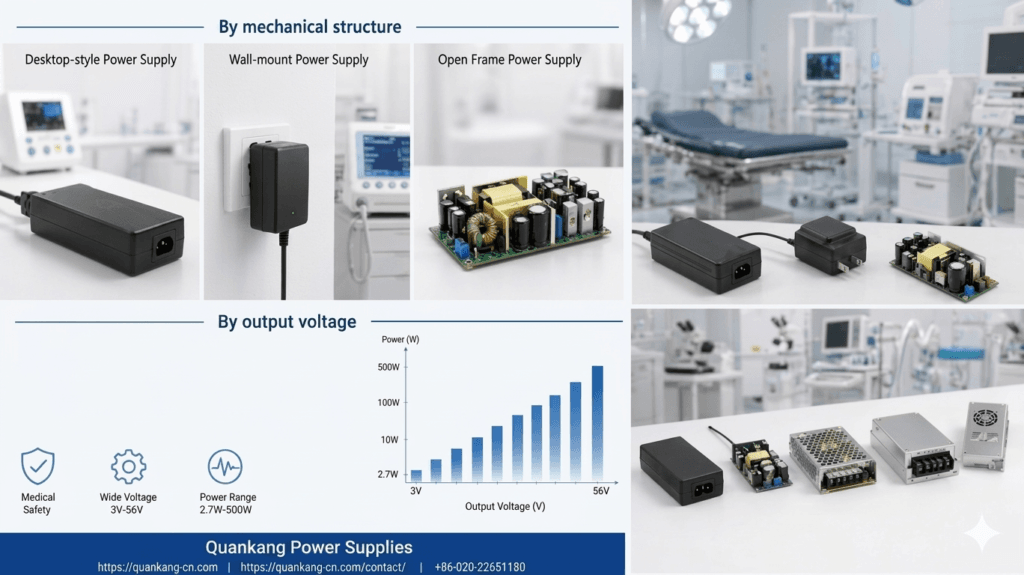
- Open frame
- Enclosed chassis
- Desktop adapter
- Wall mount adapter
- Ultra-thin structure
- Fanless cooling
- Waterproof housing
Connectors and Cabling
- Locking DC connectors
- Medical locking plugs
- Custom cable lengths
- Color coding
- Shielded cable design
Connector reliability is especially important for mobile medical systems where vibration and movement are common.
Branding and OEM Support
- Logo printing
- Private label packaging
- Regulatory labels
- User manuals
- Carton customization
IEC 60601-1 Compliance Explained
Why IEC 60601-1 Matters
International Electrotechnical Commission IEC 60601-1 is the core safety standard for medical electrical equipment.
It focuses heavily on:
- Patient protection
- Electrical isolation
- Mechanical safety
- Thermal safety
- Abnormal condition operation
Failure to meet IEC 60601-1 can prevent medical products from entering major global markets.
Understanding 2×MOPP, Leakage Current, and EMC
What Is 2×MOPP?
Means of Patient Protection (MOPP) defines insulation requirements between electrical circuits and patients.
2×MOPP generally requires:
- Higher isolation voltage
- Larger creepage distance
- Larger clearance distance
- Reinforced insulation structure
Devices with direct patient contact often require 2×MOPP compliance.
Why Leakage Current Is Critical
Leakage current directly affects patient safety.
Even small current leakage can become dangerous in sensitive medical applications.
Leakage current challenges commonly increase when:
- Higher power density is required
- EMI filtering becomes more aggressive
- Multiple outputs are used
- Compact layouts reduce spacing
Balancing EMC performance and leakage current is one of the most difficult parts of medical power supply design.
Real Engineering Case Studies
Case Study 1: Portable Ultrasound System
Customer Challenge
A portable ultrasound OEM required:
- 24V output
- Fanless operation
- IEC 60601-1 certification
- Maximum enclosure height below 28mm
Initial industrial PSU solutions failed thermal testing.
Engineering Solution
The redesign included:
- LLC topology optimization
- Transformer redesign
- Aluminum baseplate cooling
- Secondary-side thermal balancing
- Improved airflow structure
Result
- Passed thermal validation
- Reduced enclosure temperature by 11°C
- Achieved IEC 60601-1 compliance
- Improved long-term reliability
Case Study 2: Infusion Pump EMC Failure
Problem
During IEC 60601-1-2 testing, the infusion pump repeatedly failed EFT immunity testing.
Root cause analysis identified excessive common-mode noise coupling.
Solution
Engineers implemented:
- Additional common-mode filtering
- Transformer shielding redesign
- PCB grounding optimization
- Cable shielding improvements
Final Outcome
The device successfully passed:
- EFT
- Surge
- ESD
- Radiated immunity testing
without redesigning the complete system architecture.
Custom vs Standard Medical Power Supplies
| Feature | Standard Adapter | Custom Medical PSU |
| IEC 60601-1 optimization | Limited | Fully optimized |
| Leakage current control | Basic | Advanced |
| EMC performance | General purpose | Medical-grade |
| Mechanical fit | Fixed | Customized |
| Connector options | Limited | Flexible |
| Thermal optimization | Standard | Application-specific |
| Long lifecycle support | Weak | Strong |
| Certification support | Minimal | Comprehensive |
Medical Device Applications
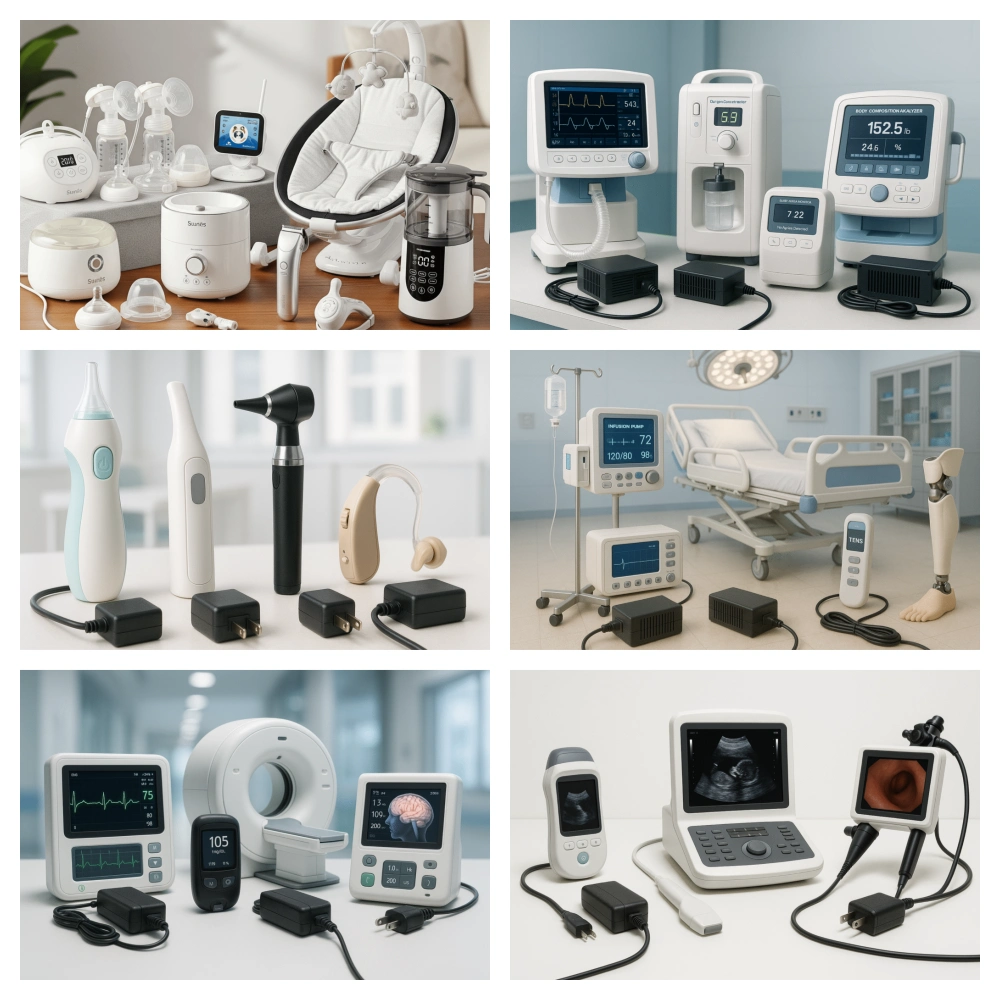
Custom medical power supplies are widely used in:
- Patient monitors
- Ventilators
- Infusion pumps
- Ultrasound systems
- CT scanners
- MRI systems
- Dental equipment
- Endoscopy systems
- Sleep therapy devices
- Home healthcare equipment
- Laboratory analyzers
- Surgical systems
OEM/ODM Development Process
Step 1 — Requirement Analysis
Customers provide:
- Electrical specifications
- Mechanical drawings
- Certification targets
- Operating environment
- Forecast volume
Step 2 — Feasibility Evaluation
Engineering teams review:
- Safety compliance
- Thermal structure
- EMC risks
- Isolation design
- Supply chain availability
Step 3 — Prototype Development
Engineering samples undergo:
- Electrical validation
- Thermal testing
- EMC pre-testing
- Reliability verification
Step 4 — Certification Support
Manufacturers typically support:
- CB reports
- Safety reports
- EMC reports
- Technical documentation
Step 5 — Mass Production
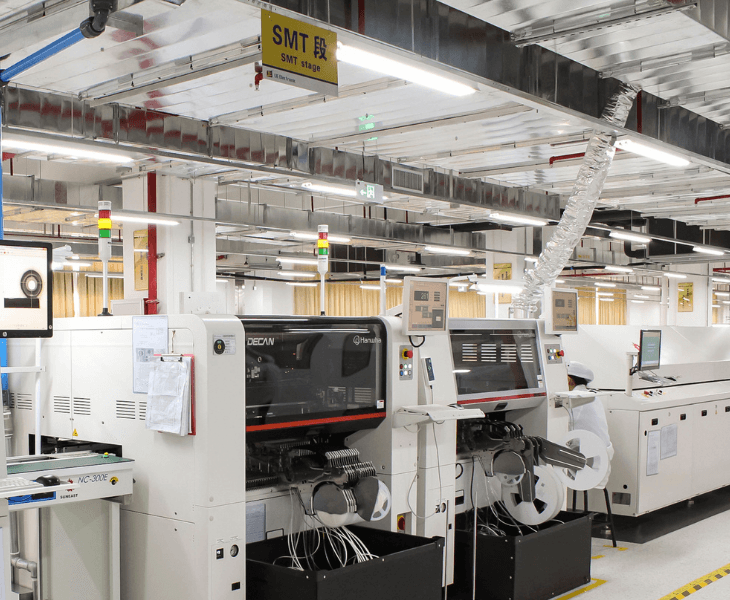
Mass production includes:
- ICT/FCT testing
- Aging test
- Traceability management
- Quality inspection
- Batch consistency verification
MOQ, Lead Time, and Certification Timeline
| Project Type | Typical MOQ |
| Label customization | 100–500 pcs |
| Connector changes | 200–1,000 pcs |
| Minor electrical modification | 500–2,000 pcs |
| Full custom design | 1,000–5,000 pcs |
Typical Timeline
| Stage | Lead Time |
| Requirement review | 1–3 days |
| Quotation | 3–7 days |
| Prototype | 2–6 weeks |
| EMC optimization | 1–4 weeks |
| Certification | 6–12 weeks |
| Mass production | 3–6 weeks |
Total development time is typically 2–6 months depending on complexity.
Common Certification Failure Risks
1. Excessive Leakage Current
Often caused by aggressive EMI filtering.
2. Creepage Distance Violations
Compact layouts frequently reduce insulation spacing below IEC requirements.
3. Thermal Overheating
Poor airflow design may cause transformer or capacitor overheating.
4. EMC Failure
Common during:
- EFT testing
- Surge testing
- Radiated emission
- Conducted emission
5. Incomplete Documentation
Missing technical files can delay certification approval significantly.
How to Choose a Reliable Medical Power Supply Manufacturer
1. Medical Industry Experience
Look for suppliers with proven medical project history.
2. Certification Capability
Key certifications include:
- ISO 13485
- ISO 9001
- IEC 60601-1
- CB Scheme
3. Engineering Strength
Evaluate:
- EMC laboratory capability
- Thermal simulation capability
- Reliability testing
- Certification experience
4. Manufacturing Quality Control
Important capabilities include:
- Traceability systems
- Automated testing
- Aging procedures
- PCN management
- Supplier qualification systems
5. Regulatory Support
Reliable suppliers should provide:
- CB reports
- Test reports
- Risk documentation
- Technical support during certification
Conclusion
Custom medical power supplies are no longer simply optional accessories for medical devices. They are now critical components that directly influence safety, EMC performance, thermal reliability, certification success, and long-term product stability.
For medical OEMs, choosing the right power supply partner can significantly reduce engineering risk, shorten certification timelines, improve reliability, and simplify global market entry.
Whether developing a portable ultrasound system, infusion pump, patient monitor, or home healthcare product, a properly engineered custom medical power supply helps manufacturers achieve:
- Better system integration
- Faster IEC 60601-1 approval
- Lower field failure rates
- Improved EMC performance
- Stronger product differentiation
- More stable long-term supply chains
As medical devices continue becoming smaller, smarter, and more portable, demand for highly customized medical-grade power solutions will continue to grow rapidly.
Frequently Asked Questions
Can custom medical power supplies still pass IEC 60601-1 certification?
Yes. Properly designed custom solutions can fully comply with IEC 60601-1 requirements.
What is the difference between MOOP and MOPP?
MOPP requires stricter insulation and patient protection standards compared to MOOP.
Can IEC 62368-1 adapters be used in medical devices?
Usually not for patient-connected applications. Medical devices often require IEC 60601-1 compliance.
Are fanless medical power supplies reliable?
Yes, when thermal management is properly optimized.
Is custom development expensive?
Minor modifications are often low-cost. Fully customized projects usually require NRE investment but reduce long-term integration risk.
Can startups request custom medical power supplies?
Yes. Many OEM/ODM manufacturers support low-volume development projects.