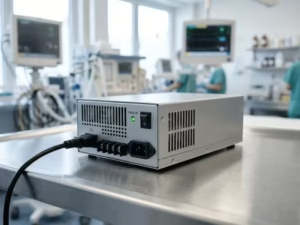
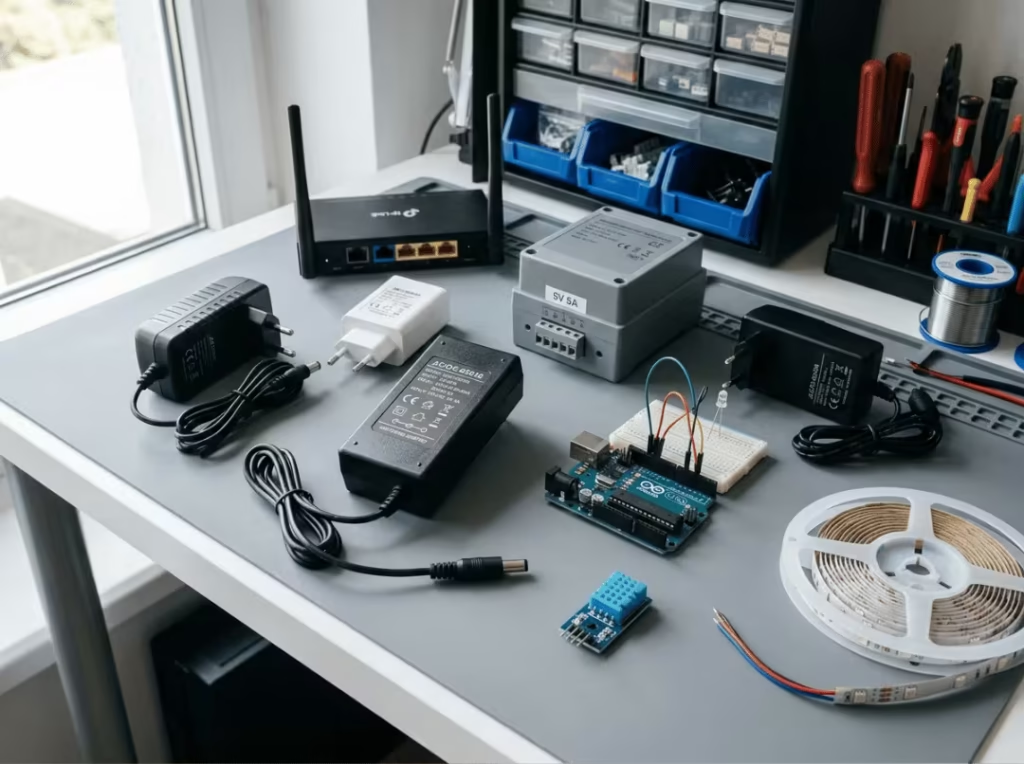
5V DC power supplies run microcontrollers, LED strips, IoT sensors, networking devices, and USB-powered accessories. Getting the selection right means matching both voltage and current rating to your actual load — and accounting for cable voltage drop, ripple tolerance, and safety certifications, not just the number on the label.
Most articles on 5V DC power supplies list devices that run on 5V and stop there. That’s useful as a quick reference. It doesn’t answer the questions that matter when you’re specifying or sourcing a supply: how much current each load actually needs, what happens across longer cable runs, when a phone charger is an acceptable substitute, and when 5V isn’t the right choice at all.
This guide covers the 5 most common 5V DC power supply applications, their current requirements, a reference table for rapid spec comparison, a practical five-step framework for confirming whether 5V is sufficient, and a clear comparison of 5V adapters, chargers, and USB power sources. There’s also a section on when to step up to 12V or 24V — because knowing where 5V stops working is as useful as knowing where it does.
Quankang’s ITE power adapter range covers a wide selection of 5V output options for both consumer and industrial applications, including OEM and custom-rated configurations.
Why 5V DC Became a Universal Low-Voltage Standard
Two independent forces converged to make 5V the default low-voltage standard in electronics — and understanding both explains why it remains dominant today.
The first was TTL logic. The 74-series TTL chips introduced in the late 1960s and 1970s established 5V as the standard operating voltage for digital logic. Entire generations of microcontrollers, processors, and embedded systems were built around that rail. That heritage didn’t disappear — it compounded.
The second was USB. When the USB specification was finalized in the late 1990s, it locked in a 5V DC output across all port types. Every USB standard since — USB-A, USB-B, USB-C, USB Power Delivery — begins handshake negotiation at 5V. Even when USB PD negotiates higher delivery voltages (9V, 15V, 20V), 5V remains the universal fallback. No other voltage has that kind of backward compatibility baked into a global interface standard.
In practice, “regulated 5V” means a stable DC output held within ±5% of 5.0V — between 4.75V and 5.25V. Logic-level circuits generally operate correctly within that window without additional downstream regulation.
There’s a cost benefit here too. Designers targeting 5V can source off-the-shelf 5V DC power supplies instead of building custom regulators, which reduces component count and simplifies certification. That said, voltage is only half of the selection equation. Current rating is the other half — and undersizing current is the single most common mistake in 5V supply selection.
Common 5V DC Power Supply Applications
Consumer Electronics
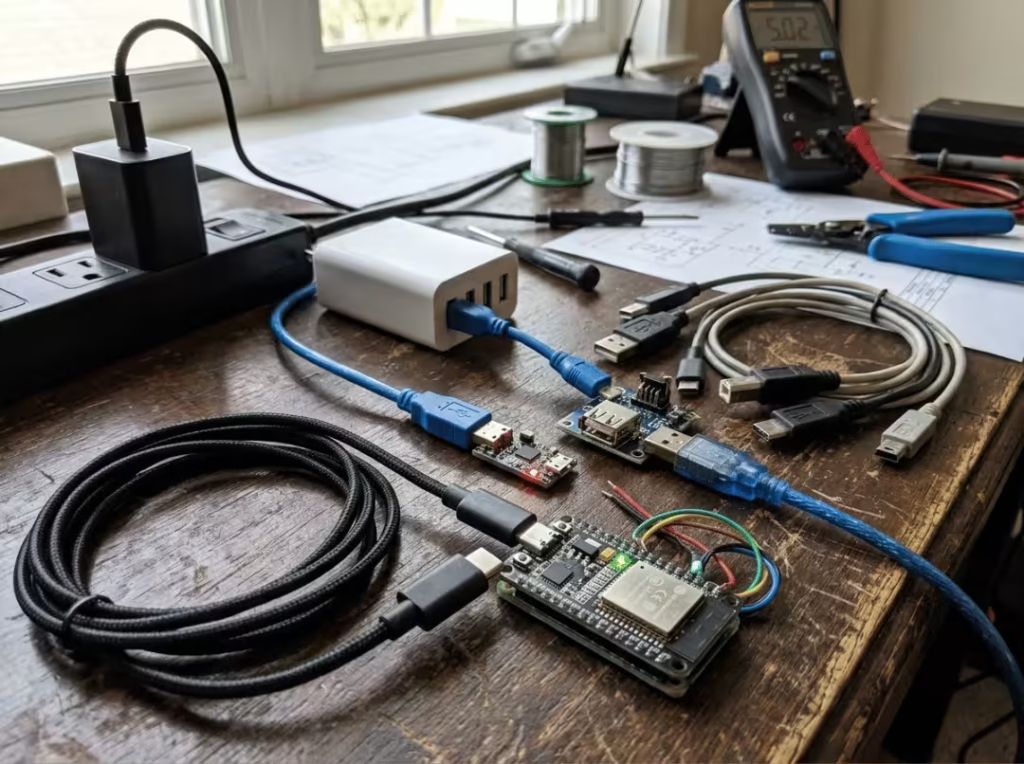
The highest-volume use case for 5V adapters is consumer electronics. Smartphones, tablets, Bluetooth accessories, portable speakers, and fitness trackers all charge at 5V — they form the foundation of the global USB adapter market.
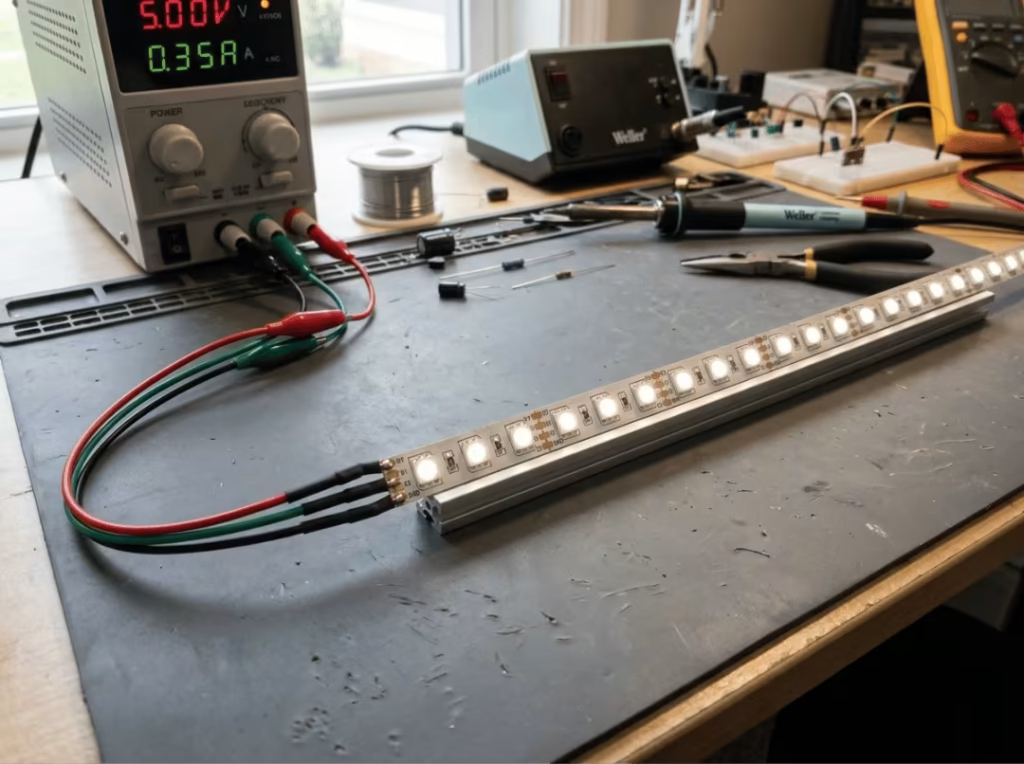
WS2812B LED strips are a commonly underestimated load in this category. Each LED draws roughly 60mA at full white. A 60-LED-per-meter strip at full brightness pulls 3.6A per meter — a figure that surprises designers who think of LEDs as inherently low-current. That current adds up fast across longer strips, and a 5V/1A adapter is nowhere near sufficient for anything beyond a handful of LEDs.
Even with the wider adoption of USB-C Power Delivery, 5V remains the baseline negotiation voltage. Devices that don’t support PD fall back to 5V automatically, preserving backward compatibility with the enormous installed base of existing adapters.
Embedded and Microcontroller Systems
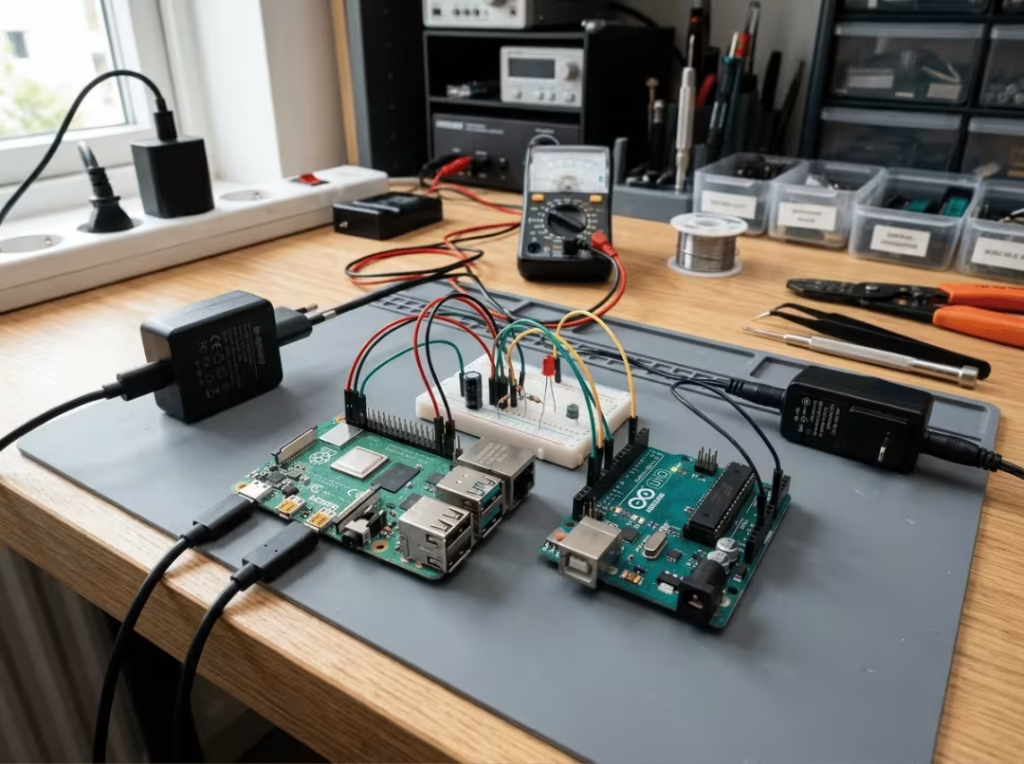
5V is deeply embedded in the development and prototyping ecosystem. The Arduino Uno and Nano accept a regulated 5V input and draw 50–200mA depending on connected peripherals — modest enough that most standard adapters handle them without issue.
The Raspberry Pi 4 is a different matter. The official minimum is 5V/3A, and that’s a hard design requirement, not a conservative suggestion. Running a Pi 4 on a 5V/1A or 5V/2A supply causes undervoltage throttling, CPU degradation, and in some cases SD card corruption from unstable write cycles. Current headroom isn’t optional here.
Sensor modules — temperature, humidity, light, IMU — typically accept 3.3V or 5V with onboard regulation and draw modest current. Motor drivers and relay modules use 5V for logic-level control, but the motor supply itself usually requires a separate, higher-current source. In education and lab settings, 5V breadboard rails are essentially the universal prototyping standard.
Networking and Smart Home Devices
Compact routers, modems, and unmanaged network switches typically run at 5V/1–2A — well within the range of a standard wall adapter. Low-power indoor IP cameras and smart home sensors are commonly USB-powered at 5V for non-PoE installations. IoT gateways and Bluetooth/Zigbee hubs share similar power budgets and fit naturally into 5V USB-based deployments.
One tradeoff worth noting: 5V eliminates the need for an onboard buck converter, which simplifies the BOM. The tradeoff is limited current headroom. For devices that occasionally spike above 2–3A, or for installations with long cable runs, 12V becomes a stronger candidate.
Industrial and IoT Applications
In industrial and IoT environments, 5V DC is a natural fit for sensor nodes, telemetry boards, and wireless automation controllers — it integrates directly with USB-based infrastructure and requires no additional voltage conversion. Small DC motors, relay control circuits, and portable lab instruments such as electronic thermometers, blood glucose meters, and benchtop educational devices all commonly operate at 5V.
The shift from consumer to industrial use changes what you need from the supply, though. Industrial deployments require regulated outputs with tight ripple specifications and appropriate safety certifications — UL, CE, CB at minimum. A consumer USB charger is not a substitute here, regardless of what the voltage label says.
5V DC Power Supply Applications: Current Requirements Table
The table below covers common devices and their typical current draws. Before locking in a supply rating, run through the five-step framework in the next section — the table gives you the numbers; the framework helps you apply them correctly.
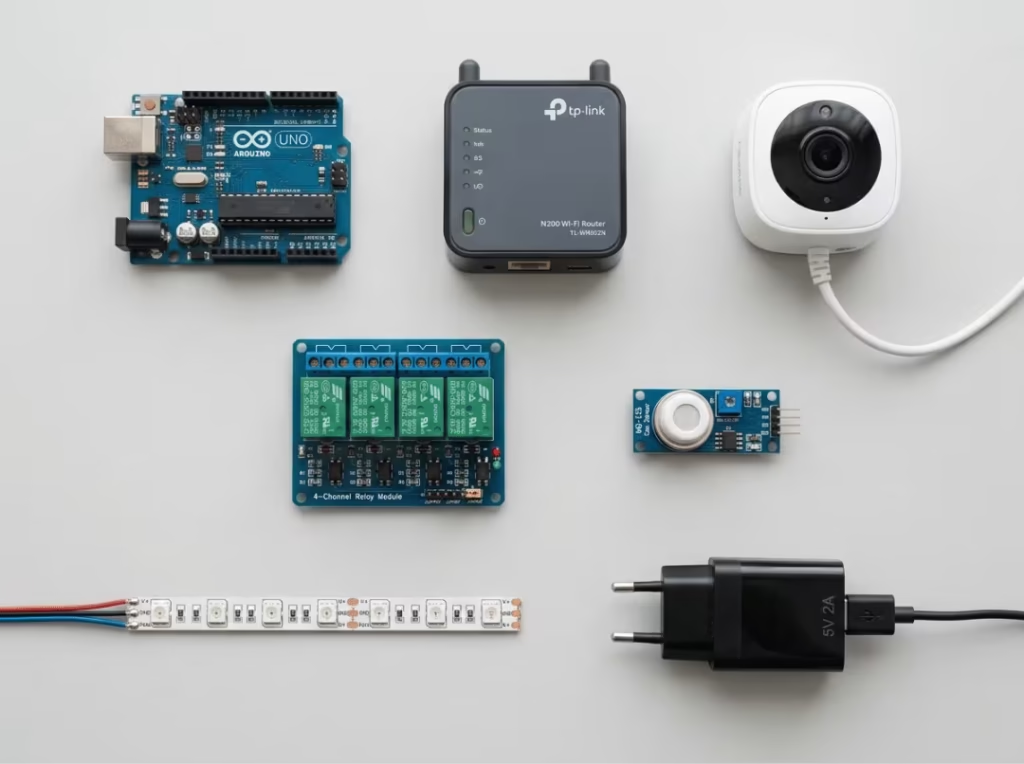
Recommended supply ratings include a 20–30% headroom buffer above peak draw. Never run a supply at its rated maximum for continuous loads.
Device / Application | Typical Voltage | Typical Current Draw | Recommended Supply Rating | Notes |
|---|---|---|---|---|
Arduino Uno | 5V | 50–200mA | 5V/500mA | Depends on shields and peripherals |
Raspberry Pi 4 | 5V | 600mA–2.5A | 5V/3A minimum | Firm requirement; undervoltage causes instability |
WS2812B LED strip (1m, 60 LEDs) | 5V | ~3.6A at full white | 5V/5A | Current scales linearly with strip length |
Single indoor IP camera | 5V | 500mA–1A | 5V/2A | USB-powered non-PoE installations |
IoT sensor node (e.g., ESP8266) | 5V | 80–300mA | 5V/500mA | RF transmit spikes require transient headroom |
ESP32 dev board | 5V | 150–500mA | 5V/1A | Higher draw during active Wi-Fi/BT periods |
Bluetooth hub / Zigbee coordinator | 5V | 200–500mA | 5V/1A | Modest steady-state draw |
Compact router / unmanaged switch | 5V | 500mA–1.5A | 5V/2A | Variable with port activity |
USB-powered OLED display | 5V | 20–100mA | 5V/500mA | Very low draw; often shares a supply with the MCU |
Relay module (5V coil) | 5V | 50–100mA per relay | 5V/500mA+ | Motor or solenoid load needs a separate supply |
For cable selection guidance relevant to these loads, see DC 5V Compatibility: Which Chargers and Cables Work?
How to Know If 5V Is Enough for Your Device
The table above tells you what devices typically draw. This framework tells you whether a given supply will actually work in your specific installation.
Step 1 — Confirm the device’s input voltage range. Check the label or datasheet. If the range includes 5V, establish whether the device has onboard regulation or expects a clean 5V rail directly at the input. Devices with onboard LDOs add a dissipation factor; those expecting a clean rail have no tolerance for output sag.
Step 2 — Calculate total current demand. Add up the current draw of every load on the 5V rail — peripherals, sensors, co-powered modules. Then add 20–30% headroom for peak transients and thermal margin.
Step 3 — Check voltage drop across the cable. A device rated for 5V may see only 4.6V at the end of a 2-meter thin-gauge cable under load. That 400mV drop can push a microcontroller below its minimum operating voltage. Specify wire gauge and cable length together — they’re not independent variables.
Step 4 — Review the power dissipation budget. If meaningful regulation happens downstream — a 5V-to-3.3V LDO feeding a sensor subsystem, for example — calculate the heat dissipated across that regulator and confirm the enclosure can manage it.
Step 5 — Assess dynamic load behavior. Motors, RF transmitters, and display backlights generate current spikes. A supply with poor transient response lets the output rail sag during those spikes, which can trigger resets or erratic behavior. Check the transient response specification, not just the steady-state regulation figure.
5V Adapter vs. 5V Charger vs. USB Power Source: What’s the Practical Difference?
These terms get used interchangeably in general conversation, but they represent meaningfully different things when you’re specifying a supply for embedded or industrial use.
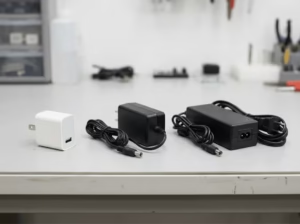
A 5V DC power supply or adapter delivers a fixed, regulated 5V output designed for continuous load. It’s typically certified for ITE or industrial use, with specified voltage regulation accuracy (often ±2–3%) and a defined output ripple specification. Output is labeled by current rating: 5V/1A, 5V/2A, 5V/3A.
A 5V charger is optimized for battery charging profiles. It may include over-voltage and over-current protection tuned to a specific battery chemistry. The output behavior during charge termination, trickle charge, and cutoff is designed around a battery load — not a logic circuit expecting a stable, continuous DC rail.
A USB power source — wall port, laptop port, or power bank — adheres to USB current specs: 5V/500mA for USB 2.0, 5V/900mA for USB 3.0, up to 5V/3A for standard USB-C. Output quality varies widely by manufacturer. Ripple, regulation accuracy, and thermal stability are rarely documented in consumer product specifications.
The practical rule: for a phone charging cable, any 5V charger works fine. For a Raspberry Pi, an embedded control board, or an industrial sensor node, use a properly rated 5V DC power supply — not a phone charger. The voltage reads the same on a multimeter. The behavior under dynamic load does not.
For a detailed side-by-side breakdown, see Difference Between 5V Power Supply and 5V Charger.
When Should You Use 12V or Another Voltage Instead?
5V has real limits. Identifying them before design lock-in avoids costly redesigns and field failures.
Motor-driven systems. Most DC motors above hobby grade require 12V or higher to deliver useful torque and speed. At 5V, motor drives are current-limited and thermally stressed under any meaningful mechanical load.
Higher-power LED systems. Larger LED strips, high-lumen fixtures, and RGBW architectural lighting are typically 12V or 24V. Powering them at 5V requires current levels that cause significant voltage drop and heat — particularly over longer runs.
Long cable runs. Voltage drop scales with both current and cable length. For the same wattage, a 12V supply delivers power at roughly one-third the current of a 5V supply, which dramatically reduces voltage drop and allows the use of thinner wire gauges over longer distances.
Industrial automation with relay-heavy loads. Solenoids, contactors, and industrial relay coils are commonly rated for 12V or 24V. Mixing 5V control with these loads requires additional converters and introduces extra failure points.
Power-over-Ethernet (PoE) applications. PoE runs at 48V DC precisely because cable-run power at lower voltages isn’t practical for distances beyond a few meters. 5V PoE-equivalent solutions don’t scale.
The practical boundary: 5V is the right choice when the load is logic-level or USB-compatible and the total current draw stays within the adapter’s range. When current exceeds roughly 3A per supply, cable runs are extended, or the load is electromechanical, 12V or 24V is the better choice.
Common Mistakes When Choosing a 5V Power Supply
Undersizing current. A 5V/1A supply connected to a Raspberry Pi 4 — which requires 5V/3A — triggers undervoltage warnings immediately, throttles the CPU, and risks corrupting data on the storage media. Always check peak draw under actual operating conditions, not just the idle current figure.
Ignoring voltage drop on cable runs. A 5V/3A supply running through a 3-meter 28AWG cable can deliver as little as 4.5V at the device end. Many microcontrollers have a minimum operating voltage of 4.75V. This is a design error, not a component failure — and it’s entirely preventable by specifying wire gauge and cable length together from the start.
Using consumer USB chargers in industrial or embedded applications. Phone chargers aren’t built for continuous regulated output. Ripple and regulation accuracy are typically unspecified. Thermal behavior under sustained load differs from the short charging bursts they’re designed for. Any application requiring reliable, continuous 5V power needs a supply with documented regulation and ripple specifications.
Overlooking ripple and noise. All switching supplies generate some output ripple. For digital loads and most microcontrollers, 50–100mV is acceptable. For analog sensor circuits, RF modules, or audio amplifiers, ripple above 20–30mV degrades signal quality in measurable ways. Specify a low-ripple supply for sensitive loads — or add downstream filtering where you can’t.
Choosing an uncertified supply. UL, CE, and CB certification isn’t administrative box-checking. Uncertified supplies may pass incoming inspection on a test bench at room temperature and fail in the field at elevated temperature or humidity. For medical, industrial, and public installation contexts, certification is both a regulatory requirement and a reliable indicator of protection performance. Before placing a volume order, verify that all certifications are active and traceable through the issuing body.
For a complete selection guide, see How to Choose the Right DC 5V Power Supply or Charger.
Sourcing a 5V Power Supply: What to Look for
The decisions covered in this guide — current sizing, cable voltage drop, ripple tolerance, certification requirements — are the same factors that determine whether a product holds up in the field or generates warranty returns six months after launch.
If you’re finalizing a 5V supply specification, here’s a practical starting point: use the current requirements table to anchor your rating, work through the five-step framework to catch installation-specific risks, and confirm certification requirements before placing volume orders.
Quankang’s ITE power adapter range includes 5V output configurations for consumer and industrial applications, with support for custom output ratings, OEM specifications, and certifications such as CE, UL, CB, and ISO 13485 for medical-adjacent use cases. Custom casing, cable length, and connector configurations are available without minimum order requirements for modifications.
FAQ: 5V DC Power Supply
What can a 5V DC power supply run?
A 5V DC power supply can run microcontrollers (Arduino, Raspberry Pi), WS2812B LED strips, IoT sensor nodes, ESP32 and ESP8266 development boards, compact routers, smart home sensors, Bluetooth and Zigbee hubs, USB-powered OLED displays, relay modules, and most USB-charged consumer electronics. See the current requirements table above for device-by-device specs.
What current rating do I need for my 5V power supply?
Add up the current draw of every load on the 5V rail, then apply 20–30% headroom above that total to cover peak transients and thermal margin. Don’t spec a supply at its rated maximum for continuous use. A concrete example: a Raspberry Pi 4 with peripherals may draw up to 2.5A at peak — the correct supply is 5V/3A, not 5V/2.5A.
Is a 5V phone charger the same as a 5V DC power supply?
No. A phone charger is optimized for battery charging profiles, not for delivering a stable, continuous DC rail. Voltage regulation accuracy, output ripple, and transient response are typically unspecified in consumer charger documentation. For embedded systems and industrial loads, use a rated 5V DC power supply with documented specifications. See Difference Between 5V Power Supply and 5V Charger for a full comparison.
Why does my Raspberry Pi 4 show an undervoltage warning with a 5V supply connected?
In nearly every case, the problem is current headroom or cable voltage drop — not the supply’s nominal output. The Pi 4 requires a minimum of 5V/3A. If the supply is rated below that, or if the cable is thin or long enough to produce meaningful voltage drop under load, the Pi’s onboard voltage monitor triggers a warning and throttles the CPU. Check the supply’s current rating, cable gauge, and connector contact resistance.
Can I power multiple devices from one 5V supply?
Yes — provided the combined current draw of all connected devices, plus 20–30% headroom, stays within the supply’s rated output. Calculate each device’s draw individually, sum them, apply the headroom factor, then compare against the supply rating. Also confirm that the supply’s transient response can handle all devices switching loads simultaneously.
What certifications should a 5V industrial power supply have?
At minimum: UL (North America), CE (European market), and CB (international market access). FCC certification applies where RF emissions are relevant. For healthcare-adjacent or medical applications, IEC 60601-1 certification and ISO 13485 manufacturing compliance are typically required. Verify that all certifications are current and traceable through the issuing body before placing volume orders — don’t rely solely on what’s stated in the datasheet.
What is the difference between a 5V DC adapter and a 5V USB power source?
A 5V DC adapter is a dedicated power supply with a specified, certified, regulated output designed for continuous load operation. A 5V USB power source — wall port, power bank, or laptop port — conforms to USB current limits (500mA to 3A depending on the standard), but output quality varies considerably by manufacturer. For consumer USB accessories, either typically works. For embedded systems or industrial devices, a certified 5V DC adapter is the right choice. See the adapter vs. charger vs. USB section above for the full comparison.