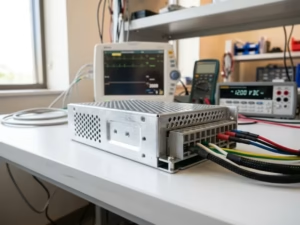
Power over Ethernet (PoE) allows network devices to receive electrical power and data through Ethernet cabling. It is widely used for IP cameras, WiFi access points, VoIP phones, industrial Ethernet equipment, IoT devices, and other network-connected products.
However, not all PoE technologies work in the same way.
When selecting a PoE adapter, PoE injector, or PoE power supply, one of the most important questions is whether the application requires Active PoE or Passive PoE.
The difference is critical because Active PoE uses a standardized power negotiation and detection process, while Passive PoE typically delivers power without the same device detection and negotiation mechanism.
Choosing the wrong PoE solution can result in compatibility problems and, in some cases, damage to connected equipment.
For network equipment manufacturers, system integrators, OEMs, ODMs, and engineers, understanding the difference between Active PoE and Passive PoE is essential for selecting the right power architecture.
This guide explains how Active PoE and Passive PoE work, their key differences, compatibility considerations, safety risks, typical applications, and how to choose the right PoE adapter for your device.
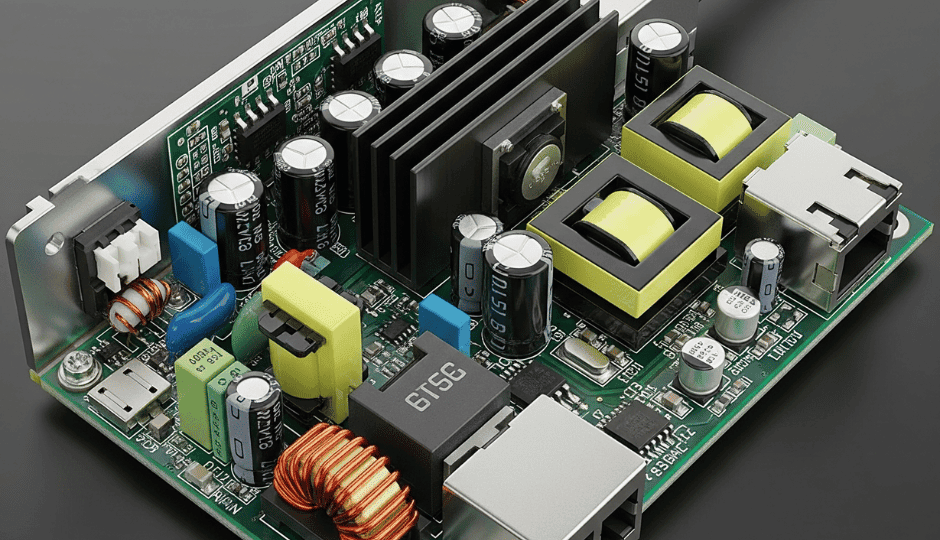
Quick Answer: Active PoE vs. Passive PoE
The simplest distinction is:
Active PoE is typically based on IEEE 802.3 PoE standards and uses detection and classification or negotiation mechanisms before delivering power. Passive PoE generally supplies power continuously at a predefined voltage without the same standardized detection and negotiation process.
In general:
- Active PoEis commonly used with IEEE 802.3af, 802.3at, and 802.3bt compliant devices.
- Passive PoEis typically used for specific devices designed to accept a predefined passive power input.
- Active PoEis generally the preferred choice for standardized enterprise and commercial network equipment.
- Passive PoEcan be suitable for specific applications when the device and power source are explicitly designed to work together.
If you are unsure which type your device requires, do not assume that any PoE adapter will work.
Always verify the device’s PoE requirements before connecting a power source.
What Is Active PoE?
Active PoE refers to PoE systems that use a standardized power delivery process to determine whether and how power should be supplied to a connected powered device (PD).
The most widely recognized IEEE PoE standards include:
- IEEE 802.3af
- IEEE 802.3at
- IEEE 802.3bt
These standards define how power is delivered between the power sourcing equipment (PSE) and the powered device.
Depending on the PoE standard, the system can use mechanisms for:
- Device detection
- Power classification
- Power negotiation
- Power allocation
This helps ensure that compatible devices receive the appropriate level of power.
A simplified Active PoE connection can be represented as:
AC or DC Input
↓
PoE Adapter / PoE Injector / PoE Switch
↓
IEEE PoE Detection and Power Delivery
↓
Powered Device (PD)
↓
IP Camera / WiFi Access Point / Network Device
The exact implementation depends on the equipment and PoE standard.
What Is Passive PoE?
Passive PoE is a type of power delivery method in which power is supplied over Ethernet without the same standardized device detection and negotiation process used by IEEE 802.3 PoE systems.
The power source may continuously apply a predefined voltage to specific Ethernet pairs.
Unlike Active PoE, the power source may not verify whether the connected device is designed to receive that voltage before delivering power.
Passive PoE solutions can be designed around different voltage levels and wiring configurations.
Therefore, compatibility must be verified carefully.
For example, a device designed for a specific passive PoE voltage may not be compatible with another passive PoE source using a different voltage.
This means that Passive PoE should not be treated as a universal PoE standard.
The exact requirements must be confirmed between the power source and powered device.

Active PoE vs. Passive PoE: Key Differences
The most important differences can be summarized as follows:
| Feature | Active PoE | Passive PoE |
| IEEE 802.3 Standard | Typically yes | Typically no |
| Device Detection | Supported by standardized mechanisms | Typically not supported |
| Power Negotiation / Classification | Supported depending on standard | Typically not supported |
| Power Delivery | Controlled according to PoE standard | Usually continuously supplied |
| Compatibility | Broad compatibility with compliant devices | Device-specific |
| Voltage | Defined by applicable PoE standard | Depends on implementation |
| Incorrect Connection Risk | Generally lower with compliant equipment | Higher if specifications do not match |
| Typical Applications | Enterprise and commercial networks | Specific proprietary or device-specific applications |
| Device Interoperability | Generally higher | More limited |
| OEM Customization | Available for compliant solutions | May be application-specific |
The key difference is how power delivery is controlled and how compatibility is established.
If you require a standard power supply with high compatibility and auto-detection capabilities, you might consider the Quankang standard IEEE 802.3 series PoE adapters.
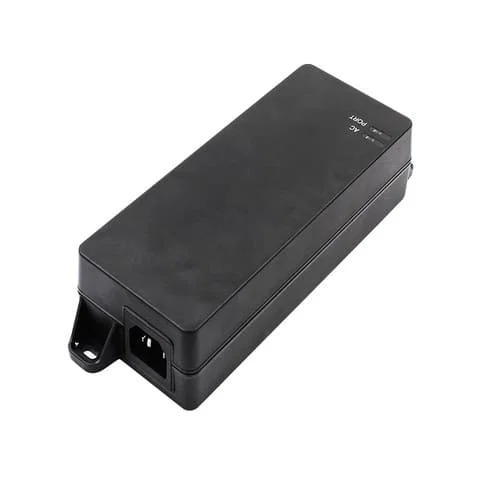
How Does Active PoE Detect a Device?
One of the main advantages of IEEE-compliant Active PoE is its ability to identify whether a connected device is designed to receive PoE power.
The process can be simplified into several stages.
Step 1: Device Connection
A powered device is connected to the PoE source using an Ethernet cable.
Step 2: Detection
The PoE source performs a detection process to determine whether the connected device is compatible with the PoE system.
Step 3: Classification or Power Negotiation
Depending on the PoE standard and implementation, the system determines the amount of power the device requires or is permitted to receive.
Step 4: Power Delivery
Once the appropriate conditions are met, power is supplied to the powered device.
This process helps reduce the risk of unintentionally applying PoE power to incompatible Ethernet equipment.
The exact behavior depends on the IEEE PoE standard and equipment implementation.
How Does Passive PoE Work?
Passive PoE typically does not use the same standardized detection process before supplying power.
The power source is configured to deliver a predefined voltage through designated Ethernet conductors.
The connected device must therefore already be designed to accept:
- The correct voltage
- The correct polarity
- The correct wiring configuration
- The appropriate power level
If these parameters do not match, the connected equipment may not operate correctly.
In some cases, incorrect voltage or wiring may cause equipment damage.
This is why Passive PoE requires careful verification before installation.
Active PoE vs. Passive PoE: Which Is Safer?
For general-purpose network equipment, Active PoE is generally considered the safer choice because standardized detection mechanisms help prevent power from being delivered to devices that are not recognized as compatible powered devices.
However, this does not mean that every Active PoE product is automatically safe in every situation.
System designers should still verify:
- PoE standard
- Input voltage
- Output power
- Device compatibility
- Cable configuration
- Protection functions
- Manufacturer specifications
Passive PoE can also be safe when used correctly with compatible equipment.
The key difference is that Passive PoE typically relies more heavily on the system designer or installer to verify compatibility before connecting the equipment.
Can Passive PoE Damage a Device?
Yes, it can, if the device is not designed to accept the supplied passive PoE voltage and wiring configuration.
Potential problems may include:
- Device failure
- Overvoltage damage
- Incorrect power delivery
- Network instability
- Unexpected device shutdown
For this reason:
Never connect a Passive PoE power source to a device unless the device manufacturer explicitly confirms compatibility.
This is particularly important when working with:
- IP cameras
- WiFi access points
- Industrial Ethernet devices
- IoT gateways
- Network switches
- OEM equipment
Is IEEE 802.3 PoE Active PoE?
In general, IEEE 802.3af, 802.3at, and 802.3bt are considered Active PoE because they use standardized mechanisms for device detection and power delivery.
These standards include:
- IEEE 802.3af — PoE
- IEEE 802.3at — PoE+
- IEEE 802.3bt — PoE++
They are widely used for standardized network devices.
For example, IEEE-compliant PoE may be used to power:
- IP cameras
- WiFi access points
- VoIP phones
- Network devices
- Industrial Ethernet equipment
- IoT devices
However, not every product described as “PoE” is necessarily IEEE 802.3 compliant.
Always check the actual product specifications.
Active PoE vs. Passive PoE Voltage
Voltage is one of the most important considerations when comparing Active and Passive PoE.
IEEE 802.3 PoE systems operate within standardized voltage ranges defined by the applicable PoE standard.
Passive PoE, on the other hand, may use different voltage levels depending on the product and application.
Common passive PoE implementations may include:
- 12V
- 24V
- 48V
The actual voltage must be confirmed from the device documentation.
For example, a device designed for 24V Passive PoE should not be connected to a Passive PoE source that supplies a different voltage unless the device explicitly supports it.
Therefore:
Never select a Passive PoE adapter based only on the product name. Always verify the exact input voltage and wiring requirements.

Active PoE vs. Passive PoE for IP Cameras
IP cameras are one of the most common PoE applications.
However, the appropriate solution depends on the camera model.
A standard IEEE PoE-compatible IP camera may support:
- 3af
- 3at
- 3bt
The required standard depends on the camera’s power consumption and features.
For example:
Basic Fixed IP Camera
A low-power fixed camera may require IEEE 802.3af.
IR IP Camera
A camera with infrared illumination may require additional power when operating in night mode.
PTZ Camera
A PTZ camera may require more power because of:
- Pan motors
- Tilt motors
- Optical zoom
- IR illumination
- Heaters
Higher-power PoE may be required.
If the camera is designed for IEEE 802.3 PoE, an IEEE-compliant Active PoE adapter is generally the appropriate solution.
Passive PoE should only be used when the camera manufacturer explicitly specifies compatibility.
For more information, see:
How to Choose the Right PoE Adapter for IP Cameras: A Complete Guide
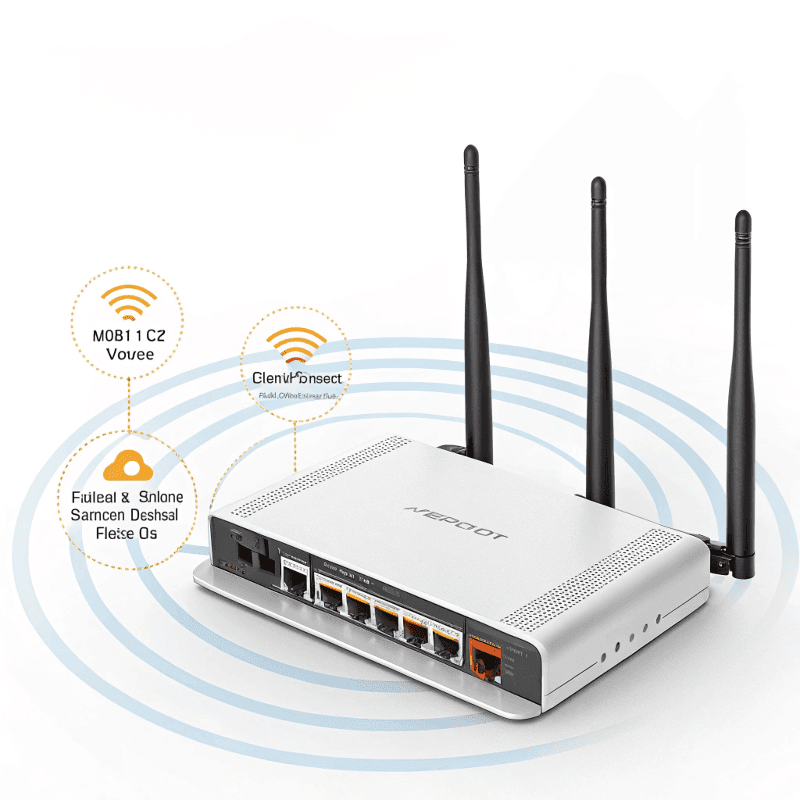
Active PoE vs. Passive PoE for WiFi Access Points
WiFi access points also have different power requirements.
A basic access point may require relatively little power, while advanced WiFi equipment may require more.
Power requirements can depend on:
- WiFi generation
- Number of radios
- Antennas
- Maximum transmit power
- USB functions
- Additional hardware
Many enterprise WiFi access points are designed for IEEE-compliant PoE.
The correct PoE adapter should therefore match the access point’s required PoE standard and power consumption.
For WiFi 6 and WiFi 7 access points, higher-power PoE may be required depending on the product design.
For more information, see:
How to Choose the Right PoE Adapter for WiFi Access Points: A Complete Guide
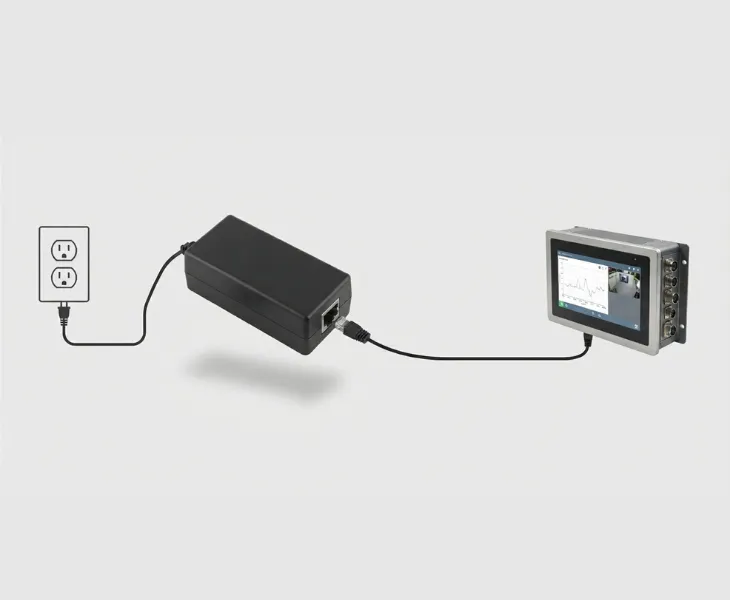
Active PoE vs. Passive PoE for Industrial Applications
Industrial applications require additional attention to compatibility and environmental conditions.
Industrial network devices may be exposed to:
- Wide temperature ranges
- Electrical noise
- Voltage fluctuations
- Transient disturbances
- Continuous operation
For standardized Industrial Ethernet devices, an IEEE-compliant Active PoE solution may offer a more interoperable architecture.
However, some industrial or proprietary equipment may be designed specifically for Passive PoE.
In such cases, the exact requirements must be verified.
Industrial PoE selection should consider:
- PoE standard
- Input voltage
- Output power
- Operating temperature
- EMC performance
- Surge protection
- Overvoltage protection
- Overcurrent protection
- Short-circuit protection
- Long-term reliability
For OEM and ODM applications, the PoE solution should be evaluated as part of the complete industrial equipment design.
For more information, see:
Industrial PoE Adapter: How to Choose the Right Solution for Industrial Ethernet
Active PoE vs. Passive PoE: Which One Should You Choose?
The decision can be simplified as follows.
Choose Active PoE When:
- The device supports IEEE 802.3 PoE.
- Interoperability is important.
- The network uses standardized PoE equipment.
- You want standardized detection and power delivery.
- The equipment is used in enterprise or commercial networks.
- You need a broadly compatible PoE architecture.
Consider Passive PoE When:
- The powered device explicitly supports Passive PoE.
- The required voltage is clearly specified.
- The power source and device are designed to work together.
- The application uses proprietary or device-specific PoE.
If You Are Not Sure:
Do not connect the equipment until the PoE requirements have been verified.
Check:
- PoE standard
- Input voltage
- Maximum power
- PoE class
- Wiring configuration
- Connector requirements
If the device documentation does not clearly specify Passive PoE compatibility, do not assume that a Passive PoE adapter will work.
How to Choose the Right PoE Adapter: Active or Passive?
When selecting a PoE adapter, follow these steps.
Step 1: Identify the Powered Device
Determine the exact model and application.
Is it:
- IP camera?
- WiFi access point?
- Industrial Ethernet device?
- IoT gateway?
- VoIP phone?
- Custom OEM device?
Step 2: Check the PoE Standard
Determine whether the device supports:
- IEEE 802.3af
- IEEE 802.3at
- IEEE 802.3bt
- Passive PoE
Do not assume compatibility based on the word “PoE” alone.
Step 3: Check Power Requirements
Confirm:
- Maximum power
- Average power
- Startup power
- Peak power
The PoE source should provide sufficient power under the device’s maximum operating conditions.
Step 4: Confirm Voltage Requirements
This is especially important for Passive PoE.
Verify:
- Voltage
- Polarity
- Wiring configuration
Step 5: Consider the Operating Environment
For industrial or outdoor applications, evaluate:
- Temperature
- Humidity
- EMC
- Surge
- Electrical noise
Step 6: Consider the Network Architecture
Determine whether you need:
- PoE adapter
- PoE injector
- PoE switch
The right solution depends on the number of devices and overall network design.
Active PoE vs. Passive PoE for OEM and ODM Applications
For OEM and ODM customers, the Active vs. Passive PoE decision should be made early in the product development process.
A customized PoE adapter may need to meet specific requirements for:
- Input voltage
- Output power
- PoE standard
- PoE class
- Connector
- Mechanical dimensions
- Protection functions
- Operating temperature
- EMC
- Safety
- Certifications
For example, an IP camera manufacturer may develop a new camera that requires a specific PoE power level and customized connector.
An industrial equipment manufacturer may require a PoE adapter that supports a specific input voltage and environmental condition.
An IoT equipment manufacturer may need a compact PoE solution that fits within a limited enclosure.
In these situations, working with an OEM/ODM PoE adapter manufacturer can allow the power solution to be developed around the equipment’s requirements.
The development process may include:
Application Analysis
↓
PoE Architecture Selection
↓
Electrical Specification
↓
Prototype Development
↓
Engineering Testing
↓
Design Optimization
↓
Mass Production
This approach can reduce compatibility issues and help ensure that the PoE adapter is properly integrated into the final product.
Whether you require Passive PoE with non-standard voltages or Active PoE solutions featuring specific housings or interfaces, please take a look at our custom power adapter services.
Active PoE vs. Passive PoE: Common Mistakes
Mistake 1: Assuming All PoE Is the Same
“PoE” is a broad term.
Always check whether the device supports IEEE 802.3 PoE or a specific Passive PoE implementation.
Mistake 2: Connecting Passive PoE Without Checking Voltage
Passive PoE may use different voltage levels.
Always verify the exact voltage before connection.
Mistake 3: Assuming a Higher Wattage Is Better
More power does not automatically mean better compatibility.
The PoE standard and device requirements must match.
Mistake 4: Confusing PoE Adapter and PoE Injector
These products may serve different roles in a network architecture.
Select the equipment according to the actual application.
Mistake 5: Ignoring Peak Power
Some devices consume more power during startup or when additional functions are activated.
Always consider maximum and peak power requirements.
Mistake 6: Choosing a Product Without Considering the End Application
A PoE solution suitable for an office network may not be suitable for an industrial environment.
Evaluate the complete operating conditions.
Active PoE vs. Passive PoE Selection Checklist
Before purchasing or designing a PoE power solution, verify:
Device model
IEEE 802.3af / 802.3at / 802.3bt support
Passive PoE support, if applicable
Input voltage
Maximum power consumption
Peak power
PoE class
Polarity
Ethernet wiring configuration
Cable length
Operating temperature
EMC requirements
Surge protection
Overvoltage protection
Overcurrent protection
Short-circuit protection
Safety certifications
OEM/ODM requirements
Frequently Asked Questions
Is Active PoE better than Passive PoE?
Not necessarily.
Active PoE is generally preferred when standardized IEEE PoE compatibility and interoperability are required.
Passive PoE can be appropriate for specific devices designed to use a particular passive power configuration.
The best choice depends on the equipment.
Is 802.3af Active PoE?
Yes.
IEEE 802.3af is an Active PoE standard that uses standardized detection and power delivery mechanisms.
Is 802.3at Active PoE?
Yes.
IEEE 802.3at, commonly known as PoE+, is an IEEE-standardized Active PoE technology.
Is 802.3bt Active PoE?
Yes.
IEEE 802.3bt is an Active PoE standard designed to support higher power levels than earlier IEEE PoE standards.
Can I use a Passive PoE adapter with an 802.3af device?
Generally, you should not assume compatibility.
An IEEE 802.3af device is designed to operate according to the IEEE PoE standard.
A Passive PoE source may not provide the detection and power delivery behavior required by the device.
Always confirm compatibility with the equipment manufacturer.
Can I use an Active PoE adapter with a Passive PoE device?
Not necessarily.
A Passive PoE device may require a specific voltage and wiring configuration that is different from IEEE 802.3 PoE.
Check the device specifications before connecting it.
Which is better for IP cameras: Active or Passive PoE?
For IP cameras that support IEEE 802.3af, 802.3at, or 802.3bt, an IEEE-compliant Active PoE solution is generally appropriate.
Passive PoE should only be used when the camera is specifically designed for the corresponding passive PoE configuration.
Which is better for WiFi access points?
Many enterprise WiFi access points use IEEE-standardized Active PoE.
However, the correct solution depends on the specific access point model and its required PoE standard.
Is Passive PoE dangerous?
Passive PoE is not inherently dangerous when used with compatible equipment.
However, because it typically does not use the same standardized detection process as IEEE 802.3 PoE, incorrect voltage or wiring can create compatibility risks.
Always verify specifications before connection.
Final Thoughts: Active PoE or Passive PoE?
The difference between Active PoE and Passive PoE is primarily about how power is delivered, detected, and managed.
Active PoE based on IEEE 802.3 standards is generally the preferred solution for standardized network equipment because it provides a more interoperable and controlled approach to power delivery.
Passive PoE can be effective for specific applications when the power source and powered device are explicitly designed to work together.
The most important rule is:
Never choose a PoE adapter based solely on the word “PoE” or the advertised wattage. Verify the PoE standard, voltage, power requirements, and device compatibility first.
For OEM and ODM applications, the selection process should begin even earlier.
The PoE power solution should be designed around the final product’s electrical, mechanical, environmental, and compliance requirements.
Quankang provides PoE adapter and PoE power supply solutions for network equipment and OEM/ODM applications.
If you are developing an IP camera, WiFi access point, Industrial Ethernet device, IoT product, or other PoE-enabled equipment, share your power specifications and application requirements with our engineering team.
Quankang can help evaluate the required PoE architecture and develop a suitable PoE adapter solution for your product.