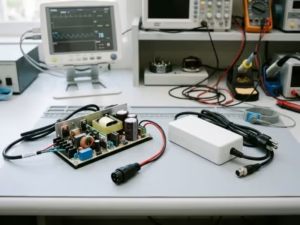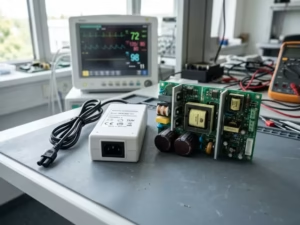
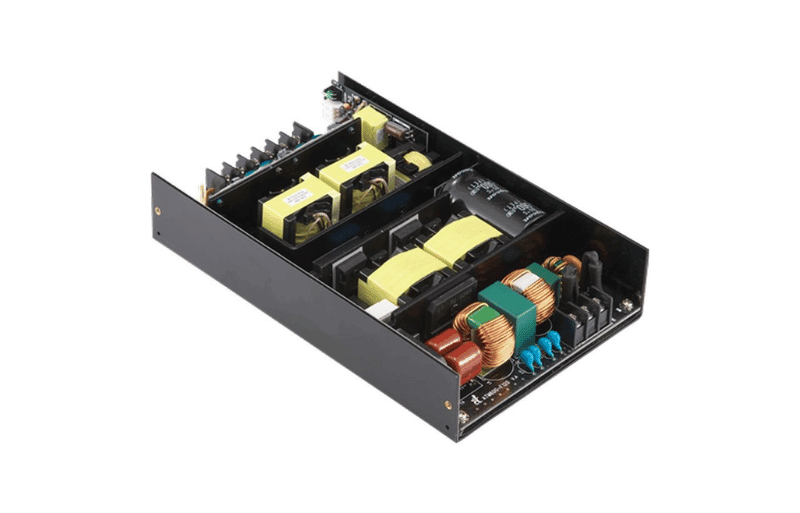
Open frame power supplies are AC-DC converters built on an exposed printed circuit board without a protective metal case. They strip away the enclosure to save space, weight, and cost, relying on the host system for cooling and protection. You find them inside medical instruments, industrial controllers, LED lighting, telecom gear, and embedded systems, where a larger chassis already manages airflow and shields users from contact. This guide explains what open-frame power supplies are, how they compare to enclosed units, how to cool them, the certifications they require, and a clear, step-by-step way to pick the right one.
Key Takeaways
- An open-frame power supply is an exposed-board AC-DC converter without a protective shell, designed to be dropped into a larger system.
- They win on size, weight, and cost, but depend on the host system for cooling and safety.
- Most are switching designs. An open-frame switching power supply uses high-frequency switching for efficient, compact conversion.
- Cooling is airflow-dependent. Read the derating curve, because rated output usually assumes a certain airflow and ambient temperature.
- Safety is non-negotiable. The board carries live mains voltage, so proper grounding, clearance, and an enclosure are required.
- Certifications matter. Look for UL, CE, IEC, and medical-grade approvals based on your market and application.
- Selection comes down to load, airflow, footprint, and certifications. Match the unit to its surroundings, then bench-test under real conditions.
What Are Open Frame Power Supplies? {#what-are}
Open frame power supplies are AC-DC converters built on an exposed PCB without a protective metal enclosure, designed to save space, weight, and cost while relying on the host system for cooling and protection.
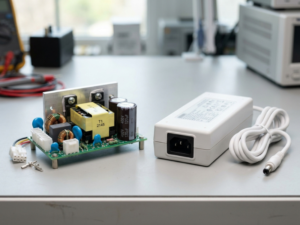
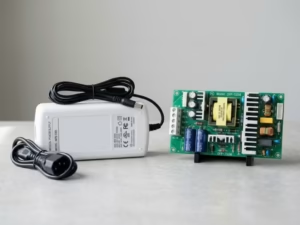
An open-frame power supply gives you the bare board and its components mounted on a simple frame or standoffs, with no surrounding shell. You see the transformer, the capacitors, the heat sinks, and every solder joint. That openness is the whole point. Without a metal box, the unit is lighter, smaller, and cheaper to build.
These supplies are almost always switching designs. An open-frame switching power supply uses high-frequency switching to efficiently convert AC mains into a regulated DC output. That efficiency keeps heat down, which matters when there is no enclosure to manage airflow on its own.
You will find open-frame AC-DC power supplies inside medical equipment, industrial automation, LED lighting, test gear, and telecom hardware. Anywhere the host chassis already handles cooling and protection, an open frame PSU makes sense. The designer drops the board into the larger system and lets that system do the heavy lifting.
The trade-off is simple. You gain space, weight, and cost savings. You give up the built-in protection and self-contained cooling that a sealed unit provides. Whether that trade works depends entirely on where the supply will live.
Open Frame vs Enclosed Power Supplies {#open-vs-enclosed}
Open-frame power supplies win on size, weight, and cost, while enclosed units win on protection and standalone cooling, so the choice between open-frame and enclosed power supplies depends on your enclosure and application.
Seeing the two side by side makes the decision easier. Here is how an open frame design stacks up against a fully enclosed unit.
Factor | Open Frame Power Supply | Enclosed Power Supply |
|---|---|---|
Size | Smaller, lower profile | Larger footprint |
Weight | Lighter (no metal shell) | Heavier |
Cost | Lower per unit | Higher per unit |
Cooling | Relies on host system airflow | Often self-contained with a built-in fan |
Protection | Exposed board, needs external safety | Shielded against dust, contact, and debris |
EMI shielding | Minimal, may need extra measures | Better built-in shielding |
Typical use | Embedded systems, industrial, and medical gear | Standalone equipment, harsh environments |
The pattern is clear. If your design already has a protective chassis and managed airflow, an open-frame power supply slots right in, saving money and space. If the unit has to survive on its own, an enclosed model earns its keep.
How Open Frame Power Supplies Work {#how-they-work}
An open-frame switching power supply rectifies incoming AC, switches it at high frequency through a transformer, then rectifies and filters the output into stable, regulated DC.
The process runs in a few clear stages. First, incoming AC mains passes through an input filter and a rectifier, turning it into rough DC. Next, a high-frequency switching stage chops that DC into a fast on-off waveform, often tens or hundreds of kilohertz. This waveform feeds a compact transformer that steps the voltage up or down and provides isolation between the mains side and the output.
After the transformer, the output is rectified again and smoothed by filter capacitors into clean DC. A feedback loop watches the output and adjusts the switching to hold a steady voltage as the load changes.
High-frequency switching is what makes the open frame format possible. It shrinks the transformer and filter components, cuts wasted heat, and lets the whole supply sit on a small, exposed board. That same efficiency reduces the cooling burden, which helps when there is no enclosure to channel air.
Benefits of Open Frame Power Supplies {#benefits}
Open-frame power supplies offer smaller size, lower weight, lower cost, and easier integration, making them ideal for space-constrained designs within a protective host system.
The advantages stack up quickly for the right application:
- Compact size. No metal shell means a lower profile that fits tight enclosures.
- Lighter weight. Removing the case cuts mass, which helps portable and rack-mounted gear.
- Lower cost. You pay only for the board and components, not the enclosure, shielding, or built-in fan.
- Easy integration. The exposed board drops onto standoffs and bonds to system ground with minimal fuss.
- Simple servicing. With nothing blocking access, swapping or troubleshooting an open-frame PSU is fast.
- Good efficiency. The switching design keeps heat and energy waste to a minimum.
For builders and engineers working within a managed chassis, these benefits often make the open-frame format the default choice.
Limitations and Risks {#limitations}
Open-frame power supplies expose live circuitry to dust, moisture, physical contact, and EMI, so they require a host enclosure, planned cooling, and proper grounding to operate safely.
The open design carries real trade-offs. Keep these in mind before you commit:
- Exposed circuitry. Live mains voltage sits on a bare board, creating a shock hazard if left accessible.
- Cooling dependence. Without an enclosure to channel air, the supply leans on the host system for airflow.
- Dust and debris. Particles settle directly on heat sinks, the transformer, and the PCB, trapping heat and, in severe cases, bridging contacts.
- Moisture risk. Exposed pins and connectors have less protection, so high humidity can cause corrosion over time.
- EMI emissions. An open-frame AC-DC power supply throws off more electromagnetic noise than a shielded unit.
- Physical damage. A spilled liquid, a stray tool, or a curious hand can cause an instant short.
None of these is a dealbreaker in the right setting. They simply mean the host system has to provide what the missing enclosure would.
Cooling Requirements and Derating {#cooling}
Open-frame power supplies depend on host-system airflow, and their rated output typically assumes a specific airflow and ambient temperature as defined by a derating curve.
People assume an exposed board automatically runs cool because air moves freely around it. That is only half the story. The components do get ambient air, but they lose the directed airflow a sealed system creates. A fan without ducting just stirs the surrounding air instead of forcing it through the fin stack.
Some parts feel this more than others. The main transformer, the output rectifiers, and the switching components carry the most heat and rely on moving air to stay within their ratings. Leave them in still air and temperatures climb, which shortens component life and can trip thermal protection.
This is where the derating curve comes in. Most datasheets include a graph showing how much output the supply can deliver at a given airflow and ambient temperature. At 25°C with forced air, a unit might hit its full rating. At 50°C in still air, that same unit may only deliver 50 to 60 percent of its label rating. Reading this curve is the single most important step in cooling an open frame switching power supply.
Two practical rules follow. First, confirm your system supplies the airflow the curve assumes, usually expressed in linear feet per minute (LFM) or cubic feet per minute (CFM). Second, if you cannot guarantee that airflow, pick a unit rated well above your peak load so the derated output still covers your needs.
Common Applications {#applications}
Open frame power supplies power medical devices, industrial automation, LED lighting, telecom equipment, and embedded systems where the host enclosure handles cooling and protection.
These units thrive wherever a larger system already manages the environment:
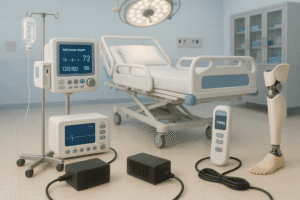
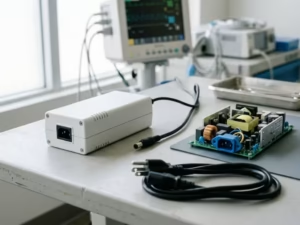
- Medical devices. An open frame AC-DC power supply with medical-grade certification and low leakage current fits neatly inside sealed instruments and diagnostic equipment.
- Industrial automation. Control cabinets and PLCs provide the protection, while the compact board saves space and cost.
- LED lighting. Drivers and large-scale lighting systems use open frame designs because they are small and affordable at volume.
- Telecom equipment. Rack-mounted gear relies on these supplies for space-efficient, efficient DC power inside a controlled chassis.
- Embedded systems. Kiosks, vending machines, and built-in controllers integrate an open frame PSU directly onto the host board layout.
- Test and measurement gear. Benchtop and lab equipment uses them for compact, reliable power.
The common thread never changes: the surrounding system does the protecting and cooling, so the supply does not have to.
Safety Considerations {#safety}
Open-frame power supplies are safe when installed inside a protective enclosure with proper grounding, adequate creepage and clearance, and no user access to the live board.
The exposed board carries mains voltage, so safety planning is not optional. Start with grounding. An open frame AC-DC power supply must bond solidly to the system ground through its designated mounting points. A floating or poorly grounded board is both a shock hazard and an EMI source. Keep the ground path short and low-impedance.
Respect creepage and clearance specs. The datasheet defines the minimum distances between live traces and other conductors. Crowd the board against metal or other boards and you risk arcing or a short. Give it the space the manufacturer requires.
Mount it inside a protective host enclosure that blocks user contact. No one should be able to touch the live board while it is powered. Add protective covers over high-voltage sections if the design allows hands nearby during service.
Finally, mind orientation. Many open frame power supply designs specify a preferred mounting orientation for proper convection. Mount one sideways when it expects horizontal airflow and you undercut its cooling. Check the datasheet before locking your layout.
How to Choose an Open Frame Power Supply {#how-to-choose}
Choose an open-frame power supply by matching the output voltage and current, reading the airflow-dependent derating curve, confirming safety certifications, and verifying that it fits your enclosure and cooling setup.
Picking the right unit follows a clear sequence:
- Define your output needs. Start with the voltage rails and total current your system draws. Add 20 to 30 percent headroom so the supply is not pinned at full load.
- Read the derating curve. Confirm the unit holds its rating at your actual airflow and ambient temperature, or size up.
- Check the form factor. Measure your enclosure and verify the board fits, including clearance around live components and matching mounting holes.
- Confirm certifications. Match the approvals to your market and application before anything else gets locked.
- Plan for EMI and protection. Decide what filtering, shielding, and protective covers you will add around the exposed board.
- Verify efficiency and protections. Check efficiency ratings to limit heat, and confirm over-voltage, over-current, and short-circuit protection.
- Test under real conditions. Bench-test the unit at your true load and ambient temperature before committing the design.
Get this sequence right and the open frame PSU you choose will run cool, stay safe, and last.
Certifications to Look For {#certifications}
Open frame power supplies should carry the safety certifications your market requires, such as UL, CE, and IEC standards, plus medical-grade approvals like IEC 60601-1 for medical applications.
Certifications prove the supply meets recognized safety and performance standards. The right set depends on your region and use case:
- UL / cUL (North America). Demonstrates compliance with US and Canadian safety standards for the application.
- CE (Europe). Signals conformity with EU directives, including the Low Voltage Directive and EMC Directive.
- IEC standards. International safety baselines such as IEC 62368-1 for IT and AV equipment.
- Medical-grade approvals. IEC/EN 60601-1 with strict leakage-current limits for devices that contact or operate near patients.
- EMC compliance. Emissions and immunity standards (such as the CISPR family) that matter more for an unshielded open frame design.
- Energy efficiency marks. Regional efficiency requirements where applicable.
An uncertified open frame AC-DC power supply can stall a product launch, so confirm the required approvals before you buy, not after.
8-Step Selection and Compliance Checklist {#checklist}
Select and qualify an open-frame power supply in 8 steps: calculate the load, confirm airflow, read the derating curve, check the footprint, verify certifications, plan EMI mitigation, confirm protections, and bench-test under real conditions.
- Calculate your load. Total the voltage rails and current, then add 20-30% headroom.
- Confirm available airflow. Measure or specify the LFM/CFM your host system provides at the supply’s location.
- Read the derating curve. Verify rated output holds at your airflow and ambient temperature, or size up.
- Check the footprint and mounting. Confirm the board, clearance, and mounting holes fit your enclosure.
- Verify certifications. Match UL, CE, IEC, or medical-grade approvals to your market and application.
- Plan EMI mitigation. Budget for filtering, ferrite cores, shielding, or layout changes around the exposed board.
- Confirm protections and efficiency. Ensure over-voltage, over-current, and short-circuit protection, plus efficiency that keeps heat down.
- Bench-test under real conditions. Run the unit at actual load and ambient temperature before finalizing the design.
Work through all eight, and you’ll remove the guesswork from selecting an open-frame power supply.
Frequently Asked Questions {#faqs}
What are open-frame power supplies used for?
Open frame power supplies are used in embedded and built-in applications where the host system provides cooling and protection. Common uses include medical devices, industrial controllers, LED lighting, telecom equipment, and test gear. Their small size and low cost make them ideal anywhere a larger enclosure already manages the environment.
What is the difference between open-frame and enclosed power supplies?
Open frame power supplies have an exposed PCB with no metal shell, making them smaller, lighter, and cheaper. Enclosed power supplies add a protective case with better dust resistance, EMI shielding, and often self-contained cooling. In the open-frame vs. enclosed power supply choice, open-frame units rely on the host system for protection and airflow, while enclosed units can stand alone.
Are open-frame power supplies safe?
Open frame power supplies are safe when installed correctly inside a protective enclosure with proper grounding and clearance. The exposed board carries live mains voltage, so it should never be touched while powered or left accessible to users. Always mount it in a host chassis that shields users from contact.
How do you cool an open-frame power supply?
You cool an open-frame power supply with airflow from the host system, usually a fan moving air across the transformer, rectifiers, and heat sinks. Check the derating curve to confirm the airflow the unit requires for your load and ambient temperature. Without adequate airflow, the supply must be derated.
What is an open-frame switching power supply?
An open-frame switching power supply is an exposed-board AC-DC converter that uses high-frequency switching to regulate output efficiently. The switching design keeps heat and size down, which suits the open frame format. It is the most common type of open-frame power supply on the market.
What certifications should an open-frame power supply have?
Look for the safety certifications your market and application require, such as UL, cUL, CE, and IEC 62368-1. Medical applications often need IEC 60601-1 approval with stricter leakage limits. An uncertified open-frame AC-DC power supply can prevent a product from being sold, so confirm certifications before buying.
Do open-frame power supplies need extra EMI shielding?
Open-frame power supplies often require additional EMI measures because they lack the shielding provided by an enclosed case. If you place one near sensitive analog, audio, or radio circuitry, plan for added filtering, ferrite cores, or a shield. Test for EMI early to avoid compliance surprises later.
How do I know what size open frame power supply I need?
Add up the voltage and current your system requires, then add 20-30% headroom. Match those numbers to the unit’s rated output, but read the derating curve to confirm the rating holds at your airflow and ambient temperature. Finally, verify the physical board fits your enclosure.
What does a derating curve tell you?
A derating curve shows how much output an open-frame power supply can deliver at a given airflow and ambient temperature. As the temperature rises or the airflow drops, the safe output falls. Reading this curve prevents you from overloading a supply that looks adequate on its headline rating alone.
Can you use an open-frame power supply in medical equipment?
Yes, provided it carries the right approvals. Medical applications require an open-frame AC-DC power supply certified to IEC/EN 60601-1, with low leakage current and appropriate patient protection. Mount it inside the sealed instrument with proper grounding and clearance.
Why are open-frame power supplies cheaper than enclosed ones?
Open frame power supplies cost less because they skip the metal enclosure, extra shielding, and sometimes the built-in fan that enclosed units include. You pay only for the board and components. The host system supplies the protection and cooling that the case would otherwise provide.
How long do open-frame power supplies last?
An open-frame power supply lasts for years when run within its ratings and kept clean and cool. The main factors affecting lifespan are heat and dust. Excessive temperature accelerates capacitor aging, and dust buildup traps more heat, so adequate airflow and regular cleaning significantly extend the unit’s life.
What is the difference between an open-frame PSU and a brick power supply?
An open-frame PSU is a bare board designed to be mounted inside a host enclosure, while a brick is a fully sealed, self-contained unit, often external. The open-frame design is smaller and cheaper but requires host protection and cooling; the brick is rugged and standalone but larger and more expensive.
Do open-frame power supplies require a fan?
Not always. Some open-frame switching power supply units are convection-cooled at lower loads, while higher-power models require forced air cooling. The derating curve tells you whether a fan is required to reach your target output at your ambient temperature.
Final Thoughts {#final-thoughts}
Picking an open-frame power supply is really about matching the unit to its surroundings. You gain a compact, lightweight, affordable board that drops cleanly into a managed system. In exchange, you take on the work of cooling it, shielding it, and keeping it safe inside a proper enclosure.
If your design already has airflow and a protective chassis, an open frame power supply is a smart, cost-effective choice that engineers reach for every day. If the supply has to survive on its own in a harsh or exposed spot, a fully enclosed unit is the safer call. Match the supply to your airflow, enclosure, certifications, and application, and your open-frame PSU will run cool, stay safe, and deliver reliable power for the long haul.