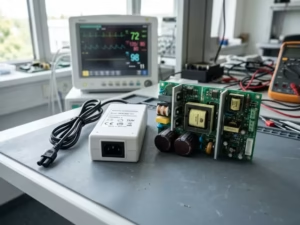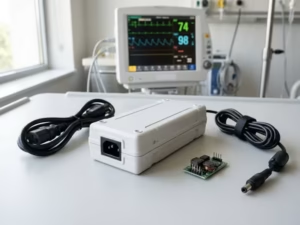

The most expensive power supply problems surface during safety certification — after the enclosure is tooled, the firmware is frozen, and the schedule has no slack left. A leakage current limit that wasn’t modeled early, an isolation barrier sized for the wrong environment, a connector that shifts the compliance picture: any one of these can push a launch back by months. In medical device development, that kind of late-stage discovery rarely comes as a surprise in hindsight. It almost always traces back to requirements that weren’t pinned down when the design had room to absorb them.
Customizing a medical power supply is rarely just about output specs. Electrical limits, mechanical fit, leakage current, isolation, EMC behavior, applicable standards, verification scope, and supply chain all need to be considered together — and early. This guide covers when customization makes sense, how to choose among standard, semi-custom, and full-custom paths, and how each choice can influence your certification timeline, cost, and risk.
When Does a Medical Device Need a Custom Power Supply?
Consider a custom medical power supply when a standard unit cannot meet your electrical, mechanical, or environmental requirements without meaningful compromise. If an off-the-shelf supply fits, use it. Customization adds cost and complexity, so it should address a real constraint rather than a preference.
Signs a Standard Power Supply May Not Be Enough
Watch for these signals during early design:
- The output voltage or current you need falls outside standard catalog options.
- Your enclosure cannot accommodate a standard form factor.
- The device requires a lower leakage current than typical commercial units are rated for.
- Connector type, cable length, or cable exit direction does not match available products.
- Thermal conditions in your housing exceed what a standard supply can handle without significant derating.
Common Triggers for Customization
Most custom projects start from a limited set of drivers: non-typical voltage or power requirements, constrained or unusual form factors, demanding thermal conditions, specialized connectors, or stricter safety and EMC targets tied to patient contact or use environment. When two or more of these apply, a standard product is unlikely to meet your needs without compromise.
Standard, Semi-Custom, or Fully Custom: Which Path Fits?
Choose the least invasive path that still meets your requirements. Moving toward full custom increases flexibility but also raises cost, lead time, and the scope of compliance work required.
Standard Product with Configuration
This path uses a catalog supply with parameter-level configuration. It fits when your needs closely match an existing product. Certification impact is typically minimal, and lead times are shortest.
Semi-Custom Modifications
Here, you start from a proven platform and modify specific elements — connectors, cabling, output adjustments, or mechanical mounting. This balances flexibility with manageable risk, though certain changes may affect safety or EMC evaluation and could prompt partial retesting.
Fully Custom Development
This path designs the supply from the architecture up. It suits non-typical electrical requirements or integration demands that no standard product can satisfy. It offers the most design control but also entails the highest NRE, the longest timelines, and the broadest compliance evaluation scope.
Consideration | Standard (Configured) | Semi-Custom | Fully Custom |
|---|---|---|---|
Scope of change | Parameter configuration | Partial electrical/mechanical edits | Architecture-level redesign |
Best fit when | Needs closely match a catalog unit | Interface, form, or cabling changes needed | Non-typical electrical or tight integration required |
Certification impact | Typically minimal | May require partial re-evaluation | Requires full evaluation and planning |
NRE cost | Low or none | Moderate | Higher |
Lead time | Shortest | Moderate | Longest |
Typical MOQ | Low | Medium | Higher |
Flexibility | Low | Medium | High |
The right path depends on your device classification, target markets, and how far your requirements sit from existing products.
Electrical Requirements to Define First
Lock your electrical requirements before anything else — they drive every decision that follows. Underspecified electrical inputs are a leading cause of rework in custom medical power projects.
Output, Transients, Hold-Up, and Efficiency
Define more than nominal output. Specify peak and transient load profiles, hold-up time, ripple and noise limits, and efficiency targets. Medical devices often include motors, pumps, or RF stages that draw sharp transients; a steady-state spec will not capture.
Leakage Current and Isolation
Leakage current is among the most critical parameters in medical power supply design. Acceptable limits depend on the applicable standard, the device type, the type of applied parts (if any), and the target market. Treat published values as starting points to verify against your specific situation, not universal rules. Isolation requirements are equally context-dependent, varying with patient contact, use environment, and the standards that apply to your device.
Means of Protection: MOPP vs MOOP
These two terms are easy to conflate. MOPP (Means of Patient Protection) refers to protection for the patient; MOOP (Means of Operator Protection) refers to protection for the operator. Which applies, at what level, and in what combination depends on patient contact, applied part classification, and intended use. Not every medical power supply requires 2 × MOPP. Confirm the applicable requirement based on your device’s classification and intended use environment, rather than defaulting to the most stringent assumption. Read More: The Critical Role of MOOP and MOPP in Medical Power Adapters
Mechanical and Integration Constraints
Mechanical fit can derail a custom project even when the electronics are sound. Physical constraints — available volume, cooling approach, connector placement, and enclosure type — directly affect thermal performance and safety requirements, and the trade-offs among them are easier to resolve early than to untangle late. Establish these constraints before the design advances, so each decision about form, fit, and heat removal can be made with full visibility into its downstream consequences.
Form Factor, Mounting, and Enclosure
Specify available volume, mounting method, and enclosure expectations up front. A supply that fits electrically but not physically forces redesign on both sides.
Connectors, Cabling, and Cable Exit
Connector type, cable length, gauge, shielding, and exit direction all matter. These are among the most common semi-custom requests, but cabling changes can sometimes affect safety evaluation or EMC behavior. Treat them as items to review, not cosmetic modifications.
Use Environment
A clinical bedside device, a portable home-use product, and a device exposed to cleaning or sterilization each place different demands on the power supply. Cleaning agents, required ingress protection ratings, portability, and ambient conditions all shape the design. Define the real use environment — not a generic one.
Three cooling approaches cover most medical power supply applications, each with trade-offs that tie directly to enclosure type and use environment. Natural convection uses no moving parts, runs silently, and suits sealed enclosures well, but it has limited heat-dissipation capacity and works best when paired with a high-efficiency design. Forced air moves significantly more heat and can support higher power densities, but it introduces fan noise, draws contaminants into the enclosure, and adds a wear component — trade-offs that are often unacceptable in sterile or quiet clinical settings. Baseplate cooling transfers heat by conduction into the device chassis, effectively turning the housing into a heat sink; it suits fanless, sealed designs well but requires early coordination with the mechanical team to ensure the chassis can absorb and distribute the load. The right choice depends on your available volume, efficiency targets, enclosure sealing requirements, and the environment in which the device will operate — and, like most thermal decisions, it is far easier to resolve before the layout is fixed than after.
Cooling Approaches and Thermal Management
Safety and Regulatory Considerations
Safety standards shape design choices from the start, not at the end. For medical power supplies, IEC 60601-1 is the primary framework governing isolation design, leakage current limits, creepage and clearance distances, and protection strategy.
How IEC 60601-1 Shapes Design Decisions
IEC 60601-1 connects power supply design directly to patient and operator safety requirements. It influences isolation barriers, leakage current limits, creepage and clearance, and means of protection. Focus on how the standard’s requirements interact with your specific design decisions, and engage your test laboratory or manufacturer early to work through the details. Read More: IEC 60601-1: Key Changes from the 2nd to the 3rd Edition
Intended Use, Device Classification, and Target Markets
Applicable requirements vary by intended use, device classification, the presence and type of applied parts, and the markets you sell into. Define classification and target markets as early as possible — they determine which requirements apply to your power supply and at what level.
EMC and Environmental Requirements
EMC compliance is a design requirement, not just a test outcome. For medical devices, IEC 60601-1-2 provides the EMC framework and addresses two distinct aspects.
IEC 60601-1-2 Emissions and Immunity
Treat emissions and immunity as separate design considerations. Emissions limits govern the electromagnetic interference your device generates; immunity requirements define the level of external interference your device must withstand without degradation. Required performance levels can vary with the intended use environment — requirements for professional healthcare facility use may differ from those for home healthcare. Confirm the applicable edition and environment category for your device.
Temperature, Altitude, Humidity, and Cleaning
Environmental conditions feed directly into electrical and mechanical design. Operating temperature range, storage temperature, altitude, humidity, and exposure to cleaning agents or sterilization processes all affect component selection, derating margins, and enclosure requirements. Define these conditions before the design freeze.
How Customization Affects Certification, Testing, and Time to Market
Customization can affect certification scope, but the impact depends on the nature and extent of the changes. Some modifications carry limited compliance consequences; others may require re-evaluation. Knowing which situation applies before committing to a change is far more efficient than discovering it afterward.
Which Changes May Trigger Re-Evaluation
Changes affecting insulation systems, isolation barriers, creepage and clearance distances, or safety-critical components are among those most likely to require safety re-evaluation. Modifications to cabling, shielding, or board layout may affect EMC performance and could prompt retesting. Whether re-evaluation is required depends on the nature of the change, the device classification, the applicable standards, and the target market. Review proposed changes with your manufacturer or test laboratory rather than assuming the impact is negligible.
Why Late Requirement Changes Carry the Highest Cost
Requirements defined late are the most disruptive. A change introduced after tooling, firmware freeze, or initial testing can significantly affect multiple downstream deliverables and extend the certification timeline. Defining requirements early and completely is the most effective way to manage project cost and schedule.
Cost, MOQ, NRE, and Supply Chain Trade-Offs
Total cost extends well beyond unit price. Custom medical power supplies carry upfront, lifecycle, and supply chain costs that a unit-price comparison will not reveal.
Upfront vs Lifecycle Costs
Evaluate NRE, tooling, validation, and documentation alongside per-unit price. A higher initial investment can reduce lifecycle cost by improving reliability, simplifying integration, or reducing downstream compliance risk. Assess the full cost picture rather than optimizing for unit price alone.
Lead Time, Validation, and Change Control
Custom development adds lead time for design, validation, and qualification. Component availability, lifecycle management, and supplier change control also warrant early attention. Medical devices commonly remain in service for a decade or more, which means the power supply — and its bill of materials — must stay supportable for that same period. Map critical components, identify secondary sources where possible, and monitor lifecycle status from the start; an unplanned end-of-life part can force a redesign and potentially a new round of regulatory work. Traceability is equally important: medical manufacturing requires documentation that allows a finished unit to be traced back through its components and processes, both for regulatory audits and field investigations. In medical products, even minor component substitutions can carry compliance implications depending on device classification and the nature of the change. Build change control and lifecycle planning into your project structure from the beginning, not as an afterthought once the design is stable.
Questions to Answer Before You Start a Custom Project
Work through these questions before requesting customization. Clear inputs improve quote accuracy, reduce surprises, and shorten the path from concept to qualified design.
- What are the device’s intended use, classification, and patient-contact profile?
- Which markets and applicable standards must the supply meet?
- What are the full electrical requirements, including transient loads and hold-up time?
- What leakage current limits and isolation requirements apply, and what protection measures are needed?
- What are the mechanical constraints: volume, mounting, connectors, and cabling?
- What is the intended use environment, including temperature range, cleaning exposure, and required ingress protection?
- What are your target volume, timeline, and budget for NRE and tooling?
- Which existing certifications, if any, could be affected by the proposed changes?
Bringing clear answers to these questions into your supplier conversation shortens the path from concept to qualified design.
Frequently Asked Questions
When should you customize a medical power supply rather than use a standard one?
Customize when a standard unit cannot meet your electrical, mechanical, or environmental requirements without meaningful compromise. If a catalog supply fits, use it. Customization should address a specific, identifiable constraint — not a preference — since it adds cost, lead time, and compliance scope.
What is the difference between semi-custom and fully custom medical power supplies?
Semi-custom starts from a proven platform and modifies specific elements, such as connectors, cabling, or output parameters. This limits development risk and cost relative to a full custom design. Fully custom designs, supplying from the architecture up to meet requirements that no standard or semi-custom path can satisfy. It offers the most flexibility but carries the highest NRE, the longest timelines, and the broadest compliance evaluation requirements.
What changes can affect IEC 60601 compliance?
Changes to insulation, isolation, creepage and clearance, safety-critical components, or EMC-relevant aspects of the design are among those most likely to affect compliance. Whether re-evaluation is required depends on the nature of the change, the device classification, the applicable standard, and the target market. Review proposed changes with your test laboratory or manufacturer rather than assuming the impact.
Does changing the enclosure, connector, or cable trigger recertification?
It may, depending on the specific change. Mechanical and cabling changes can affect safety evaluation or EMC performance, so each change should be assessed on its own merits. Some minor changes have a limited impact on compliance; others may require partial or more extensive retesting. Do not assume without a review.
What do MOPP and MOOP mean for power supply selection?
MOPP (Means of Patient Protection) addresses patient protection requirements. MOOP (Means of Operator Protection) addresses the operator’s protection requirements. Which applies, at what level, and in what combination depends on patient contact, applied part classification, and intended use. Determine the applicable requirement based on your specific device and use environment rather than defaulting to the most conservative assumption.
How does customization affect lead time, MOQ, and cost?
Customization generally increases NRE, lead time, and often MOQ, with fully custom paths carrying the most impact across all three. Standard configuration typically sits at the low end, and semi-custom falls in between. Evaluate lifecycle cost and supply chain factors alongside unit price to get a complete picture.
Key Takeaways and Planning Your Customization Project
Customizing a medical power supply is a decision driven by constraints rather than preferences. Use the least invasive path that meets your requirements, define your electrical, mechanical, safety, and EMC needs as early as possible, and treat compliance as a design input rather than a final hurdle. Projects that lock requirements early cost less, move faster, and avoid late-stage disruptions.
Before committing to a customization path, work through the pre-project checklist and assess how proposed changes might affect your certification scope and target markets. Keep MOPP and MOOP distinct, treat emissions and immunity as separate design considerations, and verify leakage current and isolation requirements against your specific device, classification, and applicable standards.
If you would like help evaluating whether your device needs a custom power supply or want to understand how a specific change might affect your compliance path, contact our engineering team. We can help you match the right approach to your requirements, your standards, and your timeline.