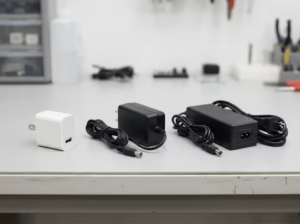
Medical devices depend on highly stable and reliable power systems to ensure patient safety, accurate diagnostics, and uninterrupted operation. From portable patient monitors and ventilators to ultrasound systems and infusion pumps, the performance of the medical power supply directly affects the reliability of the entire device.
Unlike consumer electronics, medical equipment often operates continuously in demanding clinical environments where power-related issues may lead to:
- IEC 60601 certification failure
- EMC redesign
- Device instability
- Unexpected shutdown
- Delayed product launch
- Increased warranty and maintenance costs
For medical ODM/OEM manufacturers, power supply problems are not simply component-level failures. In many projects, they become major engineering and compliance risks that affect development timelines, regulatory approval, and long-term product reliability.
This guide explains the most common medical power supply failures, the real engineering causes behind them, and how IEC 60601-compliant medical power adapters help reduce certification risk and improve system reliability.
Why Medical Power Supply Reliability Matters
Medical power systems are fundamentally different from standard industrial or consumer adapters.
In many applications, medical devices maintain direct or indirect patient contact, requiring significantly stricter standards for:
- Leakage current
- Isolation protection
- EMC performance
- Thermal reliability
- Long-term operational stability
Medical environments also introduce additional engineering challenges:
- 24/7 continuous operation
- Compact fanless enclosure design
- Sensitive signal acquisition systems
- Portable battery-powered operation
- High EMC requirements
- Long certification cycles
A poorly selected power supply may cause far more than simple hardware failure.
| Potential Problem | Possible Project Impact |
| Excessive leakage current | IEC 60601 test failure |
| Thermal overload | Unexpected reboot or shutdown |
| EMI interference | ECG or imaging signal distortion |
| Voltage instability | System malfunction |
| Ripple noise | Sensor inaccuracy |
| Poor lifecycle stability | Field failure and warranty claims |
In many OEM projects, replacing an unsuitable power adapter late in development may require:
- PCB redesign
- Additional EMC testing
- Safety reevaluation
- Mechanical redesign
- Delayed regulatory approval
This significantly increases project cost and delays time-to-market.
For this reason, selecting a medical-grade IEC 60601 power supply should be considered an engineering and compliance decision rather than a simple purchasing decision.
Common Medical Power Supply Failure Types
Medical power supply failures are usually caused by a combination of:
- Thermal stress
- Poor EMC design
- Insufficient isolation
- Ripple instability
- Weak transient performance
- Component aging
- Manufacturing inconsistency
The most common failure mechanisms include:
| Failure Type | Typical Cause | Real-World Risk |
| Overheating | Poor thermal design | Device restart or shutdown |
| EMI interference | Inadequate filtering | EMC certification failure |
| Excessive leakage current | Poor insulation design | Patient safety risk |
| Ripple noise | Weak output filtering | Signal distortion |
| Voltage drop | Poor transient response | System reboot |
| Capacitor aging | Long-term thermal stress | Premature field failure |
| Certification failure | Non-compliant architecture | Delayed product launch |
Each issue may directly affect IEC 60601 compliance and long-term product reliability.
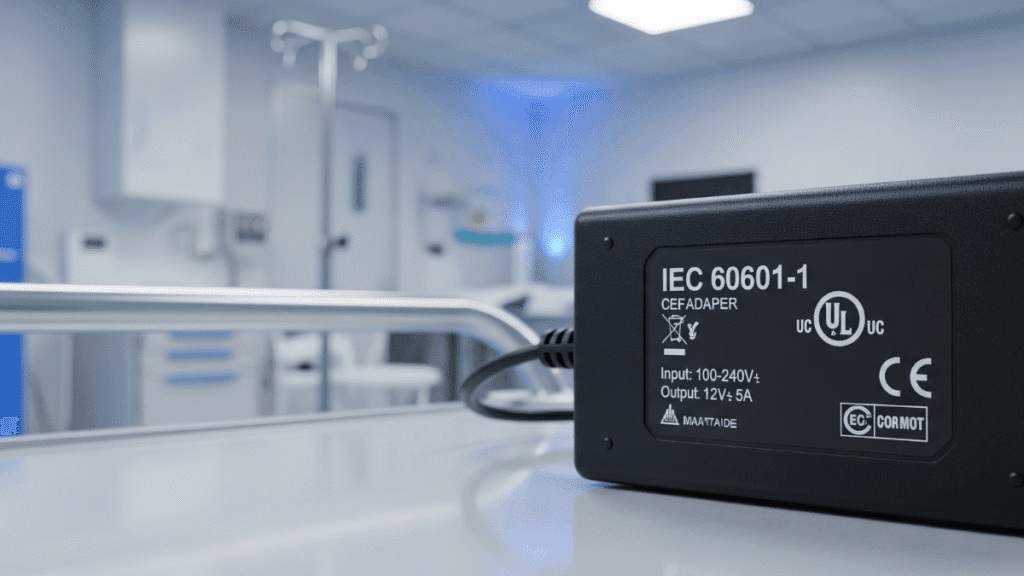
Thermal Failures in Compact Medical Devices
Thermal stress is one of the most common causes of premature medical power supply failure.
Portable medical devices such as handheld ultrasound systems, compact ventilators, and patient monitoring equipment often use fanless enclosure designs with very limited airflow.
In several OEM projects supported by Quankang, low-efficiency commercial adapters generated excessive internal heat during continuous operation in hospital environments where ambient temperatures exceeded 40°C.
As internal capacitor temperature increased, output voltage stability gradually deteriorated, causing:
- intermittent system reboot
- touchscreen instability
- communication interruption
- unexpected shutdown during monitoring
In some projects, the problem only appeared after 6–8 hours of continuous operation, making troubleshooting particularly difficult during product validation and reliability testing.
Common Causes of Thermal Failure
- Low conversion efficiency
- Poor airflow design
- Undersized internal components
- High switching losses
- Inadequate thermal derating
- Low-grade electrolytic capacitors
Engineering Solutions Used in Medical Power Supplies
Quankang medical power adapters typically improve thermal reliability through:
- High-efficiency power conversion topology
- Long-life 105°C capacitor selection
- Optimized thermal architecture
- Conservative derating practices
- Long-duration burn-in testing
- Stable high-temperature operation validation
These measures help improve long-term reliability in continuously operating medical environments.
For more details on thermal stress and overheating prevention, see:
→ Why Medical Power Supplies Overheat
Why Medical Devices Fail EMC Testing
One of the most common problems during IEC 60601-1-2 testing is excessive conducted or radiated EMI generated by the external power adapter.
This issue is particularly common in:
- portable patient monitors
- ultrasound systems
- wireless medical devices
- imaging systems
- motor-driven medical equipment
Real OEM Problem
Many OEM engineers encounter situations like:
“Our portable monitor passed functional testing, but EMC radiation exceeded limits during IEC 60601 certification.”
In many cases, the root cause is not the main PCB itself, but switching noise generated by a low-quality external adapter.
The problem becomes more severe when:
- enclosure space is limited
- grounding is insufficient
- high-speed communication modules are integrated
- ripple couples into signal circuits
Common EMI Symptoms
- distorted ECG waveform
- unstable touchscreen behavior
- communication interruption
- wireless instability
- imaging artifacts
- EMC certification failure
How Quankang Medical Power Supplies Reduce EMI
In Quankang-supported OEM projects, medical-grade adapters reduce EMI through:
- multi-stage EMI filtering
- shielded transformer structures
- optimized PCB grounding layout
- low-ripple switching topology
- controlled switching frequency architecture
These optimizations help OEM customers improve EMC margins and reduce redesign cycles during certification.
Many OEM projects encounter unexpected IEC 60601-1-2 failures during EMC testing.
Common root causes and engineering solutions are discussed here:
→ IEC 60601 EMC Testing Problems and Solutions
For practical EMI troubleshooting methods in medical systems, see:
→ Medical Power Supply EMI Troubleshooting Guide
Excessive Leakage Current and Patient Safety Risks
Leakage current is one of the most critical safety requirements in medical electrical systems.
In patient-connected applications, even extremely small leakage currents may create safety hazards or cause IEC 60601 certification failure.
Typical Leakage Current Requirements
| Application Type | Typical Leakage Current Requirement |
| General medical equipment | < 500 μA |
| BF applied part equipment | < 100 μA |
| CF applied part equipment | < 10 μA |
Applications requiring ultra-low leakage performance include:
- ECG systems
- EEG systems
- patient monitoring equipment
- electrosurgical devices
- cardiac-related applications
Common Causes of Leakage Current Failure
- improper Y-capacitor selection
- insufficient transformer isolation
- poor creepage and clearance design
- grounding architecture problems
- low-quality insulation materials
IEC 60601 Isolation Requirements
Medical-grade adapters commonly require:
| Protection Requirement | Typical Value |
| Isolation protection | 2 × MOPP |
| Isolation voltage | 4000VAC–5000VAC |
| Reinforced insulation | Required |
| Creepage distance | IEC 60601 dependent |
How Quankang Medical Adapters Reduce Leakage Current
Quankang medical power solutions are engineered with:
- reinforced insulation systems
- high-isolation transformers
- optimized low-leakage EMI filtering
- controlled parasitic capacitance design
- IEC 60601-compliant creepage architecture
These measures help improve patient safety while reducing certification risk.
Many IEC 60601 certification failures are directly related to leakage current problems in patient-connected applications.
For detailed engineering solutions and design strategies, see:
“How to Reduce Leakage Current in Medical Devices”
Ripple Noise and Signal Instability
Ripple noise is often underestimated during early-stage product development.
However, unstable DC output can significantly affect sensitive medical electronics and precision diagnostic systems.
Real-World Engineering Problem
In several portable ECG and imaging projects, excessive ripple noise from low-quality adapters introduced interference into analog front-end circuits, resulting in:
- waveform distortion
- unstable sensor readings
- imaging artifacts
- ADC instability
- communication noise
These problems became especially severe under high-load conditions or after capacitor aging.
Common Ripple Sources
- inadequate output filtering
- overloaded power stages
- low-quality capacitors
- unstable feedback circuits
- poor switching topology
Typical Medical Ripple Requirements
| Parameter | Typical Requirement |
| Ripple noise | < 100mVp-p |
| Low-noise output | Required |
| Conducted EMI | IEC 60601-1-2 compliant |
How Medical Power Supplies Reduce Ripple
Quankang medical adapters improve signal stability through:
- low-noise switching architecture
- multi-stage output filtering
- high-performance capacitor selection
- stable feedback compensation design
- controlled transient response
This is especially important for precision medical systems using sensitive analog signal acquisition.
Why Systems Restart When Motors or Pumps Start
Medical devices containing pumps, compressors, or motor-driven systems often experience transient startup problems.
Common symptoms include:
- screen flickering
- MCU reset
- communication interruption
- sudden voltage drop
- system reboot during motor startup
Why This Happens
Many commercial adapters cannot handle:
- startup inrush current
- transient overload conditions
- dynamic load switching
This problem is common in:
- infusion pumps
- portable suction devices
- respiratory systems
- motorized rehabilitation equipment
Engineering Solutions
Quankang medical power solutions for motor-driven systems typically include:
- enhanced transient response
- stable hold-up time
- overload protection
- dynamic load regulation
- improved startup current capability
These features help maintain voltage stability during sudden load changes.
Capacitor Aging and Long-Term Reliability
Medical devices often remain in operation for many years under continuous load conditions.
Over time, high internal temperatures accelerate capacitor aging, which may lead to:
- increased ripple noise
- unstable startup
- voltage drift
- shortened product lifespan
- sudden field failure
Capacitor aging is especially common in low-cost commercial adapters using consumer-grade components.
Why Lifecycle Stability Matters for Medical OEM Projects
Medical products often have production lifecycles exceeding 5–10 years.
Unexpected power supply failure may result in:
- maintenance cost increase
- field replacement issues
- recertification risk
- supply chain disruption
Reliability Improvements in Medical Power Supplies
Quankang medical adapters improve lifecycle stability through:
- 105°C long-life capacitors
- conservative thermal derating
- long-duration aging tests
- stable component sourcing
- lifecycle management support
This helps reduce long-term maintenance risk for OEM customers.
Common IEC 60601 Certification Failures
Many medical device manufacturers underestimate the importance of power architecture during certification preparation.
However, power-related issues are among the most common causes of IEC 60601 failure.
Typical Certification Failure Areas
| Failure Item | Typical Root Cause |
| Leakage current failure | Poor isolation design |
| EMC emission failure | Inadequate filtering |
| Surge immunity failure | Weak transient protection |
| Hi-pot failure | Insufficient insulation spacing |
| Temperature rise failure | Poor thermal management |
| ESD failure | Weak grounding design |
Why Certification Delays Become Expensive
Late-stage certification failure may require:
- PCB redesign
- enclosure modification
- EMC retesting
- repeated safety evaluation
- delayed product launch
In many projects, selecting the wrong adapter early in development creates far greater cost than the adapter itself.
This is why many OEM manufacturers now prioritize IEC 60601-certified medical adapters during the early design stage.
→ Related Resource:
“Common Reasons Devices Fail IEC 60601 Certification”

How to Select a Reliable Medical Power Supply Supplier
Selecting a medical power supply supplier involves far more than comparing wattage or pricing.
Medical OEM manufacturers should evaluate suppliers based on engineering capability, certification support, lifecycle stability, and long-term manufacturing reliability.
Certification Support
A qualified supplier should provide:
- IEC 60601 certification reports
- CB documentation
- EMC support
- safety test documentation
Engineering Capability
Reliable medical power suppliers should support:
- leakage current optimization
- EMI troubleshooting
- thermal analysis
- custom power design
- OEM and ODM collaboration
Manufacturing Quality
Look for suppliers operating under:
- ISO 13485 quality systems
- controlled component sourcing
- reliability validation procedures
- lifecycle management systems
Long-Term Supply Stability
Medical products often remain in production for many years.
A stable supplier should support:
- revision control
- stable BOM management
- component continuity
- long-term production planning
For many medical OEM projects, long-term engineering support is more important than the initial adapter cost.
Applications of IEC 60601 Medical Power Supplies
Medical-grade IEC 60601 adapters are widely used in:
- patient monitoring systems
- portable ultrasound equipment
- infusion pumps
- ventilators
- sleep therapy devices
- imaging systems
- rehabilitation equipment
- home healthcare devices
Each application requires different levels of:
- leakage current control
- EMC performance
- isolation protection
- thermal reliability
- transient load capability
Selecting the correct power architecture is essential for certification success and long-term reliability.

Engineering Support for Medical Device Power Systems
Medical OEM manufacturers often face complex challenges involving:
- EMC certification failure
- leakage current optimization
- thermal reliability
- ripple noise
- voltage instability
- long-term lifecycle management
Quankang engineering teams support medical device manufacturers with:
- IEC 60601-1 compliant AC-DC power solutions
- ultra-low leakage current medical adapters
- EMC and EMI optimization support
- custom desktop and wall-plug medical power supplies
- long lifecycle component management
- OEM and ODM engineering collaboration
Whether you are developing portable monitoring equipment, infusion systems, imaging devices, or home healthcare products, selecting the right medical power architecture can significantly reduce certification risk and improve long-term product reliability.
FAQ
What causes medical power supplies to fail most often?
The most common causes include overheating, EMI interference, excessive leakage current, capacitor aging, poor transient response, and insufficient isolation protection.
Why do medical devices fail EMC testing?
Many EMC failures are caused by conducted or radiated noise generated by low-quality switching adapters. Poor grounding, ripple coupling, and inadequate EMI filtering can also contribute to IEC 60601-1-2 test failure.
What leakage current is acceptable under IEC 60601?
Typical leakage current limits include:
- General medical equipment: < 500 μA
- BF applied parts: < 100 μA
- CF applied parts: < 10 μA
Requirements depend on device classification and patient contact level.
What is 2 × MOPP?
2 × MOPP (Means of Patient Protection) is an IEC 60601 isolation requirement designed to provide reinforced electrical protection between AC mains and patient-accessible parts.
Can consumer power adapters be used in medical devices?
In most cases, no. Consumer adapters typically do not meet IEC 60601 requirements for leakage current, isolation, EMC performance, or patient safety.