Surge testing is one of the most revealing diagnostic tools available for electrical insulation. When you inject a controlled high-voltage pulse into a winding, coil, or cable, the resulting waveform tells a story — about insulation condition, turn-to-turn integrity, and fault risk — that steady-state resistance measurements simply cannot.
This guide covers the full scope of surge testing: what it is, how the equipment works, which methods apply in which situations, and how to interpret your findings.
What Surge Testing Is and Why It Matters
A surge test applies a rapidly rising high-voltage pulse — a surge — to the device under test (DUT). The voltage spike stresses the insulation between turns, between phases, and between conductors and ground. Any weakness in that insulation produces a measurable change in the waveform.
That’s the core principle: healthy insulation responds predictably. Damaged or degraded insulation doesn’t.
Where Surge Testing Fits in Electrical Diagnostics
Surge testing is primarily used to detect turn-to-turn insulation faults in wound components — motors, generators, transformers, coils, and inductors. It’s also applied to cables and connectors where the integrity of the insulation is critical.
The method is sensitive to faults that other tests miss. Insulation resistance testing and DC hipot testing measure bulk insulation resistance, which is valuable but doesn’t catch localized turn-to-turn weaknesses. A fault between two adjacent turns might involve very little change in resistance at the component level, yet be immediately detectable in a surge waveform.
When Surge Testing Is Used
Surge testing appears across several stages of an electrical component’s life:
- Manufacturing quality control — testing stators, coils, and transformers before assembly or shipment
- Incoming inspection — verifying new or reconditioned equipment before installation
- Preventive maintenance — periodically testing in-service motors and generators to track insulation aging
- Fault investigation — diagnosing suspected winding faults after an operational anomaly or failure
In motor rewind shops, surge testing at every stage — bare winding, after varnish, after cure — is standard practice. Each stage can reveal different fault types.
Surge Test Equipment: What You’re Working With
The type of surge tester you need depends on the application. The choices range from bench-top laboratory instruments to portable field testers, and the differences matter when you’re selecting equipment or evaluating a test lab’s capability.
High-Voltage Surge Testers
High-voltage surge testers are designed for testing large motors, power transformers, generators, and high-voltage cables. They charge a capacitor to the required test voltage — which can reach several kilovolts depending on the application — and then discharge it into the DUT through a controlled switch.
The resulting surge pulse propagates through the winding or conductor. The instrument captures the voltage and current waveforms via an oscilloscope or built-in surge comparator, and the operator (or automated software) compares the trace against a reference.
These instruments typically offer:
- Adjustable surge voltage with precise control
- Selectable capacitance or energy settings
- Waveform capture and storage
- Comparison functions, including the error area ratio (EAR) calculation
- Phase-to-phase comparison capability for three-phase equipment
When I review equipment specifications for a test laboratory, I look for independent control of voltage, rise time, and energy — not just a single “surge level” setting. That flexibility matters when testing a wide range of component sizes and insulation classes.
Portable Surge Testers
Portable surge testers are designed for field use — maintenance teams working on installed equipment, or technicians who need to move between machines on a plant floor.
They trade some measurement resolution and voltage range for portability and simplicity. Most portable testers cover motors and transformers in the low- to medium-voltage range and provide a pass/fail output based on waveform comparison against a stored reference or against a companion phase.
For field maintenance programs, a portable tester used consistently — with documented baselines and clear acceptance criteria — adds real value. The key is consistency: the same test voltage, the same setup procedure, the same operator interpretation standard, applied every time.
Surge Test Methods: Pulse Testing and AC Surge Approaches
Surge testing uses two broad method types, and knowing when each applies is important.
The method differences affect what you can detect, how you set up the test, and what the results mean.
Impulse (DC Surge) Testing
The most common surge test method uses a single impulse pulse — a rapid rise followed by a decaying oscillation. The capacitor discharges into the DUT, producing a damped sinusoidal waveform whose shape is determined by the winding’s inductance and capacitance.
Turn-to-turn faults change the local inductance. Insulation voids or weaknesses affect how the waveform damps. Comparing waveforms between healthy and suspect phases — or against a known-good reference — reveals these changes.
Rise time is a critical parameter in impulse testing. Faster rise times stress the insulation more effectively, especially between the first few turns near the connection point, where the voltage gradient is steepest. When I need to detect subtle inter-turn weaknesses or small voids, I use a faster rise time within the range the DUT can handle without unnecessarily risking the insulation.
AC Surge and Repetitive Pulse Methods
Some test systems apply repetitive surge pulses or AC high-voltage stress rather than a single impulse. These approaches are used in specific contexts — partial discharge testing, cable insulation verification, and some coil production testing protocols.
Repetitive pulse methods allow averaging of waveform data, which improves signal-to-noise ratio and can improve detection of subtle fault signatures. The trade-off is the accumulation of stress on the DUT.
Choosing the Right Test Voltage
Selecting the test voltage is one of the most important decisions in a surge test program. Set it too low, and you won’t stress the insulation enough to reveal marginal faults. Set it too high, and you risk damaging the insulation you’re trying to evaluate.
The appropriate surge test voltage depends on:
- The rated voltage of the equipment being tested
- The insulation class and system voltage
- The stage of manufacture or maintenance (new, rewound, in-service)
- The applicable standard or customer specification
As a general principle, surge test voltages are set significantly above operating voltage but well below the dielectric withstand level of new, undamaged insulation. Exact levels should be determined from the relevant standard — IEC 60034, IEEE 522, or the motor or transformer manufacturer’s test specification — and from the test history of the specific component.
Don’t guess at test voltage. Use documented, traceable criteria. If you’re testing three-phase motors across a range of ratings, maintain a test voltage schedule and stick to it.
Surge Test Standards and Their Practical Impact
Standards don’t just define test levels — they define the context in which those levels are meaningful. Using the right standard for your application ensures your results are defensible and comparable.
IEC and IEEE are the two primary standards families for surge testing of electrical equipment. IEC standards are widely applied in Europe, Asia-Pacific, and international procurement contexts. IEEE standards are the baseline for North American practice. Many global test labs work on both.
What Standards Govern in Practice
For wound components such as motors and generators, relevant standards address:
- Maximum test voltage relative to rated equipment voltage
- Number of impulse pulses per test
- Acceptable rise time ranges
- Pass/fail criteria based on waveform comparison
- Requirements for testing at different stages of manufacture
For cables and connectors, cable-specific standards govern surge and high-voltage testing, with different voltage levels and test duration requirements.
The impact of standards on daily testing practice is significant: a surge test performed without reference to the appropriate standard may be technically interesting, but it isn’t certifiable. If your test results need to support a quality certificate, an insurance claim, or a warranty dispute, they need to be conducted to a named standard with documented traceability.
What the Waveform Tells You
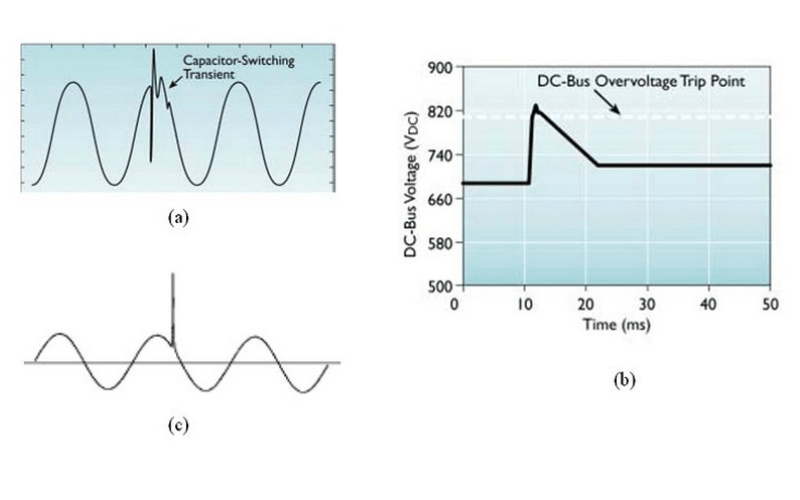
Interpreting surge test waveforms is where experience separates useful results from inconclusive data. The waveform is not just a pass/fail indicator — it’s a diagnostic signal.
Waveform Shape and Fault Signatures
A healthy winding produces a smooth, well-defined damped sinusoidal waveform. The oscillation frequency reflects the inductance and capacitance of the winding. Deviations from the expected waveform indicate changes in those parameters.
Common signatures and what they mean:
- Reduced oscillation frequency: increased inductance — possible shorted turns or turn-to-turn faults adding effective inductance
- Increased damping rate: energy loss in the winding — arcing, partial discharge, or high-resistance fault between turns
- Waveform collapse or distortion early in the trace: low-impedance fault — turn-to-turn short or severe insulation breakdown
- Asymmetry between phases: phase-specific fault in a three-phase winding — compare all three phases under identical test conditions
When I see a waveform that decays faster than the reference while maintaining its frequency, I treat it as a partial discharge or a weak insulation indicator until proven otherwise. It may not be a hard fault yet, but it warrants follow-up.
Error Area Ratio (EAR)
EAR is a quantitative comparison metric. It measures the area between the test and reference waveforms as a proportion of the reference waveform’s area. Higher EAR values indicate greater deviation from the reference — a more severe or more likely fault.
Different standards and equipment manufacturers define EAR threshold values for pass/fail decisions. Know what threshold applies to your application and document it explicitly in your test procedure.
Partial Discharge Indications
Some surge testers incorporate partial discharge (PD) detection. During the surge event, insulation voids can generate PD pulses — high-frequency bursts of energy that appear as superimposed noise on the surge waveform or as separate PD events captured by the instrument.
PD activity doesn’t mean the insulation has failed. It means there are voids or weak points where partial breakdown is occurring. In many cases, PD is an early warning — the insulation is still functional but degrading.
If a surge test shows consistent PD activity at voltages below the test level, investigate further before returning the equipment to service.
Surge Testing and Insulation Integrity: Getting the Balance Right
One of the most common concerns I hear from maintenance teams is whether surge testing itself damages insulation. It’s a legitimate concern, and the honest answer is: it can, if you do it wrong.
A correctly applied surge test — appropriate voltage, correct number of pulses, proper rise time for the DUT — should not cause measurable insulation degradation in healthy insulation. The test is designed to reveal existing weaknesses, not create new ones.
Where damage risk increases:
- Excessive test voltage: stressing insulation beyond its design dielectric strength, even for a brief pulse
- Too many pulses: cumulative energy stress, particularly in equipment with marginal insulation
- Inappropriate rise time: very fast rise times concentrate voltage stress on the first few turns, which may not be relevant to the failure mode you’re investigating
- Testing equipment with known insulation voids: PD activity during testing can accelerate void growth
The discipline here is following the test procedure rigorously. Set the voltage and pulse count to the specification. Don’t repeat the test multiple times to chase an inconclusive result — if the result is ambiguous, the next step is a different diagnostic method, not more surge pulses.
Surge Testing vs. Inductance Testing
Inductance measurement and surge testing are complementary, not competing.
An inductance test measures the overall inductance of the winding under steady-state or low-frequency excitation. It detects gross changes in turn count — for example, multiple shorted turns that significantly reduce the coil’s effective inductance.
Surge testing detects localized, early-stage turn-to-turn faults that may not yet measurably affect bulk inductance. A winding with one or two shorted turns in a large multi-turn coil may show a completely normal inductance measurement while the surge waveform clearly shows a fault.
For comprehensive diagnostics on motors, generators, and transformers, use both. Inductance first for a quick sanity check on gross winding integrity, then surge testing for turn-to-turn insulation evaluation.
Practical Test Setup: Getting Results You Can Trust
The quality of a surge test result depends as much on setup as on the instrument itself. Poor setup creates false positives, masks real faults, and makes results unrepeatable.
Cable Length, Grounding, and Coupling
The cable length between the tester and DUT affects the waveform. Longer test leads add inductance and resistance that alter the surge characteristics. Always use the shortest practical lead length consistent with safe separation.
Grounding is critical. The DUT must be grounded to the tester’s ground reference — not to a separate building ground that may have a different potential. Ground loops introduce noise and can corrupt the waveform baseline.
Coupling to adjacent coils or windings in a multi-phase device needs to be managed. When testing one phase of a three-phase motor, the other phases should be grounded or connected per the test procedure, not left floating. Floating phases can develop induced voltages that affect the test circuit.
Oscilloscope and Calibration
Whether you’re using a built-in surge comparator or an external oscilloscope, calibration matters. Verify the instrument calibration status before a test program. For production testing, the calibration frequency should match the testing’s throughput and criticality.
Probe placement and shielding affect high-frequency waveform capture. Use shielded connections and the probe configuration specified by the instrument manufacturer. Improvised setups with unshielded wiring introduce noise that can look like a fault signature.
Best Practices: Before, During, and After the Test
A surge test program is only as good as the discipline around it.
Preparing for the Test
Before applying any voltage, verify the equipment is de-energized and isolated. Check for residual charge on capacitive windings and discharge them. Inspect connections for tightness — a loose connection creates a high-resistance contact that distorts the waveform.
Document the starting conditions: winding temperature, ambient conditions, insulation resistance measurement (megger test), and phase-to-phase resistance balance. These baselines contextualize surge results and support trend analysis over time.
Safety During Surge Testing
High-voltage surge testing involves a real lethal hazard. Establish a clear safety perimeter. Verify that all personnel are clear before energizing. Use rated PPE — insulating gloves, face protection, and non-conductive footwear as appropriate for the voltage class.
Never handle test leads while the tester is armed or energized. After testing, discharge the capacitor through the instrument’s internal discharge circuit before touching leads or the DUT.
Follow your organization’s lockout/tagout procedures for the equipment under test, and ensure the test tester itself is handled in accordance with the manufacturer’s safety instructions.
Post-Test Analysis and Reporting
After the test, document everything: test voltage, number of pulses, rise time setting, EAR values, waveform captures, and the pass/fail decision against the stated acceptance criteria.
If a fault is indicated, the surge test result is the starting point for investigation, not the conclusion. Follow up with:
- Insulation resistance measurement to check the bulk insulation condition
- DC resistance balance across phases to check for partial shorts
- Inductance measurement to assess gross winding integrity
- Visual inspection of accessible winding areas for signs of discharge, burning, or mechanical damage
- Dielectric withstand test to determine if the insulation must be re-qualified before return to service
If the winding is in a rewind shop, the surge test result can guide targeted disassembly — identifying which coil group or slot region to inspect closely rather than rewinding blindly.
Reading the Whole Picture
Surge testing is powerful, but it’s one tool in a broader diagnostic toolkit. The most useful test programs combine surge testing with insulation resistance trending, resistance balance checks, and visual inspection — and use each result to inform the interpretation of the others.
When a surge trace shows a deviation, ask what else in the diagnostic picture supports or contradicts that finding. Consistent fault indicators across multiple test methods give you a confident diagnosis. A single anomalous surge result, with everything else normal, warrants a retest and further investigation, not an immediate rewind decision.
The goal is actionable, accurate information. A well-conducted surge test, analyzed with appropriate rigor, gives you exactly that.