When deploying IP cameras, access points (APs), IoT gateways, smart access control systems, or industrial sensors, companies often face a critical question: Should you choose a POE power supply or a traditional DC power supply?
This article provides an in-depth comparison from multiple perspectives including principles, application scenarios, cost, installation methods, and safety. It helps procurement managers, system integrators, and engineers make quick and accurate power supply decisions.
Long-tail keywords covered: poe vs non-poe, poe power vs dc power supply, poe power advantages, poe or non-poe which is better
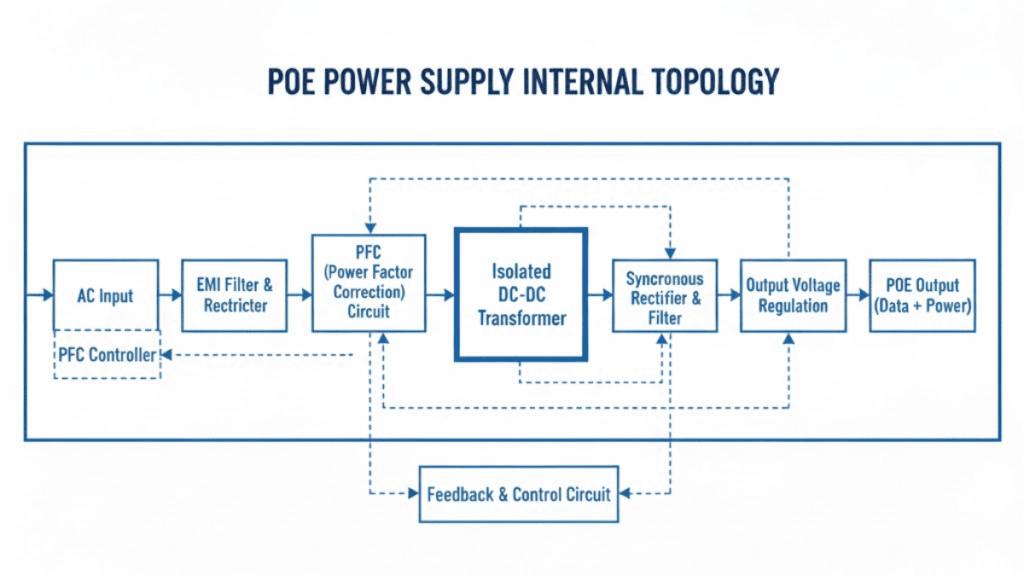
What Are POE and Non-POE Power Supplies?
| Comparison Aspect | POE Power Supply (Power over Ethernet) | Non-POE (Traditional DC Power) |
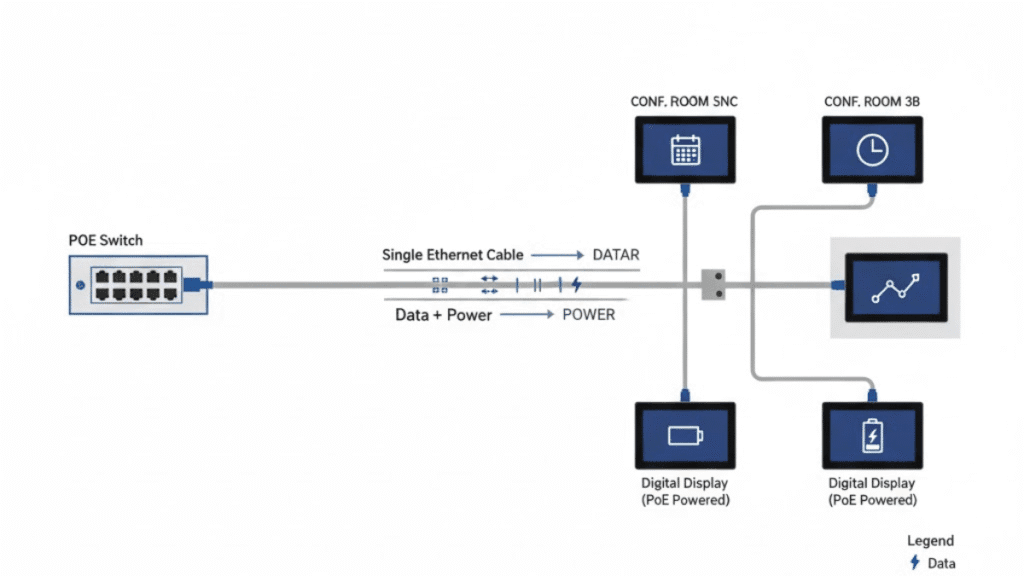
| Power Delivery | Data + power over a single Ethernet cable | Separate power line + network cable |
| Installation | No extra power outlets needed, flexible deployment | Requires pre-installed power lines, more complex |
| Typical Applications | IP cameras, WiFi APs, IoT, smart building devices | LEDs, motors, industrial control, legacy devices |
| Power Standard | IEEE 802.3af / at / bt | DC 12V/24V/48V customizable |
| Remote Management | Supports remote power control, reboot | Not supported |
| Protection Features | Overvoltage / overcurrent / surge protection built-in | Depends on the power supply product |
| Cost Structure | Higher upfront cost but lower operational cost | Cheaper initially, higher maintenance cost |
Key Advantages of POE (Why More People Choose It)
1.Power + Data with a Single Cable
Eliminates the need for AC outlets and additional wiring, especially ideal for ceiling-mounted, corner-mounted, or high-altitude cameras.
2.Flexible Installation and Easy Expansion
Add new cameras or APs with just one Ethernet cable, supporting plug-and-play deployment for projects.
3.Remote Power Off and Device Reboot
Smart management for unmanned scenarios such as monitoring systems, outdoor APs, and industrial IoT devices.
4.Higher Power Delivery Safety
POE adapters include protection against short circuits, overload, overvoltage, and surges, reducing device damage risk.
Further Reading:
How to Choose the Right POE Power Adapter for Your Device (Selection Guide)
802.3af / 802.3at / 802.3bt POE Standards Explained (Technical Matching Guide)

Scenarios Suitable for POE
| Application Scenario | Recommended Power | Reason |
| IP Camera Surveillance | POE | Remote deployment, centralized management, no separate power needed for ceiling/outdoor |
| WiFi Access Point | POE | Supports remote power control, convenient cabling for ceilings/meeting rooms |
| Smart Building IoT Nodes | POE | Large number of distributed devices, can be remotely managed and monitored |
| Industrial Sensors | POE / DC24V | Long-distance transmission requiring stable power / standard compliance |
| LED Displays / Motors | Non-POE | High power consumption, requires large current output |
When POE May Not Be Suitable
| Reason Not Suitable | Recommended Alternative |
| Power requirement exceeds 60W | Use DC power or industrial-grade adapters |
| Device does not support network | Traditional DC 12V/24V power supply |
| Existing stable power wiring | Continue using Non-POE for cost savings |
| Long-distance outdoor power (>150m) | DC power with dedicated power line |
Cost Comparison: Is POE Always More Expensive?
| Cost Factor | POE | Non-POE |
| Initial Procurement Cost | ★★☆ (Moderate) | ★☆☆ (Low) |
| Cabling & Installation Cost | ★★☆ (Low) | ★★★ (High) |
| Maintenance Cost | ★☆☆ (Low) | ★★★ (High) |
| Expansion Cost | ★☆☆ (Low) | ★★★ (High) |
| Total Cost Over Project Cycle | Lower | Higher |
For engineering projects, large-scale deployments, and long-term operation, POE’s total cost is significantly lower than Non-POE.
Quankang POE Adapter Product
- PoE Adapter PoE16WC-480035
- Home PoE Adapter PoE16WC-480035 48V AC Port Ethernet Powerline PoE Adapter For Smart Devices 16W 90~ 264 Vac input -10°C to +45°C temperature range Protections
- PoE Adapter PoE12WC-480025
- Home PoE12WC-480025 12W Wall Plug Switching PoE Power Adapter 12W 150~ 264 Vac input -10°C to +50°C temperature range Protections against:short circuit/over current/over voltage Meets
- PoE Adapter PoE100-54A
- Home PoE Adapter PoE100-54A Series 100W AC-DC desktop PoE Adapter 100 W 90~ 290Vac input 54Vdc output options -40°C to +70°C temperature range Power Factor≥0.95
Features: wide voltage input, Smart Detection, three-level protection (overvoltage / overcurrent / lightning surge).
Further Reading:
POE Power Adapter Applications in IP Surveillance & IoT (Industry Applications)
POE Adapter Installation & Troubleshooting Guide (Installation & Maintenance)
Conclusion: How to Quickly Decide Between POE and Non-POE
| Usage Scenario | Best Choice |
| Network devices requiring remote power management | POE |
| Surveillance, smart buildings, IoT projects | POE |
| High-power traditional devices without network transmission | DC Non-POE |
| Cost-sensitive systems with existing power wiring | Non-POE |
| Engineering deployments prioritizing easy maintenance | POE |
If your devices include IP cameras, WiFi APs, IoT gateways, smart access control, or industrial sensors, POE is almost always the optimal choice!
If you are looking for highly compatible, safe, and stable industrial-grade POE adapters for cameras, APs, IoT gateways, or building control systems, contact the Quankang technical team. We offer:
Full series IEEE 802.3af/at/bt POE injectors
OEM / ODM customized voltage: 12V/24V/48V
Industrial-grade surge & lightning protection solutions
Project quotations and long-term supply capabilities