IEC 60601 is the internationally recognized series of standards governing the safety and performance of medical electrical equipment. It applies to devices that use electrical power and may come into contact with or interact with patients. Manufacturers targeting most major markets—including the US, EU, China, and Japan—are expected to demonstrate compliance before regulatory submission.
Medical device development is full of high-stakes decisions. Few carry more weight than selecting and correctly applying the right safety standard. For manufacturers of electrically powered medical devices, IEC 60601 is almost always central to that process.
This guide covers everything you need to know: what the standard is, how it’s structured, which devices it applies to, and what compliance actually looks like in practice. It’s designed for engineers, regulatory affairs professionals, and product managers navigating certification for the first time—or revisiting it for a new product line.
By the end, you’ll have a clear picture of how IEC 60601 works, the most common compliance pitfalls, and how to build a testing and documentation strategy that holds up under regulatory scrutiny.
Why IEC 60601 Matters for Market Access
Regulatory agencies don’t write detailed electrical safety requirements from scratch for every medical device category. Instead, they recognize harmonized standards—and IEC 60601 is the one they consistently point to for electrically powered medical equipment.
In the European Union, compliance with IEC 60601-1 (the core document) supports conformity with the Medical Device Regulation (EU MDR 2017/745). In the United States, the FDA recognizes IEC 60601-1 Edition 3.1 as a consensus standard for demonstrating substantial equivalence in 510(k) submissions, particularly for electrically powered devices. Similar recognition exists in Canada (Health Canada), Japan (PMDA), China (NMPA), and Australia (TGA).
This doesn’t mean IEC 60601 compliance automatically equals market approval—regulatory submissions involve much more. But failing to meet it creates a significant barrier. Regulators expect to see evidence of compliance, and gaps will prompt questions, requests for additional data, or outright rejection.
Getting IEC 60601 right early in development saves time and cost later. Getting it wrong—or leaving it to the end of the project—is one of the most common reasons device launches are delayed.
Which Devices Need IEC 60601?
IEC 60601 applies to medical electrical equipment—a term defined in the standard. Broadly, this covers electrically powered equipment that:
- Is intended for use in the diagnosis, treatment, monitoring, or alleviation of disease or injury
- Makes physical or electrical contact with a patient, or transfers energy to or from the patient
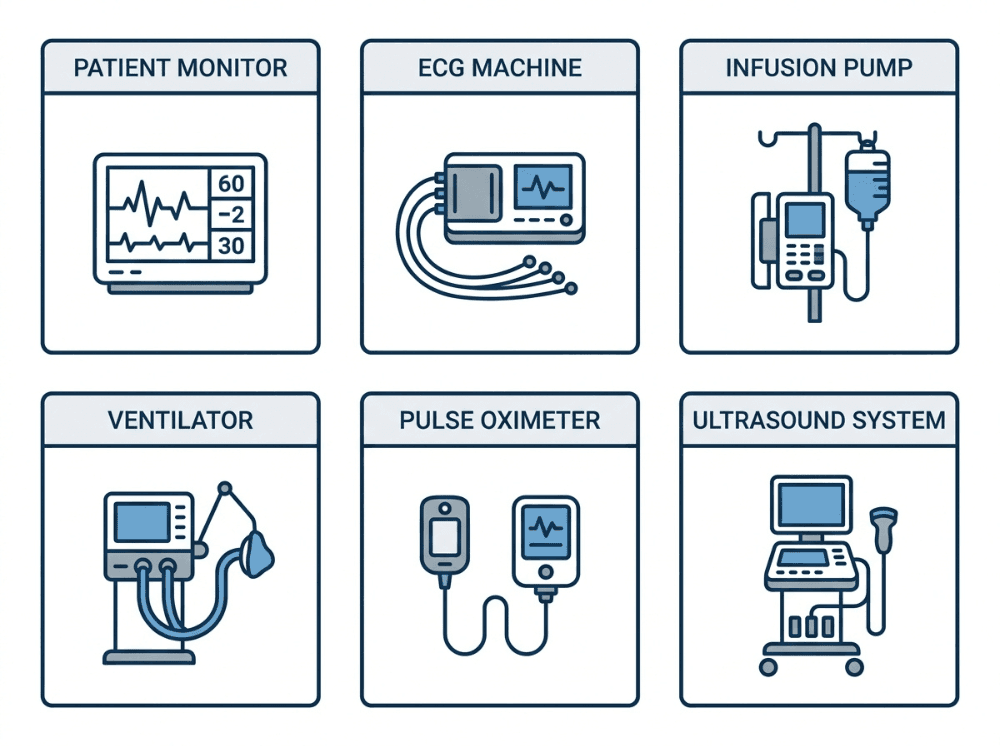
Typical device categories that require IEC 60601 compliance include:
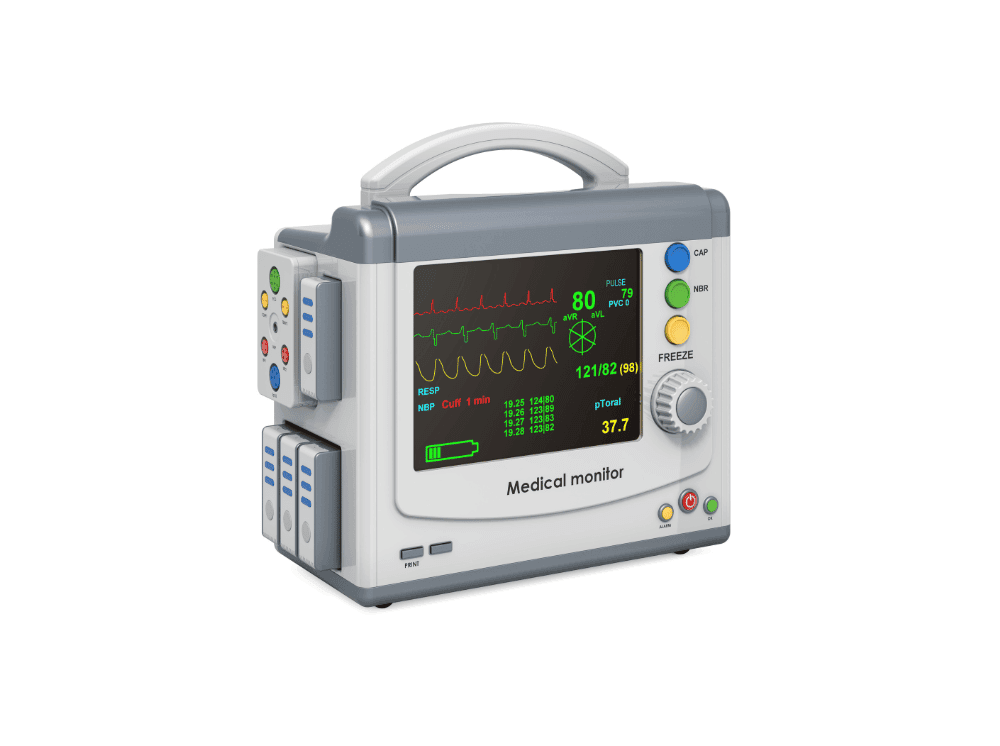
- Diagnostic equipment: Patient monitors, ECG machines, ultrasound systems, imaging devices
- Therapeutic devices: Infusion pumps, ventilators, surgical lasers, electrosurgical units, TENS devices
- Life-support equipment: Defibrillators, anesthesia machines, dialysis equipment
- Home healthcare devices: Blood pressure monitors, pulse oximeters, home ventilators
- Dental equipment: Dental chairs with electrical components, dental lasers
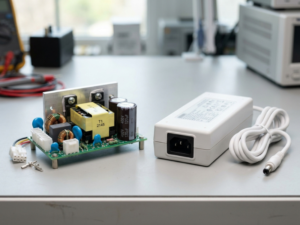
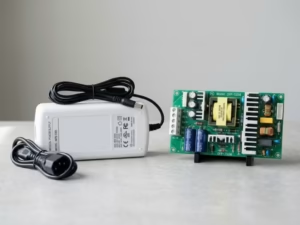
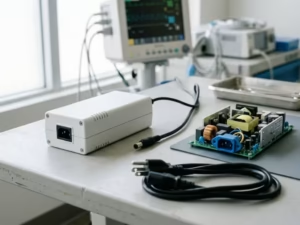
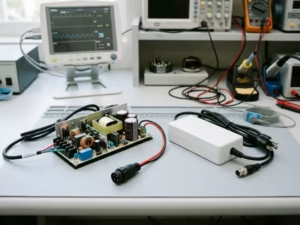
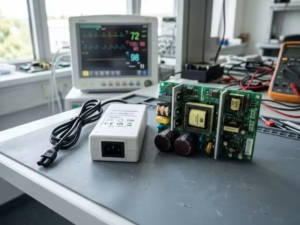
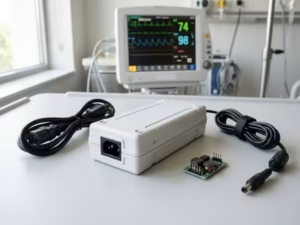
External power adapters and internal power supply modules used in these devices also fall within the standard’s scope. Understanding the IEC 60601-1 safety requirements for medical power supplies is therefore essential for any engineer working on the power architecture of a medical device.
If you’re unsure whether your device falls within scope, the first step is to review the definitions in IEC 60601-1 Clause 3 and map your device’s intended use against them.
How the IEC 60601 Series Is Structured
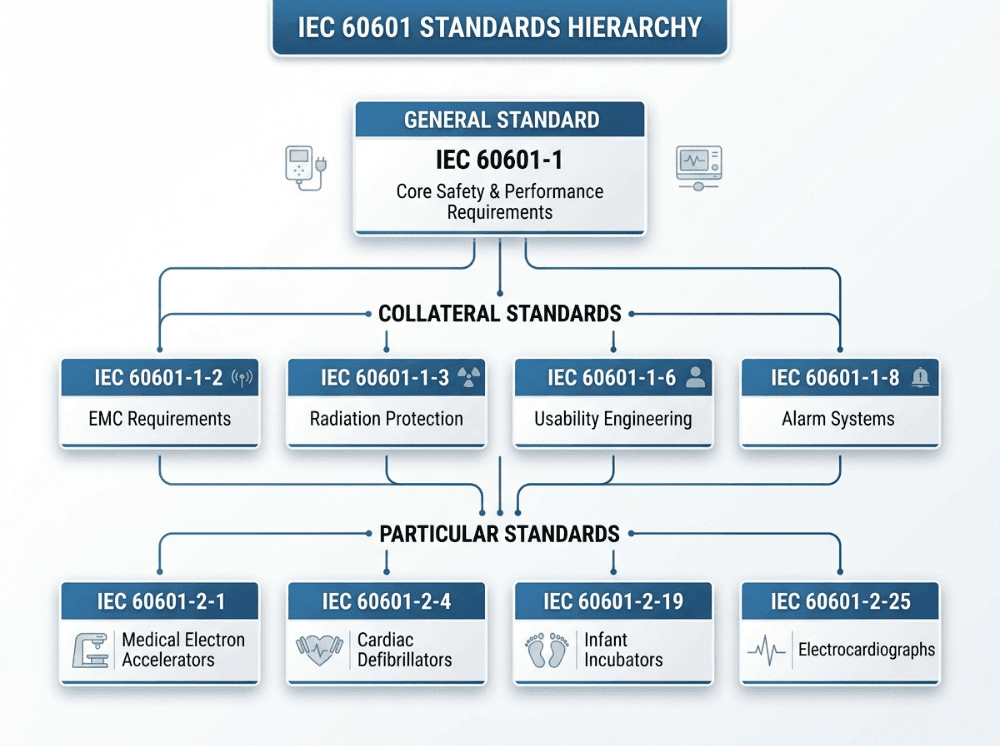
IEC 60601 is not a single document. It’s a family of over 100 standards, organized into three tiers that work together.
The Core Document: IEC 60601-1
IEC 60601-1 is the foundational standard. It sets general safety and essential performance requirements that apply to all medical electrical equipment and systems. The current edition is Edition 3.1 (2012, consolidated with Amendment 1), though Edition 3.2 has been published and is being phased into use across markets.
Every device subject to IEC 60601 must comply with IEC 60601-1 as a baseline. The standard covers electrical safety, mechanical safety, protection against hazardous outputs, and the risk management framework linking to ISO 14971.
Collateral Standards (IEC 60601-1-X)
Collateral standards extend the requirements of IEC 60601-1 in specific technical areas. They apply alongside the general standard and address topics that cross device categories. Key collateral standards include:
- IEC 60601-1-2: Electromagnetic compatibility (EMC)
- IEC 60601-1-6: Usability engineering
- IEC 60601-1-8: Alarm systems
- IEC 60601-1-11: Requirements for medical electrical equipment used in home healthcare environments
Particular Standards (IEC 60601-2-X)
Particular standards address specific device types. They modify, replace, or supplement the general and collateral requirements for defined product categories. For example:
- IEC 60601-2-27 covers electrocardiographic monitoring equipment
- IEC 60601-2-30 applies to automated non-invasive blood pressure monitoring equipment
- IEC 60601-2-49 governs multi-parameter patient monitoring equipment
When a particular standard exists for your device type, it takes precedence over conflicting requirements in IEC 60601-1. If no particular standard applies, the general standard governs in full.
How General, Collateral, and Particular Standards Work Together
Think of IEC 60601-1 as the foundation, collateral standards as horizontal extensions, and particular standards as vertical specializations. A patient monitor, for example, would need to comply with IEC 60601-1 (general), IEC 60601-1-2 (EMC), IEC 60601-1-6 (usability), and IEC 60601-2-49 (the particular standard for multi-parameter monitors)—among others, depending on its features and intended environment.
Building a standard applicability matrix early in development—mapping each applicable standard to the device’s intended use, features, and target markets—is a practical way to avoid gaps later.
Key Safety Concepts You Need to Understand
Basic Safety vs. Essential Performance
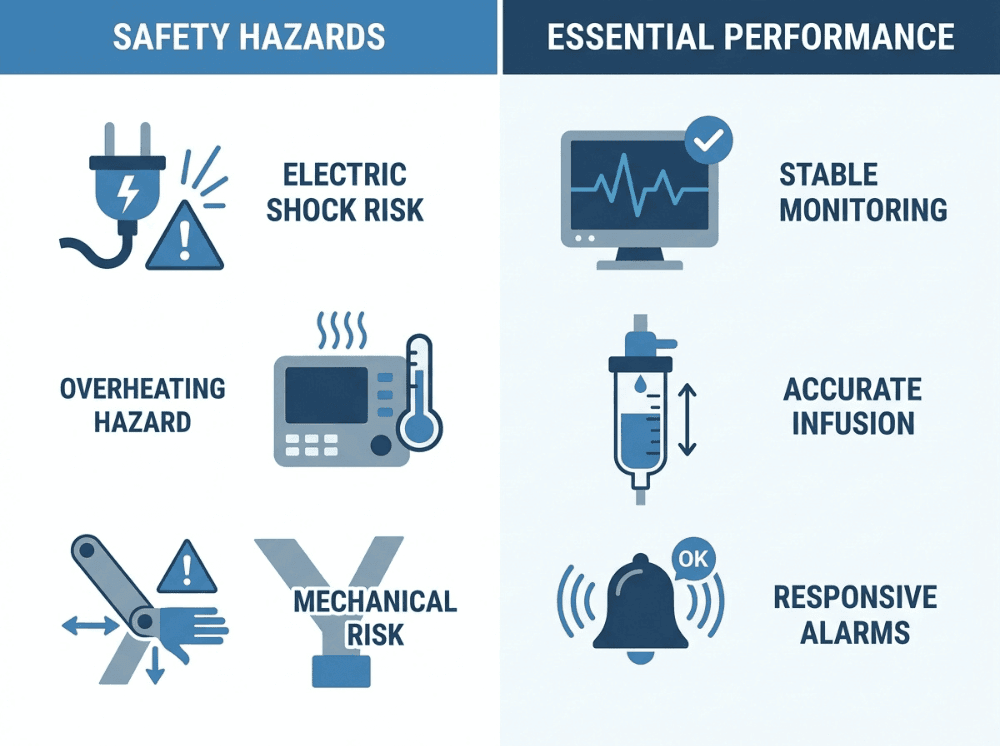
IEC 60601-1 distinguishes between two categories of requirements:
- Basic safety refers to freedom from unacceptable physical risks caused by the equipment itself—for example, electric shock, excessive heat, mechanical hazards, or fire.
- Essential performance refers to the performance necessary to avoid unacceptable risk—for instance, accurate drug delivery in an infusion pump, or accurate alarm triggering in a monitor.
The distinction matters because essential performance requirements are device-specific and must be defined by the manufacturer as part of risk management. A device can be electrically safe but still fail compliance if its essential performance is not maintained under defined conditions.
Means of Protection (MOPP and MOOP)
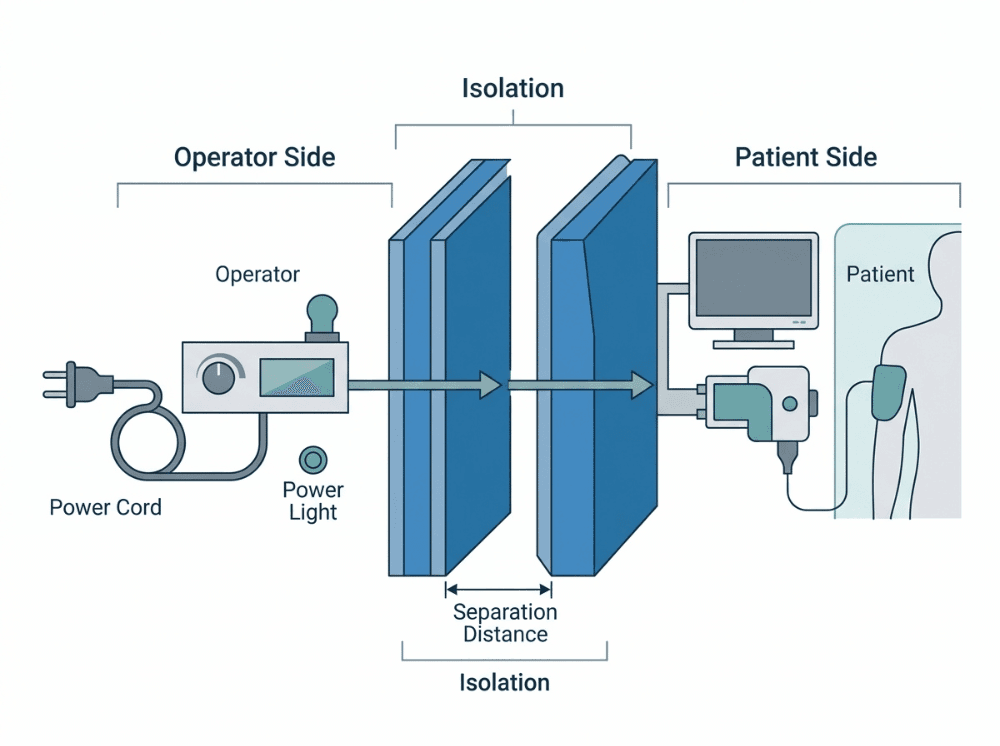
IEC 60601-1 uses two key terms to describe protective insulation barriers:
- MOPP (Means of Patient Protection): Insulation or separation protecting patients from hazardous voltage. These requirements are stricter because patients may be unconscious, sedated, or otherwise unable to react to electrical hazards.
- MOOP (Means of Operator Protection): Insulation protecting operators (clinical staff or users) who can be expected to recognize and react to hazards.
A typical medical power supply designed for patient-contact applications provides 2×MOPP—two independent means of patient protection. This is achieved through creepage and clearance distances, and is measurable through dielectric strength testing. Quankang’s medical-grade power supplies, for example, are designed to meet the 2×MOPP requirement, with leakage current ≤ 100 µA, for patient-contact applications.
Isolation Requirements: Creepage, Clearance, and Insulation
Three terms define the physical and electrical separation between conductors:
- Clearance: The shortest distance through air between two conductive parts
- Creepage: The shortest path along the surface of an insulating material between two conductive parts
- Insulation type: Classified as functional, basic, supplementary, or reinforced—each with different withstand voltage requirements
These values are determined by the working voltage, pollution degree, material group, and the type of protection required (MOPP or MOOP). Errors in calculating or testing these values are a common cause of test failures.
Applied Parts Classification: Type B, BF, and CF
IEC 60601-1 classifies applied parts—the parts of equipment that come into contact with the patient—into three protection levels. Each represents progressively stricter patient protection requirements:
- Type B (Body): Provides a basic level of patient protection with defined limits on patient leakage current. Suitable for devices not intended for direct cardiac application.
- Type BF (Body Floating): Provides a higher level of protection through an F-type (floating) isolated applied part, with stricter leakage current limits than Type B. Suitable for surface-contact applications where greater isolation from earth is required.
- Type CF (Cardiac Floating): Provides the highest level of patient protection with the most stringent leakage current limits. Required for devices with applied parts intended to make direct cardiac contact, such as intracardiac catheters.
Choosing the wrong classification for your applied parts is an error that surfaces late in testing—and can require hardware redesign to correct.
Risk Management and the Link to ISO 14971
Why the Risk Management File Is Central to Compliance
IEC 60601-1 does not operate in isolation from risk management. Clause 4 of the standard explicitly requires that the device’s safety be addressed through a risk management process in accordance with ISO 14971 — the international standard for risk management of medical devices.
This means compliance with IEC 60601-1 is not simply a matter of passing electrical safety tests. The manufacturer must maintain a risk management file that:
- Identifies all hazards associated with the device
- Estimates and evaluates associated risks
- Implements risk controls
- Evaluates the effectiveness of those controls
- Confirms that residual risk is acceptable
Regulators reviewing a technical file or 510(k) submission will expect to see this documentation. A weak or incomplete risk management file undermines the credibility of compliance evidence, even when test reports show passing results.
Using Risk Assessment to Justify Test Applicability
Not every test in IEC 60601-1 applies to every device. Some tests are conditional—they apply only when specific features, hazards, or use environments are present. Risk assessment is the mechanism by which manufacturers justify which tests apply and, where relevant, why certain tests are not applicable.
This requires careful reading of the standard, an accurate description of the device, and a defensible rationale. Regulators have become more attentive to manufacturers claiming that tests are inapplicable without adequate justification.
Major Collateral Standards You Need to Know
IEC 60601-1-2: Electromagnetic Compatibility
IEC 60601-1-2 defines EMC requirements for medical electrical equipment—both emissions (how much electromagnetic noise the device generates) and immunity (how well the device withstands external interference).
The current edition is Edition 4 (2014), with Amendment 1 (2020) adding requirements for wireless-enabled devices. Medical devices operating in environments with other electronic equipment—hospitals, home settings, ambulances—must demonstrate they neither disrupt nor are disrupted by the electromagnetic environment.
EMC testing is frequently treated as a final-stage activity. This is a mistake. EMC performance is largely determined by design choices made early: PCB layout, shielding, filtering, and cable management. By the time a device reaches final EMC testing, fixing failures can require significant redesign.
IEC 60601-1-6: Usability Engineering
IEC 60601-1-6 requires manufacturers to apply a usability engineering process—aligned with IEC 62366-1—to ensure the device’s user interface does not create unacceptable risk. This includes summative and formative usability evaluations and documentation of the user interface design rationale.
Usability engineering is not a post-design activity. It needs to begin during concept development and be integrated throughout the design process.
IEC 60601-1-8: Alarm Systems and Alarm Fatigue
IEC 60601-1-8 specifies requirements for alarm systems in medical electrical equipment. It covers alarm signal priorities, types, and the information conveyed to operators.
Alarm fatigue—where clinicians become desensitized to frequent alarms—is a recognized patient safety issue. The standard addresses this through requirements for alarm signal distinctiveness, pausing, and the management of alarm conditions. Software implementing alarm logic should also be developed in accordance with IEC 62304 (medical device software lifecycle) and informed by the risk management process under ISO 14971.
IEC 60601-1-11: Home Healthcare Environment
IEC 60601-1-11 applies to medical electrical equipment intended for use in home healthcare environments—a category that has grown significantly with the expansion of remote patient monitoring and home therapy devices.
Home environments present different hazards than hospitals: less controlled power quality, a greater likelihood of use by untrained users, and different physical conditions. IEC 60601-1-11 adds requirements for robustness, user instruction, and the specific hazards of the home setting.
Common Standards Often Used Together
IEC 60601 rarely operates alone. Most medical electrical equipment projects require a coordinated set of standards. The most commonly referenced alongside IEC 60601 include:
Standard | Scope |
|---|---|
ISO 14971 | Risk management for medical devices |
IEC 62304 | Medical device software lifecycle processes |
IEC 62366-1 | Usability engineering for medical devices |
IEC 60601-1-2 | EMC requirements |
IEC 60601-1-6 | Usability engineering (references IEC 62366-1) |
IEC 60601-1-8 | Alarm systems |
ISO 13485 | Quality management systems for medical devices |
For power supply engineers specifically, IEC 60601-1 works alongside ISO 13485 manufacturing requirements to define both the design and the quality management framework within which medical-grade power supplies must be produced.
The Path to Certification and Testing
Identifying the Correct Edition for Your Target Market
Different markets recognize different editions of IEC 60601-1. The EU and many other markets have transitioned to Edition 3.1. The FDA currently recognizes Edition 3.1 in its list of recognized consensus standards. Some markets have transition periods for newer editions (such as Edition 3.2), and timelines vary.
Checking the current recognized edition for each of your target markets before beginning testing avoids the costly situation of completing a test program to an edition that is no longer accepted.
Selecting an Accredited Testing Laboratory
For most markets, testing should be conducted by a laboratory accredited under the relevant national or international scheme. Many manufacturers use laboratories participating in the IECEE CB Scheme (the international system for mutual acceptance of test reports and certificates for electrical and electronic equipment), which allows a single CB test report to support certification in multiple member countries.
For the US market, some manufacturers use laboratories recognized under the OSHA National Recognized Testing Laboratories (NRTL) program for product safety certification. The right laboratory choice depends on your target markets, timeline, and the specific standards in scope.
Preparing the Technical File
A complete IEC 60601-compliant technical file includes:
- Device description and intended use
- Standards applicability matrix with rationale
- Risk management file (per ISO 14971)
- Design documentation (schematics, BOM, software architecture if applicable)
- Test reports for all applicable standards
- Usability engineering file (per IEC 62366-1)
- Software documentation (per IEC 62304, if applicable)
- Labeling and instructions for use
Gaps in any of these areas will generate regulatory questions. Building the file in parallel with development—rather than assembling it at the end—is strongly recommended.
Common Testing Failures and How to Avoid Them
Several failure modes appear repeatedly across IEC 60601 test programs:
- Leakage current failures: Often caused by insufficient isolation design or incorrect creepage/clearance calculations. Verify isolation requirements against the standard’s tables before finalizing the PCB layout.
- Dielectric strength failures typically indicate that insulation materials or clearances don’t meet the MOPP/MOOP requirements for the working voltage.
- EMC failures frequently trace back to PCB layout, grounding, or filtering choices made early in the design. Don’t treat EMC as a final-step activity.
- Essential performance failures under fault conditions: Occur when the device’s essential performance has not been adequately defined, or when fault condition testing reveals unacceptable degradation.
- Temperature failures: Surface temperature or internal component temperatures exceed the standard’s limits. Thermal modeling early in design helps anticipate these.
IEC 60601 and FDA 510(k) / CE Submission
For FDA 510(k) submissions for electrically powered devices, the FDA recognizes IEC 60601-1, Edition 3.1, as a consensus standard. Declaring conformance to a recognized standard, backed by test reports, simplifies the submission and reduces the likelihood of additional questions. That said, the specific standards applicable to a 510(k) submission depend on the device type, its predicate, and the FDA’s guidance for the relevant device category. IEC 60601 conformance is expected for applicable device types, but should be mapped carefully against the device’s specific classification.
For CE marking under EU MDR 2017/745, compliance with harmonized standards—including IEC 60601-1 and relevant collateral and particular standards—creates a presumption of conformity with the corresponding Essential Requirements and General Safety and Performance Requirements (GSPRs). The Declaration of Conformity and technical documentation must reference the specific editions of standards applied.
In both cases, the power supply plays a significant role in the submission. Regulatory reviewers examine isolation architecture, leakage current test data, and certifications held by the power supply manufacturer. Selecting a medical-grade power supply from an ISO 13485-certified manufacturer with traceable IEC 60601-1 certifications simplifies this part of the submission considerably.
Common Mistakes Manufacturers Make
Even experienced teams encounter the same compliance pitfalls. Here are the most consequential ones:
- Starting risk management too late. ISO 14971 and IEC 60601-1 both require risk management to be integrated throughout the product lifecycle—not completed as a documentation exercise at the end of development. Late risk management leads to weak files that don’t reflect actual design decisions.
- Selecting applicable standards too late. Identifying which particular and collateral standards apply should happen during concept development. Discovering a relevant particular standard late in the process can mean having to repeat significant portions of the test program.
- Treating EMC as a final-stage test. EMC performance is determined by design. PCB layout, component selection, and shielding strategies established early in development determine whether a device passes EMC testing. Finding EMC failures during final testing, when design changes are expensive, is avoidable.
- Misdefining essential performance. Essential performance must be defined by the manufacturer based on the device’s intended use and risk analysis. Defining it too narrowly (to minimize testing burden) can leave real hazards unaddressed. Defining it too broadly creates an unnecessarily difficult test program. Getting this definition right early saves significant rework.
- Assuming a prior PCB layout will re-pass testing. Modifying a PCB—even seemingly minor changes, such as component substitution or trace rerouting—can affect EMC performance, leakage current, and thermal behavior. Re-evaluation against applicable standards is required after significant design changes.
A Practical IEC 60601 Readiness Checklist
Use this checklist to assess where your project stands before entering formal testing:
Standards and Scope
- Applicable standards identified (general, collateral, particular) with rationale documented
- Correct edition confirmed for each target market
- Standards applicability matrix completed
Risk Management
- Risk management plan established per ISO 14971
- Hazard identification completed for all foreseeable hazards
- Risk controls implemented and verified
- Essential performance is defined and documented
Design Documentation
- Schematics and BOM finalized and version-controlled
- Creepage, clearance, and insulation values calculated and verified against standard requirements
- Applied part classification (Type B, BF, or CF) confirmed
- MOPP/MOOP requirements mapped to design elements
Software (if applicable)
- Software safety class determined per IEC 62304
- Software lifecycle documentation in progress
Usability Engineering
- Usability engineering file initiated per IEC 62366-1
- User interface risk analysis completed
- Formative evaluations planned or completed
EMC
- PCB layout reviewed for EMC considerations
- Pre-compliance EMC scan completed or scheduled before final testing
Testing and Certification
- Accredited laboratory identified for target market(s)
- CB Scheme applicability assessed for multi-market certification
- Test schedule integrated with development timeline
Frequently Asked Questions About IEC 60601
What is IEC 60601 used for?
IEC 60601 is the international standard series governing the safety and performance of medical electrical equipment. It sets requirements for electrical safety, mechanical safety, essential performance, and risk management for powered medical devices.
Which devices need IEC 60601 compliance?
Devices that are electrically powered, intended for medical use, and may contact or transfer energy to or from a patient typically require IEC 60601 compliance. This includes patient monitors, ventilators, infusion pumps, surgical devices, and home healthcare equipment, among many other categories.
What is the difference between IEC 60601-1 and IEC 60601-2 standards?
IEC 60601-1 is the general standard that applies to all medical electrical equipment. IEC 60601-2-X particular standards address specific device types and modify or supplement the general requirements for those categories.
Is IEC 60601 required for an FDA 510(k) submission?
The FDA recognizes IEC 60601-1 Edition 3.1 as a consensus standard. For electrically powered medical devices, demonstrating conformance is expected and simplifies the 510(k) submission process. The specific standards applicable to a submission depend on the device type and its predicate.
What is the difference between MOPP and MOOP?
MOPP (Means of Patient Protection) refers to insulation barriers protecting patients who may be unable to respond to electrical hazards. MOOP (Means of Operator Protection) refers to barriers that protect operators, who are expected to recognize and react to hazards. MOPP requirements are stricter than MOOP.
What are Type B, BF, and CF applied parts?
These classifications represent progressively stricter levels of patient protection for parts of a device that contact the patient. Type B provides basic protection; Type BF adds floating isolation for surface applications; Type CF provides the highest level of protection and is required for direct cardiac contact applications.
How long does IEC 60601 certification testing typically take?
Timelines vary significantly depending on the device complexity, the number of applicable standards, and the laboratory’s schedule. A straightforward device with a single standard may complete testing in 8–12 weeks. Complex systems with multiple collateral standards can take 6 months or longer.
What is the CB Scheme, and why does it matter for IEC 60601?
The IECEE CB Scheme is an international system that allows a single CB test report to support product certification in multiple participating countries. For manufacturers targeting multiple markets, using a CB Scheme-accredited laboratory reduces the need for redundant testing.
Build Your IEC 60601 Compliance Strategy on a Solid Foundation
IEC 60601 compliance is a process that runs from the first design decision to post-market surveillance. The manufacturers who navigate it most efficiently are those who make the right foundational decisions early—particularly around power supply architecture, risk management methodology, and standards applicability.
The power supply is often where compliance problems originate. It is also where they can be most effectively prevented. Selecting a medical-grade power supply that already carries traceable IEC 60601-1 certification, provides 2×MOPP isolation, and is manufactured under ISO 13485 quality management removes a significant variable from the certification process.
If you are working through power supply selection for a new medical device design, Quankang’s engineering team can support compliance review, provide CB test reports, and help match the right power solution to your device’s applied part classification and leakage current requirements. Explore the full range of IEC 60601-1 certified medical power supplies or contact the team to discuss your specific application.