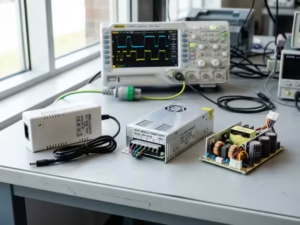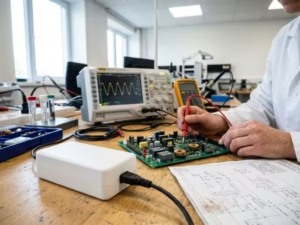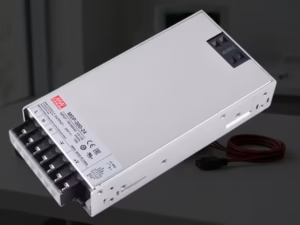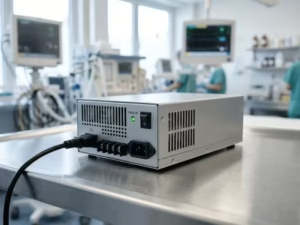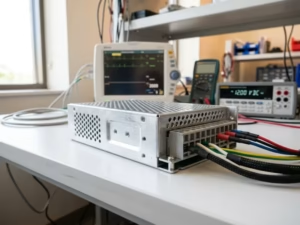
In modern healthcare, life-saving devices are essential tools that help medical professionals monitor, diagnose, and treat patients under critical conditions. From ventilators that sustain breathing to infusion pumps that deliver precise medication doses, these devices rely on one fundamental component: the medical power supply. While it may seem like a minor part of complex medical systems, the power supply’s role is vital in ensuring safety, reliability, and uninterrupted operation. This article explores the importance of medical power supplies in life-saving devices, the unique standards they must meet, and the considerations for selecting the right power solutions.
Unlike consumer or industrial power supplies, medical-grade power supplies are designed for applications where electrical safety directly affects patient health. Many life-support systems remain connected to patients continuously, making isolation performance, leakage current, electromagnetic compatibility (EMC), and long-term reliability essential design requirements rather than optional features. As medical technologies become increasingly portable, connected, and intelligent, power supplies have evolved from simple AC/DC converters into critical components that influence regulatory compliance, device performance, and product lifecycle.
1. Why Medical Power Supplies Are Critical
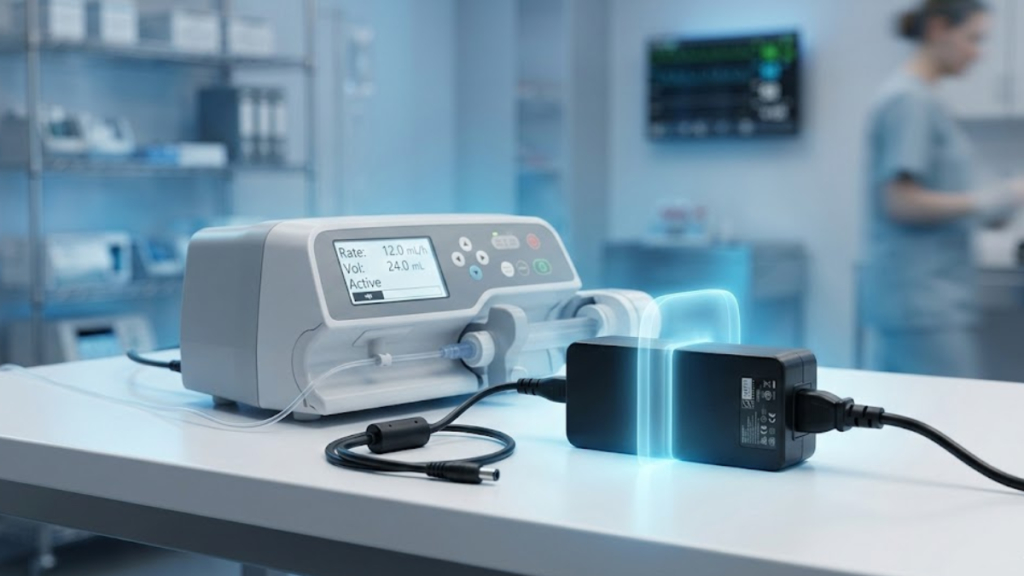
Life-saving medical devices operate in environments where failure is not an option. A brief power disruption, voltage fluctuation, or electrical fault can have severe consequences, including patient injury or even death. The medical power supply is responsible for converting incoming electrical energy into safe, stable, and regulated output to drive device operation. Its critical functions include:
Providing stable power: Ensures devices perform accurately under varying load conditions. For example, infusion pumps rely on constant voltage to deliver precise medication volumes.
Protecting patients and operators: Medical-grade power supplies limit leakage currents and provide reinforced insulation to prevent electrical shocks.
Supporting continuous operation: Many life-saving devices operate 24/7, requiring power solutions with high reliability and long-term stability.
Ensuring compliance: Medical power supplies meet rigorous international standards that guarantee safe operation in hospitals, intensive care units, and home care environments.
Without a properly designed medical power supply, life-saving devices risk malfunction, inaccurate readings, or complete shutdown, directly affecting patient outcomes.
2. Key Life-Saving Devices Relying on Medical Power Supplies
Ventilators
Ventilators assist or replace spontaneous breathing in patients with respiratory failure. They require uninterrupted, precise electrical power to control airflow, pressure, and oxygen concentration. Even a short power interruption can compromise patient safety. Medical power supplies in ventilators are designed with redundancy, low leakage current, and high reliability to ensure continuous operation.
Infusion and Syringe Pumps
These devices deliver medication, fluids, or nutrients in precise amounts over specified periods. Voltage fluctuations can cause dosing errors, leading to underdosing or overdosing, which could be life-threatening. Medical power supplies ensure ultra-stable output with minimal ripple to maintain dosing accuracy.
Patient Monitors
Devices such as ECG, pulse oximeters, and blood pressure monitors continuously track vital signs. They require low-noise, reliable power to guarantee accurate measurements and prevent interference from other equipment in critical care environments.
Defibrillators and Cardiac Devices
Defibrillators deliver high-energy shocks to restore normal heart rhythm during cardiac arrest. They demand power supplies capable of rapid energy delivery and precise timing. Medical-grade power solutions provide the reliability and safety margins needed for such high-stakes applications.
Imaging and Diagnostic Equipment
MRI, CT scanners, and ultrasound systems require high power and sensitive operation. Medical power supplies provide regulated and stable voltages, protecting delicate imaging circuits and ensuring clear, accurate diagnostic outputs.
Typical Power Requirements for Life-Saving Medical Devices
| Medical Device | Primary Power Requirement | Why It Matters |
| Ventilator | Continuous regulated output | Prevents interruption of respiratory support |
| Infusion Pump | Low ripple and voltage stability | Ensures accurate drug delivery |
| Patient Monitor | Low EMI and stable DC output | Improves signal accuracy |
| Defibrillator | High peak power capability | Supports rapid energy discharge |
| Ultrasound System | Stable multi-output voltages | Maintains image quality |

3. Medical Standards and Safety Requirements
Medical power supplies are distinct from standard commercial or industrial units due to their stringent safety and performance requirements. Key standards include:
IEC 60601-1: Defines general safety requirements for medical electrical equipment, including isolation, creepage distances, and mechanical strength.
2 x MOPP (Means of Patient Protection): Ensures reinforced insulation and isolation between input and output to prevent patient shock hazards.
IEC 60601-1-2: Specifies electromagnetic compatibility (EMC), ensuring medical devices do not interfere with other critical equipment.
Leakage Current Limits: Typically less than 100 µA for patient-connected devices, protecting patients from electrical hazards.
Compliance with these standards is not optional. Devices failing to meet them may be barred from medical markets, and patient safety could be compromised.
4. Key Electrical Specifications Engineers Should Evaluate
When evaluating a medical power supply, engineers should look beyond output voltage and wattage. Electrical performance, safety margins, and long-term reliability all influence the overall performance of medical equipment.
| Parameter | Importance |
| Leakage Current | Minimizes patient shock risk |
| Isolation Voltage | Provides patient protection |
| Ripple & Noise | Maintains signal accuracy |
| MTBF | Indicates long-term reliability |
| Efficiency | Reduces heat generation |
| Hold-up Time | Prevents shutdown during brief power dips |
| Operating Temperature | Ensures stable performance in harsh environments |
| Protection Functions | OVP, OCP, SCP and OTP improve system safety |
Evaluating these specifications early in the product development process helps OEM manufacturers reduce certification risks and improve long-term product reliability.
5. Design Considerations for Life-Saving Device Power Supplies
When selecting or designing a power supply for life-saving devices, several factors are critical:
Reliability and Redundancy
Life-critical devices must operate continuously without failure. Medical power supplies often include redundant systems or backup pathways to prevent downtime. High MTBF (Mean Time Between Failures) and rigorous stress testing ensure long-term reliability.
Noise and Ripple Control
Sensitive medical devices can malfunction if electrical noise interferes with signal processing. Power supplies for these applications are designed with low ripple and minimal electromagnetic interference, ensuring accuracy in monitoring and diagnostics.
Thermal Management
Many life-saving devices operate in environments where fan noise or airflow is undesirable, such as patient rooms or operating theaters. Medical power supplies often use fanless or convection-cooled designs to manage heat without disrupting the clinical environment.
Compact Form Factor
Portable and wearable life-saving devices, like emergency ventilators or defibrillators, require compact, lightweight power solutions without compromising performance or safety.
Global Certification
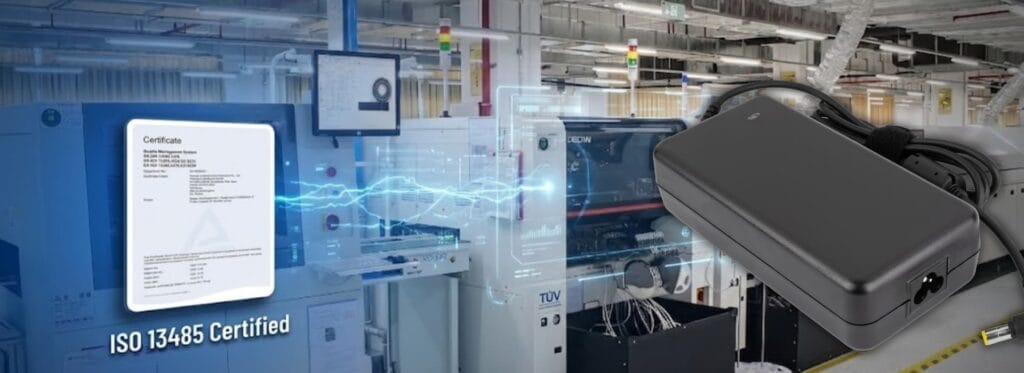
For medical devices marketed worldwide, power supplies must carry approvals such as UL, CE, CB, FCC, or PSE, facilitating regulatory compliance and faster market entry.
Mechanical Integration and Customization
In addition to electrical performance, OEM manufacturers often require customized connectors, cable lengths, enclosure dimensions, mounting options, and labeling to simplify product integration. Selecting a supplier capable of providing engineering customization can reduce development time and improve manufacturing efficiency.
6. What Happens When a Medical Power Supply Fails?
Medical power supply failures can affect far more than device uptime—they may directly impact patient safety and regulatory compliance.
Examples include:
- A ventilator shutting down because of unstable power input.
- Excessive ripple introducing noise into ECG signals and affecting diagnosis.
- Overheating leading to premature component aging.
- High leakage current increasing electrical safety risks.
- EMC failure causing interference with nearby medical equipment.
Proper power supply selection minimizes these risks while extending overall equipment reliability.

7. Emerging Trends in Medical Power Supplies
The medical power supply industry is evolving rapidly to meet the demands of modern life-saving devices:
Higher Power Density: Enables smaller, portable devices with improved performance.
Smart Power Management: Integration with IoT systems for predictive maintenance and energy efficiency.
Wireless Power Solutions: Reduces cable clutter and enhances patient mobility.
Sustainable Design: Higher efficiency and eco-friendly materials reduce energy waste and environmental impact.
These trends allow healthcare providers to deploy advanced, patient-friendly technologies without compromising safety.
Conclusion
Medical power supplies are not merely components; they are critical enablers of patient care and life-saving technology. They ensure devices operate reliably, safely, and efficiently in the most demanding environments, protecting patients and supporting healthcare professionals worldwide. Choosing the right power supply is therefore as important as selecting the medical device itself.
Quankang Medical Power Supply
Quankang specializes in providing high-quality medical power supply solutions for a wide range of life-saving devices. Our products comply fully with IEC 60601-1 and IEC 60601-1-2 standards, featuring ultra-low leakage current, 2 x MOPP insulation, and high reliability for 24/7 operation. From ventilators and infusion pumps to diagnostic imaging systems and portable emergency devices, Quankang ensures safe, efficient, and compliant power solutions.
With Quankang medical power supplies, healthcare device manufacturers can confidently deliver life-critical solutions that meet international standards and protect patient safety worldwide.
Recommended Medical Power Supply Solutions
Suitable for handheld medical devices.
Ideal for patient monitoring systems.
Designed for ventilators and diagnostic equipment.
Supports high-performance portable medical systems.
Frequently Asked Questions
What makes a medical power supply different from a standard power adapter?
Medical power supplies comply with IEC 60601 safety standards, provide reinforced isolation, and maintain ultra-low leakage current for patient protection.
Can industrial power supplies be used in medical equipment?
Generally no. Medical equipment connected to patients typically requires medical-grade certification and enhanced electrical isolation.
Why is low leakage current important?
Leakage current reduces the risk of electrical shock for patients and is a key requirement under IEC 60601.
What is 2 × MOPP?
2 × MOPP (Means of Patient Protection) defines reinforced insulation requirements that provide two independent levels of patient protection.