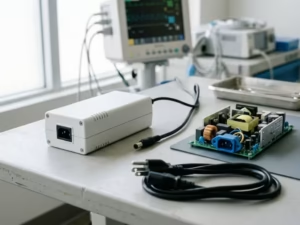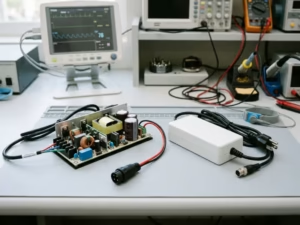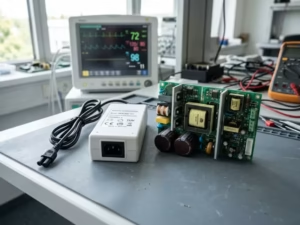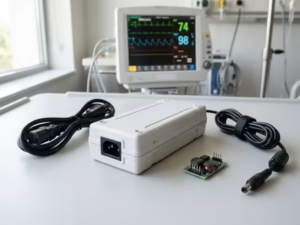

I’ve spent a long time around power electronics, and medical power is its own world. The stakes are different. When a patient is physically connected to a device, the power supply isn’t just running the electronics. It’s standing between mains voltage and a human heart.
That changes everything about how you design and select it. Let me walk you through what actually matters when choosing power supply solutions for patient-connected medical equipment, from safety standards to the practical trade-offs you’ll wrestle with in the lab.
Why Patient-Connected Equipment Needs Specialized Power Solutions
A standard industrial or consumer power supply has one main job: deliver clean, reliable power. A medical supply for patient-connected gear has a second job that’s just as important. It has to protect the patient, even when something fails.
That’s the part people underestimate. It’s not enough for the supply to be safe when everything works. It has to keep the patient safe when a component shorts, a wire breaks, or a fault current tries to find a path through the person on the table.
Standard supplies usually fall short on two fronts: isolation and leakage current. They simply aren’t built to the tighter limits these applications demand. You can’t bolt safety on later, either. It has to be engineered in from the start.
In the sections ahead, I’ll cover applied part classes, the IEC 60601-1 rules that govern this space, how to control leakage current, the split between low- and high-power solutions, the design headaches you’ll run into, and how to pick the right product.
Understanding Patient Risk and Applied Parts
Patient-connected equipment is any device with an applied part that comes into contact with a person during treatment or diagnosis. Think ECG leads, blood pressure cuffs, ultrasound probes, or a catheter sensor.
The central hazard is leakage current. Every power supply leaks a tiny amount of current, usually to ground, through the small capacitances inside it. In most products, that’s harmless. But if that current can flow through a patient, even a few microamps in the wrong place can cause a shock or disrupt a heart rhythm.
Here’s the key idea: the type of patient contact drives every downstream power decision. A device touching dry skin is a very different problem from one with a direct path to the heart.
That’s why the safety bar sits so far above normal electronics. You need extra isolation and much tighter current limits. Isolation is the heart of it. It’s the physical and electrical barrier that keeps dangerous voltage from ever reaching the patient.
IEC 60601-1 Classifications: Type B, BF, and CF
The IEC 60601-1 standard sets the safety baseline for medical electrical equipment, and it’s been adopted across the major global markets. It sorts applied parts into three classes based on how they contact the patient.
Learn more: IEC 60601-1: Key Changes from the 2nd to the 3rd Edition
Type B (Body)
This is the least stringent class. Type B parts are generally non-conductive and may be connected to Earth. A good example is an LED treatment light or an exam lamp. The part touches the patient, but there’s no intimate electrical connection.
Type BF (Body Floating)
Type BF parts are electrically connected to the patient and must “float,” meaning they’re separated from Earth. Blood pressure cuffs and ultrasound probes fit here. There’s a real electrical connection, but it doesn’t reach the heart directly.
Type CF (Cardiac Floating)
This is the strictest class. CF parts are suitable for direct cardiac and intravenous connection, so they demand the lowest leakage limits and full isolation from Earth. Dialysis machines and certain surgical or catheter-based tools live here.
The pattern is simple. As you move from B to BF to CF, isolation requirements climb and allowable leakage drops. Your power supply has to match the classification, not exceed your budget, and not miss the mark.
MOPP, MOOP, Isolation, Creepage, and Clearance
IEC 60601-1 defines two kinds of protection, and the difference matters when you read a datasheet.
MOOP stands for Means of Operator Protection. It protects the person operating the equipment, such as a nurse or technician. MOPP stands for Means of Patient Protection and directly protects the patient.
MOPP is the tougher standard. It requires higher insulation voltages and greater physical spacing than MOOP because the patient is more vulnerable than a healthy operator. A patient may be sedated, have broken skin, or have a direct internal connection.
For patient-connected outputs, you’ll typically need 2 x MOPP between the mains input and the patient side. That’s two independent layers of protection, so a single failure doesn’t expose the patient.
Those layers are verified with isolation test voltages. Basic isolation often tests around 1500 VAC, and a 2 x MOPP barrier tests considerably higher. Treat exact numbers as class- and design-dependent, but the principle holds: more protection means a higher test voltage.
Then there’s creepage and clearance. Creepage is the distance between conductive parts measured along a surface. Clearance is the straight-line distance through air. Both matter, on the circuit board and inside the transformer, because they prevent a high voltage from arcing or tracking across to the patient side.
Managing Leakage Current in Patient-Connected Systems
Leakage current isn’t one number. There are three you need to keep straight.
- Earth leakage current flows through the ground conductor back to the supply. It has to stay low enough to avoid nuisance tripping of protective devices.
- Touch (chassis) current flows when someone touches the equipment housing, creating a path to ground.
- Patient leakage current flows from the applied part, through the patient, to Earth. This is the one that can hurt someone, so it’s the metric that matters most.
As a practical reference, the standard limits the current to around 100 μA under normal conditions and 500 μA under a single-fault condition. Patient leakage limits are far stricter, especially for CF parts.
Here’s the design tension that trips up many teams. To pass EMI requirements, you usually add filter capacitors that bleed noise to ground. But those same capacitors increase leakage current. Low noise and low leakage pull against each other.
Good medical supplies address this with specialized transformers and very low input-to-output capacitance, often in the 20-50 pF range. That low capacitance is what lets you push patient leakage down to single-digit microamps.
Low-Power vs High-Power Power Supply Solutions
The right architecture depends heavily on how much power your system needs. There isn’t one answer.
Low-Power Systems
For lower-power devices, a clean and cost-effective approach is a two-stage design. You start with a standard, medically approved AC-DC supply, then add a second isolated medical DC-DC converter near the patient circuit.
That second stage adds another barrier of basic isolation at mains voltage and, just as important, very low capacitance. When done right, this can reduce patient leakage to around 2 μA. That’s low enough to qualify for both BF and CF use, which is a big deal for a modest added cost.
High-Power Systems
High-power gear is a different story. Think surgical tools, ventilators, or motor-driven equipment. Here, bolting on a second isolation stage usually isn’t practical, because high-power isolated DC-DC converters are hard to source. Converting the power twice also reduces efficiency and generates unwanted heat.
For these systems, you want a single, purpose-built supply with all the isolation, spacing, and leakage control engineered in from the ground up. These are often BF-rated rather than CF, which relaxes the leakage target somewhat but still demands serious design discipline.
AC-DC Supplies, DC-DC Converters, and Two-Stage Architectures
Let me put the pieces together, because the parts work as a system.
The medically approved AC-DC supply is your front end. It takes mains power and provides the first layer of isolation, along with a regulated DC rail. On its own, many standard medical AC-DC supplies aren’t safe for direct patient connection, because their input-to-output capacitance is too high.
That’s where the isolated medical DC-DC converter earns its place. These typically run from about 1W to 30W, add a second isolation barrier, and offer very low capacitance. Slotted in behind the AC-DC stage, they deliver compliant, low-leakage power without breaking the budget.
The two-stage architecture is the result. AC-DC front-end plus an isolated DC-DC stage near the patient circuit. It’s often the most cost-effective path to compliance for lower-power designs, and it also protects against noise coming back from external gear, such as a monitor or computer.
For portable and battery-powered devices, wide-range DC input converters are the tool of choice. They maintain tight output across a broad input range and can provide up to 2x MOPP isolation. And when the DC-DC stage is behind a regulated AC-DC supply, you can often use a fixed-input, semi-regulated converter, which keeps costs down nicely.
If your system already runs from a DC bus or battery source, it may also be useful to understand when a standard AC-DC supply can be fed directly from DC input.
Thermal, EMI, Fanless, and Portable Design Considerations
Safety gets the headlines, but these practical issues decide whether your design actually works in the field.
Efficiency and heat. Higher efficiency means less waste heat. That’s critical for sealed medical enclosures that can’t use a fan. Less heat in equals fewer thermal problems and longer component life.
Fanless cooling. Many medical environments can’t tolerate a fan. Fans pull in dust and can spread pathogens in a sterile setting like an operating room. Conduction-cooled, fanless supplies solve that problem and run quietly, which matters in patient spaces.
EMI control. Power supply noise can corrupt sensitive bio-signals. An ECG or EEG reading is measured in microvolts, so even small interference can distort the trace. Tight EMI control protects the very signal the device exists to capture.
Derating. Pay attention to the derating curve. A supply rated for full power at room temperature may deliver much less at higher ambient temperatures. Size for the real operating environment, not the best-case spec.
Portable needs. Battery-powered devices add their own list: high power density in a small package, charging circuits that meet medical safety standards, and low standby power to extend battery life and comply with energy rules.
Common Obstacles in Medical Power Design
A few problems show up again and again. Knowing them early saves you a painful redesign later.
- Space versus power. Handheld devices require high power density in a tiny footprint, and that’s hard to achieve while maintaining isolation and cooling.
- Low emissions versus low leakage. As I mentioned, these goals fight each other. Balancing them is one of the trickiest parts of medical power design.
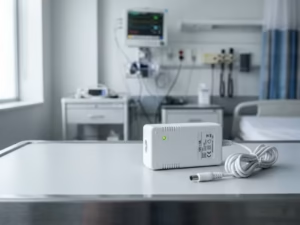
- External brick versus internal module. An external power adapter is often easier to certify, since it isolates much of the safety burden. An internal module saves space but pulls more of the certification work into your product.
- Battery charging. Charging circuits in portable equipment must also meet medical safety standards. They aren’t a free pass.
- Lifecycle and supply chain. Medical products often stay in production for ten years or more. Pick a supply whose maker can support it that long, or you’ll be redesigning to dodge an obsolete part.
FAQs
What separates a medical-grade power supply from an industrial-grade one?
Medical-grade supplies meet IEC 60601-1, with tighter leakage limits, higher isolation, and MOPP-rated barriers. Industrial supplies focus on reliability and operator safety, not patient protection, so their leakage and isolation aren’t built for direct patient contact.
Can I use a 1 x MOPP supply for a patient-connected device?
Usually not on its own. Patient-connected outputs typically need 2 x MOPP. You can sometimes reach that by combining a 1 x MOPP supply with a second isolated DC-DC stage, but you have to verify the full system meets the requirement.
When should I add an isolated DC-DC stage instead of buying a single medical supply?
The two-stage approach shines in lower-power systems, where it’s a cost-effective way to hit very low leakage and dual isolation. For high-power systems, a single purpose-built supply is usually the better and more efficient choice.
Why do leakage current limits differ between regions like North America and Europe?
Different regions adopted the standards on slightly different timelines and added their own national deviations. The core IEC 60601-1 framework is shared, but the exact limits and test conditions can vary, so always design to the strictest market you’re selling into.
Is an external power adapter better for medical safety certification?
Often, yes. An external, pre-certified adapter handles much of the mains isolation, which simplifies your product’s certification. The trade-off is less integration and a separate brick the user has to manage.
What happens if a supply fails the isolation test during production?
That unit is rejected. Isolation testing, often called hipot testing, is a pass/fail safety gate on the line. A failure points to a flaw in spacing, insulation, or a component, and the unit can’t ship until it’s resolved.
How to Choose the Right Power Solution
Here’s the practical sequence I’d follow.
Start by pinning down the applied part classification. Is your device B, BF, or CF? That single answer sets your safety target before anything else.
Next, confirm the protection level you need. For patient-connected outputs, that’s usually 2 x MOPP between mains and the patient side.
Then match the architecture to your power level. Use a two-stage AC-DC plus isolated DC-DC design for low power, and a single high-isolation supply for high power.
After that, check the practical fit. Look at the thermal profile, the cooling method, and the EMI behavior against the real environment your device lives in.
Finally, vet the supplier. Make sure they provide complete test reports, the right certifications, and long-term production support. A proven medical power specialist is worth more than a cheaper part you can’t trust for a decade.
Future Trends in Patient-Connected Medical Power
Technology keeps evolving, and a few trends are worth watching.
AC-DC supplies are getting more compact and more efficient, which eases the constant pressure on space and heat. Low-capacitance, low-leakage converters are improving, too, which makes demanding CF-rated designs simpler to achieve.
Portable, battery-powered, patient-connected devices are growing rapidly, driving advances in power density and smart charging. At the same time, advanced imaging, surgical, and therapy systems continue to demand more power, stretching the high-power side of the market.
And the bar for EMC and safety keeps rising as the standards evolve. That’s a good thing for patients, and it rewards teams who design conservatively from the start.
Conclusion
The right power solution comes down to two questions: what’s the applied part class, and how much power does the system need? Answer those, and the path forward becomes much clearer.
For low-power devices, lean toward a two-stage design, a medical AC-DC supply plus an isolated DC-DC converter near the patient. For high-power devices, choose a single, purpose-built supply with built-in isolation and leakage control.
Whatever you do, treat isolation and leakage as first-day decisions, not afterthoughts. Catching these issues early saves you from expensive redesigns and, far more importantly, keeps patients safe.
Pick medically approved, well-documented products from a supplier you trust to be there for the life of your device. In this field, diligence is the whole job.