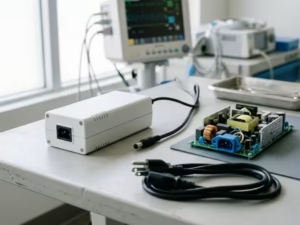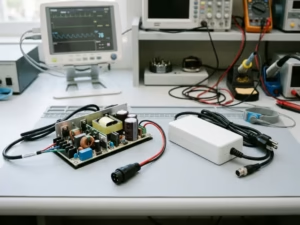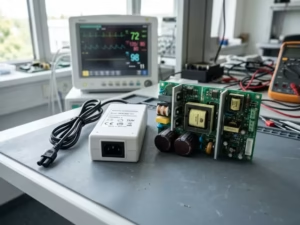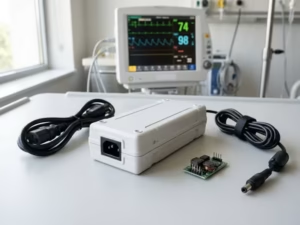
I’ve wired up more power systems than I can count, and one question keeps coming up from engineers and hobbyists alike: can you feed a standard AC-DC power supply with DC rather than AC? The short answer is often yes, with some important caveats. Let me walk you through it.
Why Power an AC-DC Supply from DC?
Picture a setup that already runs on a DC bus, a battery bank, or a solar array. Then you’ve got a piece of equipment that ships with a normal AC-DC power supply, the kind you’d plug into the wall.
You’ve got two choices. You can invert your DC back up to AC just to feed that supply, or you can feed the DC straight in and skip a conversion stage entirely.
Skipping that stage saves energy. Every conversion costs you a little efficiency, and inverters add weight, cost, and another point of failure. So when you can feed DC directly, you often should.
This comes up all the time in solar battery storage, electric vehicle systems, telecom DC plants, and industrial backup power. If you work with any power source, an AC/DC system that mixes both, this trick is worth knowing.
In this article, I’ll cover why it works, how it handles supplies, how to wire it, and the safety limits you can’t ignore.
AC vs. DC Input Basics
Let’s keep this quick. AC, or alternating current, swings back and forth, reversing direction many times per second. That’s what comes out of your wall outlet.
DC, or direct current, flows in one steady direction. Batteries, solar panels, and DC buses all deliver it.
AC-DC supplies are built to expect AC, because that’s what the grid hands them. Their whole job is converting that AC into the clean DC your electronics need.
So here’s the real question this article answers: in a power-source AC/DC situation, can you feed DC into a supply designed for AC input? More often than you’d think, the answer is yes. Here’s why.
Why Many SMPS AC-DC Supplies Can Accept DC Input
Most modern supplies are switch-mode power supplies, or SMPS. To understand why they tolerate DC, you need to peek inside the input stage.
The very first thing an SMPS does with incoming AC is rectify it. A bridge rectifier, a set of four diodes, flips the AC into pulsing high-voltage DC almost immediately.
Here’s the key insight: the rectifier’s output is already DC. So if you feed DC into the input in the first place, it can often pass right through the rectifier and on to the next stage without any trouble.
After the rectifier, a bulk capacitor sits. It smooths that DC into a steady high-voltage rail before the switching circuit chops it up and steps it down to your output voltage.
Many supplies use a universal input design, rated for 90-264V AC. Those wide-range units tend to accept DC especially well, because they’re already built to handle a broad span of input voltages.
One rule of thumb helps you pick the right DC level. Aim for roughly the peak of the rated AC voltage, about 1.4 times the RMS value. So a 120V AC input corresponds to around 170V DC. Treat that as a starting point, not gospel, since designs vary.
Compatible Power Supply Types
Not every supply plays nice with DC. The big divide is switch-mode versus linear.
Modern SMPS units are your best candidates, especially universal-input models. Their rectify-first architecture is exactly what makes DC input feasible.
Linear power supplies are a different animal. They usually fail or overheat on DC because they rely on a 50/60 Hz transformer at the input. A transformer needs alternating current to work. Feed it steady DC, and you get no transformer action, just a low-resistance coil drawing heavy current until something smokes. Don’t do it.
The single most important step, before you connect anything, is to check the manufacturer’s data sheet. Some supplies explicitly list a DC input range. If yours does, follow it. If it doesn’t, you’re operating outside the spec and accepting the risk yourself.
Typical applications that suit direct DC input include solar power systems, EV platforms, telecom racks, and industrial gear already running off a DC bus.
When Direct DC Input Makes Sense vs. a Converter or Inverter
You’ve really got three paths. Feed DC directly, use a DC-DC converter, or use an inverter to convert DC to true AC first. Each has its place.
Direct DC input is the cleanest option when you have a compatible SMPS and your DC voltage sits in the right range. Fewest parts, least loss, highest reliability.
A DC-DC converter makes more sense when your source voltage doesn’t match the supply’s requirements. If your battery bank sits at 48V but the supply wants around 170V DC, a converter bridges that gap far better than feeding it raw.
An inverter is the right call when the equipment genuinely needs an AC waveform, not just the AC-DC supply. Some gear has motors, timing circuits, or other parts that truly depend on alternating current.
Base your choice on the source voltage, output requirements, total power draw, and whether the load can tolerate direct DC. When in doubt, the converter path is the safe middle ground.
Physical Wiring and Connection Steps
Once you’ve confirmed compatibility, the wiring itself is straightforward. Connect your positive and negative DC leads to the standard AC input terminals, the ones marked L (line) and N (neutral).
Polarity often doesn’t matter at the input because the bridge rectifier routes current correctly regardless of the direction it flows. That said, I still wear it consistently and treat it with care. Don’t get cavalier just because the diodes forgive you.
Always use the ground terminal, even on DC. It matters for safety and for keeping electrical noise down. Skipping ground is a habit that catches up with you.
Before you apply full voltage, confirm that the datasheet allows DC on those terminals. I can’t stress this enough.
When you first power up, start at a safe, low voltage if your source lets you, and watch how the supply behaves before bringing it up to full level.
Voltage Matching, Derating, and Thermal Management
Getting the voltage right keeps the supply happy and your equipment safe.
Start with the rated input range. Your DC voltage needs to land inside it, ideally near that 1.4x peak value I mentioned earlier. Too low and the supply may not start or may draw excess current. Too high and you stress the input capacitors.
If your DC source sits well below the needed level, add a boost stage. If it runs higher, buck regulation or direct use may fit. Match the topology to your source.
Plan to derate the supply on DC. A unit rated for full power on AC may not safely deliver that same power on DC, so back off from its maximum rating to stay cool and reliable.
If the supply has to run at near-full capacity for long stretches, add larger heat sinks or active cooling. The input stage runs hotter on DC, and you want a margin.
During your first tests, keep an eye on the input-stage temperature. Catching a hot spot early beats discovering it after a failure.
Critical Safety Limitations
This is where I get serious, because DC introduces hazards that AC doesn’t.
Bridge Rectifier Heating
On AC, all four diodes share the load as the current alternates. On a DC circuit, only two diodes ever conduct. That means half the bridge does all the work and runs hotter. This is a major reason to derate and to watch temperatures.
DC-Rated Fuse
The internal fuse may need to be replaced with a DC-rated one. Here’s why it matters: AC naturally crosses zero many times per second, which helps snuff out an arc. DC never does. A DC arc is much harder to extinguish, so a fuse built only for AC may not clear a fault safely. This is a real fire risk, not a theoretical one.
Capacitor Stress
The input capacitors take a beating if your DC voltage runs too high or too low. Stay within the rated window to protect them.
Inrush and Bypass Circuits
Some supplies have inrush current limiters or bypass circuits that expect AC cycles to operate. On steady DC, they may not behave as designed. Factor that into your testing.
In higher-power systems, layer on broader protections as well: overcurrent and overvoltage protection, proper isolation, and EMC filtering. Treat DC safety with the same respect you’d give AC, or more.
FAQs
Can I use a car battery to power a standard AC computer power supply?
A 12V car battery is far too low for a supply expecting around 170V DC. It won’t work directly. You’d need a DC-DC boost converter or an inverter to bridge that gap.
Will running on DC shorten the lifespan of my power supply?
It can, mainly from the extra heat on half the bridge rectifier. Derate the supply, keep it cool, and the impact stays manageable.
Does polarity matter when connecting DC to the L and N terminals?
Usually not, because the bridge rectifier corrects for it. Still, wire it consistently and double-check your data sheet for any exceptions.
What happens to the efficiency rating when switching from AC to DC input?
Efficiency often improves slightly, since you skip the rectification losses on the input side. The published rating assumes AC, so test your own setup to know for sure.
Do I need a special fuse for DC operation?
Often yes. AC-rated fuses may not safely interrupt a DC arc. Fit a properly DC-rated fuse to avoid a fire hazard.
Is it safe to use a modified sine wave inverter instead of a direct DC inverter?
It can work, but the modified sine wave output is rough and can stress the input stage more than a clean DC or a true sine wave. Direct DC is usually gentler when the supply supports it.
Should I choose a DC-DC converter instead of feeding DC straight in?
If your source voltage doesn’t match the supply’s range, yes. A converter gives you proper voltage scaling and tighter control.
Best Practices and Final Checklist
The main payoff here is efficiency. In battery-backed and renewable energy systems, feeding DC directly cuts a conversion stage and saves real power over time.
Before you power up, confirm the manufacturer’s documentation supports DC input. That step protects you and your equipment.
Fit a dedicated DC-rated fuse. This is non-negotiable for fire safety.
Run through this checklist before going live:
- Verify that the DC input voltage is within the supply’s rated range, near the 1.4x peak value.
- Confirm polarity and solid grounding.
- Install a DC-rated fuse sized for your load.
- Derate the supply below its AC rating.
- Run thermal checks, watching the input stage under load.
- Start at low voltage where possible, then bring it up gradually.
Conclusion
The big takeaway is simple. Many modern SMPS units accept DC because their input stage already rectifies AC into DC. Feed it the right DC and it often just works.
Success comes down to a few conditions: pick a compatible switch-mode supply, match the voltage, derate for heat, and guard against DC-specific risks like arcing and bridge heating.
This technique fits right into the growing world of DC-powered systems, from solar and EV setups to industrial backup. As more of our infrastructure runs on DC, knowing this trick pays off.
So check the data sheet, test carefully, and give DC the same respect you’d give AC. Do that, and you can safely and efficiently power your AC-DC supply from a DC source.